

Good morning everyone and happy Saturday! The Trump administration faced embarrassment this week over the Reflecting Pool debacle and dismissal of criminal charges, with one Trump ally saying the episode made the administration “look like a monkey having intimate relations with a football.” Meanwhile, the war in Iran is rapidly escalating, with China and Russia both stepping in to help Tehran. And Trump says he wants to revive the anti-weaponization fund even as he continues to tank Todd Blanche’s confirmation chances.
I sat down with Epstein survivor Dani Bensky to talk about all of this and so much more.
Even on a Saturday morning, I’m getting you the news and this critical interview, because the moment is too important to sit out.
If this work means anything to you, the most powerful thing you can do right now is become a paid subscriber. It’s what lets me keep sitting across from survivors like Dani, keep chasing the files, and keep showing up when everyone else has moved on.
Here’s the news:
Trump’s Legal/Political Troubles:
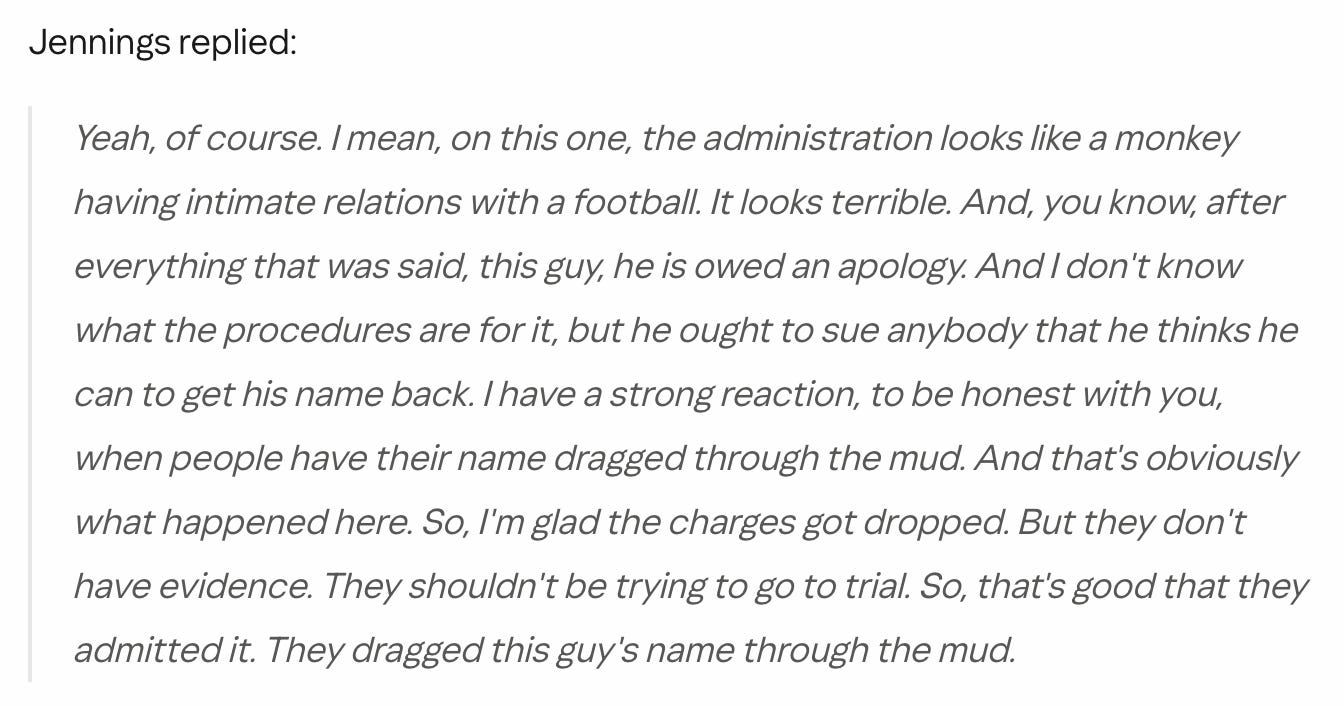
US Attorney Jeanine Pirro’s office dropped a felony vandalism charge Friday against David Hearn, a former Olympic canoe slalomist accused of damaging the Lincoln Memorial Reflecting Pool, after the Department of the Interior revealed the damage was actually caused by a botched installation, not vandalism. Pirro had previously held a press conference insisting the government could prove Hearn ripped up the pool’s lining; Hearn had pleaded not guilty. Republican strategist Scott Jennings, appearing on CNN’s The Source, said the episode made the administration “look like a monkey having intimate relations with a football” and argued Hearn deserves an apology and should consider suing to reclaim his reputation, saying “they dragged this guy’s name through the mud.”
The pool’s renovation, ordered by Trump, involved two no-bid contracts: a $13.1 million deal with Atlantic Industrial Coatings and a separate contract with Greenwater Services, owned by John Cafaro, who pleaded guilty in 2001 to bribing a congressman.
Senate Judiciary Chair Chuck Grassley pushed back a committee vote on Todd Blanche’s nomination for attorney general to Tuesday, after a planned Thursday vote was postponed, though the delay reflects committee notice rules rather than a sign a deal is imminent. Blanche’s confirmation is stuck on holdouts Sen. John Cornyn and Sen. Thom Tillis, who want the Justice Department to scale back a $1.8 billion “Anti-Weaponization Fund” tied to a settlement between Trump and the IRS, along with limits on a tax audit immunity provision in the pact. Trump said Friday the fund is “dead” but added “I wish it weren’t,” saying he’d still like to see people he considers victims of government abuse, including Jan. 6 participants, compensated. Cornyn, who lost his primary to a Trump-backed challenger, has held firm on his demands, and Blanche cannot afford to lose a single GOP vote to advance out of committee. A Judiciary Committee spokesperson said Grassley wants Blanche confirmed before the August recess, framing the rescheduled vote as giving the White House more time to lock down support.
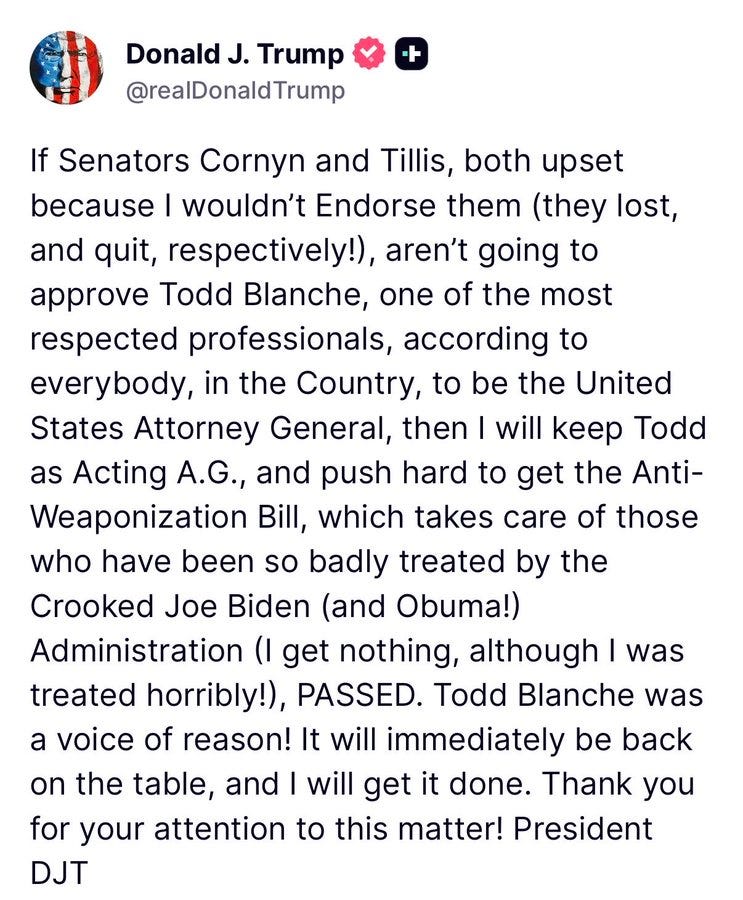
Trump issued an ultimatum to Sens. Thom Tillis and John Cornyn today: confirm Todd Blanche as attorney general, or he’ll keep Blanche as acting AG and revive his push for the roughly $1.8 billion “anti-weaponization fund” they oppose. Tillis and Cornyn have refused to vote for Blanche unless Trump puts in writing that he’ll abandon the fund, which was created to compensate people who claim political persecution and was announced in May as part of a settlement of Trump’s lawsuit against the IRS and Treasury. Trump called the fund “dead” at a Camp David Cabinet meeting but said he still wants those he considers victims, including Jan. 6 participants, compensated for their “pain,” while Blanche has separately testified under oath that the fund isn’t moving forward and no money changed hands. The fund faced a federal judge’s temporary block in May and criticism from Democrats and some Republicans as a “slush fund” that Congress never authorized. The Senate Judiciary Committee has rescheduled its vote on Blanche’s confirmation to Tuesday, with Chairman Grassley hoping to confirm him before the chamber’s summer recess, which begins at the end of next week and runs until mid-September.
Iran War Quickly Escalates:
US embassies in Amman, Jerusalem, and Baghdad issued security alerts warning American citizens to consider leaving the Middle East or be prepared to depart amid fears of an “unforeseen escalation” in the region’s conflict. The warnings advised checking flight details, following local safety guidance, and expecting possible flight cancellations and airspace closures; Americans in Jordan were told to avoid US military bases (recently hit by Iranian missiles), while those in Israel were urged to locate nearby bomb shelters. The Jerusalem embassy called Iran “unpredictable,” citing its recent unprovoked strikes, including an expansion of attacks to Egypt, where a drone hit a US-owned gas vessel on Wednesday, sparking a fire still under investigation. Iran’s military accused Washington of “escalating tensions” and warned that any country serving as a “defensive shield” for the US would be “engulfed by the flames of war.” The war, which began February 28 when the US and Israel struck Iran, has continued with exchanges of fire resuming this week after a brief lull, though no strikes were reported overnight Friday into Saturday.
The US and Israel are planning what could be one of their harshest bombing campaigns yet against Iranian energy infrastructure, with strikes possible throughout the weekend, according to multiple sources cited by CBS News. There was some discussion of wrapping up before financial markets open Monday, given concerns about economic fallout, but no firm end point was set, and Trump has not yet given final approval. The strikes would mark Israel’s return to combat after halting operations during the now-collapsed US-brokered truce, though an Israeli official said Israel hasn’t been asked to join any renewed military action. Likely targets include power plants and refineries, aimed at crippling the Iranian military’s ability to govern and provide services; White House press secretary Karoline Leavitt said Trump is committed to ensuring “Iran will not have a nuclear weapon under his watch.” The plan follows Trump’s warning last week that he’d destroy an Iranian bridge or power plant for every attack on a ship in the Strait of Hormuz, and comes as several US embassies in the region issued weekend security alerts warning Americans of possible flight disruptions.
Gen. Alexus Grynkewich, who heads U.S. European Command, sent the Pentagon a written warning this week that without another Navy destroyer, he’ll have to choose between defending Israel and prioritizing the U.S. homeland. EUCOM’s ships help intercept ballistic missiles fired at Israel from both Iran and Iran-backed Houthi forces in Yemen. Currently two U.S. destroyers are stationed in the eastern Mediterranean and one in the Red Sea, but EUCOM is stretched thin because it’s simultaneously responsible for guarding against Russian incursions into NATO territory and the threat from Russian long-range missiles capable of reaching the U.S. The warning illustrates how the sustained Iran conflict is straining Navy resources across multiple theaters at once.
According to Reuters, Iran is set to receive the first shipment within weeks of up to 400 Chinese-made shoulder-fired air-defense missiles (MANPADS), including QW-12 and FN-16 systems, in a deal worth $60-70 million, according to three sources familiar with the matter. The purchase, arranged through Hong Kong-based intermediary Zhongqing Baoshang International Investment, marks one of Tehran’s largest known efforts to rebuild short-range air defenses after months of war with the US and Israel exposed gaps in protecting its military sites and infrastructure. Deliveries are planned to fly from Urumqi in western China, transiting through Pakistan, though China’s foreign ministry called the report “completely groundless” and Pakistan’s military denied any involvement. Trump said such a deal would be “surprising” given what he described as assurances from Xi Jinping that China wouldn’t get involved militarily on Iran’s behalf. Sources cautioned that delivery timelines and quantities could still change, and the deal follows earlier Reuters reporting that Iran was also close to a separate agreement with China for anti-ship cruise missiles.
A report from NBC News, citing US and European officials, claims Russia has been supplying Iran with electronic intelligence, including satellite surveillance and signals intelligence, that could strengthen Tehran’s air defenses, sharpen its drone and missile strikes, and help it track US military movements during the ongoing conflict. Neither Russia nor Iran has commented, and the claims haven’t been independently verified. The report surfaced days after Trump downplayed similar allegations from Ukraine’s Zelenskyy, telling reporters aboard Air Force One on July 28 that any Russian support had been “very unimpactful” and that he’d ask Putin directly. Zelenskyy has said Ukrainian intelligence detected active Russian satellite surveillance of Gulf states and US military facilities since early July, with the resulting images later appearing in Iran. The claims come amid deepening Russia-Iran ties, including a January strategic partnership agreement and Western accusations that Iran has supplied drones to Russia for use in Ukraine, both of which the two countries deny.
Fifa President Loses Confidence:
FIFA scraps the World Cup investment plan. Gianni Infantino withdrew his Fifa Forward Enterprise proposal on Friday after it triggered a global backlash. The plan would have sold a stake in the commercial rights to the men’s and women’s World Cups and the Club World Cup to private investors, aiming to raise hundreds of millions and distribute over $10bn to Fifa’s 211 member associations. Infantino said the project had “created divisions of a nature... no longer in the interest of the objective,” but stopped short of admitting fault. Reports suggest Thrive Capital, the lead investor group, had also grown wary as opposition mounted.
The backlash came from nearly every corner of football. UEFA voted to boycott future Fifa tournaments if the plan wasn’t dropped, and Concacaf and the Asian Football Confederation also voiced strong opposition. Fifa’s own chief operating officer, Kevin Lamour, criticized Infantino for a “serious lack of respect” in trying to push the deal through with minimal consultation, and senior advisor Carlos Cordeiro resigned in protest. Only Infantino’s base in Africa held firm, leaving him without the numbers to salvage any version of the plan. The revolt came just weeks after separate criticism of his handling of the Folarin Balogun affair during the World Cup.
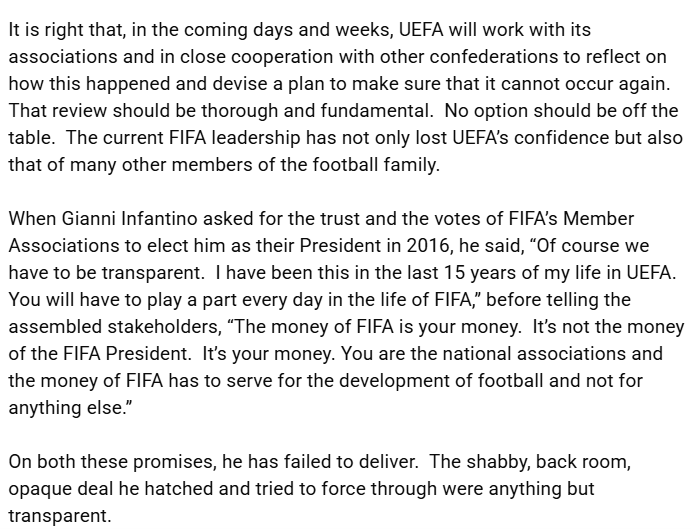
UEFA’s response signals deeper trouble for Infantino’s presidency. Rather than simply welcoming the withdrawal, UEFA issued a pointed statement Saturday saying it has “lost confidence” in Fifa’s current leadership, accusing Infantino of breaking 2016 transparency promises with a “shabby, back room, opaque deal.” UEFA and other confederations are now actively searching for a candidate to challenge him in March’s presidential election, where he’d been expected to win a fourth term unopposed. Possible challengers include AFC president Sheikh Salman bin Ebrahim Al Khalifa, who lost to Infantino in 2016, and PSG president Nasser Al-Khelaifi. Whether Infantino can rebuild trust before the vote, given the scale of the internal revolt, remains uncertain.
Other news:
George Santos agreed Friday to pay $35,000 to settle a CFTC investigation into suspicious trades on prediction market Kalshi, where he bet against his own stated plans to attend Trump’s State of the Union, then didn’t show, citing an airport delay. The settlement covers roughly $17,000 in earnings from the trades plus a $17,500 fine, along with a three-year trading ban; Santos didn’t admit wrongdoing, saying he chose a quick resolution over costly litigation. Kalshi, which had flagged the trades to regulators, plans its own enforcement action and says it will try to reimburse affected traders. The probe also led rival platform Polymarket to cut ties with Santos in June. Santos was expelled from Congress and pleaded guilty to federal fraud and identity theft charges, serving under three months of a seven-plus-year sentence before Trump commuted it last year.
Hungary’s only nuclear power plant, Paks, will shut down for the first time in its 44-year history due to record-low water levels on the Danube River, Prime Minister Péter Magyar said Friday, warning it may stay offline for several weeks. The Soviet-built, four-reactor plant, which supplies nearly half of Hungary’s electricity, is already running at less than half capacity (965 megawatts versus its usual 2,000) because low river levels are straining the pumps that bring in cooling water, with a full shutdown expected by Tuesday or Wednesday. Magyar said the river could recede to negative 144 centimeters, far below the previous 2018 record of negative 98 centimeters, and that a reading of negative 134 centimeters would force the plant to fully power down; he stressed the shutdown poses no safety or environmental risk. The prolonged Central European drought, which has also hit tourism, agriculture and industry, shows no signs of easing, with no significant rainfall forecast in the coming weeks. In response, Hungary has asked large energy users to voluntarily cut consumption during peak hours, with conglomerate MOL committing to a 40% reduction, while Magyar’s party is suspending parliamentary sessions and ordering state institutions to turn off decorative lighting to conserve energy.
Rescuers backed by military helicopters resumed searching Saturday for at least six members of a 10-person expedition swept away by an avalanche on Pakistan’s Broad Peak, a day after authorities recovered three of four bodies found so far, including Omani climber Nathira Ahmed, American climber Mallory Geis, and Nepalese climber Bahadur Gurung. The team lost contact with base camp Thursday after the avalanche struck, and there’s been no communication since, though experienced Pakistani climbers and army helicopters continue the search despite fading hopes. The expedition, which included five Nepalese climbers plus Omani, American, Pakistani and Chinese members, was led by renowned mountaineer Nirmal Purja, known as Nims Dai, who set a record in 2019 for climbing the world’s 14 highest peaks in 189 days (later broken in 2023). The climb was American climber Mallory Geis’ first attempt at an 8,000-meter peak in Pakistan, while it was meant to be the final major expedition for Pakistani guide Sohail Sakhi, a geographer and high-altitude photographer. Broad Peak and other northern Pakistani mountains see frequent accidents due to avalanches, falling ice and rock, high altitude, and rapidly shifting weather.
See you soon.
— Aaron


