

Good morning, everyone. Two major stories I’m tracking today: Todd Blanche and Mitch McConnell.
Blanche’s attorney general nomination is in serious peril. His committee vote was cancelled overnight, and Republican senators still aren’t there to confirm him. Meanwhile, Mitch McConnell remains absent, his staffers are refusing to answer any questions, and the letter his office released this week was likely signed using an autopen. On top of that, the Trump administration is building an AI tool for “pre-crime” policing, Iran is threatening major retaliation, the US economy is slowing, and there’s much more to cover.
This afternoon I’ll have big Epstein news: Melania Trump reportedly threatening to silence a journalist for reporting on her connections to people tied to Epstein. Tonight, paid subscribers get a live session at 8:15 PM EST, and I’ll also be speaking with Troy Jackson, the new Maine Democratic Senate candidate.
Here’s the news:
Todd Blanche:
Todd Blanche’s attorney general nomination stalled after Senate Judiciary Republicans John Cornyn and Thom Tillis blocked a planned committee vote, demanding written assurances that the Trump-IRS settlement’s “Anti-Weaponization Fund” is truly dead. Cornyn wants the tax immunity piece of that settlement narrowed so it covers only existing audits rather than shielding Trump from scrutiny of future tax filings. Cornyn, who recently lost his Texas primary, accused the Justice Department of “stonewalling” and said “the ball is in Blanche’s court,” adding “we’ve been trying to help them get to a conclusion here and they won’t let us.” A Judiciary Committee spokesperson confirmed Thursday’s markup was postponed while work continues to secure sufficient support, calling Blanche “highly qualified” despite the delay. Separately, the Senate unanimously passed a resolution opposing any presidential pardon for Ghislaine Maxwell, underscoring the broader political heat around Trump-related Justice Department matters.
The dispute traces to a May announcement that the Justice Department would resolve Trump’s $10 billion lawsuit against the IRS by creating a fund to compensate his supporters and Jan. 6 rioters, along with a provision barring IRS audits of Trump’s and his relatives’ past returns. A seven-figure settlement to anti-abortion activist Paul Vaughn, disclosed just hours before the vote was delayed, shows the department can still funnel taxpayer money to self-described victims of “weaponization” even without the formal $1.8 billion fund structure Blanche says was scrapped.
Vaughn, convicted in 2024 of conspiring to block abortion clinic access and later pardoned by Trump, received his payout through a decades-old Justice Department claims process rather than the abandoned fund itself. Blanche has publicly defended the fund’s purpose while refusing to put its demise in writing, telling lawmakers in June “I’m not committing to putting anything in writing” even as he called it dead. Democrats have branded the arrangement a slush fund for Trump’s allies, and federal judges have separately found Blanche’s Senate testimony about the fund’s legal review “at best, misleading and, at worst, disingenuous.”
The fund fight has become the most consequential test yet of Blanche’s unusually hands-on management style since becoming the Justice Department’s No. 2 official in March 2025, with critics saying he still acts like Trump’s personal defense attorney rather than a law enforcement official accountable to taxpayers. Federal judges have repeatedly named Blanche directly in rulings criticizing prosecutorial overreach, including a Nashville judge who called the dismissal of a human smuggling case against Kilmar Armando Abrego Garcia a vindictive “abuse of prosecuting power” built on a “tainted investigation.”
A Minnesota judge similarly found that Blanche’s aggressive rhetoric toward Gov. Tim Walz and Minneapolis Mayor Jacob Frey, including a vow to stop their “terrorism by whatever means necessary,” helped justify a batch of improper grand jury subpoenas later quashed as part of a “broader campaign to coerce” state officials. A Virginia judge has kept a separate lawsuit alive specifically because Blanche and the department refused to file a sworn affidavit that the fund “will not proceed in any manner, under any name.” With a single Republican “no” vote on the committee capable of sinking the nomination, the unresolved fund question leaves Blanche’s confirmation in real jeopardy even as the administration insists he remains the president’s pick.
Mitch McConnell:
Mitch McConnell spokesperson Robert Steurer twice refused to answer independent journalist Nicholas Ballasy’s questions Wednesday about whether McConnell will release a video statement proving he’s alive, with one exchange ending as Steurer simply walked away from the camera. It’s the second such confrontation this month; press secretary Stephanie Penn similarly ignored Ballasy’s questions earlier in July, smiling and waving at others as she passed. McConnell, 84, hasn’t been seen publicly since June 14, when medics were called to his home for what was logged as cardiac arrest, and his office stayed silent about his condition for nearly a month, fueling online conspiracy theories including a claim from Laura Loomer that he’s “brain dead.”
The office’s first substantive update came July 12 with a statement and photo of McConnell in bed beside wife Elaine Chao, saying he’d briefly lost consciousness and developed pneumonia but had no heart attack, stroke, or broken bones; both that photo and a similar one released last week were widely dismissed on social media as AI-generated. Chief of staff Terry Carmack, like Steurer, has also stayed quiet on McConnell’s condition, and doctors say the senator remains “not yet medically cleared” to leave rehab.
Mitch McConnell’s office released a letter that McConnell’s signature was on concerning disaster relief:
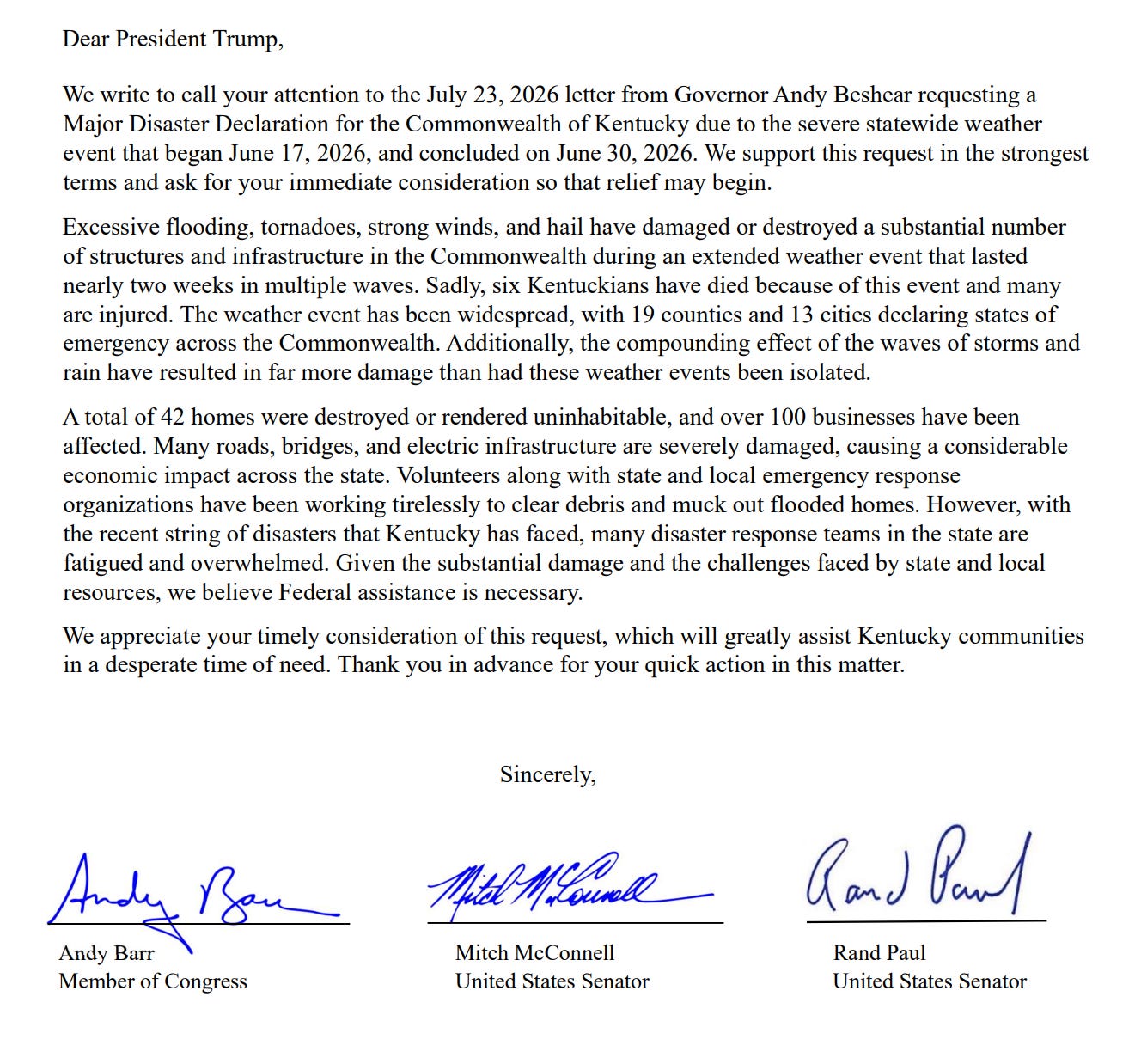
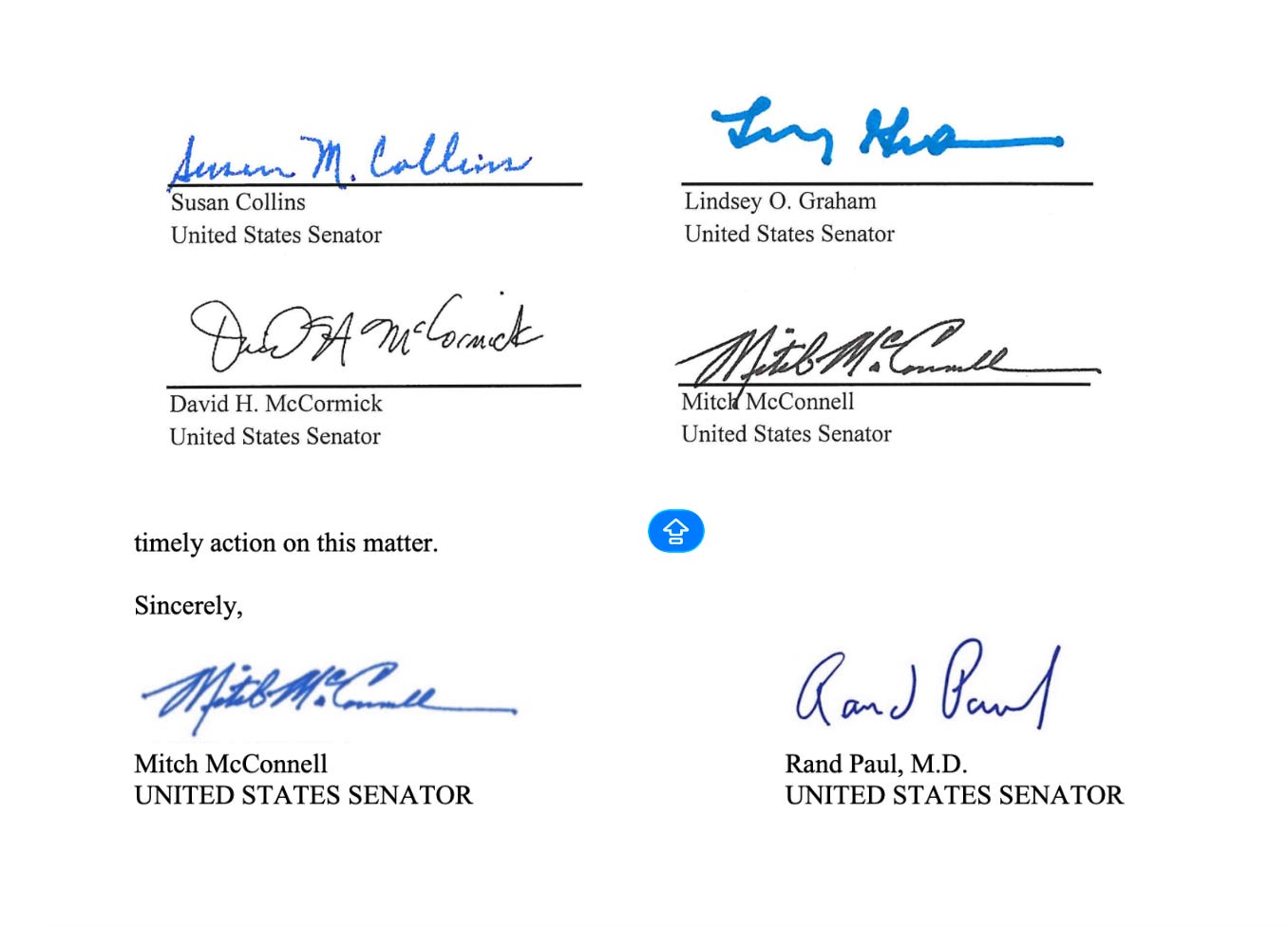
Comparing the signature from McConnell on that letter to prior signatures on other letters, it appears as though the signature, on first glance, may have been auto-generated. Here are older signatures for McConnell in the two most recent letters his office put out in 2025. As you can see below the signatures are the same with one another and appear to be scanned onto a computer. The signature above, from this week’s letter, however, appears to be computer-generated.
Pre-crime policing:
The Trump administration is building an AI system for “pre-crime policing,” aiming to mine government data on private citizens to predict crimes before they occur. Reason obtained procurement documents showing the FBI’s Threat Screening Center (TSC) is soliciting vendors for predictive AI that analyzes “similarity, pattern alignment, and attribute correlation” across federated data to flag people before they act. This would supercharge a watch list that already holds close to 2 million names. The FBI declined to comment on the request.
The TSC, created in 2003 to track jihadist threats, has shifted its focus toward domestic dissent under National Security Presidential Memorandum-7, which targets “anti-Americanism,” anti-capitalism, and hostility to “traditional American views.” Director Kash Patel has touted double-digit growth in biometric capabilities and intelligence production, and says AI will let the bureau get “instantaneous results” from terabytes of data. Fewer than 10,000 Americans were on the list at the start of Trump’s second term, but the new focus and AI tooling could rapidly expand that number.
Civil liberties advocates and courts have long criticized the watch list’s error rate and due-process failures. The Boston Marathon bombers and the Pulse nightclub shooter were all on it before their attacks, while the Supreme Court ruled against the FBI in cases involving wrongly listed citizens. The State Department has also expanded the pool by labeling groups like the International Anti-Fascist Defense Fund as terrorist-linked, and Secretary Rubio’s office published a report tying dozens of U.S. politicians and left-wing figures, including Rep. Ilhan Omar, NYC Mayor Zohran Mamdani, and Ben Cohen of Ben & Jerry’s, to alleged foreign terrorism networks. Critics argue these foreign “nexus” claims are being used to justify surveillance of domestic political dissidents.
Iran:
Iran vowed to “punish the aggressor today” after the U.S. military said it completed a “heavy wave of strikes” overnight, retaliation for Tehran’s attack on American forces in Jordan, shattering a brief calm that had seen both sides push toward diplomacy. President Trump had vowed to hit Iran hard, and Central Command said it struck dozens of IRGC targets over two hours, including military command centers, missile and drone facilities, coastal surveillance sites and maritime capabilities. Iranian state media reported three IRGC members killed in Zanjan province and three people, including a toddler, killed on Qeshm island in the Strait of Hormuz, the key waterway that remains the central sticking point in peace talks. Jordan said it intercepted a new Iranian missile barrage for a second straight day, and Kuwait said an Iranian strike hit a Chinese company’s building, killing one worker.
The conflict showed signs of widening to draw in new countries, raising stakes for the region and global economy. Egypt confirmed a drone ignited fires on two natural gas vessels, a U.S.-owned floating storage facility and a Greek-owned tanker, at the port of Damietta, though it remains unclear who was responsible; an Iranian strike there would mark a major escalation against a key U.S. ally and mediator. Trump, asked if Iran was behind it, said only “it’s a little more of the same” and that the U.S. was “going to be hitting them very hard because it’s our turn to hit them.” He had separately vowed Wednesday to “beat the f---ing s--- out of” Iran, according to Fox News.
Despite the fighting, mediators insisted diplomacy was still alive. Pakistan’s foreign ministry said talks between the U.S. and Iran were “ongoing,” particularly on de-escalating around the Strait of Hormuz, under the Islamabad memorandum of understanding signed in June. Shipping data showed a Qatar-managed LNG tanker, the Al Areesh, transited the strait overnight with Iran’s permission, the first such tanker to do so since an earlier strike, while an Iranian container ship and roughly 59 vessels moved through the nearby Bab el-Mandeb strait, suggesting trade flows are continuing despite the war. Oil prices spiked again, with Brent crude near $90 a barrel, though analysts noted the market has grown used to rapid spikes fading once actual supply disruptions and diplomacy play out.
The strikes on Iran followed a joint U.S.-Saudi operation that killed at least 20 fighters and six Iranian advisers among Iran-backed militias in Iraq on Wednesday, after Saudi Arabia accused those militias of drone attacks on its oil facilities; Saudi Arabia is also fighting a renewed conflict with Houthi rebels, who have declared a blockade of Saudi shipping through the Bab el-Mandeb strait. Israeli strikes separately killed four people, including two children, in Gaza despite an October ceasefire with Hamas, as mediators from Egypt, Qatar and Turkey pressed Hamas on disarmament terms. Shell reported its profits more than doubled to $9.84 billion in the second quarter, powered by war-driven oil and gas price spikes, even as its integrated gas production fell 30%. Analysts described the flare-up across Iraq, Iran, Jordan, Kuwait and Egypt as pushing the region into “uncharted territory,” heightening concerns about depleted U.S. munitions stockpiles and the durability of any ceasefire.
Other news:
Elon Musk is reviving his dormant super PAC, America PAC, to make a major investment in boosting Republican turnout ahead of the midterms, according to sources with knowledge of the plans who spoke to Axios. The PAC previously spent more than $260 million helping elect Trump in 2024, and Musk is now redirecting that infrastructure toward a new target: the 2026 midterms. The effort will focus on door-knocking, digital advertising and direct mail aimed at mobilizing the conservative base. A key priority is turning out voters who typically skip non-presidential election years, when turnout among casual or low-propensity voters tends to drop sharply. The move marks a significant re-engagement by Musk in electoral politics after a period of relative quiet on the super PAC front.
U.S. GDP grew at just a 1.5% annual rate in the second quarter, down from 2.1% in the first quarter, as the war with Iran drove up gasoline and other petroleum-based prices that dampened inflation-adjusted growth figures. Consumer spending and business investment, particularly AI-related capital expenditure, stayed relatively strong, with a "core" growth measure combining consumption and private investment rising to 3.9% from 1.7%, but a pullback in government spending and rising imports dragged on overall momentum. Real, inflation-adjusted household income has fallen at its fastest pace since 2022, and with tax refunds now exhausted and savings buffers thin, economists like Eric Wallerstein of Clocktower Group expect consumption to weaken further through the rest of the year. The Federal Reserve held interest rates steady Wednesday despite three dissenting members favoring a hike, while new chairman Kevin Warsh weighs inflation risks against harming a labor market that has stabilized at an average of 111,000 jobs added monthly.
A Senate Democrats’ report released Thursday found that DHS’s shift of staff toward immigration enforcement and countering alleged left-wing extremist groups has left significant gaps in U.S. counterterrorism and election security operations, with as many as 1,294 external law enforcement personnel pulled from other federal offices to support ICE deportation operations starting in August 2025. Sen. Gary Peters, the committee’s top Democrat, said counterterrorism infrastructure has been “basically eviscerated” nearly 25 years after 9/11 prompted DHS’s creation, warning the cuts have “made Americans less safe” and put communities “at risk for future terrorist attacks”; DHS did not respond to a request for comment, though the administration has defended its immigration focus as necessary to fix border security failures under Biden.
The report singles out DHS’s Office of Intelligence and Analysis, which shares threat information with state and local partners, noting 300 unfilled vacancies and allegations that the office has faced pressure to skew its analysis toward targeting leftist groups. It also details cuts to election security staff at CISA under former Secretary Kristi Noem, and while the administration and Republicans have since embraced the agency’s mission, CISA told the committee that none of its newly rehired staff will be in place before the November midterms and that it has not assessed the risks from killing a state election security funding program in October 2025. Democrats also criticized DHS for withholding clear data on what counted as staffing contributions to ICE and for failing to provide updated figures since September 2025.
The USDA’s Food Safety and Inspection Service recalled about 12,000 pounds of smoked bacon imported from Canada by Maple Leaf Foods after it entered the country without proper reinspection. The affected products, Royale Natural Applewood Smoked Bacon and Top Valu Uncured Hardwood Smoked Bacon, were shipped to grocery distributors and retailers in Idaho, Oregon and Washington state. Recalled packages carry EST.1 markings, specific September sell-by dates, and health certificate number 2026-S732971612 on master case boxes. FSIS said there are no confirmed illnesses or injuries linked to the products so far. Some readers commented that the recall may reflect broader distrust of the food inspection system rather than an urgent safety threat.
The National Urban League’s 50th annual “State of Black America” report, released Thursday, warns that the American Dream is further out of reach for Black Americans than at any point since the Civil Rights Movement, citing Trump administration policy changes. The report points to the overhaul of the Justice Department’s Civil Rights Division and EEOC, along with the Safeguard American Voter Eligibility Act, as rollbacks of civil rights gains, and it condemns a broader “economic assault” including corporate retreats from diversity initiatives. CEO Marc Morial said the attacks target Black Americans but will ripple out to “working Americans, poor Americans, aspirational middle-class Americans,” and the report urges civil rights groups to consolidate legal wins into durable policy and build economic infrastructure independent of any administration.
Russian air strikes killed at least 13 people across Ukraine on Thursday, from Kyiv to the western city of Lviv, forcing Poland to scramble fighter jets to secure its airspace; the attacks came as President Zelenskyy returned from the U.S., where he said Trump agreed to give Ukraine licenses for Patriot missiles. One person died and two were injured in Kyiv, while six more, including two children, were killed in the Dnipropetrovsk and Poltava regions, with a direct Iskander-M missile strike on a home in Zelenskyy's hometown of Kryvyi Rih killing two girls aged 5 and 12 among six victims there. In Lviv, near the Polish border, Russian missiles damaged two apartment buildings and injured 26, while Polish police found a crater and debris from an unidentified object near the Ukrainian border in Lublin region. Zelenskyy had warned a massive Russian attack was likely and said Ukrainians' safety depends on allies' willingness to provide anti-missile defenses, while Russia's defense ministry said it struck "military facilities" and three cargo ships and claimed to have downed 258 drones overnight.
French authorities allowed 84,000 evacuees to return home Thursday after cooler temperatures, higher humidity and light rain helped firefighters gain ground on a wildfire that has burned an area four times the size of Paris. Nine localities near Bordeaux were cleared to return, and nearly two-thirds of the 224,000 people originally displaced in southwest France are now back home; the A63 highway to Spain also reopened. France has deployed 3,300 firefighters, two dozen aircraft, riot-control water cannons and over 80 miles of new firebreaks to contain the blaze, which has held steady at 162 square miles. The wildfire crisis spans Europe amid one of its hottest summers on record: Spain is battling one of its largest fires ever, Greece reported three firefighter deaths on Crete, Turkey is fighting blazes in its western provinces, and England has declared half the country in drought while battling a Suffolk coast fire. In Romania, the Cernavoda nuclear plant shut down both reactors due to low Danube River water levels needed for cooling. Officials in France, Germany and Britain have reported thousands of excess deaths this summer tied to the heat waves.
China generated less than 50% of its electricity from coal for the first time, with coal’s share falling to 49.7% in the six months through June, officials said Thursday. Renewable energy’s share rose to 41.2%, topping 40% for the first time, with wind and solar alone contributing 24.6% and natural gas and nuclear making up the rest. Despite the shrinking share, analysts expect China’s total coal use could still rise this year as power demand grows from electric vehicles, AI data centers and exports; the government has set a 2030 deadline for coal consumption to peak. China’s targets aim for wind and solar to hit 30% of the power mix by 2030, but Greenpeace East Asia says that could happen as early as 2028 with more rooftop solar-plus-battery storage. China’s coal reliance remains far higher than the U.S., where coal made up just 17% of utility-scale generation in 2025, but lower than India, where coal and lignite accounted for 69% of power generation last year.
Regional elections in Pakistan-administered Kashmir turned deadly, with a banned Kashmiri group claiming more than 30 people were killed around the town of Rawalakot in clashes with security forces ahead of a second voting round; authorities separately said one security member was killed and five injured, while an official cited at least three protester deaths in Mirpur. Pakistan’s ruling PML-N party won nine of 13 contested seats in Monday’s first round, held in the districts of Mirpur, Kotli and Bhimber, while the vote was split into three rounds through August 10 over security concerns and boycotted by Imran Khan’s PTI party over fraud allegations. Communications have been disrupted since the regional government banned the Joint Awami Action Committee (JAAC) protest movement in June, making the death toll difficult to verify independently. Pakistani officials have blamed the unrest partly on alleged India-backed militants, an accusation India has previously denied, while residents and protesters have called the election fraudulent and demanded a peaceful resolution.
See you soon.
— Aaron


