

Happy Saturday. The Trump administration’s DHS has been quietly using an obscure customs law to secretly obtain private phone, financial, and subscriber records on journalists, unions, and nonprofits without a judge ever signing off, including going after a Minneapolis reporter’s phone records just weeks after a federal judge had already rejected a warrant for the same information. Meanwhile crews are cutting down trees, including a reported healthy cherry tree, at East Potomac Park ahead of Trump’s planned golf course overhaul, a federal appeals judge issued a striking First Amendment ruling on AI generated child sexual abuse material, and Tucker Carlson said Trump should be removed from office immediately over nuclear weapons rhetoric on Iran.
We’ve also got the latest on Mitch McConnell’s continued disappearance from public life, Trump’s escalating “Lake America” feud with Canada, a major free speech win for a deported Stanford student journalist, thousands of Canadians boycotting American products, Milo Yiannopoulos’s deportation, and grim updates out of Ukraine and Nepal, where death tolls keep climbing.
None of this reporting happens without readers like you. If you’ve been getting value out of this newsletter, I’d ask you to consider becoming a paid subscriber today. It’s what allows me to keep digging into stories like the DHS surveillance piece above, and it directly funds the research, fact checking, and time that goes into every edition. Thank you for reading, and for considering it.
Here’s the news:
Trump uses obscure law to spy on journalists:
The Trump administration’s Department of Homeland Security has been using an obscure customs-related law, 19 USC 1509, to secretly obtain private records on journalists, unions, and nonprofits without any judicial oversight, since the statute only requires sign-off from a DHS official rather than a judge. In one case, DHS obtained six months of phone records, including logs of more than 10,000 calls and texts, for Minneapolis journalist Georgia Fort from T-Mobile, without notifying her, months after a federal judge had twice rejected a separate warrant request for her and journalist Don Lemon’s YouTube account information, finding no probable cause. Less than a month after that judicial rejection, DHS simply pivoted to the 1509 summons route with Google to get the same YouTube data, sidestepping the judge entirely, a maneuver experts called an “improper use” of a law meant strictly for customs violations. Former DHS lawyer Chris Duncan and former DHS inspector general John Roth both said the law has nothing to do with journalism, church protests, or immigration matters, with Roth calling it “outrageous conduct” and saying “it’s hard to know where to begin.”
DHS also targeted YouTube accounts belonging to Democracy Now, conservative podcaster Megyn Kelly, the Milwaukee Journal-Sentinel, and independent journalist Brendan Gutenschwager, citing videos that included straightforward news coverage and interviews rather than just livestreams of the protest at the center of the case. Privacy advocates note it’s unclear why DHS would need subscriber information, including IP addresses and login timestamps, for people who aren’t even charged with crimes tied to those videos, with Caitlin Vogus of the Freedom of the Press Foundation warning such demands could expose journalists’ confidential sources. In a separate case involving 15 activists facing conspiracy charges, DHS successfully obtained financial and Venmo records from the Sunrise Movement, the SEIU, the Communications Workers of America, and the nonprofit Voices for Racial Justice, none of which face any criminal charges themselves. ACLU attorney Nathan Freed Wessler said DHS has a long history of abusing this summons authority specifically to target people whose protected speech irritates the agency, and because companies aren’t required to disclose when they’ve been served, and the New York Times has reported hundreds of such subpoenas have gone out to social media companies with no public accounting of how many succeed.
The administration has defended its authority in court filings, arguing the statute’s reference to “duties, fees, and taxes” doesn’t actually limit DHS’s investigative power, a reading Duncan flatly rejected, saying Congress never intended the law to authorize “wild goose chases into possible violations of any federal law without any judicial oversight.” Some companies have pushed back, as Google did in Fort’s case by refusing to comply and telling DHS it hadn’t shown any connection to a customs investigation, but fighting a summons in court can cost ordinary users or small nonprofits tens of thousands of dollars they don’t have. DHS has also shown a pattern of withdrawing summonses once they’re formally challenged in court, as happened with a 2017 Twitter lawsuit over an anonymous critical account and again last year in a Meta case involving an account tracking ICE activity, a tactic advocates believe is designed specifically to avoid a binding judicial ruling that would gut the tool going forward. A 2017 DHS inspector general report had already found “inconsistent” and “improper” use of these same summonses and recommended reforms DHS agreed to, suggesting the current pattern is a continuation of a problem the agency has known about for years.
Trump cuts down cherry trees:
Crews have begun removing trees at East Potomac Park, including more than 60 counted by the Washington Post, with grassroots group Save East Po and Beltway Golfer Magazine posting crowdsourced photos of freshly cut stumps around the course. The timing has park advocates on alert because the Trump administration’s planned overhaul of the municipal golf course is set to begin September 1, even though the public still hasn’t seen a final plan or price tag. Save East Po leader Alex Rosen said “I’m not a botanist, but it’s pretty obvious that the trees they’re cutting down are not sick or dying,” and a Beltway Golfer post shows a stump it says belonged to a healthy cherry tree near the 14th hole. The Interior Department tells Axios the work is “routine maintenance” targeting hazard trees, non-native invasive trees, and declining or dying trees, but would not say whether it’s related to the golf course project or confirm that a cherry tree was removed, and the National Park Service notes cherry trees are not considered invasive since they are ornamental and don’t harm their surroundings.

Records show the Interior Department awarded a $349,000 contract to Ross Tree Expert Company of Falls Church, Virginia, for tree and stump removal and pruning at East Potomac Park, running from August 19 to early October. Ross has received more than $2 million in government contracts dating back to the George W. Bush administration, but this is the first that names East Potomac Park specifically. Save East Po and the Washington Area Bicyclist Association are hosting a demonstration at the park this Saturday calling for accountability and transparency around the project. The tree removals come as construction on the golf course overhaul itself has not yet visibly begun, but advocates see the stump clearing as a possible early signal.
The tree work is unfolding alongside an ongoing lawsuit filed in February by two golfers and the D.C. Preservation League against the Interior Department, which claims the administration violated the National Environmental Policy Act by failing to conduct an environmental study or allow public input on the golf course overhaul. Federal judge Ana C. Reyes has stopped short of blocking the project but told both sides in July to work out a plan for the government to give notice before doing work on the course, and she said in May that she wanted to be notified before more than 10 trees were removed. It remains unclear whether the court was given notice before this round of tree removal began, and both the Trump administration and the plaintiffs declined to comment. The dispute echoes last October’s sudden demolition of the White House East Wing, which also triggered a legal fight over the approval process for Trump’s construction projects in Washington.
7th Circuit Issues Major Warning Concerning CSAM:
A federal appeals court judge ruled that the First Amendment protects an individual’s right to privately possess AI-generated child sexual abuse images in their own home, as long as the material doesn’t depict a real person, while also urging the Supreme Court to revisit decades-old legal precedents that predate modern AI. Judge John Z. Lee, writing for the 7th Circuit, upheld a lower court’s dismissal of a possession charge against Steven Anderegg of Holmen, Wisconsin, who was accused of using an AI image generator to create thousands of explicit images of children after the Justice Department brought charges against him in 2024. Lee based his ruling on a 1969 precedent protecting private possession of obscenity in the home and a 2002 ruling that virtual child sexual abuse material not depicting a real person isn’t legally child pornography, while acknowledging that “the relentless advancement in artificial intelligence models” has created legal lines the court isn’t free to redraw itself. The production and distribution charges against Anderegg remain pending, and he separately faces a criminal charge for allegedly transferring similar AI-generated sexual images to a 15-year-old boy via Instagram. Lee’s opinion also noted that the Supreme Court has already carved out an exception for “morphing” images that edit real children’s faces onto explicit content, since that practice is still considered child pornography because it harms an actual child.
Legal experts offered differing takes on how much the ruling will actually change in practice. Riana Pfefferkorn, a policy fellow at the Stanford Institute for Human-Centered AI, said the decision won’t meaningfully slow prosecutions since it only protects private possession, not how someone obtains such material in the first place, whether by producing it themselves or downloading it from elsewhere. She noted the ruling doesn’t shield someone who downloads images from a third-party site or takes a device storing them outside the home. Eric Goldman, a law professor at Santa Clara University, called the decision “a reminder to the world that virtual CSAM may be different than actual CSAM” and said it might end up regulated or constitutionally protected differently going forward. Daniel Lyons, a law professor at Boston College, said there’s a decent chance the Supreme Court takes up the case, pointing to the justices’ recent willingness to revisit early-internet-era speech and pornography precedents in last year’s ruling upholding Texas’s right to require age verification on porn websites. Lyons argued that tightening restrictions on AI-generated abuse material has become necessary because the flood of synthetic images is straining a system originally built to combat imagery of real children.
The case highlights growing strain on the reporting infrastructure built around the National Center for Missing and Exploited Children, or NCMEC, which for decades has let tech companies automatically compare suspected abuse material against a database of digital fingerprints for known illegal content. NCMEC recently told Congress it’s being overwhelmed by the surge of reports from tech companies flagging suspected AI-generated abuse material, and that many of those reports omit basic information law enforcement needs to actually investigate. In Anderegg’s case, law enforcement learned of his activity through a CyberTip filed by Meta, which owns Instagram, after he allegedly sent the AI-generated images to a minor via direct message; he had created the images using a model released by the open-source developer Stable Diffusion. A spokesperson for Stability AI, which develops that software, said the company “is committed to preventing the misuse of AI technology, particularly in the creation and dissemination of harmful content, including CSAM.” The ruling arrives as a novel test case for the Justice Department, which is trying to stretch existing obscenity laws to address a form of AI-generated harm that didn’t exist when those laws were written.
Other news:
Senator Mitch McConnell has not been seen in public for at least 75 days since he was found unconscious and hospitalized on June 14, and his team is now refusing to provide any update on his condition or timeline to return to the Senate. His office’s last statement came on August 6, when a release attributed to the 84-year-old said he would continue an “intensive regimen of physical therapy from home” while still engaging with staff and colleagues on Senate business, and two days later a visitor to his home inadvertently revealed boxes for MCombo lift recliners, a mobility aid for those with limited movement. When HuffPost’s Jennifer Bendery pressed McConnell spokesperson Stephanie Penn on Thursday for more details, Penn said she had “nothing to add” to the August 6 statement. The only other glimpses of McConnell since his hospitalization came on July 12, with a photo showing him seated beside his wife holding a newspaper alongside a statement describing a “mild case of pneumonia” and ruling out broken bones, concussion, heart attack or stroke, and a later still image that only intensified public demand for proof of his condition.
Trump on Saturday posted an AI-generated video depicting an army of buff, bequiffed “Donald Ducks,” modeled after Canada geese with human arms and assault rifles, patrolling the shores of “Lake America” to the theme song from Hawaii Five-O, days after he signed an executive order directing federal agencies to refer to Lake Ontario as “Lake America” amid an escalating tariff war with Canada. Canadian Prime Minister Mark Carney pushed back, noting the name Lake Ontario comes from a Wendat word meaning “the lake is beautiful, the lake is big” and predates both Canada’s Confederation and the U.S. Declaration of Independence, while Ontario Premier Doug Ford separately called Trump a “dictator,” a “bully,” and “king of bankruptcies” after Trump labeled him a “flunky.” The renaming push follows Trump’s similar rebranding of the Gulf of Mexico as the “Gulf of America” last year, and comes as the U.S. has imposed 50 percent tariffs on about $20 billion of Canadian exports, with Canada retaliating with tariffs of up to 50 percent on U.S. goods, amid Trump’s repeated suggestions that Canada become the “51st state.”
Ontario Premier Doug Ford responded to Trump’s push to rename Lake Ontario “Lake America” by insisting the lake was called Lake Ontario long before Trump and will remain Lake Ontario long after he’s gone. He declared it “Lake Ontario now and forever.”
Tucker Carlson, a former staunch Trump ally turned vocal critic, said Friday that Trump should be removed from office "immediately" over the possibility of the U.S. using nuclear weapons in the war with Iran, arguing that "any leader of any country who suggests first use of nuclear weapons has forfeited his right to lead." Carlson, who opposed both of Trump's impeachments as "absurd," claimed the president has repeatedly floated using nuclear weapons against Iran and pointed to Trump's April warning that "a whole civilization will die tonight" if Iran didn't meet U.S. demands as evidence, while also alleging that tactical nuclear weapon discussions have taken place at the Pentagon. The comments extend Carlson's widening break with Trump and the GOP, which began in June when he announced he was leaving the Republican Party and floated helping build a third party, and follow his recent remarks calling nuclear war and AI the "two biggest threats in all of history." For his part, Trump has sent mixed signals on the subject, explicitly ruling out using a nuclear weapon against Iran in late April while separately suggesting last year that he'd ordered the Pentagon to resume nuclear testing "on an equal basis" with Russia and China, something the U.S. hasn't done since 1992.
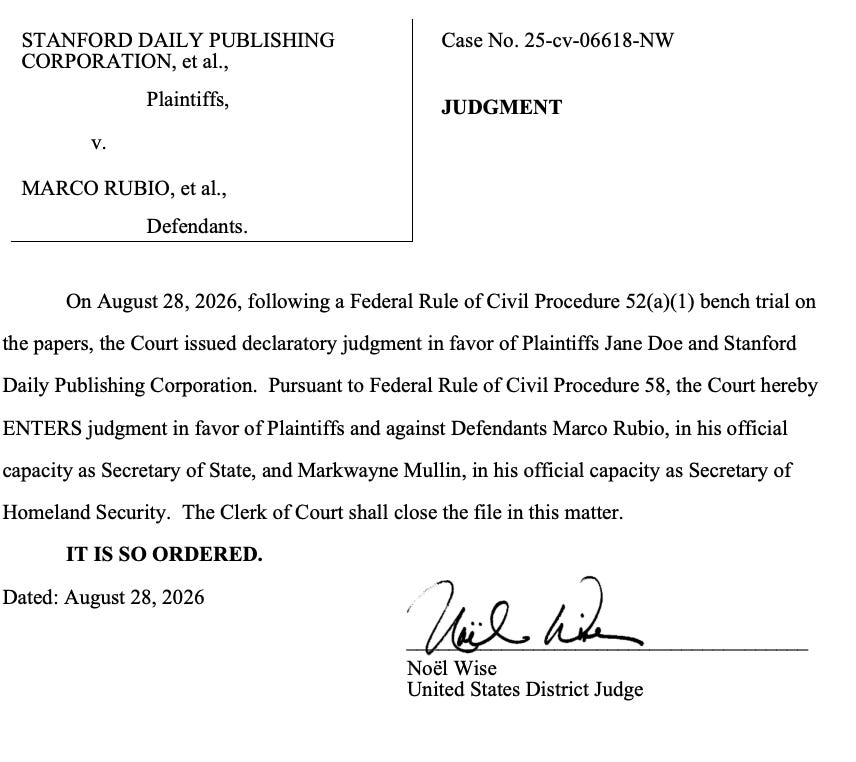
A federal judge in California ruled Friday that the Trump administration’s use of the Immigration and Nationality Act to deport noncitizen students over political speech violates the First and Fifth Amendments, siding with the Stanford Daily in its lawsuit against Secretary of State Marco Rubio. Judge Noël Wise, a Biden appointee, found that Rubio’s approach had chilled foreign students from writing opinion pieces critical of the administration, writing that “in the United States, freedom of speech belongs to the people. It is not the government’s to take.” The case grew out of the administration’s 2025 campaign to revoke visas and pursue deportation against pro-Palestinian student activists, including Columbia’s Mahmoud Khalil and Mohsen Mahdawi, Tufts doctoral student Rümeysa Öztürk, and Georgetown scholar Badar Khan Suri, several of whom were detained for months over campus activism or op-eds critical of their schools’ handling of the Gaza war. The administration had argued the students’ presence could harm U.S. foreign policy, while their attorneys countered that they were being punished for constitutionally protected speech, a fight that also drew public protests and pressure from congressional Democrats. Conor Fitzpatrick, an attorney for the Foundation for Individual Rights and Expression which brought the suit on the Stanford Daily’s behalf, called the ruling proof that “free speech isn’t a privilege, but the inalienable right of every man, woman, and child.”
More than 3,500 Canadians told the Guardian how they’ve overhauled their spending habits to boycott American goods and services in response to Trump’s trade war, tariff threats, and annexation rhetoric toward Canada, with the “ABUS” and “Elbows Up” movement spanning everything from groceries and whiskey to tech products and streaming services. Individual stories ranged from a Thunder Bay mechanic paying an extra C$1,000 a year for Canadian beer, to a Halifax IT worker who sold all his Apple products and switched to European email and mapping apps, to a Calgary whiskey-tasting group that redirected roughly $10,000 a year away from American brands entirely. A July Angus Reid poll found 40 percent of Canadian grocery shoppers are now actively checking product origins, and many respondents said the boycott has forced genuine lifestyle changes, like growing their own vegetables or driving hours out of their way to avoid connecting through U.S. airports. This week’s escalation, with the U.S. imposing 50 percent tariffs on $20 billion of Canadian goods and Trump renaming Lake Ontario “Lake America” in retaliation for Canada’s matching tariffs, has only deepened the sense among many respondents that the relationship with the U.S. is permanently damaged, with several saying they won’t resume buying American products even if the political administration eventually changes.
Far-right media provocateur Milo Yiannopoulos was arrested by ICE on Thursday at Louis Armstrong New Orleans International Airport and deported to the United Kingdom on Friday, with DHS saying he entered the U.S. legally in May 2019 but overstayed his visa and was issued a final removal order on July 22 after missing an immigration hearing. He was reportedly on his way to a Ye (Kanye West) concert at the Caesars Superdome when he was detained, having previously worked on Ye’s 2024 presidential campaign, and Laura Loomer claimed she was the one who reported him to ICE amid their long-running public feud. Yiannopoulos is a former Breitbart editor and past intern for Marjorie Taylor Greene whose career has included a 2017 CPAC controversy over comments seeming to condone pedophilia, a 2016 Twitter ban that was reversed in 2022 under Elon Musk, and his own history of advocating aggressive ICE deportation tactics, including posts calling for on-the-spot deportation checkpoints at places like supermarkets and gas stations.
Ukraine says it has intelligence that Russia’s Kremlin leadership has tasked military chiefs with planning new ground offensives against Kyiv and Chernihiv, according to Pavlo Palisa, deputy head of Ukraine’s presidential office, though he said there’s no evidence yet of Russian troops actually massing for the attacks. Palisa said Ukraine’s priority now is preventing Russia from ever creating the conditions to launch such an offensive, a callback to Russia’s failed 2022 attempt to take Kyiv early in the full-scale invasion. The warning comes alongside reports that Russia is testing its mobilization capacity even as it loses more troops each month than it can recruit, fueling a growing exodus of Russians amid fears Moscow may announce a new mobilization. Polish Prime Minister Donald Tusk said Saturday that “escalation from Russia’s side is progressing,” warning that the next six months “will be decisive” for NATO readiness, while Ukrainian President Volodymyr Zelenskyy said Kyiv is facing “virtually nonstop” attacks from jet-powered drones and that Ukraine urgently needs to accelerate production of interceptors capable of shooting down Iranian-designed Shahed drones.
A Russian drone strike on a Ukrainian military warehouse storing ammunition in the town of Myla, near Bucha in the Kyiv region, killed at least 37 people and injured 42 more, including four children, damaging at least 50 residential buildings including a care home for elderly and disabled people. President Zelenskyy said the depot stored shells, mines, drones and other munitions that should never have been located there, and criminal proceedings have been opened on charges of official negligence, with prosecutors also opening a separate investigation into the legality of storing explosive materials so close to homes. One of those killed was Taras Didych, head of the Dmytrivka community, who died while rescuing others. Ukrainian Prime Minister Serhii Koretskyi lamented that lessons weren’t learned from a similar deadly strike on a munitions depot in Vyshneve in July, which killed 22 people and exposed regulatory failings by a state-owned company. Russia’s defense ministry said it targeted a warehouse storing components for long-range drones and also struck the ports of Mykolaiv and Izmail along with facilities storing parts for Ukraine’s Flamingo cruise missiles, while separate Russian attacks in the southern Kherson region killed two people and wounded 27 others, including a child.
Masked Israeli settlers attacked a Palestinian woman and an NBC News crew in the West Bank town of Jalud on Saturday while the team was interviewing Aida Ahmed Abdullah, who said settlers had driven her family from their home. Video shows a car with Israeli plates reversing toward the group before at least four masked men jumped out and beat the woman and journalists with sticks and thrown rocks, injuring Abdullah along with NBC correspondent Matt Bradley and three other crew members, though Israeli authorities said her injuries were not life-threatening. The attack came amid a broader wave of settler violence in the area, including a days-long siege of the nearby village of Qusra and settlers pepper-spraying Palestinian workers there the same day. Israeli security forces said they intervened to separate the groups and confiscated vehicles linked to the rioters, and Prime Minister Benjamin Netanyahu condemned the violence as the work of “a handful of rioters,” though his government has faced accusations of turning a blind eye to settler attacks, which according to U.N. data killed 76 Palestinians between January and July compared to three Israelis killed over the same period. The West Bank, home to about 3 million Palestinians and 500,000 Israeli settlers since Israel captured it in 1967, has also seen a reported rise in attacks on journalists amid the escalating violence.
The death toll from the catastrophic Nepal-Tibet flash floods rose to at least 675 in Nepal as of Saturday, with nearly 2,500 people still missing, including around 90 Americans, even as more than 7,500 people have been rescued and roughly 90,000 affected by the disaster. China separately reported seven deaths and 554 people missing in its Tibet region, though it’s unclear how much overlap exists between the two countries’ missing-person counts. The disaster began Wednesday when a massive chunk of ice and rock broke off a mountaintop, triggering flooding so violent that seismic monitors initially registered it as a magnitude-4.4 earthquake, and rescue efforts have been hampered by damaged roads, power outages, and fears of further flooding. Among the missing are several Texas residents, including a couple who were crossing the China-Nepal border when the floods hit and another couple on a religious pilgrimage to Mount Kailash, while bodies recovered from rivers have been brought to Pokhara for identification, some too decomposed for visual recognition. Nepal’s finance minister estimated the country may need $4 billion to $5 billion to rebuild, with the World Bank, India, China, and the U.S. already pledging a combined $229 million in relief funding.
German Chancellor Friedrich Merz is preparing to formally blame Russia for the attempted drone attack at Leipzig/Halle Airport and announce “extensive” sanctions against Russian entities, according to three officials, with the announcement expected early next week alongside a parallel EU sanctions package being discussed at a foreign ministers’ meeting in Ireland. The drone, rigged with explosives and reportedly aimed at a Ukrainian cargo plane, has already been linked to Russia by German media investigations and a Wall Street Journal report citing U.S. intelligence assessments, though the German government spokesperson declined to confirm any official attribution ahead of the announcement. The move, which two officials described as a “Zeitenwende 2.0” echoing Olaf Scholz’s 2022 defense shift, comes as Germany also investigates a cache of weapons and ammunition discovered near Berlin last October that officials suspect may be linked to Russian intelligence, and amid a broader wave of suspected Russian sabotage incidents across NATO countries including Romania, Slovakia, Estonia, Italy and Bulgaria. The timing is politically delicate, landing just before elections in three German states, including Saxony-Anhalt and Mecklenburg-Western Pomerania, where the pro-Russia, far-right AfD currently leads in the polls. Separately, EU diplomats say a sweeping new sanctions package covering roughly 1,600 Russian individuals and companies is being finalized for adoption around mid-October, with renewed discussion of using frozen Russian central bank assets, though that effort still faces resistance from Belgium over concerns about Russian retaliation against the Brussels-based depository Euroclear.
See you soon.
— Aaron


