

Good evening, everyone. This morning, I published my investigation into Donald Trump’s nearly 50-year relationship with Russia, laying out the documented record in one place, from Soviet bloc surveillance files to waived sanctions and delayed air defense missiles for Ukraine. The response has been overwhelming. Hundreds of thousands of you read it, shared it, and sent it to people who needed to see it.
It has also made some people very angry. Since this morning, the attacks on our work have increased significantly. I want you to know that I’m safe, I’m taking the necessary precautions, and none of it will change what we do here. If anything, the pushback tells me the reporting landed exactly where it needed to.
And today’s news only reinforces why this work matters. The Justice Department is suing to block certification of Alaska’s Senate race if the Republican loses, and Trump says he personally ordered it. The White House is taking credit for a ceasefire in Ukraine that Pope Leo was publicly pushing for a week ago. And yet, there’s real reason for hope: Trump’s campaign to take over our elections is failing in the courts and with voters, with at least 34 federal rulings against him and a new poll showing most Americans reject his fraud narrative. You’ll find all of it below.
I’m able to do this work because I’m fully independent. No advertiser dictates my coverage. No corporation can pressure me into pulling a story. No political office shapes my reporting. I answer only to you. But that independence only works if readers make it possible, and when the attacks get louder, your support is what keeps this reporting alive and growing.
With the midterms just 11 days away, this is the moment that matters most. If you believe in independent journalism that holds power accountable no matter the pushback, become a paid subscriber today. It’s the single most powerful way to make sure this work keeps reaching the people who need it.
Here’s what you need to know tonight.
Trump’s Campaign to Take Over Elections Is Failing in the Courts and With Voters
Trump’s attempts to seize control of how Americans vote are collapsing in court, with at least 34 federal rulings blocking his efforts. Judges across the political spectrum have ruled against him, including 22 appointed by Democrats and 12 appointed by Republicans, eight of them appointed by Trump himself. His March 2025 executive order requiring documents like a passport to register to vote has been largely blocked, with one judge writing that when it comes to running elections, “the President does not feature at all.” His second order, directing the Postal Service to refuse to deliver mail ballots to voters left off a new federal list, was also struck down, with a judge warning it could have disenfranchised millions of citizens. The Supreme Court let that ruling stand, guaranteeing voters can cast mail ballots in the midterms without interference. Ruling after ruling has delivered the same message: the Constitution gives the president no power over who votes or how.
Trump’s Justice Department has lost every single one of its 26 decided lawsuits demanding states hand over Americans’ private voter data. Since May 2025, the department has tried to force nearly every state to turn over complete voter rolls, including driver’s license and partial Social Security numbers, and election officials from both parties have refused. Judges have called the demands baseless, and an Oregon court described as “chilling” the department’s plans to build a nationwide voter database for uses including immigration enforcement. Even a Trump-appointed judge in Maine rejected the department’s attempt to twist a Jim Crow-era civil rights law to justify the grab, saying it would “take a sledgehammer” to the balance Congress created. The administration’s one notable win came when the Supreme Court allowed it to keep using an expanded citizenship-checking program that a lower court had ruled illegal, but even that ruling is not expected to affect the midterms. Taken together, Trump’s legal push to control elections has been rejected at nearly every turn.
Trump’s effort to convince Americans the midterms will be rigged is failing too, with voters overwhelmingly rejecting his fraud narrative. A new YouGov poll for Protect Democracy found Trump hasn’t persuaded most voters, or even a plurality of Republicans, that the election will be fraudulent or that federal intervention is justified. A majority, 56 percent, believe he’s trying to control election rules to ensure Republicans win whether or not elections are fair, while only 37 percent think he wants fair elections regardless of the outcome. Nine in ten voters, including 88 percent of Republicans, say officials have a duty to certify results even when the other party wins. Election denial is also backfiring politically, with 58 percent saying they’d be less likely to support an official who tries to block or delay certification, compared with just 13 percent who’d be more likely. Election denialism remains stuck at roughly one in five voters, and the pollsters called its failure to spread a very positive sign for democracy.
Trump Says He Ordered DOJ Lawsuit to Block Certification of Alaska Senate Race if Sen. Dan Sullivan Loses
The Justice Department has sued to block Alaska from certifying its Senate race if Republican Sen. Dan Sullivan loses, and Trump says he ordered it. The lawsuit, filed Thursday in federal court in Anchorage, targets a second candidate on the ballot named Daniel J. Sullivan Jr., whom the DOJ accuses of running to mislead the senator’s supporters into voting for him by mistake. It asks a judge to halt certification if the senator loses and would have won had all of Sullivan Jr.’s votes gone to him instead, pending an investigation into voter confusion. “I’m the one that said do it,” Trump told reporters Friday, calling the second Sullivan’s candidacy “a disgrace.” The suit was signed by Associate Attorney General Stanley Woodward, who represented Trump allies and Jan. 6 defendants before joining the department. It was filed 11 days before the Nov. 3 election, the same day Attorney General Todd Blanche told reporters the DOJ never intends to improperly interfere with elections or certification.
The race could decide control of the Senate, and the second Sullivan’s place on the ballot has already been settled by Alaska’s courts. Democrat Mary Peltola, a former congresswoman, led the August all-party primary with 49.5 percent, followed by Sen. Sullivan at 41.4 percent and Sullivan Jr. at 2.5 percent. Polls show Peltola tied or slightly ahead in a state Trump carried by about 14 points in 2024, with his approval hurt by high fuel prices and an unpopular conflict in the Middle East. Alaska’s Republican election officials tried to remove Sullivan Jr. from the ballot in June, but a state court and the Alaska Supreme Court kept him on. On the November ballot, the senator is listed as the Republican incumbent, while Sullivan Jr. appears with no party label. Sullivan Jr., a former teacher and Forest Service worker, denies any scheme and says he’s exercising his right to run, while Peltola’s campaign says it has no involvement with either Sullivan campaign.
Election law experts say the lawsuit has little legal basis and is unlikely to survive. Notre Dame law professor Derek Muller said federal law doesn’t let the DOJ block certification, called it one of the worst legal arguments he’s ever seen, and said it seems designed to win a press release rather than the case. David Becker of the nonpartisan Center for Election Innovation and Research called it an unprecedented federal intervention, noting the Constitution leaves it to states to run and certify their own elections. Democrats warn it signals a broader willingness to contest midterm results, echoing Trump’s failed effort to overturn the 2020 election, and the Democratic Senatorial Campaign Committee called it a “sham lawsuit” to steal an election. The DOJ says it is acting under the National Voter Registration Act to stop a “frivolous candidacy” from undermining the election’s integrity. The senator’s campaign wouldn’t say whether it supports the suit, saying only that it will let the complaint run its course.
Trump Lashes Out at Reporter Over Ramaswamy Ad Featuring Amy Acton’s Estranged Mother
Trump called an NBC reporter a “horrible little reporter” after she pressed him on his support for Vivek Ramaswamy’s ad featuring Amy Acton’s estranged mother. The ad, from Republican Ohio gubernatorial candidate Ramaswamy, features Acton’s birth mother, Donna Arthur, calling her daughter a liar and urging voters not to elect her. NBC’s Monica Alba asked Trump Friday whether the sexual abuse allegations against Acton’s stepfather “mean nothing” to him, noting the mother had stayed with the man accused of raping Acton as a child. Trump asked which outlet she worked for, called NBC “one of the worst” networks, told her to be quiet, and said he didn’t know anything about “stepfathers from many many years ago.” He insisted the ad had “nothing to do with a stepfather,” called the mother “fair game,” and said he would be lucky to have an ad like it. At a rally in Iowa the night before, Trump said Ramaswamy had called him for advice and that he told him, “You’ve got to ride with it.”
Acton’s stepfather was charged with raping her when she was 12, and her mother lost custody of her and her brother. According to police and court records obtained by the Associated Press, Cledith Arthur was arrested in July 1978 after Acton’s biological father reported him, accused of abusing her from December 1976 to April 1978. He pleaded not guilty and was indicted by a grand jury, then skipped a court hearing and remained a fugitive until at least 1981; he has since died. Acton, Ohio’s former public health director during the COVID-19 pandemic, has spoken openly about the neglect, abuse, and homelessness she experienced as a child, saying she shares her story to give others hope that they can escape similar circumstances. She told Spectrum News she won’t normalize someone who treats her childhood as “something I’m complaining about.” At a campaign stop this week, a supporter asked if she could give Acton a hug, one sign of the outpouring Acton says she has received since the ad aired.
Ramaswamy is doubling down, while some prominent Republicans have broken with him. Speaking in northeast Ohio Friday, Ramaswamy said the ad was about lying, not childhood abuse, and accused critics of “lying about an ad that is about lying.” He has argued Acton has spread defamatory claims about him and his family, pointing to a Democratic ad in which a man accuses him of promoting an Alzheimer’s drug that didn’t work. But Republican Gov. Mike DeWine, who appointed Acton as health director and has endorsed Ramaswamy, said “it’s wrong to run this ad” and called for it to be taken down. The race is one of the most competitive governor’s contests in the country, with Acton vying to become Ohio’s first elected female governor and its first Democratic governor elected in two decades. An election forecaster has already shifted its rating of the race amid the backlash.
Melania Trump Credited With Oleshky Ceasefire as Starshield Confusion and Russian Strikes Continue
The White House is now crediting Melania Trump with brokering a ceasefire in Ukraine, just one week after Pope Leo personally called Vladimir Putin to push for the exact same thing. On October 16, Pope Leo called Putin from his hospital bed to request a ceasefire in the Russian-occupied Ukrainian city of Oleshky so desperately needed food and medical aid could reach civilians and those who want to leave could be evacuated. The Kremlin said afterward that Putin supported the Vatican’s effort and would cooperate. Fast-forward to Friday, and the White House announced that Melania Trump brokered a ceasefire in Oleshky, claiming she initiated discussions with Russian and Ukrainian leadership to make it happen. The Associated Press reported the White House’s account without any mention of the Pope’s intervention a week earlier. So why is the White House taking credit for an initiative Pope Leo was publicly pursuing days ago?
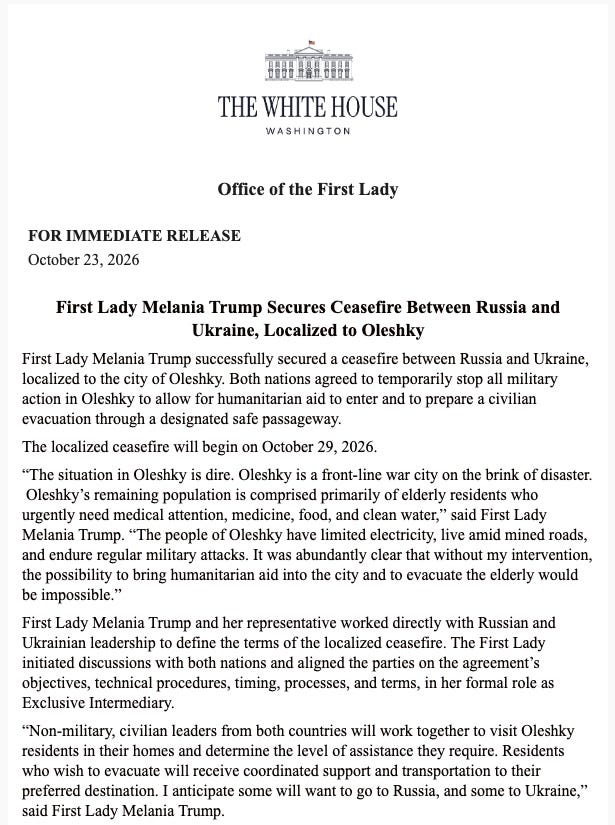
The situation in Oleshky is dire, and key details of the deal remain unclear. Once home to about 24,000 people, the city has been occupied since the first day of Russia’s full-scale invasion and now has no electricity, heat, or running water, with mined roads and drones overhead. Around 2,000 residents remain trapped amid severe shortages of food and medicine. Under the plan, a ceasefire would be followed by aid deliveries and then the option for civilians to leave, which Ukraine’s human rights ombudsman called extremely challenging to carry out. Peskov would not say whether evacuees will be taken to Russian- or Ukrainian-held territory, or how long the evacuation will last. The first lady said an impartial American media organization would document the process, and the outlet chosen is Newsmax, founded by longtime Trump friend Christopher Ruddy.
Trump says Elon Musk has restored Ukraine’s military satellite access, but Ukraine says the restrictions are still in place. Ukrainian drones began dropping from the sky in mid-October when Starshield, the military version of Starlink, suddenly cut connections for drones flying faster than 100 miles per hour, disrupting frontline operations and Ukraine’s ability to intercept Russian jet-powered drones. The New York Times reported that Trump called Musk last week asking him to restore access, and Trump said Musk “put it back,” though on Friday he said he had not spoken to Musk. Ukraine’s top diplomat in Washington said Friday that nothing had changed and the speed limits remain, while a Ukrainian drone commander described constant interruptions. Who ordered the limits is still disputed: Musk says the U.S. military and ultimately the president decide, Secretary of State Marco Rubio says no one in the administration requested changes, and The Wall Street Journal reported Musk ordered the slowdown himself. Sen. Richard Blumenthal has opened an inquiry, and a bipartisan group led by Sens. Mark Kelly and Thom Tillis urged Defense Secretary Pete Hegseth to expand Ukraine’s Starshield contract so service can’t be cut again.
Russia launched a major attack on Ukraine’s power grid just as peace talks were said to be moving forward. Overnight strikes on energy facilities across six regions knocked out electricity for more than 500,000 people, and the private energy company DTEK said one of its thermal power plants stopped generating power. The attack came days after Trump envoy Steve Witkoff met Putin in St. Petersburg, after which Putin said Russia was ready to resume U.S.-mediated talks with Ukraine in November, with the Kremlin now pointing to Abu Dhabi in the first half of the month. Trump’s “energy ceasefire,” announced October 11, has produced no meaningful results, with Ukraine resuming strikes on Russian refineries after Russia kept hitting its infrastructure. Even U.S. diplomats in Kyiv are uneasy: the embassy’s deputy chief of mission sent staff a memo acknowledging public commentary had left many wondering where the U.S.-Ukraine relationship stands. Zelenskyy says he is ready for a ceasefire but that Ukraine needs strong security guarantees.
Kushner Threatens to Sue Over Report Alleging He Had Access to $2 Billion in Secret Middle East Accounts
A new book excerpt alleges Jared Kushner had access to roughly $2 billion in secret bank accounts funded by the UAE and Saudi Arabia during Trump’s first term. The claims come from journalist Matthew Cole’s forthcoming book, “Princes and Thieves: Jared Kushner and Mohamed bin Zayed’s Secret Plot to Remake the Middle East,” excerpted by Vanity Fair. According to the report, Dutch intelligence found screenshots of Kushner’s iPhone on a server run by Russia’s military intelligence agency after flipping a Russian operative in 2017, then monitored his phone activity. The report alleges that in 2018, Dutch officials saw Kushner log into an account at First Abu Dhabi Bank that had received hundreds of millions of dollars from a bank in Azerbaijan. That account, held by a UAE government-funded charity, allegedly took in about $750 million, with Kushner listed as a signatory but not the owner. At the time, Kushner was serving as a senior White House adviser.
The report also alleges a second account in Israel received about $1 billion intended for Kushner’s personal benefit. According to the excerpt, the two accounts grew out of an idea by Gulf royals to create a slush fund to help advance the Trump administration’s foreign policy goals, an idea that eventually fizzled. A source quoted in the book says Israeli Prime Minister Benjamin Netanyahu encouraged Kushner to have the money deposited in Israel. The report says Kushner communicated with Netanyahu about the transactions through then-Ambassador David Friedman, who called the allegations about him “100% false.” As a White House employee, Kushner would have been required to disclose accounts he could access, which is why the allegations carry potential legal weight if proven. The allegations have not been established as findings of wrongdoing.
Kushner, his lawyers, the White House, and Trump have all forcefully denied the report. Kushner called the claims “completely insane,” said they “never happened,” and noted the report included no bank statements, wire records, account numbers, or transaction dates. His attorney Chad Mizelle said the team sent the publisher a 13-page letter denying the allegations before publication and now intends to pursue legal action against those responsible. White House officials called the story “baseless smears” and fiction, and said it relied on anonymous sources who never saw the alleged events firsthand. Trump told reporters Friday it was “a totally false story” and “fake news.” House Oversight Committee Democrats, meanwhile, said Kushner must answer the questions publicly, calling it the latest in a series of allegations that he has been selling foreign policy to the highest bidder.
Other news:
The Trump administration has dropped some Canada tariffs, according to Sen. Susan Collins, in a move seen as an implicit acknowledgment that the trade war could be hurting Republicans before the midterms. Collins, who faces a tough re-election fight in Maine, announced she secured exemptions from 50 percent duties on certain agricultural and forestry products, including items crucial to Maine’s blueberry, potato, apple, and seaweed growers. The exemptions also cover packing materials, refrigeration equipment, labeling machinery, and other supplies that she said farmers can’t easily get from American suppliers. Her announcement credited Trade Representative Jamieson Greer and Commerce Secretary Howard Lutnick but did not mention Trump, who has repeatedly claimed the U.S. needs nothing from Canada. The 50 percent tariffs were imposed after Canada walked away from trade talks in August, and other Republicans, including Michigan Senate candidate Mike Rogers, have said they want the trade war “wrapped up.” Meanwhile, Canadian Prime Minister Mark Carney has turned to other partners and is set to sign a historic deal making Canada the European Union’s first-ever “associate member.”
A personalized mRNA melanoma vaccine is being hailed as a “game changer” after cutting the risk of the cancer returning or causing death by 42 percent. In the late-stage trial of 1,137 Stage 3 melanoma patients who had their tumors removed, 82 percent of those who got the vaccine plus the immunotherapy drug Keytruda had no recurrence after two years, compared with 70 percent who got Keytruda alone. The vaccine, developed by Moderna and Merck, is built from each patient’s own tumor genome to train the immune system to hunt down remaining cancer cells, and patients received their custom doses in a little over nine weeks on average. Side effects were mild, similar to those of COVID vaccines, which experts called a major advantage over past combination treatments that caused serious immune reactions. Some experts urged caution, noting the benefit over Keytruda alone is modest, the data hasn’t been peer-reviewed, and 17 percent of screened patients didn’t have large enough tumor samples to make a vaccine. Researchers are already testing the approach in advanced melanoma and in bladder, kidney, and lung cancers.
An Ohio father was found guilty of murdering a retired sheriff’s deputy hours after watching police body camera video of his son being fatally shot. Rodney Hinton was convicted Friday of charges including murder for striking and killing Hamilton County Special Deputy Larry Henderson with his car in May 2025. Earlier that day, Hinton had been called to a police station to view footage of a Cincinnati officer shooting his 18-year-old son, Ryan Hinton, who police said was armed and fleeing from a reportedly stolen car. Hinton’s defense sought a verdict of not guilty by reason of insanity, citing his mental health history, while prosecutors said he accelerated to over 43 miles per hour and steered toward Henderson as the deputy tried to step out of the way. Henderson had retired about five months earlier and was directing traffic near the University of Cincinnati during graduation. Hinton is scheduled to be sentenced Nov. 16.
U.S. consumer sentiment has fallen to near its lowest point on record as Iran war-driven prices sour Americans’ view of the economy days before the midterms. The University of Michigan’s consumer sentiment index slipped to 48.0 in October, the second-lowest reading since the survey began and just above the all-time low of 44.8 set in May, shortly after the war with Iran started. Sentiment is now 10 percent lower than a year ago and 15 percent lower than in February, before the conflict began, with the survey’s director saying purchasing power continues to dominate how consumers see the economy. The decline was driven largely by independents, a key swing-voter group, whose sentiment plunged from 47.7 to 42.4, while Democrats and Republicans saw slight improvements. Since January, the share of Republicans saying high prices are hurting their finances has jumped 52 percent, compared with 27 percent for independents and 15 percent for Democrats. Americans now expect inflation of 4.7 percent over the next year, up from 3.4 percent in February, as Trump’s approval hits a record low in Reuters/Ipsos polling and Republicans risk losing control of Congress.
The Justice Department has charged two former top FBI officials, frequent targets of Trump allies, with lying to Congress about the Hunter Biden investigations. Nikki Floris, former deputy assistant director of the FBI’s Counterintelligence Division, and Bradley Benavides, who worked on election security and foreign influence, each face one count of a rarely charged crime that can be difficult to prosecute. U.S. Attorney for D.C. Jeanine Pirro said the two surrendered Friday and alleged they lied about their roles in the Foreign Influence Task Force and the Hunter Biden probes. The case was brought by criminal complaint, not grand jury indictment, in a city where grand jurors have rejected several Trump-era cases, including an attempt to indict six Democratic members of Congress. Floris, the FBI’s security lead for the 2020 election, has been criticized by Republicans who allege FBI officials buried a report on Chinese election interference, which her lawyers and intelligence officials say was a standard administrative decision. Her attorneys called the charges “nonsense,” saying they were filed on “the say-so of politicians” just before an election.
Trump’s border chief is defending plans to build a wall in Texas’ Big Bend region despite a court-ordered pause and bipartisan opposition. Customs and Border Protection Commissioner Rodney Scott told the Associated Press that fortifying the border is “non-negotiable” and warned Big Bend would be “completely overrun” if left without barriers while other areas are walled off. Landowners, local businesses, environmentalists, and some Republican lawmakers argue the $46 billion project is wasteful and destructive in a region with historically low migrant crossings. A judge ordered construction in the region halted this month, and the administration has asked the Supreme Court to lift that order. Scott said plans for Big Bend National Park won’t include tall steel walls, after bulldozers seen tearing up ground there in August sparked an outcry. He says the overall wall is ahead of schedule, with about 12 miles built per week and the primary wall set to be finished by the end of 2027.
The Mississippi police officer who fatally shot 1-year-old Kohen Wiley has resigned, days after the state ruled the shooting justified. Hunter Foster left the Senatobia Police Department shortly after Attorney General Lynn Fitch’s office called the June 14 shooting a “justified” use of force. State investigators say officers responding to a shoplifting report at a Walmart tried to stop a fleeing car, the driver nearly hit an officer, and an officer fired, killing Kohen, who was in the vehicle. Kohen’s mother, represented by Ben Crump, disputes that account, saying they had gone to buy diapers and that she held her baby up to show officers he was in the car. Newly released body camera footage shows officers approaching with guns drawn and an officer firing into the front passenger window as the car pulled away from him. Foster’s lawyer says he resigned to help the community heal and insists he didn’t know a child was in the car.
U.S. airlines are choosing higher fares over fuller planes as soaring fuel costs squeeze profits. Jet fuel prices have jumped roughly 90 percent since the U.S.-Israeli war on Iran began in February, rising from $2.43 to $4.63 a gallon on the Gulf Coast. Across Delta, United, American, Southwest, and Alaska, passenger revenue rose 18 percent in the third quarter even though passenger traffic grew less than 1 percent. U.S. airfares climbed nearly 23 percent year over year through September, far outpacing overall inflation of 3.6 percent, and airlines are still pushing new fare hikes. Airport security screenings fell nearly 3 percent in the quarter, raising questions about whether high prices are starting to keep travelers home, though executives insist demand remains strong. Despite record revenue, Delta and Southwest have cut their earnings forecasts and American expects a full-year loss.
The Oregon father who stopped a school shooter says he’s haunted that he couldn’t save everyone. Kaylub Giamanco, a 36-year-old carpenter in Bend, ended up near Silver Rail Elementary on Oct. 15 only because he changed his lunch plans to go home for leftover tacos with his wife. He saw a gunman opening fire on a motorist and a woman mowing the school lawn, grabbed the handgun from his truck, called 911, and crawled into the school through a shot-out window, believing it would be the last thing he ever did. He found the 16-year-old shooter struggling with a teacher for his gun and fatally shot him, after the attacker had already killed a teacher and three young children. Police have credited his quick action with stopping the attack, but Giamanco, whose two daughters attend the school, says he can’t sleep and keeps reliving the screams. He says he wants to apologize to the families of the children who died for not saving them.
Israel has launched what critics call a campaign of collective punishment in Hebron after two Israeli soldiers were killed in a shooting near a checkpoint. Prime Minister Benjamin Netanyahu announced a siege on Hebron and nearby Halhul, promised mass home demolitions, and said residents of the gunmen’s neighborhoods would be forced out. Defense Minister Israel Katz explicitly compared the plan to Gaza and to Jenin refugee camp, where nearly 20,000 people have been displaced, and Netanyahu said the largest West Bank military operation since 1967 is “on the way.” Finance Minister Bezalel Smotrich posted a video in front of a bulldozer demolishing a Palestinian home, saying it was meant to “exact a price,” though no link was claimed between its owners and the attackers. Israel’s high court issued a temporary order halting the demolitions after human rights lawyers argued they violate international law. The escalation comes days before Israeli elections on Tuesday, with polls suggesting the governing far-right coalition could lose its majority.
Tech leaders are warning of a “vulnerability tsunami” after AI helped uncover a massive security flaw that may have left most of the internet exposed for years. Researchers used AI to find severe bugs in PHP, a programming language so widely used that some experts estimate 70 percent of all websites were at risk. Government and private websites across the U.S. and U.K. went offline temporarily to patch the flaws, and the NSA urged every site running PHP to update immediately. Cloudflare CEO Matthew Prince said hacking attempts exploded from thousands before the announcement to millions afterward, and warned the next two years will be “incredibly fraught.” OpenAI CEO Sam Altman said he no longer thinks every bug can be patched, and Anthropic’s deputy chief information security officer warned there won’t be enough time to fix critical infrastructure. Security researchers called it among the most severe vulnerabilities in software history, saying the flaws had existed for decades but were nearly impossible for humans alone to prove exploitable.
Epstein-linked billionaire Glenn Dubin has stepped down from the board of New York’s Mount Sinai hospital, which features heavily in the Justice Department’s Epstein files. Dubin, a hedge fund founder who once called Epstein a friend, had served on the board since 2007, and his wife, who dated Epstein before their marriage, also left the medical school’s board this year. Mount Sinai says their terms simply ended and they didn’t seek re-election, and won’t say whether its internal review of Epstein ties played any role. The files show Epstein’s donations gave him “VIP” status at the hospital, including an incident in which a Mount Sinai surgeon appears to have stitched up a young Russian woman’s forehead inside Epstein’s townhouse after she was injured on his island. Rep. Thomas Massie recently named Dubin on the House floor as one of 14 Epstein “co-conspirators” who should be investigated. A spokesperson for the Dubins says that had they known of Epstein’s conduct, they would have cut ties long ago.
Severe flooding in the Four Corners region has triggered rooftop rescues and mass evacuations across Colorado, New Mexico, and Utah. In New Mexico’s San Juan County, National Guard boats, helicopters, and amphibious vehicles pulled people from rooftops and homes with three to four feet of water, as rivers kept rising past forecast levels. About 600 households were ordered to evacuate in Farmington, the region’s largest city, and a county spokesperson said even the local sheriff was close to losing his home. Colorado Gov. Jared Polis declared a disaster emergency in 11 counties, with mandatory evacuations along four rivers, while in Hurricane, Utah, floodwaters swamped about 80 homes and 50 RVs. The flooding follows two months of heavy rain that ended a summer of drought, leaving the ground too saturated to absorb more. At least one person has been injured, including from tornadoes that tore through Arizona earlier in the week.
See you soon.
— Aaron


