

Hey everyone, we’ve got a packed one today. Trump had a visibly agitated moment on camera aboard Marine One last night, the capper to a Labor Day weekend that included him calling his own Iran war “small potatoes” and going on another AI-generated posting spree. Canada’s retaliatory tariffs officially kicked in overnight, and a new Wall Street Journal investigation has Corey Lewandowski facing the possibility of real criminal exposure over what he was allegedly doing with his access at DHS. Democrats are also making a genuine play for deep red territory heading into the midterms, and we’ve got a full rundown of everything else from overnight, Iceland summoning our ambassador, a hurricane bearing down on Hawaii, a museum heist in France, and more.
I also sat down with Ezra Levin, co-founder of Indivisible, to talk about No Kings Day 3.0 and what organizers are planning next. That conversation is here, and it’s one I think you’ll want to actually sit with, not just skim.
None of this reporting happens without you. If you’ve been reading for a while and haven’t subscribed yet, now’s the time. This newsletter runs on readers, not corporate backing, and every subscription is what lets me keep digging into stories like the Lewandowski one instead of just repeating press releases. And I have a major investigation coming out very soon. If you’re already a subscriber, consider upgrading or gifting one to someone who needs to see this stuff too. Seriously, hit that button below, it makes a bigger difference than you’d think.
Here’s the news.
Trump appeared visibly agitated in footage caught on camera aboard Marine One Monday afternoon, gesturing firmly and jabbing his finger while speaking to the pilots after landing at Morristown Municipal Airport in New Jersey around 4:30 p.m., following a Labor Day weekend at his Bedminster golf club. It's not clear what triggered the outburst, but 35-year-old aide Natalie Harp, who has drawn scrutiny for her closeness to the president and for helping craft some of his more eccentric Truth Social posts, was on board along with 31-year-old Communications Adviser Margo Martin. The moment capped a weekend of erratic behavior that included Trump calling his six-month, $37.5 billion war with Iran "small potatoes," stepping off a plane with noticeably darker hair that fueled fresh wig speculation, his 43rd day golfing this year, and a Sunday Truth Social spree of AI-generated images showing himself riding with George Washington, arm-wrestling Hulk Hogan, tackling Canadian PM Mark Carney in hockey gear, and a sinking Titanic labeled "Dumocratic Party," along with floating renaming New Mexico to "New America" and claiming "The Moon is Ours." After landing, Trump ignored saluting Marines to walk across the tarmac, gave reporters a brief wave, and boarded Air Force One for Joint Base Andrews.
Democrats are entering the midterms trying to expand the map deep into red territory, with candidates like Kansas Senate hopeful Adam Hamilton drawing on voter frustration over affordability, even in a state Trump has carried by at least 14 points every time he’s run. Their path is easier in the House, where they only need a handful of seats, but tougher in the Senate, where they need to net four, with Maine, North Carolina and Ohio seen as the best pickup opportunities and Alaska, Iowa and Texas as longer shots; a recent Reuters/Ipsos poll found voters favor Democrats on the generic ballot by 5 points and disapprove of Trump’s economic handling by an even wider margin than his 25-point overall disapproval.
Republicans, meanwhile, are counting on a major financial edge (the RNC had $130 million on hand in July versus the DNC’s $16 million plus $18 million in debt), MAGA Inc.’s $400 million-plus war chest already spending on races like Ken Paxton’s, and Trump’s push to campaign in 35 targeted races over the final 30 days, while trying to brand Democrats as captured by democratic socialists like Zohran Mamdani. Both parties face internal complications: Democrats are managing friction between progressive nominees and national strategists (as in Michigan’s Senate primary) and a handful of races where they’ve stepped aside for stronger independent candidates, while vulnerable Republicans are quietly distancing themselves from Trump’s Iran war and his midterm convention without directly breaking from him.
Canada’s Tariffs Begin:
Canada’s retaliatory tariffs on roughly $20 billion in U.S. goods took effect just after midnight ET on Tuesday, extending the trade war between the two countries. The tariffs range from 15% to 50%, with the steepest rate hitting American milk, perfume, video game consoles, golf clubs, fishing rods, steel, aluminum, jackets and T-shirts. Cheese, carpets, appliances like stoves and air conditioners, agricultural equipment and electronics face the 25% tier, while forklifts and industrial molds sit at 15%. American seafood was initially slated for 25% tariffs but got removed from the list after pushback from the lobster industry. Economists say the fallout could hit manufacturers in Michigan and Indiana particularly hard, along with dairy producers in Wisconsin and Vermont.
The dispute traces back to Trump’s original tariff threats on Canada and Mexico over border security shortly after he returned to office, which prompted Canada to respond with its own retaliatory measures and liquor boycotts in some provinces. The two sides later launched trade talks and called off their most stringent measures, but tensions never really cooled, and over the summer the Trump administration threatened tariffs on $20 billion in Canadian goods, accusing Canada of discriminating against American goods and retaliating excessively. Trump briefly delayed those tariffs last month as negotiators neared a deal, but talks ultimately collapsed, with both sides accusing each other of tacking on last-minute demands. Prime Minister Mark Carney said the U.S. “asked too much and offered too little” and that Washington’s “signature was written in pencil” on prior deals, while pushing back on U.S. demands for control over Canada’s trade deals with other countries. Neither government has scheduled further ministerial-level talks, though Canadian officials say Ottawa remains open to an agreement that benefits both economies.
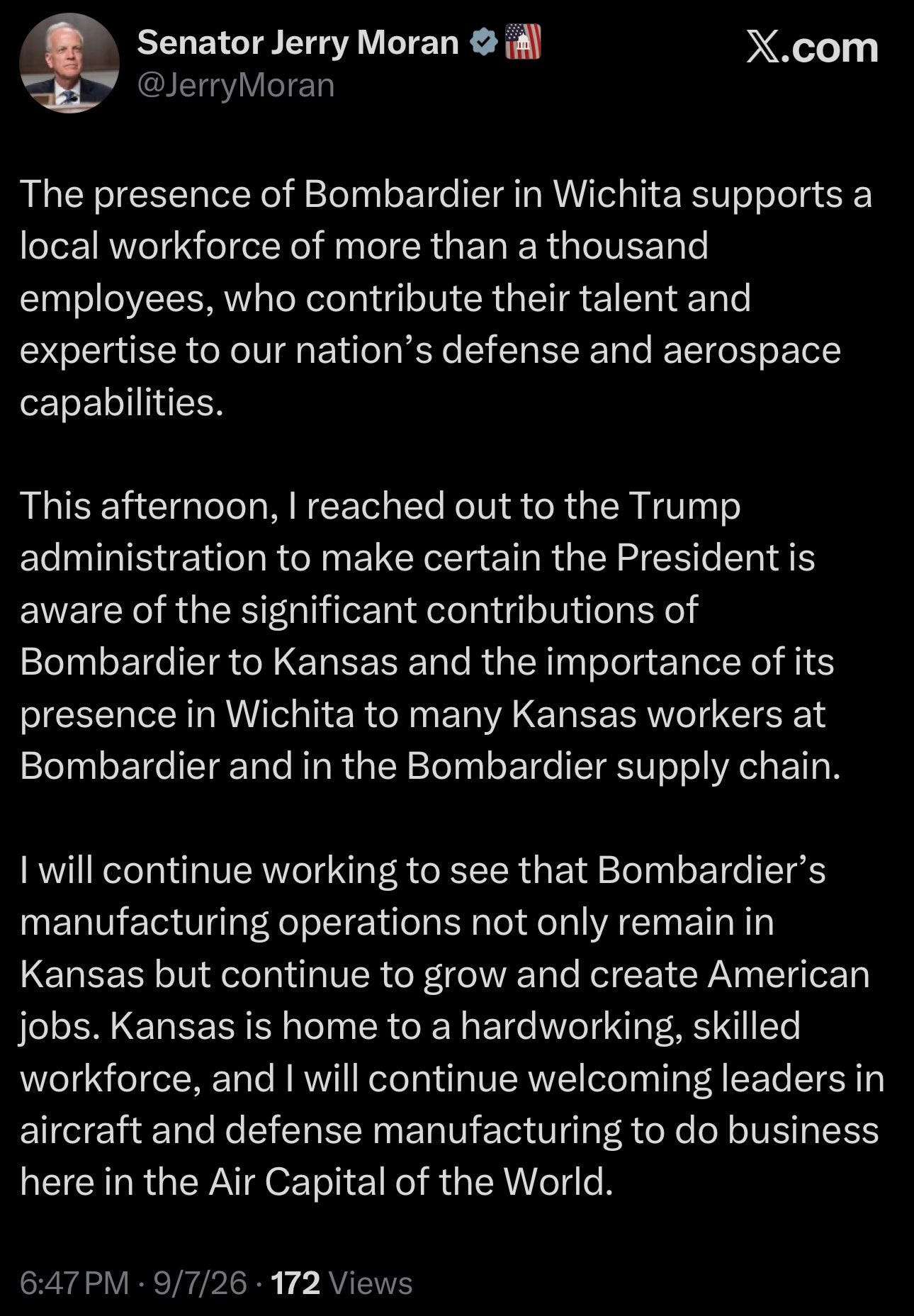
The fight has spread into the auto sector and beyond. Trump has threatened to raise tariffs on Canadian cars, trucks and auto parts to 50% starting January 1, 2027, a move that could push up vehicle and parts costs and leave dealers facing pricing and inventory uncertainty. On Monday he escalated further, posting on Truth Social “NO MORE SELLING BOMBARDIER IN THE UNITED STATES!” and telling the Quebec-based planemaker it must “build here, and stop treating America like a ‘piggybank’” to keep U.S. market access. Bombardier didn’t directly address the threat but noted it has sites in nine U.S. states plus Washington, D.C., manufactures wings in Texas and flight-control components in California, and works with about 2,800 American companies across 47 states. Quebec Premier Christine Fréchette said she’d contacted Bombardier’s CEO to offer “our full support,” writing on X that “Quebec will not allow anyone to dictate where our companies must produce in order to access a market.”
The broader U.S.-Canada relationship keeps deteriorating alongside the trade measures. The USMCA now faces annual reviews after Trump declined to extend it for another decade, which matters because Canada has leaned heavily on USMCA exemptions, shipping nearly 68% of its exports to the U.S. this year with roughly 80% of that moving duty-free under those exemptions. Trump has repeatedly floated making Canada the 51st state and signed an executive order renaming Lake Ontario to “Lake America,” and he’s said he doesn’t want “Canadian cars,” “Canadian parts,” or “Canadian anything,” claiming the country has been “ripping us off for decades.” Ontario Premier Doug Ford called Trump a “dictator” last month and told him to “kiss my a**,” a remark that came right before Trump’s Lake Ontario order. Even with all this, the tariffs currently in play cover only a small fraction of the roughly $700 billion in goods that cross the U.S.-Canada border each year.
Trump Advisor Faces Possible Criminal Inquiry:
Corey Lewandowski is facing the possibility of major criminal penalties after a new Wall Street Journal investigation detailed how he allegedly used his unofficial perch at DHS to enrich himself. Kristi Noem installed Lewandowski at the agency as a “special government employee” from April 2025 to March 2026, and while Noem asserted personal control over DHS contracts above $100,000, the Journal reports Lewandowski was signing off on major contracts before she herself approved them, giving him outsized sway over agency spending despite holding no formal secretary-level authority. The two reportedly grew personally close during this period, with TMZ catching them lunching together in Minnesota in August. A rep for Lewandowski denies any wrongdoing, insisting he never sought payment from contractors or pursued foreign contracts while volunteering his time at DHS.
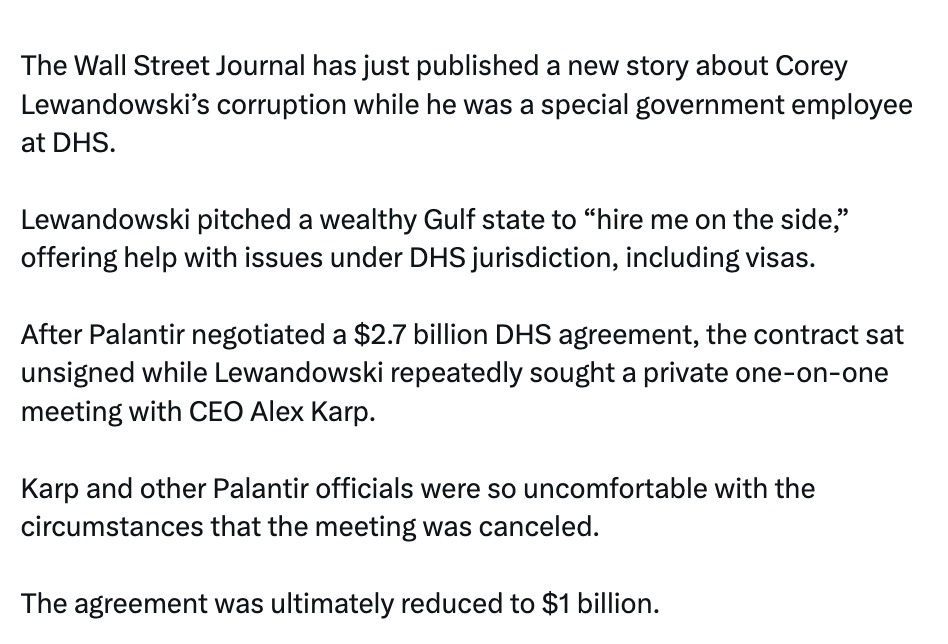
While serving in that de facto contract-approval role, the Journal reports Lewandowski approached Qatari officials offering to “help,” for a fee, with visa and other matters falling under DHS’s jurisdiction, and made a similar pitch to UAE officials. Both countries reportedly found the offers confusing and stunning since they already had established channels with senior Trump administration officials on these issues, and ultimately rejected his propositions. Separately, after Palantir negotiated a $2.7 billion agreement with DHS, the contract sat unsigned while Lewandowski repeatedly pushed for a private one-on-one meeting with CEO Alex Karp. Karp and other Palantir officials grew so uncomfortable with the situation that they canceled the meeting, and the agreement was ultimately reduced to $1 billion.
DHS’s inspector general has opened an investigation into whether Lewandowski was improperly involved in awarding government contracts, and congressional Democrats are separately investigating allegations that he sought kickbacks from government contractors. The scrutiny adds to an already turbulent stretch for Noem’s DHS, which has faced its own controversies, including the White House’s decision to keep a $70 million jet Noem leased for the department. Despite the mounting investigations, Lewandowski has reportedly told associates he expects Trump to pardon him if the matter escalates. The Journal’s reporting stands as one of the most detailed public accounts yet of how much unofficial power Lewandowski wielded inside DHS, and how directly that power intersected with his own financial interests.
Other news:
Iceland summons Ambassador: Iceland summoned U.S. Ambassador Billy Long on Monday after Trump posted an uncaptioned Truth Social image showing the island, along with Canada, Greenland, Mexico, Central America and the Caribbean, absorbed into the United States under the American flag, all labeled “United States of America.” Iceland’s Foreign Minister Thorgerdur Gunnarsdottir had Long formally told the post was “completely inappropriate,” while neither the State Department nor European embassies responded to requests for comment. The incident lands amid years of friction over Trump’s repeated push to acquire Greenland from Denmark, and came just hours after EU Commission President Ursula von der Leyen visited Greenland to announce a €200 million investment, with Danish PM Mette Frederiksen reiterating that “the Greenlandic government and the Greenlandic people have said again and again that they do not want to be American.” The episode also revives a running pattern of confusion between the two countries at the top of the administration, including Trump mixing up Greenland and Iceland at a Davos speech and Long himself once joking that Iceland would become America’s “52nd state” with him as governor, which led Reykjavík to hire a Washington lobbying firm on a $25,000 monthly retainer.
Meta smart glasses and police fears: Documents obtained by the Guardian show law enforcement agencies across the US, including the NYPD’s counterterrorism unit and DHS fusion centers in Maine, San Diego, Tennessee, Virginia and New York, are increasingly worried that Meta’s camera-equipped Ray-Ban glasses will be used to secretly record officers and facilities or to aid terrorism. The concerns started after videos surfaced of detainees using the glasses, discreet enough to pass as regular Ray-Bans or Oakleys, to covertly film inside detention centers, including a South Carolina facility already under federal investigation for unsafe conditions. A January 2025 NYPD memo also cited the New Orleans Bourbon Street truck attack that killed 14, noting the perpetrator had biked the area twice beforehand wearing smart glasses in what the FBI called “pre-attack target reconnaissance,” and ICE has since barred its employees from wearing the glasses in federal workspaces. Privacy advocates like Property of the People’s Ryan Shapiro see irony in the complaints, arguing law enforcement wants exclusive surveillance power and objects only “the moment we can watch them back.”
Mass protests in Germany: Thousands of Germans staged anti-AfD protests, with police estimating 5,000 and organizers claiming more than 14,000 at a Berlin rally near the Brandenburg Gate, after the far-right party’s record nearly 44% showing in Sunday’s Saxony-Anhalt election, the best result for a nativist party in Germany since the Nazi era. The AfD fell three seats short of an outright majority, and Buchenwald memorial director Jens-Christian Wagner called the result “a disgrace that makes you furious and stunned,” warning the party stood on the brink of governing a German state for the first time since World War II. Protests also spread to Potsdam, Münster, Göttingen, Dresden, Aachen, Bamberg, Darmstadt and Halberstadt, with a protest camp running continuously in Halle since election day, as demonstrators carried signs reading “Fascism is no alternative” and “Stop the Nazi AfD.” Attention is now turning to two more state elections on September 20 in Berlin, where several parties are bunched closely together, and Mecklenburg-Western Pomerania, where the AfD leads polling around 35% but the center-left SPD has mounted a summer comeback to score above 30%. Chancellor Friedrich Merz, whose unpopularity is seen as having weighed on the Saxony-Anhalt result, has vowed to stay in office and push painful economic and welfare reforms as the way to blunt the AfD’s rise, even as his junior coalition partner SPD signals it may back off some of the least popular measures, a rift analysts say could further destabilize the government.
Datacenter wastewater backlash: A growing number of pollution cases are fueling backlash against US datacenters, starting with the discovery of a rare, potentially hazardous bacterium in 801,000 gallons of wastewater discharged by a contractor for Meta’s $800 million Cheyenne, Wyoming datacenter, prompting the city to halt accepting that water pending appeal (Meta disputes the finding). Similar concerns have surfaced nationwide, including Virginia enforcement actions over wastewater and wetland permit violations, repeated stormwater flooding of homes near a West Virginia datacenter site, and a Georgia lawsuit threat from Flint Riverkeeper over alleged dumping of dirt and metals into the Flint River. The Waterkeeper Alliance says 55 affiliated groups are now working on datacenter issues, with most campaigns focused on pollutants like PFAS “forever chemicals,” heavy metals and antibiotic-resistant bacteria, while critics also point to a New York facility discharging cooling water at 108°F into Lake Seneca, warming a trout stream and worsening harmful algal blooms. Even some Republicans, including Wyoming’s Harriet Hageman, have demanded answers from Meta, but Trump has dismissed the backlash, calling datacenters a “golden goose” and posting that only communities wanting to “end up being backwards and poor” would oppose them.
Amazon cargo plane crash (Miami): The NTSB said all five people killed in Sunday’s crash were inside two vehicles struck by the Amazon-contracted Boeing 767, operated by 21 Air LLC, after it overran runway 30 at Miami International Airport. The plane hit a van carrying seven cleaning-company workers inside the airport perimeter, then tore through a fence and struck a Toyota outside on Northwest 67 Avenue before stopping roughly 1,300 feet past the paved surface. NTSB Chair Jennifer Homendy said investigators have recovered both the flight data and cockpit voice recorders and have 32 people on the ground, with specialized teams set to examine human performance, aircraft systems, and whether a runway-arresting system (EMAS) should have been installed. Homendy also flagged that the agency will scrutinize the contractual relationship between Amazon and 21 Air, and noted the NTSB has investigated more than 3,000 runway excursions since 2008. No cause has been determined yet; the agency expects to be on scene at least a week.
Hurricane Lowell (Hawaii): Hurricane Lowell passed just west of Hawaii with maximum sustained winds of 110 mph, a Category 2 storm just shy of major-hurricane strength, bringing damaging winds, heavy rain and dangerous surf that knocked out power to tens of thousands. As of the latest advisory the storm was 90 miles west of Lihue in Kauai County, prompting a hurricane warning there and a tropical storm warning for Oahu, with a tornado watch also in effect for Kauai and Niihau. Forecasters warned of up to 2 feet of rain in parts of the island chain, life-threatening surf and rip currents, and possible tornadoes, with Kauai and the Big Island facing the highest risk of significant flash flooding and mudslides. The Hawaii Emergency Management Agency told residents in Kauai County and Oahu to shelter in place overnight amid “very hazardous” conditions.
Ukraine-Russia strikes resume: Russia resumed airstrikes on Kyiv Tuesday morning, killing at least two people and wounding seven, ending a pause both Putin and Zelenskyy had ordered while Trump envoys Jared Kushner and Steve Witkoff held separate talks with each leader. The strikes damaged a five-story apartment building and set vehicles ablaze, with people reportedly trapped in a residential building, and neighboring Poland suspended flights from Lublin Airport over the missile activity. Witkoff and Kushner had called their weekend talks “meaningful” and said both sides would need to make “compromises,” while a senior Ukrainian official said discussions focused heavily on how to get through the winter. Trump had earlier said his envoys were bringing “an idea for peace,” and a Kremlin aide said the Americans had “formulated a number of ideas regarding possible paths to a settlement” without elaborating.
Missing plane off the Bahamas: A small plane carrying four members of a Florida family, pilot Mario Lamar, 80, his wife Lili, 79, and two grandchildren in their 20s, went missing Monday after departing Great Harbour Cay for Miami Executive Airport. Air traffic control lost contact with the PA-34 Piper about 13 miles west of Andros Island around 11 a.m., and Bahamian police say they believe it crash-landed near Red Bays, North Andros. The U.S. Coast Guard launched an HC-144 Ocean Sentry to assist the search after being contacted by Bahamian officials, but the effort was suspended due to bad weather with no clear timeline for resuming. Family members have pleaded publicly for help from boaters, fishermen and residents of Andros Island while asking for privacy as they wait for news.
Renoir Museum theft (France): Two thieves broke into the Renoir Museum in Cagnes-sur-Mer on the French Riviera early Tuesday and made off with paintings by the Impressionist master, though two of the four works taken were later recovered in the museum’s garden after the perpetrators fled. The stolen pieces originally included “Portrait of Madame Colonna Romano,” “Coco Lisant” and “Young Girl at the Well,” with a combined value around $10.5 million; it’s not yet clear which pieces remain missing. The town’s mayor, Bryan Masson, said the alarm triggered at 5:48 a.m. and police arrived within five minutes, with both municipal and national police now actively investigating. Masson called the theft an attack on the town’s heritage and pointed to it as proof of the need for a museum-security plan he’s championed, coming almost a year after the high-profile theft of an estimated $102 million in crown jewels from the Louvre.
UK sanctions on Israeli settlements: Britain announced it will ban trade in goods made in Israeli settlements in the occupied West Bank, a move framed by officials as reinforcing UK support for a two-state solution and one the U.S. is expected to strongly oppose. Israeli Finance Minister Bezalel Smotrich reacted angrily, calling for the UK ambassador to be expelled, while newly appointed Foreign Secretary Ed Miliband said he wants to reset UK policy on Israel amid concern over Israel’s E1 settlement project, which critics say would cut off land Palestinians seek for statehood. British PM Andy Burnham discussed the Middle East with Trump by phone and stressed “the importance of the two-state solution,” and minister Pat McFadden said the sanctions were driven by expanded settlement activity in recent months, while insisting there would be no broader boycott of Israeli goods. The economic impact is expected to be minimal since settlement goods are mostly agricultural and make up a tiny share of the roughly £6 billion in annual UK-Israel trade, and Britain joins Spain, Ireland and the Netherlands in adopting similar settlement-goods bans.
China’s export surge: China’s exports jumped 25% in August from a year earlier on strong demand for autos and high-tech goods, widening the country’s already-record trade surplus to $119.1 billion, up from $112.5 billion in July. Exports to the U.S. specifically rose 34.4% to $42.5 billion, partly reflecting a rebound from tariff-depressed year-ago levels, leaving China with roughly a $29.2 billion monthly surplus against the U.S., while auto exports grew 43% and semiconductor exports surged nearly 130%. The data lands just ahead of a planned late-September meeting between Xi Jinping and Trump where trade is expected to be a central topic, and comes as China leans increasingly on exports to Southeast Asia, Latin America and Africa to offset the impact of higher U.S. tariffs. China was the lone dissenter among G20 members at a recent Asheville, North Carolina meeting where the group agreed to address global trade imbalances, and analysts say the two countries remain in a standoff, with the U.S. withholding high-end tech from China and China withholding rare-earth exports in return.
See you soon.
— Aaron


