

Good morning. This week, people in Donald Trump’s own orbit started saying the quiet part out loud: if Republicans lose Congress in November, the president should consider martial law.
Not tighter voter ID laws. Not another lawsuit. Martial law. That’s the word being used, on the record, by a Trump attorney of two decades who’s now telling reporters there are only three ways this fall plays out, and one of them ends with soldiers deciding the election instead of voters. Legal experts say the emergency powers being floated don’t actually grant that authority. Trump hasn’t ruled it out anyway.
That’s the headline this week, but it’s not the whole story. It’s one thread in a broader pattern: a DOJ still trying to build a national voter list after losing 25 straight lawsuits over it, a Republican coalition that’s visibly fraying from Utah to Florida to the battleground map itself, a Canadian prime minister openly restructuring his country’s economy around the assumption that the U.S. can no longer be trusted, and a president rolling out the red carpet for Xi Jinping the same week U.S. intelligence quietly confirmed China helped Iran kill American soldiers.
Every story like this, the ones nobody else is covering the way we cover them, only happens because readers like you decide independent journalism is worth funding directly. Not advertisers. Not a hedge fund owner. You.
None of these are separate stories. They’re the same story, told from five different rooms. Let’s get into it.
Trump urged to declare Martial Law:
Election-denier allies are pressuring Trump toward drastic action, worrying his own advisers. Outside figures like attorney Peter Ticktin, radio host Wayne Allyn Root, and pardoned former Colorado clerk Tina Peters are publicly urging Trump to declare a national emergency or even martial law if Republicans lose Congress, framing it as the only way to stop a “rigged” election, despite experts noting emergency powers grant no authority over elections. Trump has fueled these theories himself, falsely reasserting he won 2020 and telling supporters to “cheat like hell,” while his White House and Cabinet have quietly worked to contain the narrative, authorizing document reviews and equipment audits that have found no evidence of major fraud. Senate Republicans killed his SAVE America Act, and internal GOP polling reportedly shows the law would suppress Republican turnout, particularly in mail-voting-heavy red states like Florida. The tension leaves genuine uncertainty about Trump’s next move, with insiders like Ticktin predicting a “nightmare scenario” narrative and preemptive claims that any Democratic win must be the result of rigged voting machines.
Cracks are showing in Trump’s GOP coalition as the midterms near. With control of Congress on a knife’s edge and Trump’s approval historically low, a growing number of Republican candidates and even a non-reelection-year senator (Utah’s John Curtis, who wants an investigation into Trump Jr.’s wedding financing) are publicly breaking from the president on issues like the Iran war, immigration enforcement, and family conduct. Senate candidates Ashley Hinson (Iowa) and Mike Rogers (Michigan) have reversed course to blame the Iran conflict for high prices, seven House Republicans joined Democrats on a troop-withdrawal resolution, and Florida Rep. María Elvira Salazar publicly criticized Trump’s immigration crackdown as having “gone too far” with Hispanic voters. Strategists on both sides read this as a sign Trump’s grip on the party is loosening as vulnerable candidates prioritize self-preservation over loyalty, even as most still try to avoid a full break, with Salazar for instance calling her conversation with Trump “fantastic” after airing her criticism publicly.
Florida Republicans are projecting confidence but privately acknowledging real vulnerability, with statewide polling for governor and Senate now inside the margin of error. The same national headwinds hurting the GOP elsewhere, Trump’s Iran war and resulting gas prices, Hispanic voter backlash over mass deportations, and affordability frustration, are hitting Florida too, prompting even one anonymous GOP county chair to say “we are hemorrhaging.” Rep. María Elvira Salazar publicly broke from Trump on immigration, several House races have shifted toward Democrats in recent polling, and Decision Desk HQ now rates the governor’s race a toss-up despite Republican candidate Byron Donalds outraising Democrat David Jolly roughly ten-to-one. Republicans still hold structural advantages, including a 1.55 million voter registration edge and a Democratic Senate nominee, Angie Nixon, whose DSA affiliation many in the GOP believe will alienate South Florida’s Cuban and Venezuelan exile communities. Still, strategists note the registration edge may be softer than it looks, since most of its recent growth came from voters switching from no party or from Democrats rather than committed Republicans, adding genuine uncertainty to a state Trump and Gov. DeSantis won by landslides in 2022 and 2024.
With 39 days until the midterms, Trump is choosing to rally in solidly red Alabama and Oklahoma next week, plus a college football game in Tennessee, rather than campaigning in the competitive states that will decide control of Congress. The exception is North Carolina, where Senate candidate Michael Whatley has taken the opposite approach of most battleground Republicans by openly embracing Trump and Vance on the trail, standing by the Iran war and opposing data center pauses, even as he trails Democrat Roy Cooper and Republicans worry he’s running out of time before outside money moves elsewhere. Democrats, meanwhile, are showing growing confidence in traditionally red terrain, with a new Schumer-aligned super PAC group forming to invest in the Texas Senate race and Kansas Democrat Adam Hamilton running ads built on Times reporting that his opponent, Sen. Roger Marshall, sued patients over medical debt, including one arrested while eight months pregnant. In Alaska, revelations that Democratic Senate candidate Mary Peltola verbally abused her staff largely failed to move voters, who mostly retreated to their partisan corners in her race against Republican Sen. Dan Sullivan. Taken together, the dispatches paint a map where Republican enthusiasm for Trump varies sharply by state, and Democrats increasingly see openings even in historically Republican strongholds.
Trump’s DOJ pushes to build voter data lists despite repeated court losses. Ahead of the Nov. 3 midterms, the Justice Department is defending DHS’s plan to compile lists of citizens eligible to vote, an unprecedented federal effort that a judge in Maryland is weighing this week amid a privacy lawsuit. The administration has lost 25 lawsuits seeking states’ voter rolls and the Supreme Court just rejected its mail-voting restrictions, yet DHS has still obtained rolls from at least 47 states and is cross-checking them using the SAVE database, which has a track record of wrongly flagging naturalized citizens as non-citizens. Critics, including voting rights lawyer Marc Elias, argue the real goal is building a “voter file” to enable mass disenfranchisement of Democratic-leaning voters rather than addressing fraud, which multiple audits (just 129 prosecutions since 1996) show is exceedingly rare. Even if DOJ wins Friday’s hearing, procedural deadlines and a separate injunction blocking the revamped SAVE database mean the lists may not affect November’s election anyway.
Canada Breaks Reliance on United States:
Carney says he’s prepared for the “extreme tail risk” that Trump could order military action against Canada, even as the two leaders keep talking. In a wide-ranging New York Times interview, the Canadian prime minister described a tense but functioning relationship with Trump, saying they’ve spoken “frequently,” including several times since trade talks collapsed last month. He was careful to frame the risk assessment as prudent planning rather than an expectation, saying “that’s just risk management... it would be irresponsible not to” prepare, and declined to detail what military action might involve. Carney characterized the dynamic as blunt but workable, saying “he’s direct, I’m direct” and that being able to “pick up the phone” makes the relationship more efficient. Still, the backdrop is stark: talks broke down in late August, both countries have since imposed new tariffs, and Trump has repeatedly called Canada’s leadership “nasty.”
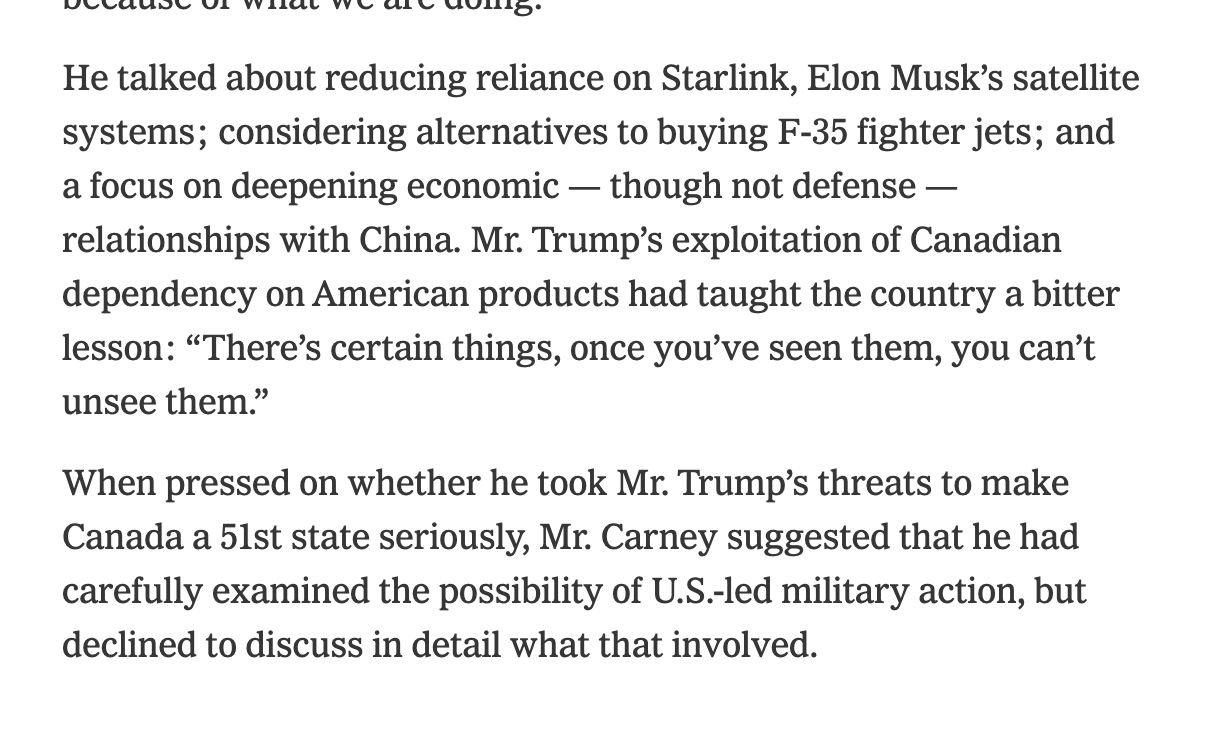
Carney detailed a deliberate strategy to cut Canada’s dependence on U.S. technology and financial systems, calling it a lesson he can’t unlearn. He pointed specifically to diversifying away from Elon Musk’s Starlink satellites, citing past disruptions and Musk’s reluctance to give Ukraine targeting data, while acknowledging alternatives are currently less capable unless pooled with European or Korean partners. Canada is also reviewing its planned purchase of 88 Lockheed Martin F-35 jets against a Swedish Saab Gripen alternative, with Carney emphasizing Arctic performance and strategic dependency as key factors. He separately renewed his longstanding argument that the world’s reliance on the U.S. dollar is unsustainable, saying Trump’s use of economic integration as “leverage” is accelerating global interest in reserve-currency alternatives, though he conceded any real shift depends on China liberalizing its financial system. His framing throughout was blunt: “once you’ve seen” the vulnerability, “you can’t unsee” it.
Despite the diversification push, Carney argued a mutually beneficial U.S. trade deal is still very much possible and pointed to potash as a concrete opening. He rejected the idea of unwinding the deeply integrated U.S.-Canada auto sector, calling that “not good policy,” and said he remains reluctant to weaponize Canada’s energy exports (roughly 60 percent of U.S. oil imports) even as he faces domestic pressure to do so, saying reliable suppliers keep a “very, very, very high threshold” before cutting off partners. On potash, the key fertilizer ingredient Canada supplies at nearly 90 percent of U.S. imports, Carney pushed back on Trump’s stated interest in sourcing from Belarus instead, arguing Canada, the U.S. and possibly Mexico could become “fertilizer independent” together without routing supply through unstable regions like the Black Sea or Strait of Hormuz. He called it “a doable component of the deal” and said Canada is ready to work toward reviving the broader trade agreement that collapsed in August.
China’s State Visit:
Xi Jinping’s first White House visit in over a decade wrapped up with pageantry and warm rhetoric but few concrete policy breakthroughs. Trump and Xi held 90 minutes of Oval Office talks Thursday, extended their tariff truce to January without striking a broader trade deal, and discussed AI, with both leaders signaling little appetite for regulation while Xi stressed keeping it “under human control”; Trump also pressed Xi to lean on Iran to end its conflict with the U.S., while Xi asked Trump to stop arming Taiwan, an issue Trump largely sidestepped. The elaborate itinerary included a military honor cordon, F-22 and B-2 flyovers, a Rose Garden review, and a state dinner attended by tech and finance titans like Musk, Zuckerberg, Bezos, Altman and Dimon, where Trump gifted Xi a bald eagle sculpture and Xi announced two pandas for the Atlanta Zoo. The friendly optics drew bipartisan criticism at home, with GOP Sen. Thom Tillis calling it a “WTF moment” given Trump’s warmer treatment of Xi than some democratic allies, and Democratic Sen. Richard Blumenthal urging Trump to confront Xi over China’s reported assistance to Iran rather than “feting” him; the visit also unfolded against tension over Trump’s earlier ban of CNN, MS NOW and Politico from White House coverage, which left the network pool declining to cover the arrival ceremony.
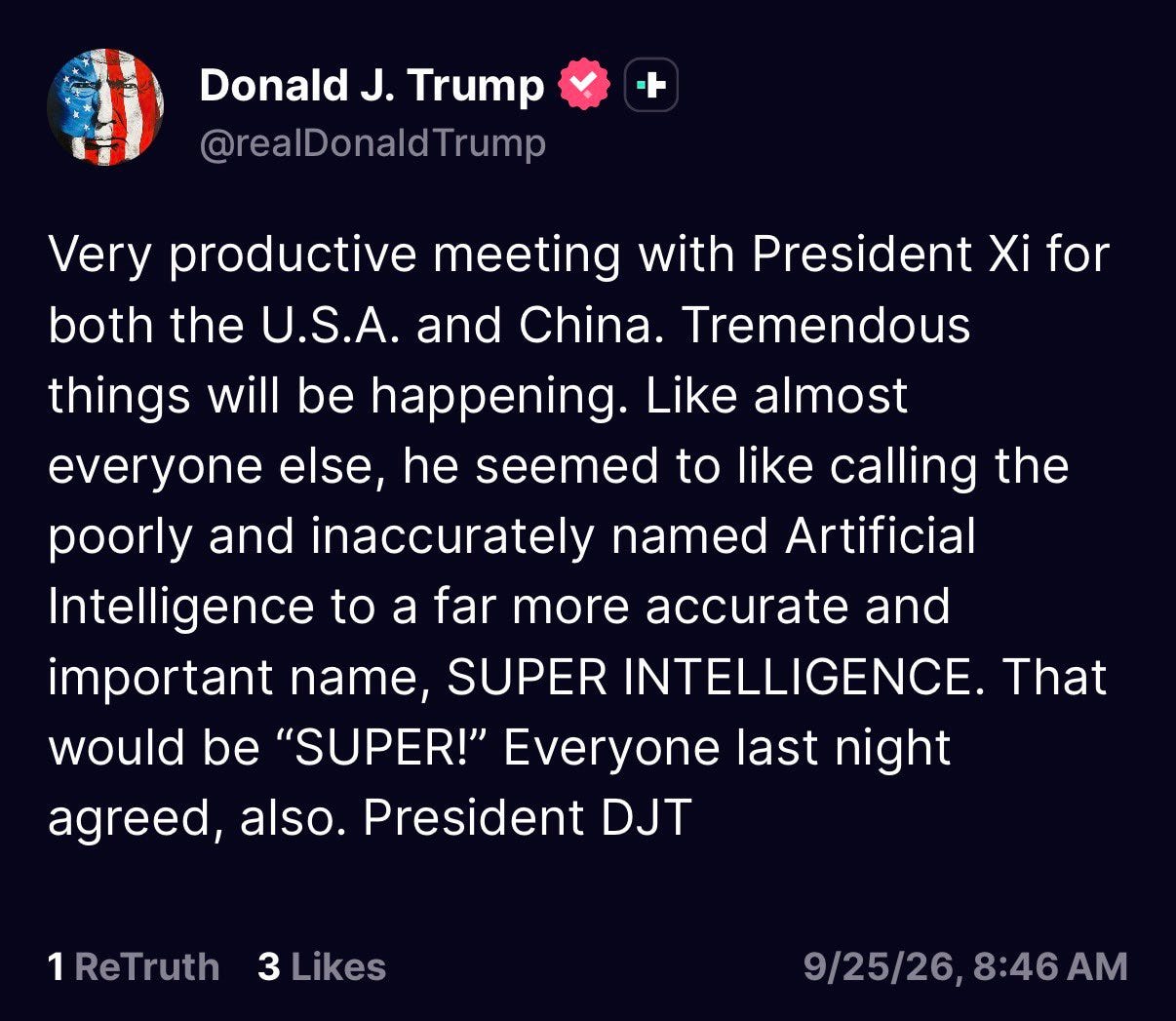
Chinese satellite imagery and intelligence have significantly boosted Iran’s ability to hit US targets with precision, according to a series of American intelligence assessments described to CNN by five sources. That support helped enable the July strike on a US base in Jordan that killed three American service members, a level of accuracy officials believe was otherwise beyond Iran’s capabilities, and it has also improved Iran’s tracking of ships through the Strait of Hormuz, letting even unsophisticated heatseeking drones time their launches more effectively. Officials say it’s hard to pin down the exact scope of Beijing’s assistance, or whether it’s government-ordered versus tacitly tolerated, and Chinese and Iranian officials didn’t respond to requests for comment, with Beijing’s foreign ministry previously saying only that it “strictly fulfills its due international obligations.” Russian support and Iran’s own growing combat experience are also cited as contributing factors, and the Trump administration has notably avoided publicly condemning China over the issue, with Secretary of State Marco Rubio saying China’s actions haven’t “changed the trajectory” of the conflict and have “in some cases” been “quite cooperative.” The revelations come as Xi Jinping visits Washington this week for meetings with Trump, and as the seven-month war has pushed Iran to adapt tactics that are increasingly straining US air defenses against low-to-medium altitude drones and missiles.
Other news:
Soaring diesel prices driven largely by the war with Iran are forcing school districts across the country to cut bus routes, with fuel now averaging $6.52 a gallon nationally, up from $3.70 a year ago. Since 87 percent of the nation’s 480,000 school buses run on diesel and more than 25 million children rely on them, the spike is hitting districts that were already strained, with a May survey finding 56 percent over budget on fuel even before this latest surge and many already consolidating routes or cutting field trips. In Tennessee, one Rutherford County bus contractor says rising costs could force her to stop operating altogether after paying nearly $2,000 to fuel just five buses, while a state gas tax relief proposal failed to pass. Colorado’s Cherry Creek Schools now expects to spend up to $2.3 million on fuel against a $1.5 million budget, and Alabama’s state superintendent credited a 25 percent boost in transportation funding with keeping districts afloat this year, though he warned more cuts could be needed later. Electric buses would seem like an obvious fix, but districts report they bring their own problems, limited range, long charging times, grid strain and high upfront costs, that are leading some to scale back electrification plans rather than expand them, even as Trump has said oil prices may not fall until after the midterms.
U.S. military planners are quietly preparing potential support forces for action around Cuba, according to an internal Army Reserve message reviewed by CBS News. The Army Reserve is checking whether it can supply U.S. Southern Command with military police, medical units, a surgical trauma detachment, and logistics and engineering battalions within 90 to 120 days, though the document doesn’t mention Cuba by name and no units have actually received deployment orders. It follows earlier reconnaissance operations near Cuban waters and airpower units placed on heightened readiness, as well as a previously reported, shelved plan for a large-scale air assault led by the 101st Airborne. Trump has escalated pressure on Havana as part of what officials call the “Donroe Doctrine,” telling the UN General Assembly this week that Cuba’s communist government “will fall” and that “freedom will be coming to Cuba,” prompting the Cuban delegation to walk out. He has also mused publicly about “taking Cuba,” even as his administration says Secretary of State Marco Rubio is in active negotiations with the island nation.
Bill Gates told “Meet the Press” that AI self-regulation isn’t enough and that Congress needs to pass legislation to guardrail the industry, warning that AI is powerful enough to help bad actors cause mass casualties. “No one thinks self-regulation is enough,” Gates said, calling for law enforcement and politicians to help set safeguards even if it adds some overhead for AI companies. His comments follow warnings from the CEOs of Anthropic and OpenAI that the race toward more powerful AI should slow down, echoed by a former Anthropic employee who said both companies are “gambling with our lives.” Meta’s Mark Zuckerberg pushed back on the idea of industry-wide coordination, arguing each lab should self-police instead, while House Speaker Mike Johnson has declined to bring lawmakers back to pass federal rules, saying AI companies haven’t offered a concrete legislative path. In the absence of federal action, states including California, Maryland and New York have already begun crafting their own AI regulatory frameworks.
Vladimir Putin’s United Russia party won a record three-fourths of seats in the country’s first wartime parliamentary election, a tightly controlled vote that excluded any genuine opposition. Central Election Commission results show United Russia took 349 of 450 Duma seats, with smaller Kremlin-aligned “systemic opposition” parties splitting most of the rest and the sole anti-war party barred from the ballot last month by Russia’s Supreme Court. Turnout reached nearly 60% of 111 million eligible voters, the highest in over a decade, aided by three days of balloting and expanded online voting. The election extended for the first time to illegally annexed Ukrainian territories and Crimea, a move Kyiv denounced as illegal, and unfolded amid heavy Ukrainian drone strikes that Moscow said killed three people, damaged an oil refinery, and struck dozens of polling stations. Putin declared the results a show of public support for Kremlin policy despite the ongoing economic strain of the war.
Japan’s finance minister revealed in unusually frank remarks that Trump personally pressed concerns about the weak yen during his UN summit meeting with Prime Minister Takaichi. Finance Minister Satsuki Katayama said Trump raised the issue directly and that Takaichi responded that an undervalued yen is “problematic,” an unusual public disclosure of normally confidential leader-to-leader talks. The exchange reaffirms the shared U.S.-Japan stance behind their July currency intervention, as the dollar continues rallying on strong U.S. economic data, a hawkish Federal Reserve, and surging Treasury yields. The weak yen is also driving up Japan’s energy import costs amid the ongoing Iran war, and Japanese officials are increasingly worried that a selloff in Japanese government bonds, which hit a 30-year yield high this week, could spill over into U.S. Treasury markets. A Japanese official separately signaled that the era of aggressive, Abenomics-style stimulus may be ending, aligning with U.S. Treasury Secretary Scott Bessent’s push for Japan to prioritize fighting inflation.
Saudi Arabia intercepted six ballistic missiles fired by Iran-backed Houthi rebels toward the city of Taif and the Red Sea oil hub of Yanbu, pushing oil prices to a one-week high. The Houthis claimed the strikes targeted “a sensitive target” in Riyadh and Saudi Aramco facilities, escalating a naval blockade they declared on the kingdom in July after seizing Yemen’s entire western coast in a rapid offensive. Oil prices climbed roughly 3% before easing on reports that the U.S. and Iran had discussed reopening the Strait of Hormuz, which remains disrupted amid the broader U.S.-Iran war. The Houthis also pressed an offensive on a key mountain supply route toward Yemen’s government-held city of Taiz, prompting Saudi Arabia, Turkey and Pakistan to schedule an urgent joint chiefs of staff meeting under their mutual defense pact. Yemen’s internationally recognized government urged the UN not to trust Houthi assurances that the blockade only targets Saudi shipping, warning the crisis threatens the entire global economy.
Nepal’s prime minister used his UN General Assembly address to demand grant-based, rather than loan-based, international climate aid, calling last month’s glacier flood that killed over 1,400 people “a warning to the world” that wealthy polluters have ignored. Balendra Shah noted Nepal produces less than a tenth of a percent of global heat-trapping emissions yet faces recovery and reconstruction costs equal to roughly 10% of its GDP, and argued vulnerable countries shouldn’t be forced into new debt to rebuild after climate-driven disasters. More than 6,000 people remain missing weeks after the flood, which Shah said may never be found, and he called for a Himalayan mechanism among Nepal, India and China to share satellite data and coordinate disaster response. The U.S., which has emitted roughly 1,500 times more carbon than Nepal over the past 75 years, has pledged $36 million in total flood aid, while the World Bank has separately offered up to $170 million in emergency financing.
Trump’s new executive order prioritizing recreational fishing is drawing warnings from ocean conservation groups that it amounts to a rollback of science-based marine protections. The order directs federal agencies to reconsider fisheries science and regulatory standards under the Magnuson-Stevens Act, convert decommissioned offshore oil rigs into artificial reefs, and create a task force to ease restrictions on shark fishing, moves the National Marine Fisheries Service says will deliver “long-overdue stability” to the recreational fishing economy. Critics, including groups like Oceana, the Center for Biological Diversity and Earthjustice, warn the administration could reinterpret bedrock standards like “overfishing” and “best available science,” and call the artificial-reef provision a “handout to the oil industry” that could leach chemicals and attract invasive species. Shark researchers cautioned that easing harvest limits risks undoing decades of slow population recovery, especially since more recreational anglers competing for fewer fish, not shark overpopulation, may explain more frequent encounters. Conservationists further warn the order’s broader deregulatory push could threaten measures like the ship-speed rule credited with reducing fatal vessel strikes on endangered North Atlantic right whales, part of a wider pattern of the administration weakening ocean protections since returning to office.
See you soon.
— Aaron


