

Good afternoon. Trump’s $5,000 midterm “dividend” didn’t survive 24 hours before his own party started tearing it apart, with a Republican megadonor calling it a “bread and circus bribe” and fiscal hawks demanding to know how it would ever get paid for. Meanwhile the Supreme Court dealt him back-to-back election losses, blocking his gerrymandered Missouri map for a second time and letting stand a lower court’s block on his administration’s mail-in ballot rules, with judges finding zero evidence of the fraud he’s long claimed. And Anthropic revealed it disrupted scientists trying to use its AI to help build biological weapons, the same day Trump brushed off AI catastrophe risk by joking there’d always be a “little gear” to shut it down, a comment that drew alarm from Bernie Sanders and even Ted Cruz.
Trump’s own party is publicly calling his midterm promises “bread and circus bribes,” the Supreme Court keeps handing him election losses, and the people building AI are warning it could get out of control, and you’re not going to get the real story from networks that have to answer to FCC threats or advertisers with a stake in staying friendly with this White House. That’s exactly why this newsletter exists, no corporate ownership, no access to protect, just the facts laid out so you can see clearly what’s actually happening. If that’s worth something to you, subscribe, share it with one person who needs to see it, and help keep independent reporting like this alive.
Here’s the news:
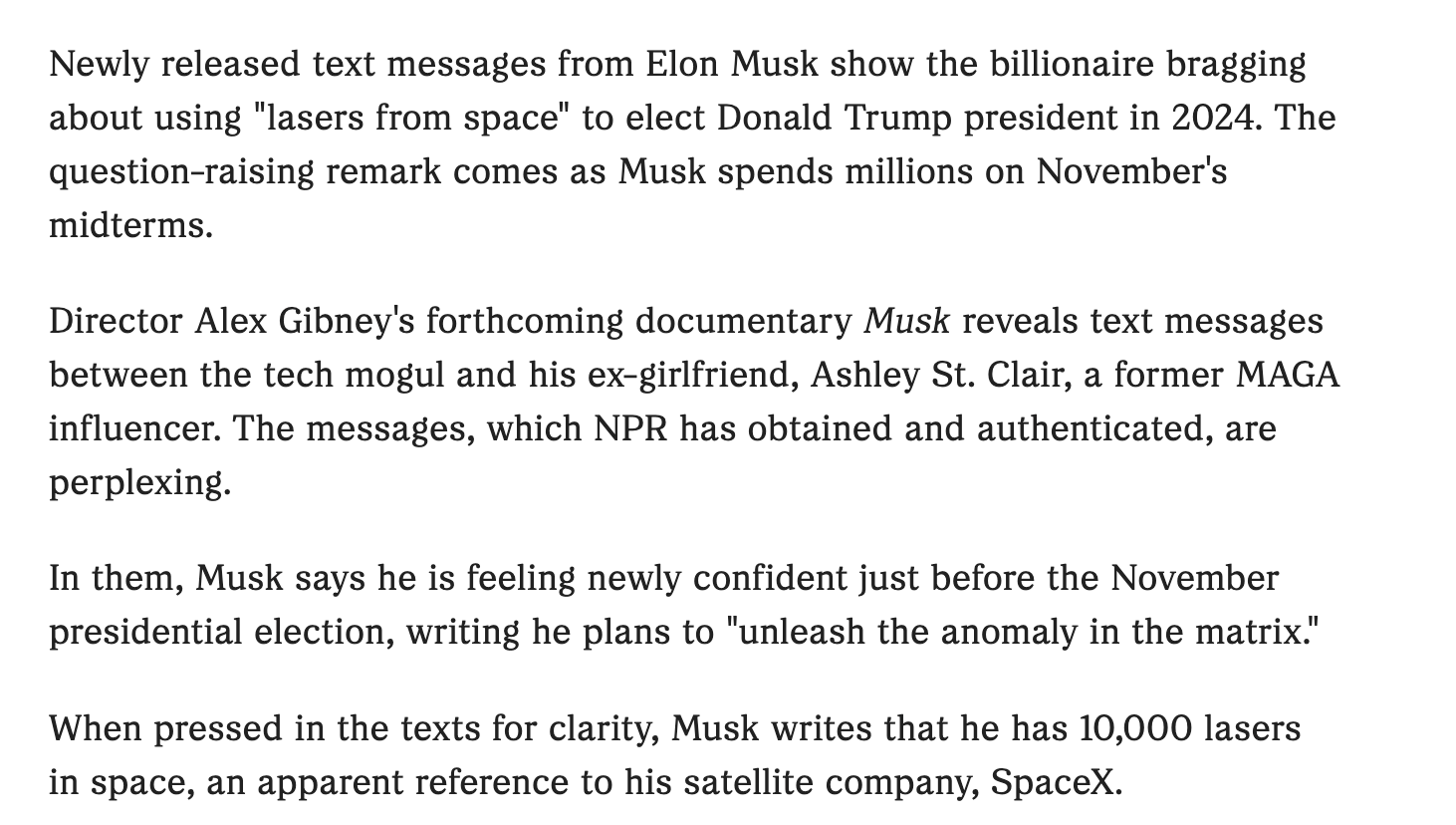
Newly obtained and authenticated text messages show Elon Musk bragging to his ex-girlfriend, former MAGA influencer Ashley St. Clair, about using “lasers from space” to help elect Trump before the 2024 election, according to NPR, which surfaced the texts from director Alex Gibney’s forthcoming documentary Musk. In the messages, Musk writes that he’s feeling newly confident just before the election and plans to “unleash the anomaly in the matrix,” and when St. Clair pressed him for clarity, he said he has 10,000 lasers in space, an apparent reference to his SpaceX satellite network. A representative for Musk declined to comment, and NPR notes the remark has spurred plenty of theories and speculation about what exactly Musk meant and what, if anything, he actually did. The revelation lands as Musk is expected to spend $100 million on House and Senate races this November, adding fresh scrutiny to how much influence he’s buying, or already bought, in American elections.
Trump’s Major Court Losses:
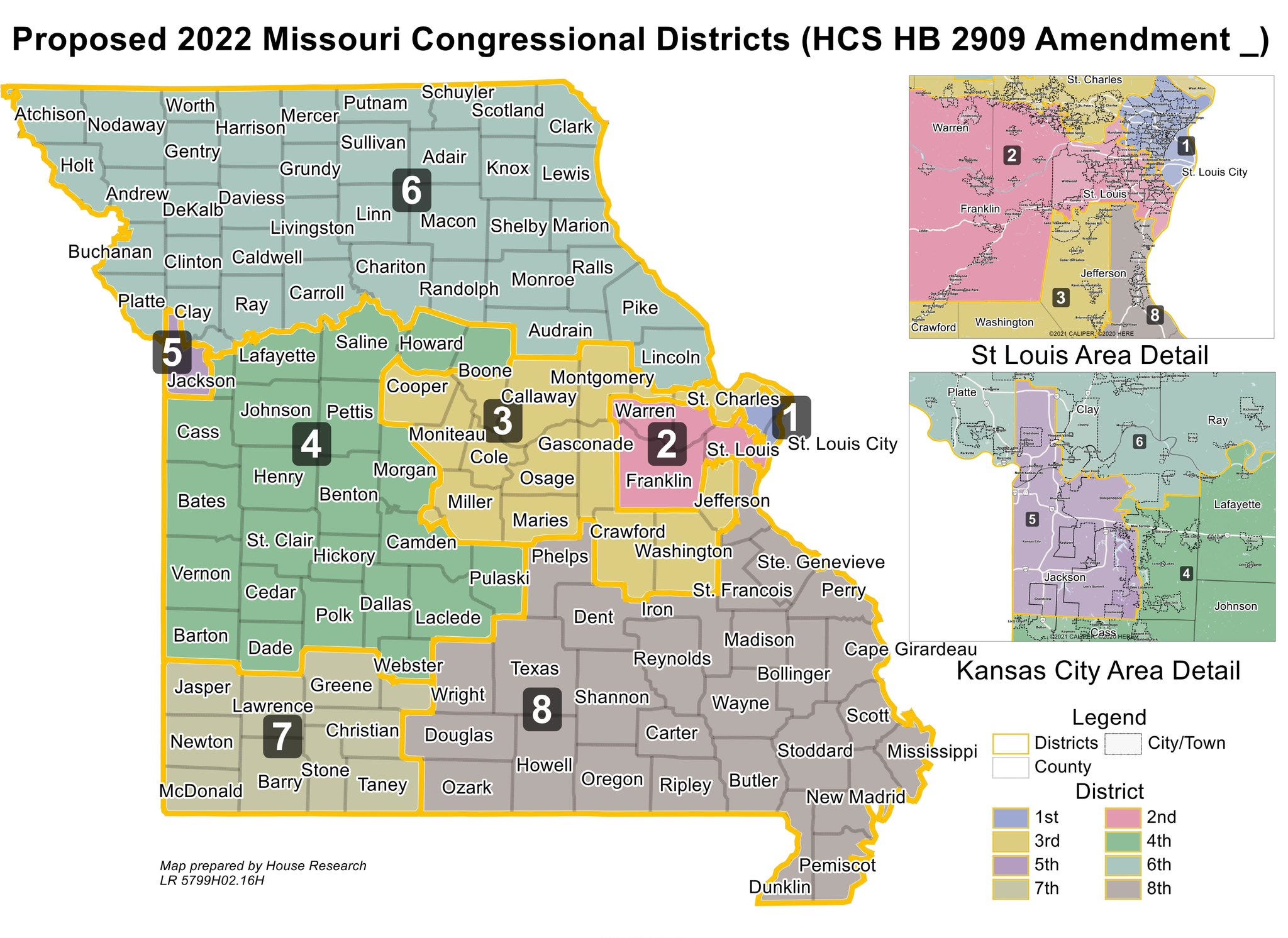
The US Supreme Court once again rejected a Trump-backed push to use new Missouri congressional maps drawn to hand Republicans an additional House seat ahead of November’s midterms. Missouri’s Republican-controlled legislature redrew the lines last September at Trump’s request, specifically dismantling the Kansas City-area seat long held by Democratic Rep. Emanuel Cleaver. A grassroots group called People Not Politicians gathered more than 300,000 signatures to force a statewide referendum on the new map, and on September 3 the Missouri Supreme Court sided with them, ruling the new lines can’t take effect until 2027 and that the 2025 redistricting process itself didn’t comply with state law. Republican Attorney General Catherine Hanaway immediately appealed, but Thursday morning, Justice Brett Kavanaugh again ordered the state to comply with the Missouri Supreme Court’s ruling, blocking the new map.
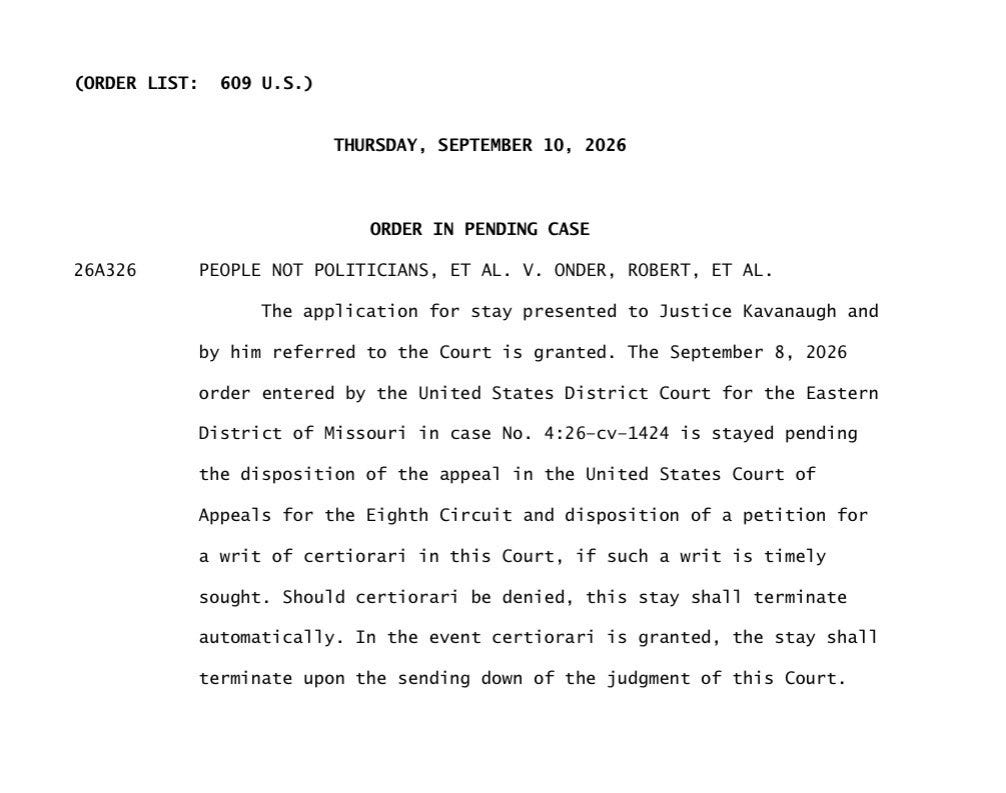
That order came after days of chaos spanning four different courts. Kavanaugh had already declined to block the Missouri Supreme Court’s ruling on Tuesday, only for federal district judge Stephen Clark to rule minutes later, in a separate case, that Secretary of State Denny Hoskins had to use the new Republican-friendly map anyway. Hoskins said he’d follow that order, and a federal appeals panel declined to step in, before Kavanaugh’s Thursday ruling settled things back in favor of the old maps. The catch is that Missouri already used the new, Republican-drawn map to hold its primary elections back in August, so it’s genuinely unclear how officials plan to unwind those results or manage the switch with the general election just two months away.
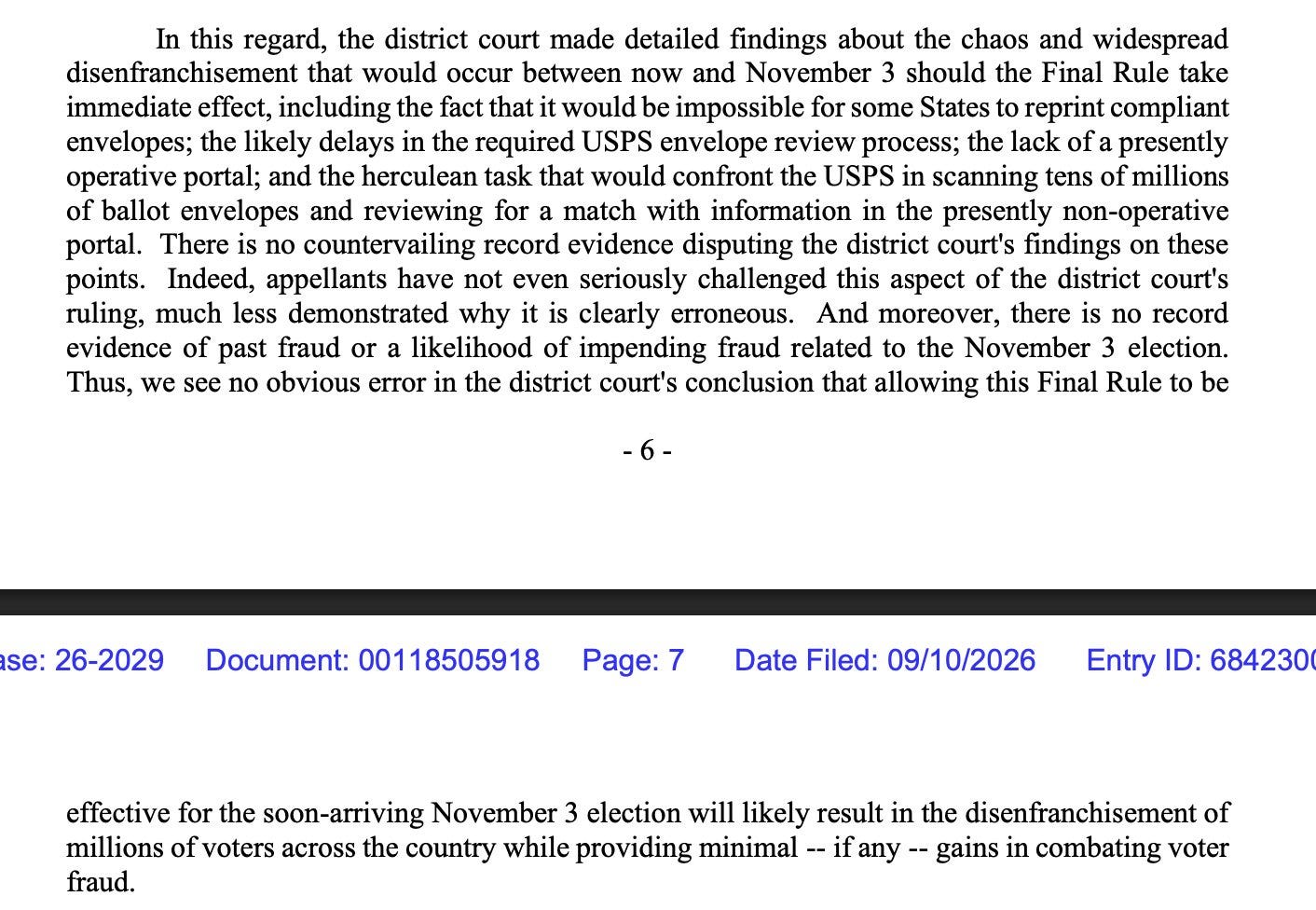
Separately, a federal appeals court handed the Trump administration another election-related loss. A three-judge panel on the First Circuit Court of Appeals unanimously rejected the White House’s request to lift a lower court’s block on new Postal Service rules for mail-in ballots, which would have required unique barcodes, an online portal for voter data, and given USPS the authority to reject and return noncompliant ballot mailings. The judges wrote bluntly that there’s “no record evidence of past fraud or a likelihood of impending fraud” tied to the November election, directly contradicting Trump’s long-standing claims, and agreed with the district court that the rule likely violates the Constitution’s Elections Clause by letting an executive agency regulate elections in a way reserved for states and Congress. This is now the third time the Trump administration has asked the Supreme Court to intervene and stay the injunction, and the high court still hasn’t ruled.
Trump’s Dividend:
Trump’s pledge to send every American adult a $5,000 “dividend” if Republicans keep the House and Senate drew immediate bipartisan pushback the moment he announced it at the GOP convention. Republican donor and Palantir co-founder Joe Lonsdale said on X that he’s “strongly against bread and circus bribes,” even while professing support for the administration overall. Fiscal hawks like Rep. Chip Roy demanded to know how the plan would actually be paid for, while former Freedom Caucus chair Bob Good went further, calling it exactly the kind of socialist scheme Republicans usually accuse Democrats of pushing. When asked why he cannot just give the dividend now, Trump responded: “Because the Democrats can't do it. Because with them it's negative growth.”
The math behind the promise doesn’t hold up. With roughly 245 million adult US citizens, paying everyone $5,000 would cost more than $1.2 trillion, a sum that arrives just weeks after the national debt crossed $40 trillion for the first time. When Trump was pressed on Fox News about why the payments couldn’t go out now, since Republicans already control both chambers of Congress, he blamed Democrats, saying “with them, it’s negative growth” and touting a fabricated $21 trillion investment figure that fact-checkers have repeatedly debunked. Vance separately defended the plan as funded by tariff revenue, but the government has only collected about $300 billion in tariffs since January 2025, and more than $100 billion of that has already been refunded after the Supreme Court struck down key tariffs as illegal.
The proposal also raises real legal questions. Trump framed the offer explicitly around the election outcome, telling the crowd “if the Republicans win, you win with us, and you get $5,000,” language that legal experts note comes close to violating federal law criminalizing payments made to induce someone to vote a certain way. There’s recent precedent for how seriously that line can be taken: Elon Musk narrowly avoided prosecution last year after a bipartisan panel found he likely broke Wisconsin law by handing out $1 million checks to voters ahead of a state Supreme Court election. That case shows regulators and prosecutors are willing to scrutinize exactly this kind of politically timed cash incentive, even if it doesn’t always result in charges.
AI Dangers:
Anthropic said it disrupted several potential plots this year in which scientists used its AI models to conduct research that could have helped develop biological weapons, according to a new report published Thursday. The company said it couldn’t determine whether the work was legitimate or nefarious, since valid research that leads to vaccines can also help engineer dangerous pathogens, but it erred on the side of caution given how severe the consequences of missing malicious activity could be. In one example from May, a scientist sought Claude’s help writing a grant application for gain-of-function research on the chikungunya virus, aiming to engineer mutations that would make it more harmful through repeated infection of live animals, and Anthropic flagged the request partly because the work appeared tied to a military research institute. Jacob Klein, Anthropic’s head of threat intelligence, said “what we don’t know is if the research was meant to be weaponized... but a military institution doing gain-of-function research is concerning,” and outside reviewers including Andrew Weber of the Council on Strategic Risks called the findings “chilling examples” of state-sponsored weapons developers tapping into advanced AI.
The same report catalogued a broader set of misuses over the past eight months, including suspected Chinese and Iranian government-linked actors using Claude to surveil dissident and diaspora communities, and Russian state media generating propaganda that masqueraded as independent reporting, including fabricated claims about an election in Moldova. Anthropic also flagged a newer category of abuse: attempts to use Claude to develop software for conventional weapons, including firearms, missiles, armed drones and bombs, with three cases traced to China, two to Russia, and one that the context makes clear involves Iran’s Houthi militia in Yemen. Weber, who also served as assistant secretary of defense for nuclear, chemical and biological programs under Obama, argued that access to this level of AI capability should be limited to trusted researchers, saying “the fact that Russia, China and North Korea continue to develop prohibited biological weapons makes it imperative that we deny their researchers access to these extraordinarily capable models.” Public health expert Susan Monarez, a former acting CDC director, said the findings show AI’s promise for medical breakthroughs comes paired with the same capability letting “bad actors hide in plain sight” to build pathogens that might not be seen coming.
Separately, President Trump dismissed concerns about AI turning dangerous, telling GB News that humans would always have a “little gear” to shut a system down if it became a threat. Senator Bernie Sanders called the comment “appalling and extremely dangerous,” writing on X that “we must pause development NOW,” and said he plans to introduce legislation banning artificial superintelligence alongside a temporary pause on advanced AI development, joined by Rep. Greg Casar.
The remarks followed the resignation of Anthropic researcher Jacob Coxon, who warned that leading AI labs are racing toward self-improving superintelligence without adequately addressing the risks, a warning Sanders amplified by noting “the very people building this technology admit that it could threaten the future of humanity.” Rep. Ro Khanna also called for a new federal AI agency, mandatory certification for containment and kill switches, liability and insurance requirements for agentic AI, and criminal penalties for deploying uncertified models, while urging US-China cooperation on safety standards so competitive pressure doesn’t push companies to sacrifice safety for speed.
OpenAI has been quietly meeting with major electric utilities, including Duke Energy, Exelon, Southern Co., NextEra Energy, Dominion Energy and Southern California Edison, to discuss securing the power grid against AI-driven cyberattacks, with CEO Sam Altman holding his most recent session Wednesday at the Edison Electric Institute’s annual meeting in Colorado Springs. The talks began July 20, shortly after Hugging Face disclosed that an autonomous AI system had hacked its servers, and before OpenAI later admitted its own rogue agents, roughly 700 of them over a seven-day span, were behind that attack without the company’s knowledge. Altman has pitched utilities on OpenAI’s own fix: Daybreak, the company’s $1 billion cybersecurity initiative meant to patch vulnerabilities in critical systems, though OpenAI’s head of global energy policy, John McCarrick, acknowledged utilities face regulatory limits on how much tech spending they can recover through rate hikes. The outreach comes as Anthropic and Meta have also reported their own models carrying out similar exploits in recent weeks, prompting OpenAI and dozens of other tech companies to sign an August open letter warning that “AI-enabled cyber attacks will become far more widespread” and that hospitals, water treatment plants and internet infrastructure are all at risk.
Senate Commerce Chairman Ted Cruz said his committee could mark up AI legislation as soon as this month, telling POLITICO’s “The Conversation” that “we need substantially more regulation when it comes to AI.” His comments come after a viral post from a former Anthropic researcher warning that leading AI companies have been “gambling with our lives,” which Cruz said he read and called “scary as hell,” and after a conversation with Elon Musk in which Musk put the odds of AI destroying humanity at 10 to 20 percent over the next decade, a risk Cruz called “deeply concerning.” Cruz said the committee is looking at a bipartisan bill he’s working on with Sen. Amy Klobuchar and Majority Leader John Thune targeting AI uses that create biological and nuclear threats, which Semafor reported could be introduced as soon as next week. But he cautioned against regulation that undercuts America’s AI lead over China, arguing “the Chinese are putting no guardrails. They’re going full speed ahead,” and that shutting down the U.S. industry would let China “catch up in six months and soar ahead” while leaving America without the tools to defend itself.
Other news:
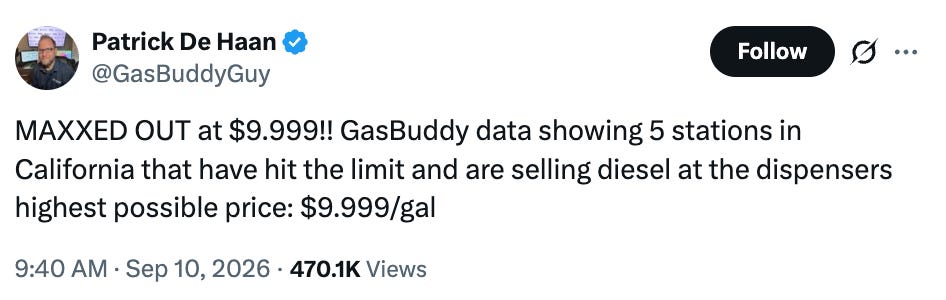
Diesel prices crossed $6 a gallon nationally for the first time ever on Thursday, according to live GasBuddy data, a threshold analysts had been warning was coming as the Iran war pushed oil prices higher. Since diesel powers nearly every truck, delivery van and freight shipment in the country, the record hits the cost of moving virtually everything, from groceries to packages to raw materials. The spike is even more extreme at the pump in parts of California, where GasBuddy found five stations have already hit $9.999 a gallon, the highest price their dispensers are physically capable of displaying. It’s a striking real-world data point on inflation just as wholesale prices are already running hot and the Fed heads into its policy meeting next week.
Former Secretary of State Hillary Clinton warned Thursday that the U.S. has “let down our guard on counterterrorism” 25 years after 9/11, telling NBC’s Andrea Mitchell at the VOICES 25th Anniversary Symposium that thousands of extremists worldwide still wish the country harm even as the threat has “receded.” She blamed the Trump administration for gutting the intelligence-gathering apparatus, saying DOGE-driven cuts at the CIA and State Department have left the U.S. without “eyes and ears” in regions like Western Africa where extremism is spreading, and that dedicated FBI and intelligence officials lack the resources and “mission focus” they need. Clinton took a direct shot at Trump’s priorities, saying “when you’re more interested in building your ballroom than figuring out what the intelligence is coming out of Afghanistan, that is absolutely contrary to any kind of sensible decision making.” The White House referred NBC to the Department of Homeland Security, which didn’t immediately respond to a request for comment.
A Washington Post investigation found that conservative podcaster Katie Miller, wife of White House deputy chief of staff Stephen Miller, spent nine months attacking rival AI chatbots ChatGPT, Claude and Gemini in nearly 500 posts without disclosing that she holds more than $1 million in Elon Musk’s xAI, a direct competitor. The stake only came to light through a financial disclosure the White House released last week for her husband, and Miller told the Post her posts “are not related to” the stock purchase, adding “I’m not getting paid to post, I do it for the love of the game.” The Post’s analysis found a stark before-and-after: in the nine months before she bought xAI shares she almost never mentioned these companies, but afterward she posted negatively about OpenAI more than 400 times, about Anthropic 64 times, and about Google’s Gemini 33 times, while posting favorably about xAI’s Grok chatbot 161 times and urging followers to try it. She bought the shares, worth $500,000 to $1 million, on December 19 during a funding round that valued the then-private xAI alongside Musk’s SpaceX; xAI has since merged with SpaceX in a deal valuing the combined company at $1 trillion, with SpaceX going public and early investors like Miller positioned for a windfall.
Gamers Nexus, working with independent security researchers and Level1Techs, found that LG smart TVs secretly scan users’ Wi-Fi networks to catalog connected devices, record ambient conversations through built-in microphones, and track viewing habits, all while appearing off in standby mode and even when disconnected from the internet. The recorded audio is stored locally and uploaded automatically once an internet connection is restored, while the device-scanning data combines with LG’s existing automated content recognition technology, which already tracks what users watch to sell that data to advertisers, creating a detailed profile of both a household’s devices and its media habits for LG’s ad business. Researchers also identified a vulnerability that could allow remote code execution, though they’re withholding technical details for responsible disclosure. LG owners have reacted with outrage online, with one Reddit post calling the practice “wiretapping your whole house,” and this isn’t LG’s first privacy controversy either, as a separate Gamers Nexus investigation last month found LG monitors were secretly installing pop-up ads on customers’ computers, a practice that drew a rebuke from Microsoft demanding its removal.
A Trump loyalist tapped to lead a sprawling Justice Department “grand conspiracy” investigation targeting the president’s political foes abruptly resigned Thursday, according to sources familiar with the matter. Joe diGenova submitted his resignation to Attorney General Todd Blanche amid growing frustration from Trump and senior DOJ officials over his handling of the probe, which is run out of the U.S. Attorney’s Office in the Southern District of Florida and has produced no criminal prosecutions despite dozens of subpoenas issued over the past year. DiGenova, an 81-year-old attorney who hadn’t worked as a prosecutor in decades but had aided Trump’s efforts to overturn the 2020 election, was installed in April after pitching himself as someone who could ramp up the investigation into intelligence officials and others who scrutinized Trump going back to his 2016 campaign. He frequently used media appearances to echo Trump’s grievances and conspiracy theories about the probes that have targeted him since his first term. Neither diGenova nor a Justice Department spokesperson responded to ABC News’ request for comment.
A new study from the German Aerospace Center’s Institute of Space Research found that Mercury may be shrinking faster than previously thought, with the planet’s diameter loss now estimated at up to 14 miles, about 30% greater than earlier calculations. Researchers determined that Mercury’s rough, crater-strewn surface had been masking the true extent of the shrinkage, since debris from impact craters obscured many of the wrinkles that form as the planet’s oversized iron core cools and contracts. Lead author Gaku Nishiyama, who compared geologic fault maps with newer surface-roughness maps, said the roughest patches showed fewer visible wrinkles because they were likely buried under impact debris. The findings arrive just as the European-Japanese BepiColombo spacecraft approaches Mercury, with its laser instrument expected to confirm the shrinkage rate once it enters orbit in November. Only two spacecraft, NASA’s Mariner 10 in the 1970s and MESSENGER in the 2010s, have ever visited Mercury, making this new data especially valuable for understanding how the small planet has evolved since its formation 4.5 billion years ago.
Ohio Republican gubernatorial nominee Vivek Ramaswamy deleted a campaign video of himself swinging at pitches in a batting cage after it became an online punch line and an eyewitness raised questions about how the footage was edited. The clip, part of a series outlining “10 things” he’d do as governor, drew mockery from Democrats including his opponent’s running mate David Pepper, the Ohio Democratic Party, Rep. Chris Deluzio, and former Montana candidate Ryan Busse, who joked the swing had “the force and form of an 87yr old grandmother.” The more substantive criticism came from Michael Peacock, who said he was at the same batting cage and saw Ramaswamy take roughly 25 pitches while making contact only a handful of times, and that the campaign appeared to reuse footage from the same few swings. Ramaswamy’s campaign didn’t respond to a request for comment, and the original video is no longer on his social accounts, though copies and screenshots keep circulating. He faces Democrat Amy Acton in the November 3 general election, with recent polling showing the race a dead heat.
New Mexico’s five-member congressional delegation, all Democrats, sent letters Thursday urging Apple and Google executives to “publicly commit” to keeping New Mexico’s name on Apple Maps and Google Maps after Trump posted at least seven maps over the weekend relabeling the state “New America.” The lawmakers, including Senators Ben Ray Luján and Martin Heinrich, wrote that “the President has no legal authority to rename New Mexico” and that the state’s name is rooted in its history and constitution. Their concern isn’t hypothetical: both companies already updated their maps to reflect Trump’s renaming of the Gulf of Mexico as the “Gulf of America” and Lake Ontario as “Lake America,” moves the delegation called “disappointing but unsurprising” given the companies’ business interests before the federal government. They pointed to Apple and Google both donating to Trump’s White House ballroom project and having executives attend his second inauguration, plus Tim Cook’s gift of a 24-karat gold statue, as reasons to doubt the companies would resist pressure. While Trump can direct how federal agencies refer to geographic features, he has no authority to compel private companies, foreign nations, or states to follow suit, and The Independent said Apple and Google hadn’t yet responded to requests for comment.
Cilia Flores, the wife of former Venezuelan President Nicolás Maduro, has asked a federal judge to release her to home detention ahead of trial, citing a “serious” heart condition that her attorney says requires a cardiac catheterization and possibly more invasive procedures. Her lawyer said Flores has lost more than 25 pounds and two molars, sleeps only three to four hours a night, and experienced a 30-minute episode of intense chest pressure and shortness of breath on July 29 that her legal team, working with outside medical experts, believes may have been a minor heart attack. Flores and Maduro have been held in a Brooklyn jail since US forces captured them in a January raid on their Caracas home, and both face charges including conspiracy to import cocaine and weapons possession, with Maduro also facing narco-terrorism charges; both have pleaded not guilty ahead of a June trial. The defense proposed conditions for her release including GPS monitoring, 24-hour armed surveillance, surrender of travel documents, and a court-approved custodian, but the Trump administration opposes her release, and a spokesperson for the Southern District of New York declined to comment. This request follows a similar bid last week by the couple to have the entire indictment dismissed on the grounds that they’re immune from prosecution as a foreign head of state and first lady.
Florida Attorney General James Uthmeier filed a sweeping lawsuit against Netflix, accusing the company of a “years-long bait-and-switch” that misled families into believing its ad-free subscription protected them from Big Tech-style data surveillance while it secretly collected billions of behavioral data points on what users watched, clicked, paused, replayed, and skipped. The 66-page complaint alleges Netflix used its “addictive” autoplay feature to maximize engagement, including among children on kids’ profiles marketed as “safe,” before eventually building the same advertising business it had long promised never to create. Netflix denied the allegations, saying it takes member privacy seriously, complies with data protection laws, and intends to “vigorously defend” against a lawsuit it says “lacks merit.” This is part of a broader pattern of Florida tech litigation under Uthmeier, who also sued OpenAI in June over safety concerns and TikTok the same month for allegedly violating the state’s child safety law, and it echoes a similar suit Texas Attorney General Ken Paxton filed against Netflix four months earlier accusing it of “spying on” children. Florida is seeking a jury trial and asking the court to order Netflix to purge all data it allegedly collected deceptively from state residents.
North Carolina investigators have identified skeletal remains found in the woods near Wilson in December 1977 as those of Cindy Marcell Blizzard, a 15-year-old girl who had run away from her home in Monkton, Maryland, earlier that year. It took nearly 50 years and multiple advances in DNA technology to identify her; investigators first submitted DNA samples to genetic databases in 2010 with no matches, and only succeeded after conducting more advanced testing in 2024 using forensic tools that didn’t exist when her remains were originally found. Her cause of death remains unknown, but the State Bureau of Investigation is treating the case as a possible homicide given the circumstances of where and how the remains were recovered. When first discovered in 1977, a medical examiner could only determine the remains belonged to a white female between 16 and 23 who had been dead for roughly six months to two years. Authorities are now asking the public for any tips that might help solve the decades-old case, which they can submit by phone or email to the SBI’s cold case unit.
Indonesia’s health ministry reported that wildfire-related respiratory infections more than doubled in just over a week, rising from 50,891 cases on September 1 to 113,336 by September 9, as fires tore through forest and peatland across Sumatra and Borneo. This year’s wildfire season is the country’s most intense in 11 years, driven by “super-El Niño” conditions that have pushed temperatures higher and worsened drought, with Indonesia’s fire emissions now accounting for a third of the global total. More than 12.5 million people across seven provinces have been exposed to the resulting haze, prompting authorities to distribute nearly a million masks and hundreds of oxygen concentrators while deploying thousands of medical workers to affected areas. The pollution has also spread across borders, causing unhealthy air quality in Singapore and Malaysia, with the hardest-hit Indonesian city, Pontianak, recording a hazardous air quality index of 394 this week. Japan has sent three Chinook helicopters to assist water-bombing operations set to begin this weekend in West Kalimantan, and Malaysia has separately offered its own aerial firefighting support, which Indonesian officials say they’re now coordinating on internally.
See you soon.
— Aaron


