

Good evening. Texas Republicans are staring down a reckoning of their own making today, from a Senate nominee even Karl Rove says would have lost to John Cornyn, to a Railroad Commission candidate whose calls for public executions just resurfaced weeks before the election, to Latino voters who carried Trump in 2024 telling us flat out they’re done with him. It’s the kind of collapse that has strategists in both parties treating a state Democrats haven’t won statewide in three decades as genuinely in play.
Meanwhile the pain keeps spreading elsewhere. America’s farm belt is buckling under $6-plus diesel, vanishing export markets, and a 20 percent jump in bankruptcies, with farmers telling us they’re not sure it’s worth passing the family farm down anymore. And the administration had itself a busy weekend on its own: gutting Title IX protections for LGBTQ students the same day prosecutors reopened the Cornell gang rape case, finalizing a rule that will cut off federal student loans for degrees like social work and teaching, and airing a third taxpayer-funded ad glorifying Trump, this one pulling straight from his 2024 campaign rhetoric, even as a Republican senator says no official should be spending public money on ads for themselves.
As it currently stands, I’m working on a significant story about the Epstein files that I plan to send you all later this week. I haven’t forgotten about them, not even close, so stay tuned. If you’re able to, become a paid subscriber today. It’s what lets me keep digging instead of just repeating the White House’s talking points.
Here’s the news:
White House Updates:
The White House has expanded its taxpayer-funded ad campaign boosting Trump, airing a third spot titled “Final Battle” that reuses black-and-white footage and rhetoric from his 2024 campaign, including him vowing to “cast out the communists, Marxists, and fascists” and “rout the fake news media.” The 30-second ad ran during “Saturday Night Live,” “Fox News Sunday,” and several football broadcasts this weekend, with more than $300,000 spent so far, and it’s unclear which agency is funding it. Democrats and former ethics officials argue the ads likely violate a decades-old federal law barring taxpayer-funded “propaganda,” while the White House insists they’re not campaign ads since Trump isn’t on the ballot and there’s no explicit call to action. Even Republican Sen. John Kennedy pushed back, telling CBS News no official, including Trump, should “spend public money on private ads for themselves,” a concern that echoes the fallout from Kristi Noem’s $200 million DHS ad campaign last year, which Trump publicly criticized before firing her.
The NFL has asked the Department of Homeland Security to take down a video the agency posted using Hall of Fame safety Brian Dawkins’ highlights, captioned “Our time has come,” in reference to a purported migrant caravan approaching the border. DHS did not directly address whether it sought permission before posting, responding instead with a statement about using “every Weapon at our disposal, from A to X” to secure the border, a nod to Dawkins’ “Weapon X” nickname; neither DHS nor the Eagles have commented further, and efforts to reach Dawkins were unsuccessful. This isn’t the first time government accounts have repurposed sports and pop culture content without clear permission, including a White House post in March mixing military explosion footage with MLB and NFL highlights just days after the Iran war began, and an earlier use of Pokémon imagery that prompted the company to publicly object, saying its “mission is not affiliated with any political viewpoint or agenda.” Major sports leagues typically require express written consent to use their footage commercially.
The President struggled to remain awake during an Oval Office meeting today. During the same meeting, he called Joe Biden “Sleepy Joe.”
A worsening farm recession is pushing American farmers to the brink, with diesel prices, trade disputes, and soaring interest rates driving a wave of bankruptcies and forcing multigenerational farms to question whether it’s worth continuing. Diesel, essential for running tractors and combines, has climbed near an all-time high of $6.53 a gallon nationally and $6.82 in Illinois, forcing seventh-generation Illinois farmer John Yeley to buy fuel in small batches for the first time in his adult life rather than in full truckloads, while trade wars with China have cut off soybean markets and wars in Ukraine and the Middle East have pushed fertilizer prices up as much as 50 percent in the past year. Farm bankruptcies rose 20 percent in the 12 months ending in June, and attorney Tom Ajamie warned that figure will keep climbing as “a lot of these farmers are on the edge.” Iowa Farmers Union president Aaron Lehman said most farms he knows expect to lose money again this year after losing money last year, calling the run of policy-driven losses “very frustrating” compared to the unpredictability farmers are used to from weather and soil conditions. Yeley, whose family has farmed the same Illinois land since 1852, said three farmers have already gone under in his small county this year and that he wouldn’t wish the current economics on his own teenage children, even as some in Congress push a farm bill and a possible diesel export ban that wouldn’t bring relief in time for this year’s harvest.
Republicans Face a Texas-Sized Problem as the State Could Flip for the First Time in Decades
Latino voters across South Texas who powered Trump’s 2024 breakthrough are turning on him, threatening the very redistricting maps Republicans drew to lock in those gains. Reuters traveled more than 360 miles through South Texas, from San Antonio to McAllen, and spoke with over 30 Latino voters who described Trump as having failed to lower prices despite the chance to do so, with Trump’s national approval now at 32 percent, the lowest of his second term. Saúl Guajardo, a 53-year-old McAllen voter who backed Trump three times, said he’s now “more open than ever” to voting Democrat, while his wife Terrie criticized Trump’s immigration crackdown as too harsh on families. Ramon Barrera, a first-time Trump voter in 2024 known online as “The Texas Tea Guy,” said he’s disappointed enough to back both Democratic congressional candidate Bobby Pulido and gubernatorial candidate Gina Hinojosa, summing up the mood with “the S&P 500 looks great, but our wallets don’t.” Republicans redrew the 15th and 35th Congressional Districts specifically to preserve Trump’s 2024 Latino support, but both are now rated competitive, with an August Texas Southern University poll showing Pulido, a Latin Grammy winner campaigning in a cowboy hat and handing out “Make Quinceañeras Great Again” hats, leading GOP Rep. Monica De La Cruz by five points in a district Trump had carried by 18. Here is Ken Paxton defending a deal with a child predator:
The GOP’s Senate nominee, Ken Paxton, is widely viewed even by fellow Republicans as a weaker candidate than the incumbent Trump pushed out of the race. At the Texas Tribune Festival, Karl Rove said flatly that if John Cornyn were still the nominee “this race would be over,” pointing to Paxton’s baggage, including multiple affairs and $200,000 in home renovations from a businessman for whom he did favors. Republican Sen. Thom Tillis went further, calling Trump’s endorsement of Paxton over Cornyn a “colossal mistake” and an “unforced error” that has put the Senate seat at risk, adding that Republicans “would not be spending tens or hundreds of millions of dollars in Texas if Cornyn had won.” Paxton’s political history includes a 2023 impeachment on corruption allegations that ended in acquittal, a felony securities fraud indictment later dismissed under a pre-trial diversion agreement, and a 2025 divorce filing from his wife of 38 years, Angela Paxton, made “on biblical grounds” citing adultery. His Democratic opponent, pastor and former state legislator James Talarico, would become the first Democrat in more than 30 years to win statewide office in Texas if he wins in November.
A second statewide GOP nominee, Railroad Commission candidate Bo French, has become an outright liability after years of inflammatory posts resurfaced just weeks before the election. French repeatedly called for publicly executing political opponents, including Obama and then-Rep. Adam Schiff, using hashtags like “#HangEmHigh” and writing that “the penalty for treason used to be death, even for a former president,” in posts spanning six years that he has since deleted. He has also asked followers whether Muslims or Jews are the “bigger threat” to America, argued at a CPAC panel that “the problem is actually Islam,” called for deporting 100 million people, and posted a racist claim that a racially diverse University of Texas football student section suggested students were in the country illegally, a claim the Dallas Morning News found included at least one naturalized citizen. The backlash was severe enough that Karl Rove said he would vote for French’s Democratic opponent, Jon Rosenthal, breaking three decades of exclusively supporting Republicans, while Sen. John Cornyn called French “an embarrassment to the Republican Party” who is “going to drag the whole ticket down.” Lt. Gov. Dan Patrick had previously called on French to resign as Tarrant County GOP chair over the Muslims-versus-Jews poll and endorsed his primary rival, only to reportedly reverse course once French won the nomination; Gov. Greg Abbott and Paxton have likewise declined to disavow him.
Together, these fractures have election analysts treating Texas as newly competitive up and down the ballot for the first time in decades. Cook Political Report’s David Wasserman noted Republicans are grappling with whether Latino voters, notoriously swingy, could snap back to Democrats the way they have in other states’ recent special elections. Sabato’s Crystal Ball rates the 15th Congressional District a toss-up, Cook Political rates it Lean Republican, and a September poll of 1,000 Texas Latinos found nearly two-thirds would be less likely to support candidates who back Trump’s immigration policies. TelevisaUnivision CEO Daniel Alegre described the electorate as persuadable rather than locked in, saying voters will back “the person who is going to make their lives better” rather than voting a straight party line. With Paxton struggling, French mired in scandal, and Gov. Abbott facing Democrat Gina Hinojosa in his bid for a fourth term, Republicans are defending a map and a slate of candidates that increasingly look shakier than the party anticipated when it redrew the state’s districts last year.
Trump strips Title IX Protections:
The Trump administration formally rescinded the Biden-era Title IX rule that extended protections against sexual harassment and assault to LGBTQ students, reinstating a 2020 rule from Betsy DeVos’s tenure, though officials stopped short of publishing a promised amendment defining sex as an “immutable biological classification as either male or female.” Education Secretary Linda McMahon previewed the move on a Fox sports show, framing it as a “full return” to policies ensuring “boys in boys’ sports and girls in girls’ sports,” while highlighting the administration’s broader push, including a settlement with the University of Pennsylvania that erased a transgender swimmer’s records, to block trans students from women’s sports and bathrooms matching their gender identity. Critics like Shiwali Patel of the National Women’s Law Center warned the change erodes protections against sexual harassment that “continues to remain pervasive,” noting the discarded 2024 rule had required schools to promptly investigate off-campus complaints and explicitly protected LGBTQIA+ and pregnant students from being pushed out of school. GOP Rep. Tim Walberg, who chairs the House education committee, countered that the reversal “restores longstanding protections for women and girls” and aligns policy with recent court rulings, including a June Supreme Court decision allowing states to bar transgender athletes from girls’ and women’s teams.
The rollback comes as the Education Department faces criticism for inconsistency and inaction elsewhere on sexual misconduct, even as it moves aggressively on gender identity policy. Patel pointed out the department has stayed silent on a high-profile Cornell University lawsuit alleging a student was drugged and gang-raped by seven fraternity members, a case prosecutors are now reopening, even while the department investigates 20 districts over staff-on-student misconduct and faces Democratic criticism for letting a backlog of abuse complaints go unaddressed. The administration has also sued California, Maine, and Minnesota over their gender identity policies and threatened to withhold federal funding from northern Virginia districts, and it’s expected to bypass the standard public comment process when it eventually publishes its formal definition of sex under Title IX. Attorneys who advise schools describe the current environment as a “wild west,” with Title IX consultant Sandra Aboy saying compliance now depends heavily on individual districts’ own ideology, and that some states with trans-inclusive policies are already fighting back with their own lawsuits.
Other news:
The Trump administration has finalized a rule barring federal student loans for degrees the Education Department judges don’t earn enough money, using IRS data to compare graduates’ salaries four years out against people with only a high school diploma and disqualifying any degree that falls short starting in 2027. Fields like social work, art, religious studies, teaching aide programs, music, and cosmetology are expected to be hit hardest, along with for-profit programs generally. The administration frames the move as “accountability” for higher education, but critics, including American Council on Education’s Ted Mitchell, argue it punishes essential, lower-paying work, noting “we need social workers” to handle crises like the fentanyl epidemic and homelessness. Even some conservatives have pushed back, with Alliance Defending Freedom’s Gregory Baylor arguing the government “shouldn’t punish people who pursue socially valuable callings just because in its judgment they don’t earn enough money,” while Stanford professor Jonathan Gienapp warned the policy ignores that a humanities program’s educational value isn’t always tied to immediate earnings.
A New York Times investigation found that after President Trump toppled Venezuelan leader Nicolás Maduro and lifted his own prior ban on Venezuelan gold, the administration rushed to broker gold-trading deals in an industry still riddled with the very corruption and gang violence Trump said he was fighting, and now hundreds of millions of dollars of that gold sits unsold because international refiners won’t touch it. The first deal went to Trafigura, one of the world’s largest trading houses, which won a yearlong right to buy gold from Venezuela’s state-owned Minerven and flew $100 million worth to the US within hours of signing, even though gold began flowing before the company or independent auditors had ever visited the mines. Reporters found that Minerven’s mines sit in gang-controlled territory where local miners and brigades pay roughly 20 percent of their gold to the Tren de Guayana gang as protection money, a practice so entrenched it’s locally known as “el sistema,” meaning at least some of the gold now imported into the US is tied to organized crime. Interior Secretary Doug Burgum personally helped broker the deal and brought bars of the gold to a White House celebration with Trump, even as Venezuela’s own interim president, Delcy Rodríguez, was reportedly skeptical but had little leverage to push back since she depends on Washington to stay in power.
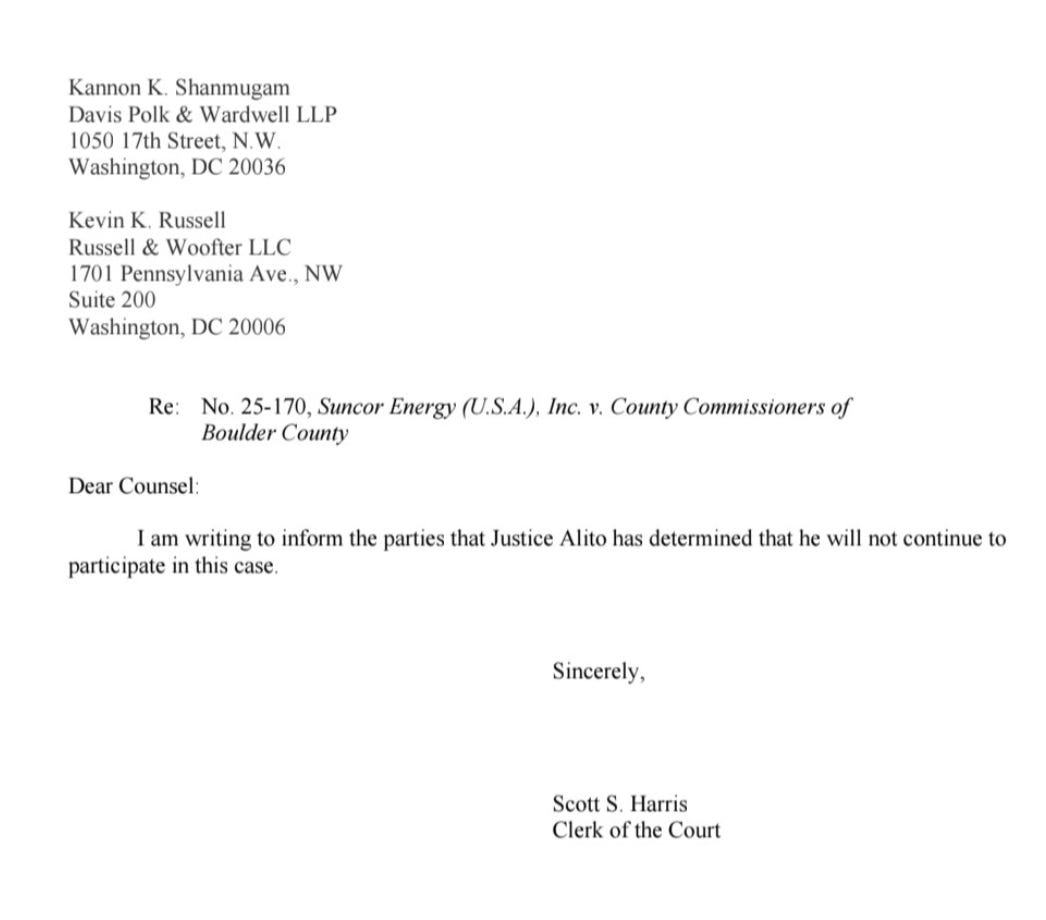
Supreme Court Justice Samuel Alito abruptly reversed course and stepped aside from a major climate change case, after previously insisting he had no reason to recuse despite calls from left-leaning groups over his oil company stock holdings. The case involves Exxon Mobil and Suncor Energy seeking to toss out a Colorado lawsuit from Boulder seeking climate damages, with broad nationwide implications expected from the ruling, which is set to be argued next week. Alito doesn’t own stock in either company directly but holds shares in ConocoPhillips, Phillips 66, and five other energy firms that could benefit if the court sides with the oil companies, since ConocoPhillips and Phillips 66 have themselves warned shareholders about the financial risks posed by similar climate lawsuits nationwide. A Consumer Watchdog spokesperson said the recusal was “the right decision, and one he should have made from the start,” pointing to those very disclosures as evidence of his conflict of interest. Alito had actually recused himself from an earlier, related appeal in the same Colorado case back in 2023, something the court later called “inadvertent,” before reversing that position and declining to step aside again until this new reversal. His recusal now raises the possibility of a 4-8 4-4 split on the 6-3 conservative court, which would leave the major legal issues unresolved, while some conservatives have separately pushed for liberal Justice Elena Kagan to recuse over an unrelated controversy involving a climate chapter in a judicial reference manual she wrote a brief foreword to.
President Trump will announce a $15 billion steel mill in Iowa on Monday, built by Mesabi Metallics with production targeted for 2030 and expected to create up to 1,750 permanent jobs, a project first reported by the Wall Street Journal. The plant will produce 10 million tons of steel annually and is designed to support defense sector requirements for high-grade steel, drawing iron ore from a new $2.5 billion Minnesota mine in the historic Mesabi Iron Range, the first new iron mine built in the US in 50 years and expected to create about 350 additional jobs. The Export-Import Bank will provide up to $10 billion in financing for the expansion, and Trump will unveil the project at a White House event alongside Commerce Secretary Howard Lutnick, Mesabi Metallics CEO Joe Broking, and Export-Import Bank Chairman John Jovanovic. The announcement comes as steel industry groups sent Trump a letter last week urging him to “stand firm” on existing steel tariffs even as the Supreme Court has already struck down many of his other tariffs, leaving the 50% duty on most steel and aluminum imports intact. White House spokesperson Taylor Rogers framed the announcement as proof Trump is “delivering on his promise to rebuild American industry, reshore manufacturing, and create new jobs.”
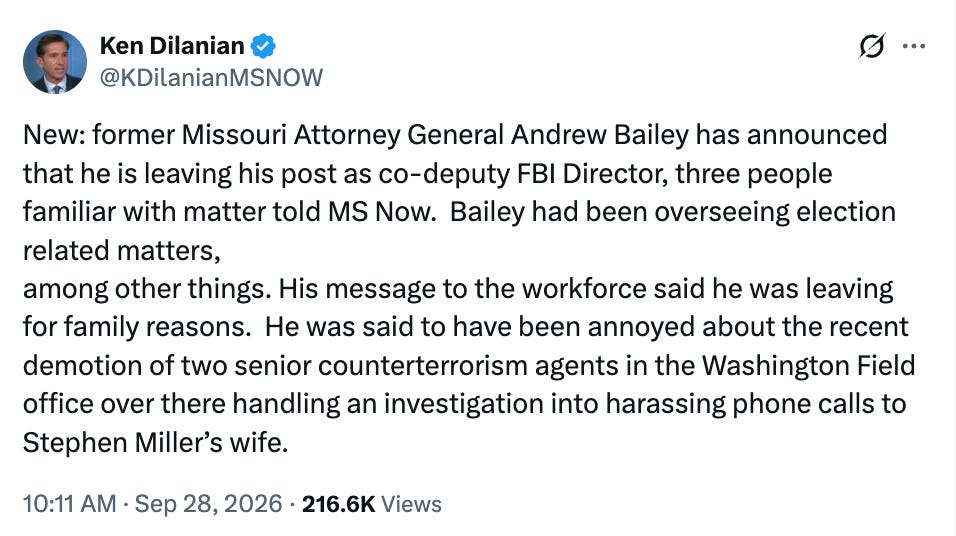
Andrew Bailey, who joined the FBI just a year ago in the unusual “co-deputy director” role, is stepping down, reportedly for family reasons, after previously serving as Missouri’s attorney general before resigning that post to join the bureau. He announced his departure Monday on social media, first reported by MS NOW, thanking Trump, Attorney General Todd Blanche, and FBI Director Kash Patel, and expressing confidence that Patel would continue to “reform the FBI, combat violent crime, defend the homeland” and restore public trust. Bailey had worked alongside then-Deputy Director Dan Bongino, a former Secret Service member and conservative podcaster who also left the post after less than a year to return to podcasting, at which point Bongino was replaced by Chris Raia, a career FBI special agent whose background was more in line with the tradition of filling the bureau’s No. 2 position with an experienced insider. The nontraditional co-deputy structure created for Bongino remained in place even after his exit. The departure adds to a pattern of rapid turnover among senior FBI leadership under this administration, as Patel simultaneously pursues a $250 million lawsuit against The Atlantic over an article about his leadership and faces increasingly heated exchanges with congressional Democrats over how he’s running the bureau.
US stocks fell Monday as bond yields surged to multiyear highs and oil prices swung erratically amid the ongoing Iran war, with the S&P 500 down 0.5%, the Nasdaq down 0.6%, and the 10-year Treasury yield hitting 5.27%, its highest level since mid-2007. Brent crude briefly spiked above $108 a barrel before easing back under $105 after reports that mediators planned separate meetings with US and Iranian officials, plus unconfirmed reports that Trump was open to offering Iran economic concessions to restart talks, though NBC News said it could not confirm those reports. This came days after Trump rejected Iran’s proposal to reopen the Strait of Hormuz, telling reporters the offered deal “would not be acceptable,” even as he said he was open to making some kind of deal. Longtime market analyst Ed Yardeni warned that while rising oil prices haven’t yet knocked the wind out of the global economy, rapidly rising interest rates still might, and cautioned that those higher rates are worsening the outlook for large government deficits worldwide, while analysts at Goldman Sachs said financial conditions have “changed little” since January because higher rates have been largely offset by rising equity prices. Despite the volatility, analysts note the stock market’s roughly 12% gain this year has been driven almost entirely by a few sectors, with tech up 28% and energy up 38%, while most other sectors, including financials, real estate, and consumer staples, have gained less than 10%, raising concerns about how narrow the rally really is heading into a month that closes with major central bank meetings, including at the Federal Reserve.
Congo’s Ebola outbreak has surpassed 8,000 confirmed cases with a death toll approaching 3,901 as of September 26, giving it a fatality rate above 48%, as the country runs critically short of health workers to contain the rare Bundibugyo strain, for which there is no known treatment or vaccine. The outbreak, first announced May 15, now spans 63 health zones across seven of Congo’s 26 provinces, and the WHO said the “continuously high crude case fatality ratio,” especially deaths occurring in communities rather than treatment centers, highlights “the seriousness of the disease and the persistent challenges in timely case detection and access to early and adequate patient care.” Health worker strikes over delayed or missing pay have further hampered the response, and roughly 50 health workers have died since the outbreak began, even as some provinces like Ituri and Haut-Uele show signs of improvement while the virus spreads into new areas. Containment efforts have also been hamstrung by insecurity, displacement, and intense population movements across the affected regions. Data from the Africa CDC shows the outbreak has already outpaced the 2014-2016 West Africa epidemic’s spread at the same point in time, with 7,840 cases by week 19 compared to 3,781 in the earlier outbreak, and WHO warns it’s on track to surpass that regional epidemic, which ultimately killed roughly 11,000 people.
Google Earth Images Reveal Scale of Gaza’s Devastation. New Google Earth satellite imagery shows the staggering scale of destruction across Gaza, with updated before-and-after comparisons of areas like Khan Yunis and Rafah revealing entire neighborhoods reduced to rubble. The images arrive as Israel continues to bar foreign journalists and independent investigators from entering the strip, making satellite data one of the only ways to document the damage. A UN report released last week found that 90 percent of working-age Palestinians are unemployed and that annual GDP per capita has collapsed to just $212, or 58 cents a day. The UN estimates that around 60 million tonnes of debris now cover the territory, work that could take decades to clear, while a CBC News investigation found satellite evidence suggesting Israel has been removing rubble that may contain human remains and evidence of war crimes. Israel denies committing war crimes and has called genocide accusations antisemitic.

Five British men in their early to mid-20s arrested near RAF Fairford, a UK air base used for US strikes on Iran, have been released on bail after “extensive interviews and inquiries,” though counterterrorism officials stress the investigation is far from over and the men remain under strict movement and contact restrictions. The men were detained Sunday after three suspicious vehicles were spotted heading toward the base, prompting the evacuation of dozens of homes and a heavy security presence in the rural Cotswolds; a local farmer described seeing “a large group of hooded and masked men” who scattered when she approached. A grainy photo circulating online showed five shirtless, apparently handcuffed men flanked by armed officers, while a UK fuel delivery company, Fuel2U, said its logo had been used without permission on one of the vans photographed near the scene and that it had no connection to the incident. Iran’s embassy in London “categorically rejected” and called “malicious” any speculation linking Tehran to the arrests, even as counterterrorism chief Laurence Taylor said investigators are examining whether the incident may involve individuals acting as proxies for a foreign state, whether knowingly or not. Trump claimed credit for the operation, telling reporters “we caught them” and calling the joint UK effort “an amazing job,” adding that authorities had the suspects “under view for a long time.” The scare comes after Iran’s Revolutionary Guard warned in July that any base facilitating strikes against Iranian territory would be considered “a legitimate target,” specifically citing bomber flights out of Fairford.
The US and China agreed to cut tariffs on a combined $60 billion of goods, with each country designating $30 billion worth of “non-sensitive” imports for more favorable treatment, unlocking improved market access for roughly 30% of US exports to China, according to US Trade Representative Jamieson Greer. China will lower duties on US agricultural products including corn, wheat, sorghum, meat, dairy, and vegetable oils, notably excluding soybeans, plus seafood, logs, cosmetics, and medical devices, while the US cuts tariffs on Chinese small appliances like coffee makers and toasters, tableware, bedding, toys, and holiday decorations. The deal, struck during last week’s Washington summit between Trump and Xi Jinping, also includes China agreeing to import 10 million metric tons of US coal annually in 2027 and 2028, about 2% of its yearly coal imports, along with a new agriculture working group set to meet before year’s end and a communication channel on AI incidents with a follow-up dialogue planned by late November. Both sides extended their broader trade truce by two months, through January 10, which China’s commerce ministry said would provide a “relatively stable and predictable policy environment” for companies while the two countries keep negotiating. Despite the agreement, Chinese stocks fell sharply Monday, with the benchmark CSI300 index dropping more than 2% to a one-year low amid renewed tensions over a bipartisan US push to ban Chinese components from data centers.
SpaceX successfully launched its massive Starship rocket into orbit for the first time Monday, delivering 26 advanced Starlink satellites, but cut the planned 10-hour, six-lap flight short for safety reasons after one engine shut down prematurely just before reaching orbit. The spacecraft reentered over the Pacific and splashed down north of Hawaii roughly three hours after liftoff from Texas, tipping over and erupting in flames on impact in a dramatic end to the mission, while the first-stage booster separately dropped into the Gulf of Mexico within minutes of launch as planned. NASA Administrator Jared Isaacman praised the mission for reaching orbit “in a safe, responsible and especially inspirational way,” calling it a key milestone toward certifying Starship for NASA’s Artemis moon program, where it’s set to compete with and later alternate against Jeff Bezos’s Blue Moon lander across upcoming Artemis III and IV missions. Musk has said the company is being deliberately cautious about flying Starship back to its Starbase launch site, warning that debris raining onto populated areas would make the company’s “popularity diminish very rapidly,” with the next test potentially attempting the first “catch” landing by year’s end or early next year if this flight’s data checks out. SpaceX is also racing to certify Starship for repeated use, having modified this rocket’s heat shield based on inspections of an earlier Starship recovered from the Indian Ocean in July, as it works toward opening new launch sites in Florida and Louisiana.
Hurricane Polo bore down on Mexico’s Baja California Sur as a Category 3 storm with 115 mph winds Monday, threatening life-threatening flooding and mudslides as residents boarded up homes and workers hauled dirt and rubble to reinforce flood barriers. Mexico’s Civil Protection coordinator, Laura Velázquez, urged residents to stay off the streets and seek shelter, announcing that travel would be suspended and regional ports closed as the storm was expected to make landfall on the mainland late Monday night or early Tuesday. In the fishing town of Puerto San Carlos, residents like Rocío Sánchez feared the earthen barriers built to prevent flooding could give way under the tides and wind, prompting some families to evacuate roughly 37 miles to shelters in Ciudad Constitucion, while the Mexican navy staged personnel, aid, and vessels in Guaymas and Mazatlán to reach communities that could be cut off. Meanwhile Hurricane Nolo, still a powerful system with winds near 155 mph, moved away from Hawaii but continued threatening the Big Island with up to 20 inches of rain as residents there remain rattled from Hurricane Lala, which swept roughly 100 homes off their foundations last month without even making landfall. Tropical Storm Rachel also formed off Mexico’s southwest coast the same weekend, though it posed no immediate coastal threat, capping an unusually active Pacific hurricane season that forecasters link to this year’s El Niño pattern.
A New York Times engineering executive, Jonathan McKinsey, was fatally shot in the parking lot of a Dublin, California park on Saturday afternoon, with police arresting his 77-year-old in-laws as suspects after a flood of witness calls. McKinsey, 40, who led engineering and games player experiences for the Times since 2023, was found lying on the ground at the Dublin Sports Grounds with multiple gunshot wounds around 3 p.m. and was pronounced dead at the scene. Police identified the suspects as Shouyong Zhang and Shili Chen, a married couple who, like McKinsey, lived in Dublin, and both are now being held at Santa Rita jail pending charges. McKinsey held a bachelor’s degree from Georgia Institute of Technology and a master’s in computer science from UC Berkeley. Police have not released a motive for the shooting, and the investigation remains ongoing.
A 29-year-old Massachusetts man, Jordende Pierre, is facing sex trafficking, kidnapping, and assault charges after allegedly holding a woman captive for six weeks in the unfinished attic of a Malden home, where she was found naked and malnourished on a mat with a bucket of urine nearby. Prosecutors say Pierre met the woman, who struggled with substance abuse, through a dating app, brought her to the property, gave her drugs, sexually assaulted her, and arranged for other men to have paid sexual encounters with her at the home, all while removing the attic door handle to prevent her escape. The property’s landlord, Qing Sun, discovered the woman by chance Sunday while investigating a water leak, immediately called 911, and said she had no idea anyone was living in the attic since Pierre was not one of her tenants. Pierre wasn’t arrested until Thursday, in an operation involving Malden police, the FBI, and US Marshals, and neighbors described the home as having a “rotating cast of characters,” frequent late-night parties, and past police visits, with one neighbor saying she felt sick knowing the woman had been held just 500 feet away without anyone realizing it. Pierre also has an open assault and battery case in Somerville and was out on bail at the time of the alleged kidnapping; he’s now being held until his next hearing on October 6, and police have not ruled out additional arrests.
See you soon.
— Aaron


