

Hey everyone, what a week. Between a diesel deal with Putin, sanctions on the International Criminal Court, and a plan to livestream an execution, it feels like we packed a month of news into five days. And it’s not slowing down anytime soon. The midterms are now less than four weeks away, and from here until November 3, this is going to be a full sprint. I’ll be here every step of the way, cutting through the noise and making sure you know what’s actually happening and why it matters.
I also want to acknowledge something. I hear from a lot of you about how heavy all of this feels. People tell me the news is making them more and more depressed, that they can’t take any more horrific headlines, that it has consumed them and taken away their sense of joy. One reader simply wrote, “Forgive me. Too emotional.”
If you’ve felt that way, there is nothing to forgive. What you’re feeling is a completely human response to an exhausting moment. Staying informed matters, but so does protecting your peace. It’s okay to step back, take a breath, and come back when you’re ready. And remember that every Sunday I share a good news update, because there are people out there doing incredible work, and you deserve to hear about that too.
Before we dive in, I want to say thank you. Seriously. Everything I do here is possible because of you: the people who read, share, comment, and support this work. I don’t have a corporate owner or a billionaire backer, just a community of readers who believe independent journalism is worth fighting for. That means the world to me.
If you’ve been reading for a while and haven’t subscribed yet, now is the perfect time. A paid subscription directly funds the reporting, the late nights, and everything it takes to cover the stretch run of this election. And if you’re already a subscriber, sharing this newsletter with a friend is one of the best ways to help it grow.
Now, let’s get into today’s news.
Trump Faces New Calls for Impeachment After Striking Diesel Supply Deal with Putin
Trump announced that Putin has agreed to release millions of tons of Russian diesel onto the global market. Trump said on Truth Social that the deal came out of a phone call with Putin and that Russia would begin supplying fuel “immediately.” Under the plan, Russia would deliver more than 300,000 tons right away, 500,000 tons in November, and 1 million tons after that, with another 3 million tons depending on the condition of Russia’s refineries. To make it happen, the Treasury Department issued a temporary license lifting sanctions on Russian diesel through April 7, 2027, including imports into the United States. Putin confirmed Russia’s “readiness” to supply the U.S. and global markets but offered no details on timing or volume.
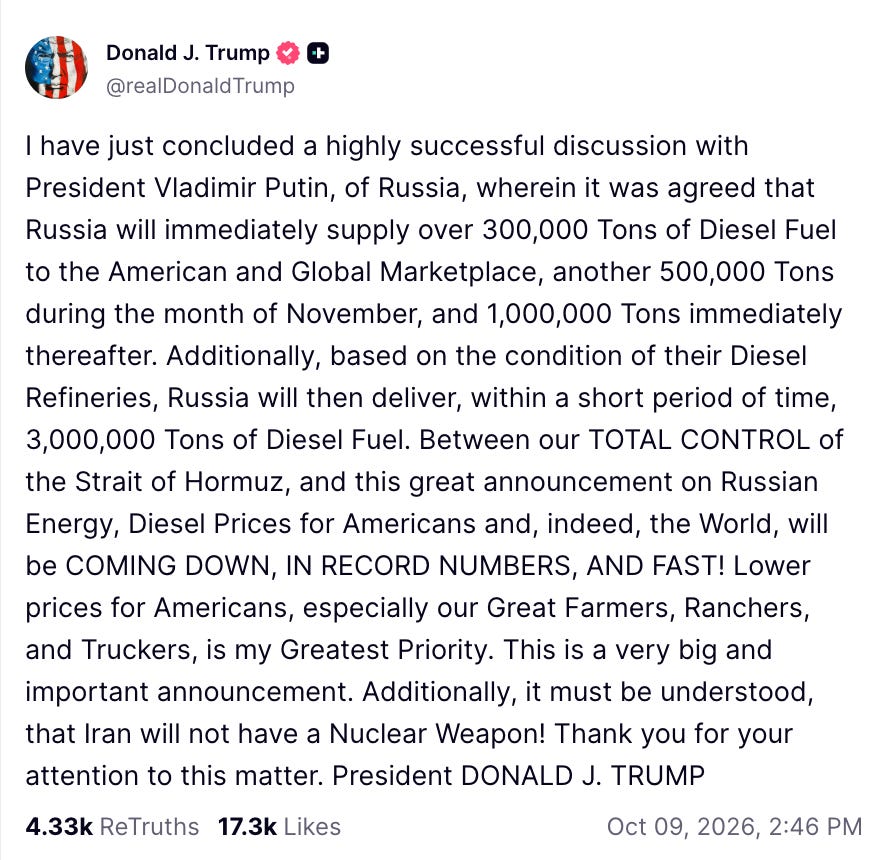
The deal looks like a publicity stunt, because Russia has no diesel to spare. Russia is in the middle of a massive diesel shortage of its own, driven by sustained Ukrainian strikes on its refineries. That shortage is exactly why the Kremlin banned diesel exports in July and extended the ban through the end of October. A country rationing its own fuel has no real surplus to ship abroad, which makes this less a supply deal than a conniving bid to cast Russia as America’s helper. The likely outcome is that Russia sends a few hundred thousand tons, if that, and pockets a sanctions waiver and a public relations win in return.
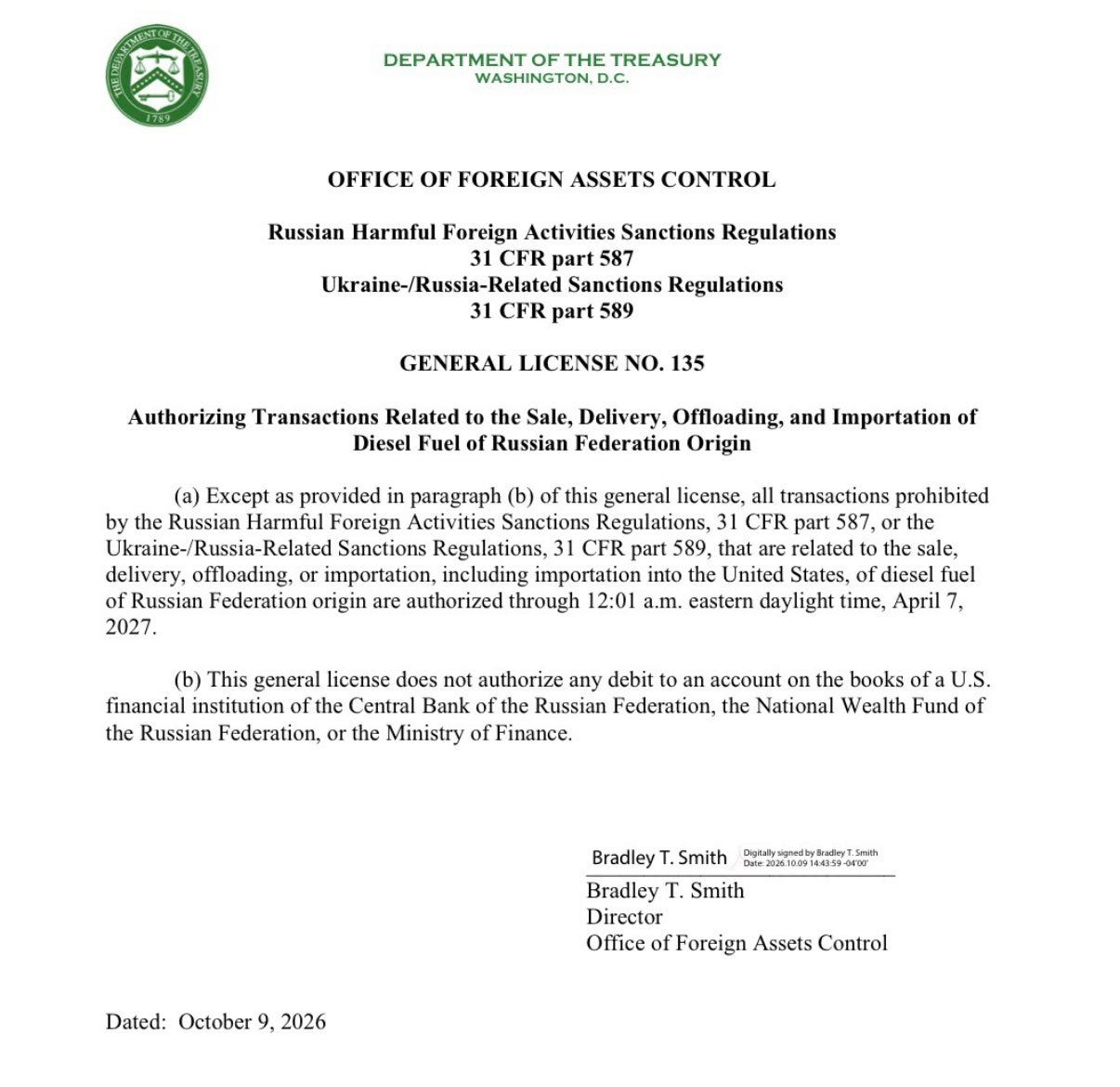
Even if Russia delivers, the amount is a rounding error against U.S. demand. The United States consumes roughly 15 million tons of diesel per month. The initial 300,000-ton shipment equals about 2% of a single month of American consumption, and that shipment is meant for the entire global market, not just the U.S. Even the full 4 million tons, spread out over many months and contingent on Russia’s battered refineries, would cover only about a week of U.S. demand. Markets seem to agree: diesel futures dipped 4% Friday but remain more than 110% higher than at the start of the year, and Brent crude barely moved at around $104 a barrel.
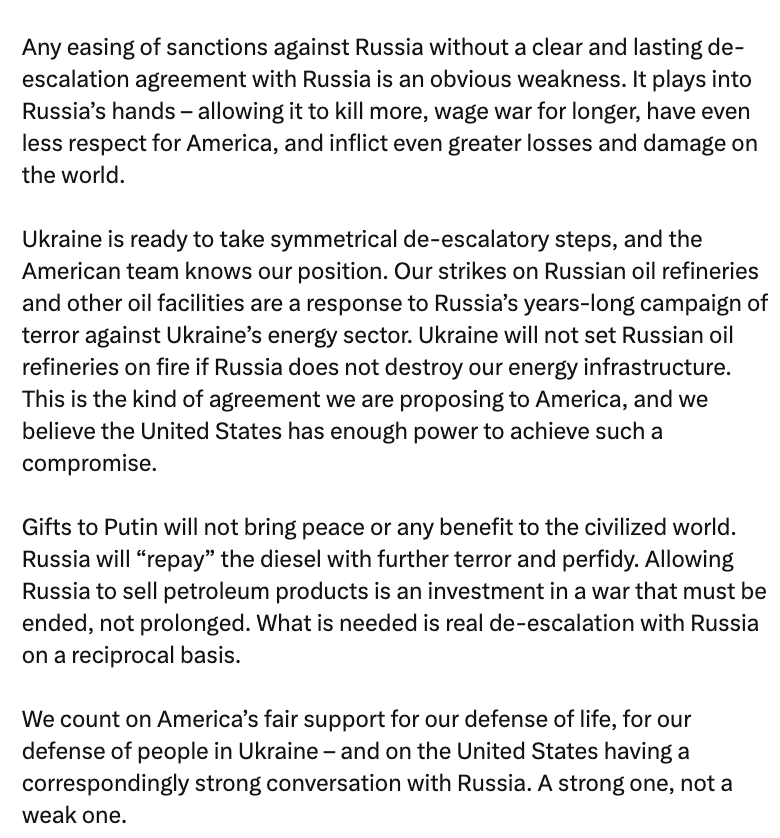
Zelenskyy blasted the move as a gift to Putin as Trump scrambles for relief before the midterms. Zelenskyy called the sanctions relief “an obvious weakness” and warned that Russia would “repay” the diesel with more terror, arguing it funds a war that should be ending. The announcement came hours after he hosted U.S. senators in Kyiv and just as Ukrainian negotiators left for peace talks in the U.S., which may now be in doubt. Diesel prices have climbed nearly 70% since the Iran war began in February, and Republicans face tough races in places like Iowa, where farmers are feeling the squeeze. Trump has tried this before: a series of 30-day sanctions waivers on Russian oil this spring expired without slowing prices.
Trump Launches Sanctions on ICC After Losing Nobel Peace Prize to Former ICC Judge
Trump sanctioned the International Criminal Court just hours after a former ICC judge won the Nobel Peace Prize he has spent years coveting. On Friday morning, the Norwegian Nobel Committee awarded the 2026 prize to South African jurist Navi Pillay, the former UN human rights chief who sat on the ICC’s Appeals Chamber from 2003 to 2008. Trump has made no secret of wanting the prize for himself. By that afternoon, Secretary of State Marco Rubio was announcing sweeping sanctions on the very court where Pillay once served, calling it a “rogue court.” The timing makes the move look less like policy and more like a president lashing out after being snubbed.
The Nobel Committee’s choice was a direct rebuke of attacks on international courts like the ones Trump has waged. The committee said Pillay’s award was meant as a show of support for tribunals at a time when judges and institutions of international law are under political attack. Trump’s administration has been the leading force behind those attacks, having already sanctioned 17 ICC judges and officials. Losing the prize to someone honored specifically for defending international justice put Trump on the wrong side of the Nobel Committee’s message. Within hours, he escalated from targeting individuals to targeting the court as a whole.
The sanctions are designed to bankrupt the court and could set accused war criminals free. The measures cut the ICC off from American banks, technology companies, and even the U.S. dollar, with a six-month window for U.S. businesses to wind down their dealings. Rubio warned that “either the ICC will end its threats, or we will end the ICC.” NYU law professor Ryan Goodman said that if the court can’t afford fair trials, detainees may have to be released as a matter of law. That includes former Philippine President Rodrigo Duterte, accused of thousands of extrajudicial killings, along with figures accused of war crimes in Libya, Sudan, and the Central African Republic.
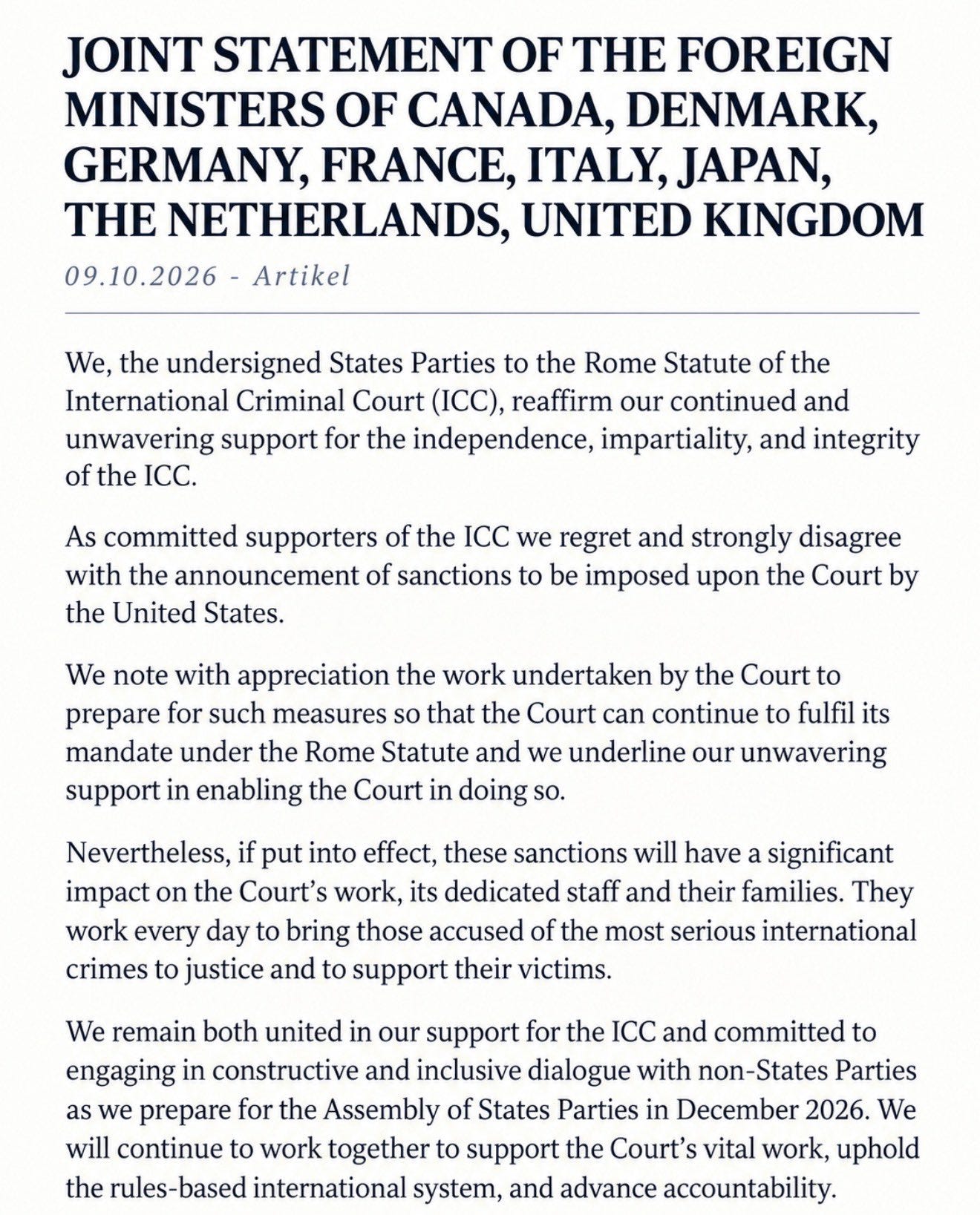
America’s closest allies and the UN rushed to defend the court against Trump. Germany, France, the UK, Italy, Canada, Japan, the Netherlands, and Denmark issued a joint statement saying they “strongly disagree” with the sanctions and will keep supporting the court. UN Secretary-General António Guterres called the move a serious blow to international criminal justice, and the EU signaled it could invoke a “blocking statute” to stop European companies from complying. The ICC called the sanctions an assault on the rule of law and declared that “history will judge this moment.” Among world leaders, Benjamin Netanyahu, who faces an ICC arrest warrant, stood out for welcoming the move.
Pentagon’s Plan to Livestream Fort Hood Shooter’s Firing Squad Execution Sparks Bipartisan and Religious Backlash
Pete Hegseth announced that the military will livestream the firing squad execution of Fort Hood shooter Nidal Hasan. Hasan, a former Army psychiatrist, was convicted of killing 13 people and wounding 32 in the 2009 mass shooting at Fort Hood, Texas. Trump approved the execution, which is scheduled for December 3 at Fort Hood, and Hegseth said the government will “make sure that people are able to watch it.” It would be the first known livestream of a lawful execution in U.S. history and the first military firing squad execution since 1945. Hegseth even reposted a 2013 Trump post calling for public executions “for all to see.” Donald Trump today confirmed he personally approved the execution:
Religious leaders across faiths condemned the plan as barbaric and a public spectacle of death. Archbishop Paul Coakley, president of the U.S. Conference of Catholic Bishops, called it “a barbaric promotion of a culture of death” that must be reconsidered. The heads of the National Association of Evangelicals, the Episcopal Church, and the Union for Reform Judaism all denounced the livestream as well. Evangelical activist Shane Claiborne compared it to lynchings and other times America has made a spectacle of death. A few Trump-aligned pastors backed the idea, including Robert Jeffress and Doug Wilson, the Christian nationalist who leads Hegseth’s own church.
Even Republicans and JD Vance are distancing themselves from the livestream. Vance said he doesn’t know if the livestream will actually happen and that if it does, “I’m not going to be watching it.” Republican Sen. John Curtis warned that a civilization erodes when it treats executions as entertainment, while Rep. Austin Scott said livestreaming executions “is what jihadists do.” Former National Counterterrorism Center head Joe Kent warned it would hand terrorists free propaganda to radicalize and recruit. A senior White House official said Trump “doesn’t oppose the idea” but hasn’t made a final decision and is hearing concerns from lawmakers, allies, and religious leaders.
The plan raises serious legal and human rights questions as the death penalty debate heats up before the midterms. Federal law bans recording or broadcasting executions in the federal prison system, but military regulations don’t carry the same prohibition. The UN human rights office said public executions amount to cruel, inhuman, or degrading treatment. If it goes forward, the U.S. would join countries like Iran and Saudi Arabia in carrying out public executions. The controversy comes just a week after a botched lethal injection in Tennessee and less than a month before the November 3 midterm elections.
Other news:
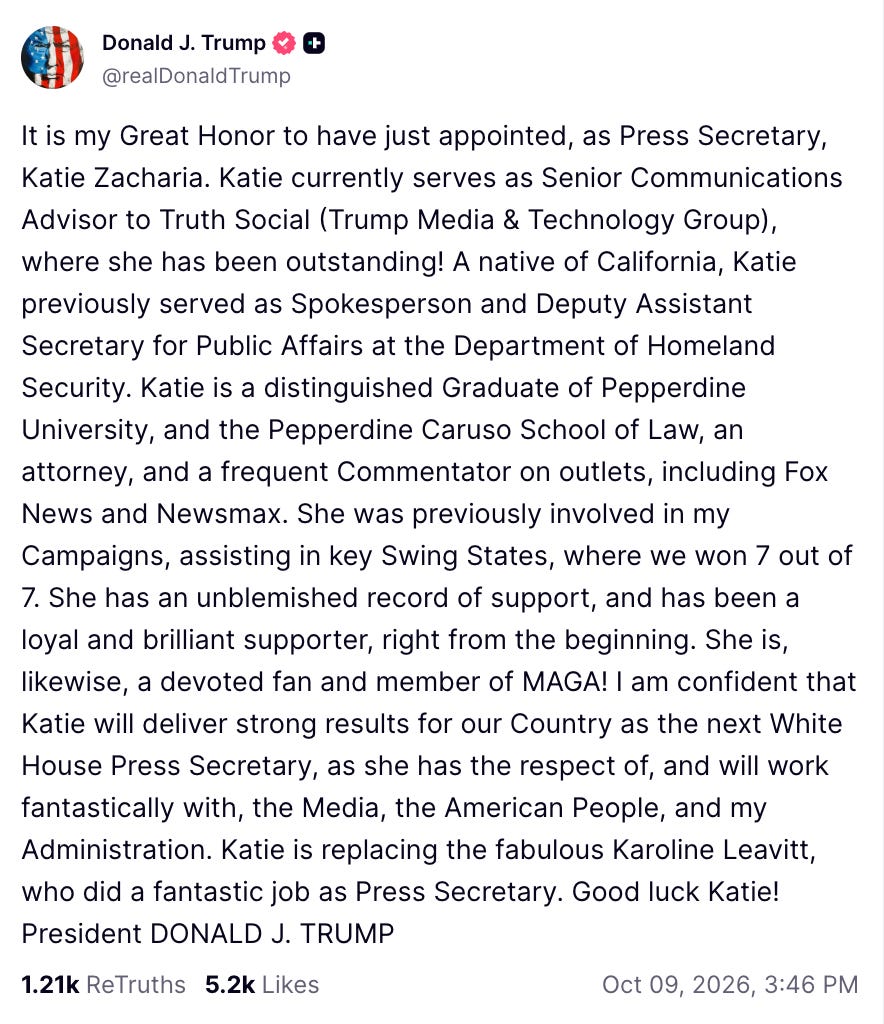
Trump picked conservative commentator Katie Zacharia to be the next White House press secretary. Zacharia, currently a senior communications adviser at Trump Media & Technology Group, will replace Karoline Leavitt, who left in late August and was just hired by Fox News as a contributor. She briefly worked in communications at the Department of Homeland Security earlier this year and regularly defends the administration on Fox News, Fox Business, Newsmax, and X. The pick comes as Trump complains that his accomplishments are being overshadowed by poor public relations ahead of the midterms, admitting at a recent event that his team is doing “an extremely poor job of promotion.” Zacharia lives in California, has four children, and earned her law degree from Pepperdine.
A second accused former fraternity member in the Cornell sexual assault case is trying to remove New York AG Letitia James from the investigation. Lawyers for Winston Lee, from the firm that represented Sean Combs and Harvey Weinstein, filed a motion asking a judge to bar James from any grand jury proceedings after Gov. Kathy Hochul appointed her special prosecutor. They argue James prejudged the case when she posted support for the accuser, known as Jane Doe, before her appointment. Another defendant, Gillio Lopes, filed a similar motion earlier this week, and a hearing in his case is set for October 29. Jane Doe’s civil suit accuses seven former Chi Phi members of sexual assault, which the men deny, and none have been criminally charged. The local district attorney previously declined to bring charges, finding in 2024 that Jane Doe’s statement to police did not describe a prosecutable crime.
The State Department’s watchdog is investigating Ambassador Kimberly Guilfoyle after a Trump donor accused her of demanding $100,000. Longtime Trump donor Eric Deters says Guilfoyle asked him to pay her $100,000 American Express bill before her 2025 confirmation hearing in exchange for access to top Trump officials, calling it a “quid pro quo.” Messages he provided appear to show Guilfoyle telling him to wire the money directly to American Express because “it won’t show up anywhere” that way. Guilfoyle’s attorney disputes the authenticity of the messages, and Deters says he never paid. JD Vance called the claims “one person’s story,” while Rubio scolded a reporter for asking about it while standing next to Guilfoyle in Athens. A senior diplomatic official said the probe set off alarm bells across the State Department, since the watchdog rarely investigates ambassadors.
Elon Musk’s plan to turn SpaceX into a major U.S. mobile carrier wiped more than $50 billion off AT&T, Verizon, and T-Mobile. T-Mobile plunged 13.3%, AT&T fell 9.8%, and Verizon dropped 8.7%, its worst day since 2002. SpaceX said Starlink Mobile will combine satellites with ground infrastructure once it gets final FCC approval, and the FCC has already approved 15,000 new satellites. FCC Chair Brendan Carr praised the plan, while Musk’s America PAC has spent more than $36 million boosting Republicans in the midterms. Analysts at JPMorgan and UBS were skeptical, noting that building a competitive ground network will take years and huge investment. Musk, the world’s first trillionaire, received an award from Trump just this week and is a frequent guest at the White House.
Trump launched a new committee to investigate Fed Governor Lisa Cook, despite the Supreme Court ruling her firing unconstitutional. The committee will consult with Justice Department officials to determine whether there is “cause” to remove her over mortgage fraud allegations. The White House will hold a closed-door hearing on November 5, with a transcript to be published afterward. Cook’s lawyers said they have “grave doubts” the hearing will be legitimate and maintain the allegations stem from clerical errors. The Supreme Court ruled in June that Trump’s 2025 firing of Cook was unconstitutional because he denied her a chance to respond to the allegations first. Cook, appointed by Biden in 2022 as the Fed’s first Black governor, was fired amid Trump’s broader pressure campaign on the central bank to lower interest rates.
Ron DeSantis withdrew a death warrant for the first time as governor, calling off a Florida execution. William Lee Thompson, 74, was set to be executed Tuesday for a 1976 murder, and his lawyers say he suffers from dementia so severe he believed “Bush” was president. DeSantis gave no reason, and the results of Thompson’s psychiatric evaluation were never released. The move comes just over a week after Christa Pike survived two botched lethal injections in Tennessee, and as the Pentagon plans to livestream a firing squad execution. Florida carried out a record 19 executions last year, and a second execution scheduled for Tuesday is still set to proceed. Thompson remains on death row, and DeSantis could sign a new death warrant for him in the future.
A federal judge ruled the Trump DOJ’s policy of collecting state voter rolls to check against immigration data is unlawful. Judge Sparkle Sooknanan said the policy violated privacy laws, exceeded the department’s authority, and had already wrongly removed U.S. citizens from voter rolls. She wrote that the policy amounts to the federal government’s attempt to decide who gets to vote, a power Congress left with the states. Roughly 18 states had handed over sensitive data including names, birth dates, addresses, and partial Social Security numbers. The ruling, in a suit brought by Common Cause, is a major setback for Trump’s push on non-citizen voting ahead of the midterms. Sooknanan also found the DOJ ignored the risk that its unreliable citizenship records would lead to eligible Americans being purged.
DHS officials defended ICE officers who shot a Dominican immigrant in New York City while his 5-year-old son sat in the back seat. DHS Secretary Markwayne Mullin blamed Oscar Bergal, saying ICE didn’t know the child was there but “Oscar knew.” ICE says Bergal rammed their vehicles and drove toward officers, while his attorneys argue officers lacked a valid warrant and say he still has a bullet in his body. Mayor Zohran Mamdani said there is “no explanation” for firing that many rounds into a car with a child inside, and protests have led to arrests. The same day in New Jersey, video showed two children screaming and collapsing on a sidewalk as ICE detained a man in front of them. Asked what would happen to those children, Mullin said the parents would be given the option to bring them into detention.
A 7.7-magnitude earthquake struck Panama, triggering tsunami warnings across Latin America. The quake hit near Panama’s southern tip, followed by multiple strong aftershocks, and was felt in Panama City, where residents evacuated skyscrapers. Tsunami warnings were issued for nine countries, including Mexico, Colombia, Ecuador, Peru, and Costa Rica. Damage was concentrated in central provinces, with video showing a cathedral collapsing in Penonomé and a hotel reduced to rubble in Playa Venao. Several injuries were reported, but no deaths were immediately confirmed. The U.S. Embassy said it is monitoring the situation and checking on Americans in Panama, a popular retirement destination.
Hurricane Isaias strengthened into a major Category 3 storm and is barreling toward the Gulf Coast. With sustained winds of 120 mph, Isaias is expected to make landfall late tonight or early Saturday between Alabama and the Florida Panhandle. Forecasters warn of life-threatening storm surge, with damaging winds reaching far inland into Alabama, Georgia, and Tennessee. DeSantis urged Panhandle residents to evacuate now and told them to “assume power is going to go out,” as 5,000 Florida Guardsmen stand ready. Isaias is the first hurricane of the 2026 Atlantic season, and Trump canceled his trip to Saturday’s Alabama-Georgia football game because of the storm. Florida has activated its price gouging hotline, with violators facing fines of up to $25,000.
See you soon.
— Aaron


