

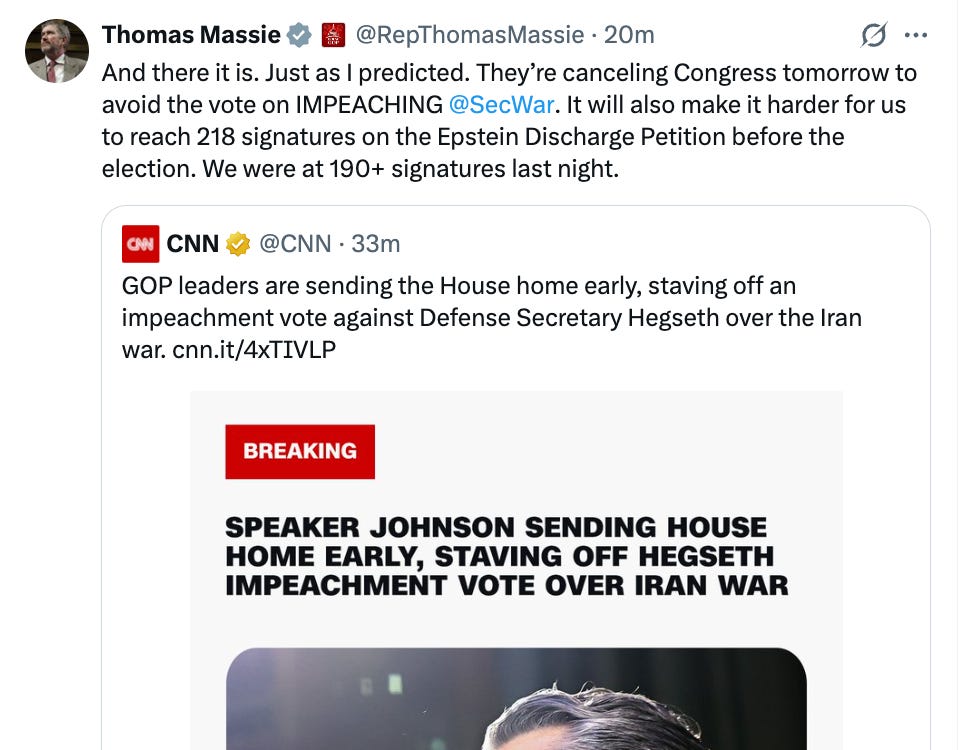
House Republicans spent this week doing everything they could to avoid a fight they’re clearly terrified of losing. Rather than let a privileged impeachment resolution against Pete Hegseth come to a vote, GOP leadership canceled tomorrow’s session entirely and sent members home to campaign until after the midterms, a move that lines up neatly with a new poll showing Trump’s approval underwater on every major issue and a majority of voters now wanting someone to check him rather than back him.
Meanwhile the Iran war keeps generating grim numbers of its own, from a U.S. official’s warning of a looming military “breakdown” to reporting that Russian satellites may have helped Iran target American bases. Add a hacked Flock camera that reveals exactly how much these surveillance systems actually track, a Trump-Beatty shouting match over the Kennedy Center, and a Fed rate hike delivered squarely against the White House’s wishes, and you’ve got a week that makes the case for itself.
That independence is paid for by readers who become paid subscribers. If this newsletter has been valuable to you, if you think this story deserves someone tracking every filing, every email, every contradiction, this is the moment to back that work.
Here’s everything you need to know.
New video from the Senate today shows Mitch McConnell struggling to vote:
Mike Johnson Sends House Home Until After Election Fearing Impeachment:
Republicans are terrified, and it showed this week when House leaders punted the Hegseth impeachment vote until after the midterms rather than force vulnerable members to take a stance. GOP leadership canceled Thursday’s votes and sent the House home until November 9th, effectively delaying Rep. Thomas Massie’s privileged impeachment resolution against Defense Secretary Pete Hegseth even though it legally required action within two legislative days. Leaders insisted the schedule change had nothing to do with Massie, but Speaker Mike Johnson dismissed the effort as “a publicity stunt” that will “immediately be tabled,” while simultaneously avoiding the vote entirely before Election Day. Johnson instead urged members to go home and campaign on the party’s record, touting tax cuts and a “126-year low” violent crime rate rather than defend Hegseth’s handling of the Iran war on the record.
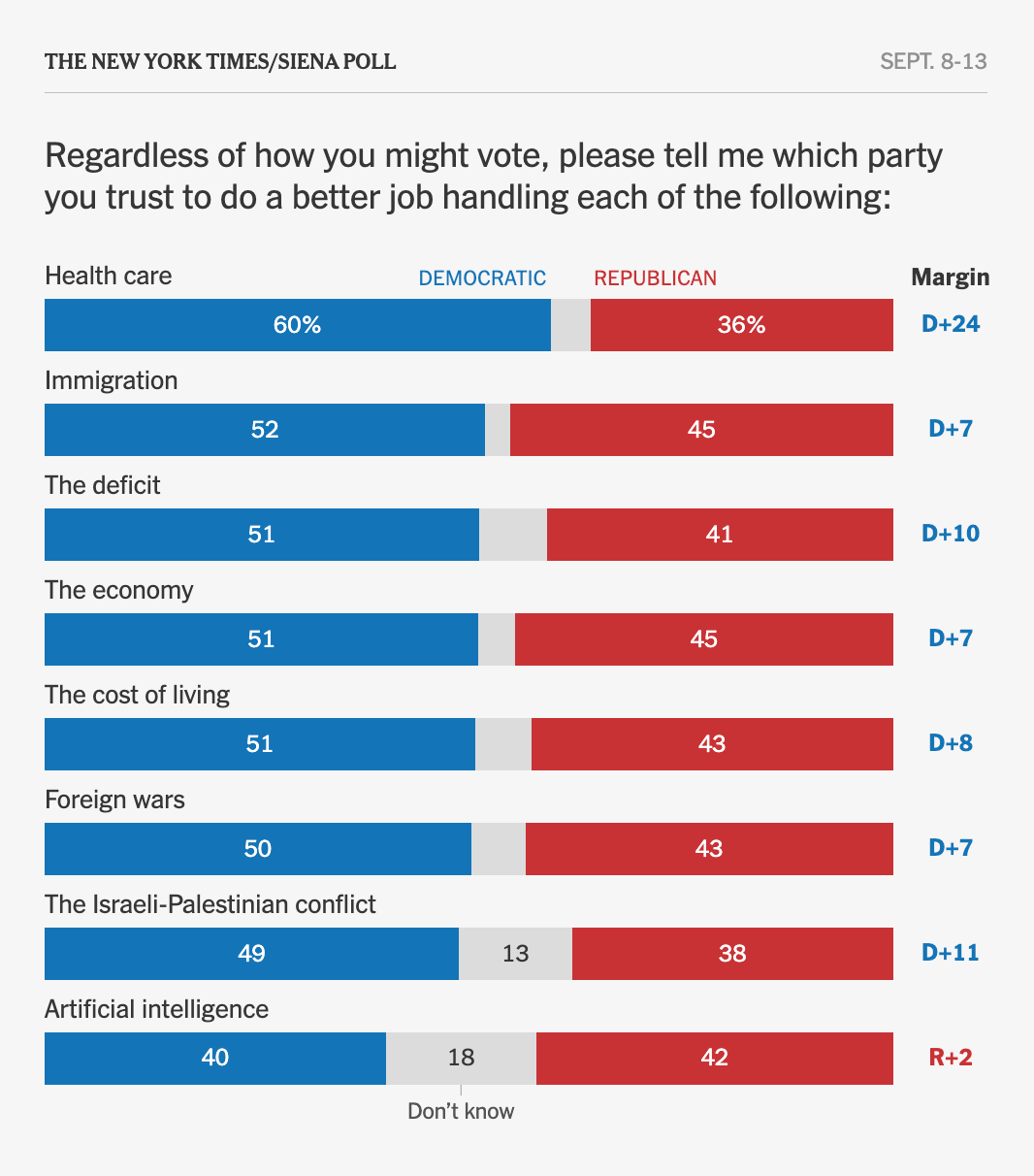
That fear is backed up by hard numbers: a new New York Times/Siena poll finds Democrats with a nearly 9-point edge heading into the midterms as Trump’s approval craters to 38 percent. A majority of voters disapprove of Trump’s handling of every major issue polled, including the economy, immigration, tariffs and especially the cost of living, where disapproval hit 71 percent, a 13-point jump since January. Voters trust Democrats more than Republicans on nearly everything, including issues that powered Trump’s 2024 win, with a 7-point edge on the economy and immigration alike, and even 29 percent of Republicans now say the economy is better than a year ago, down from 72 percent in January. The erosion is sharpest among young voters, at just 18 percent approval, and lower-wage earners, who favor Democrats 63 to 31 percent, a group Trump narrowly won in 2024.
The poll also found something more dangerous for the GOP than any single issue: voters increasingly want someone to check Trump, not support him. Forty nine percent of all voters said they’d rather back a candidate who provides a check on Trump, compared to just 26 percent who want one who supports him, and for the first time in his second term a majority, 52 percent, said they “strongly” disapprove of him. The war in Iran is compounding the damage, with more than three-quarters of independents and nearly a quarter of Trump’s own 2024 voters disapproving of his handling of it as gas prices climb above $4 a gallon. Voters also see Republicans as more extreme and more corrupt than Democrats, even as Democrats carry their own baggage, with half of voters calling the party too far left. Still, independent voters like 21-year-old Elizabeth Gloden, who backed Trump in 2024, are now switching sides, saying simply, “I’m not really seeing the change I wanted to see.”
JD Vance’s closing pitch to voters ahead of the midterms is simply asking them for patience: “Give us another chance. Give us another couple of years.”
Iran War:
A U.S. official told The Intercept the Iran war could eventually cause a “breakdown” in the military’s ability to sustain the fight, citing damaged bases and warships, depleted defensive munitions, casualties, maintenance problems and increasingly difficult logistics. With regional facilities disrupted, Navy ships now have to move supplies more than 2,000 miles from Diego Garcia, producing sea transits and logistics cycles of 14 to 18 days that one official called “difficult and ultimately unsustainable.” A second official cited a “complete lack of planning” for the conflict. A Pentagon inspector general report separately put the war’s cost at $33.4 billion through June 30, including $22.3 billion in munitions, and found Iranian attacks damaged or destroyed hundreds of structures across U.S. installations in eight countries. CNN has separately estimated the U.S. has burned through nearly 80% of its prewar THAAD interceptor stock and roughly half its Patriot supply, though Hegseth disputes those figures.
The House voted 220-204 for the third time to try to limit Trump’s war powers on Iran, with seven Republicans defecting, while the White House closed ranks around Hegseth after Rep. Thomas Massie filed impeachment articles against him. Attorney General Todd Blanche told reporters Hegseth is “doing a phenomenal job” and disputed even calling the conflict a “war,” arguing Congress already found no wrongdoing by Trump or Hegseth. House Speaker Mike Johnson separately declared the Iran nuclear issue “taken care of” and pivoted to blaming Democrats and Biden for gas prices, which have climbed to $4.37 a gallon, about 30 cents higher than a month ago. The Congressional Budget Office estimated the war has cost around $38 billion since February and could run $2-3 billion more per month for as long as it continues, driven mostly by munitions replacement.
Saudi Arabia accused Iran-backed Houthi rebels of attempting to target Mecca with a drone, a claim the Houthis dismissed as a “worn-out lie,” even as the Guardian reported U.S. officials met Houthi leaders in Oman over the weekend and decided not to help Saudi Arabia repel the group’s advance in Yemen. The Houthis reportedly assured Washington they have no intention of attacking U.S. or international shipping in the Red Sea, and will only target Saudi-linked vessels over Riyadh’s blockade of Yemen, leading Trump to condemn the Houthi advance rhetorically while declining military support for Saudi Arabia. The Houthis claimed in return that they shot down a Saudi F-15 fighter jet and struck an Aramco facility in Yanbu, though no supporting evidence was provided. A former deputy U.S. ambassador to Yemen said a “tacit understanding” now exists between Washington and the Houthis, leaving Saudi Arabia pushing for either a diplomatic deal or a regional coalition with Pakistan, Turkey and others to push the Houthis back.
CNN reported that Russian spy satellites may have helped Iran target U.S. bases during its attacks, including the March strike on Prince Sultan Air Base in Saudi Arabia that injured 12 U.S. soldiers and destroyed a Boeing E-3 Sentry surveillance aircraft. Tracking data reportedly showed the satellites, which include imaging, radio-signal detection and radar capabilities, passing over targeted U.S. sites just before Iranian strikes hit them, with analysts saying the precision would have been implausible without that intelligence. Saudi security expert Dr. Nawaf Obaid called it “Russian payback” for U.S. support of Ukraine’s strikes on Russian targets, saying it has reshaped “the security architecture of the region going forward.” The reporting adds a new dimension to a war that has already pushed oil prices above $100 a barrel and kept the Strait of Hormuz and a key Saudi east-west pipeline disrupted for months.
Flock Cameras Hacked:
A hacker collective called stegan0gram physically tore down a Flock Safety license plate camera and copied its stored data, sharing the files with 404 Media and WIRED to expose how the surveillance system actually works. The hackers recovered an encryption key from an unencrypted “media” partition on the device’s Android OS, unlocking videos and stills that Flock had described as protected by on-device encryption. Analysis of the recovered logs showed the camera photographed roughly 50,200 vehicles and generated about 1.6 million images over 21 days of activity, averaging around 3,300 vehicles a day and peaking at 4,454. One hacker explained the motive bluntly: “Why just destroy them when we can reverse engineer them and find the secrets of those spying on us?” The breach follows a wave of vandalism and arrests targeting Flock cameras nationwide, with some towns dropping the cameras entirely and one police department building a 3D-printed decoy camera to bait vandals.

The analysis revealed the cameras explicitly detect people, not just vehicles, plates, and bicycles, a capability WIRED says is typically overlooked in public debate about the technology. When reporters extracted the camera’s own detection models and ran them against its recovered footage, the software readily identified people, including a reporter’s selfie and, across more than 27,000 short video clips, 11 clips of motorcyclists. The plate-reading software also proved sloppy in practice, mistaking bumper stickers, dealership frames, and in one case an American flag patch on a motorcycle saddlebag for license plates. Flock insists its cameras don’t perform facial recognition, and investigators found no evidence of active face-recognition beyond Android’s unused default capabilities. The findings build on prior WIRED and 404 Media reporting showing Flock’s national network lets more than 2,000 agencies, including ICE, search local camera data, in some cases bypassing state bans on sharing it.
Flock called the removal and tampering illegal, while a security researcher and a former police officer offered competing takes on the vigilante approach. A Flock spokesperson said the company received no vulnerability report through its official disclosure process and couldn’t assess the hackers’ claims with the “limited information” provided, urging them to report findings properly instead. Former Pawtucket, Rhode Island officer and Flock critic Noel Pichardo said he understood the hackers’ frustration but warned that “vigilantism will only crystallize the police and the state at large in their belief that this tool is necessary.” The recovered logs also captured mundane technical chaos inside the device, including more than 27,000 “no space left on device” storage errors and a recurring health-check log message reading “Who’s a good boy?!” that appeared over 12,000 times. One hacker acknowledged the legal risk, saying, “Being investigated is a legit concern and something we are trying to avoid... we are careful and try to keep a low profile.”
Other News:
Rep. Joyce Beatty said Trump threw a “tantrum” and called her “dumb” and “incompetent” during a virtual Kennedy Center board meeting Tuesday, immediately after a federal judge blocked his name from being added to the building for a second time. Beatty, an ex-officio board member who brought the lawsuit behind the ruling, called it “the most unprofessional thing that I’ve ever witnessed,” saying Trump accused her of being an obstructionist before she fired back, “I know you’re incompetent.” She said Trump also invoked safety concerns, warning he’d hold her responsible if something fell from the ceiling and killed someone, to which she replied that people were already dying from the wars and starvation his policies were causing. The board, which Trump hand-picked, voted the same day to close the center indefinitely, citing financial strain and safety issues, a move Beatty and other critics call holding the center hostage until it bears Trump’s name. A White House spokesman countered that Trump “stepped up to save” a center that had “rotted” under Democratic oversight for decades.
Fed Raises Rates for First Time in Three Years Despite Trump Pressure. The Federal Reserve raised interest rates by a quarter point on Wednesday, the first such hike in three years, after Chairman Kevin Warsh acted despite discouraging inflation and consumer price data. The move came just four months after Trump appointed Warsh and directly against the White House’s wishes, with Trump having recently threatened to curtail trade with U.S. partners unless the Fed cut rates instead. A Duke University survey found near-unanimous agreement among former Fed officials that a hike was necessary, but Warsh faced a genuine bind: holding rates steady risked rattling bond markets and investor confidence, while raising them seven weeks before the midterms risked political backlash from Trump. National Economic Council Director Kevin Hassett had signaled the administration’s preference days earlier, arguing an “independent Fed” should “stay out of the way of elections.” How Trump responds remains unclear, though further trade restrictions in retaliation would risk pushing consumer prices even higher.

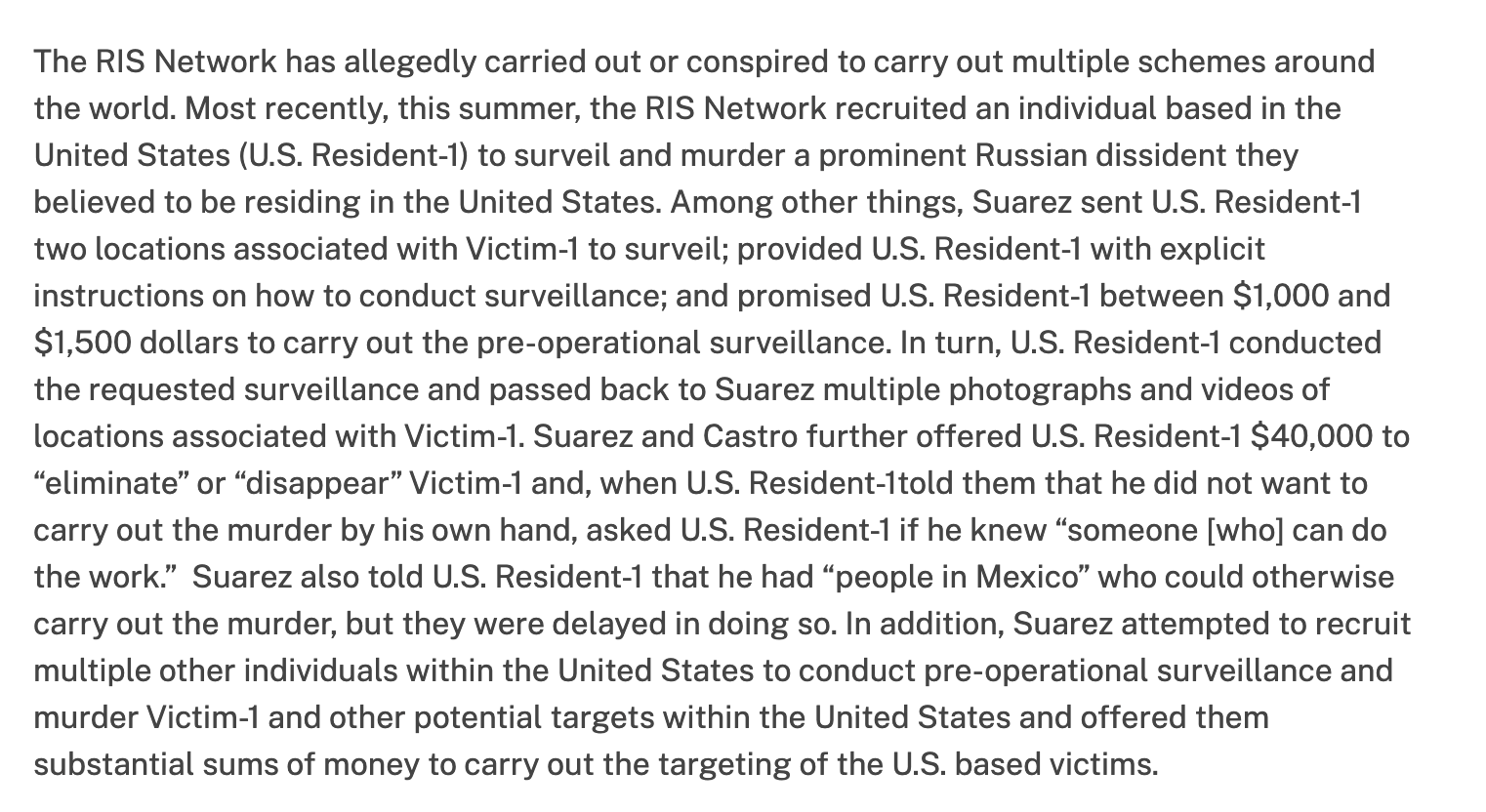
The Justice Department charged five people, allegedly working for Russian intelligence, in a scheme to surveil, recruit and carry out targeted killings, including a plot to murder a Russian dissident believed to be in the Washington, D.C. area. An indictment unsealed Tuesday names Russian national Yuri Khrameev, his son Kirill Khrameev, Cuban nationals Oemis Romagoza Durruthy and Yaidel Delgado Suarez, and Venezuelan national Angel Eduardo Castro, all still at large, with three of the five also facing murder-for-hire conspiracy charges. Attorney General Todd Blanche said the network recruited people inside the U.S. to conduct surveillance on Russian dissidents, including one living stateside and another in Lithuania, and prosecutors say one recruit was allegedly offered $40,000 to “eliminate” or “disappear” a person in the U.S., while another was offered $25,000 last year to kill someone in Lithuania. The Kremlin brushed off the charges, with spokesman Dmitry Peskov saying “until we hear and see any credible evidence and arguments based on tangible facts, we do not believe it is necessary to comment,” consistent with Russia’s past denials of running such operations on foreign soil. The case adds to a growing list of alleged Russian assassination and intimidation plots targeting dissidents abroad, underscoring how far that campaign may be reaching into U.S. soil itself. This is from the release announcing the indictment:
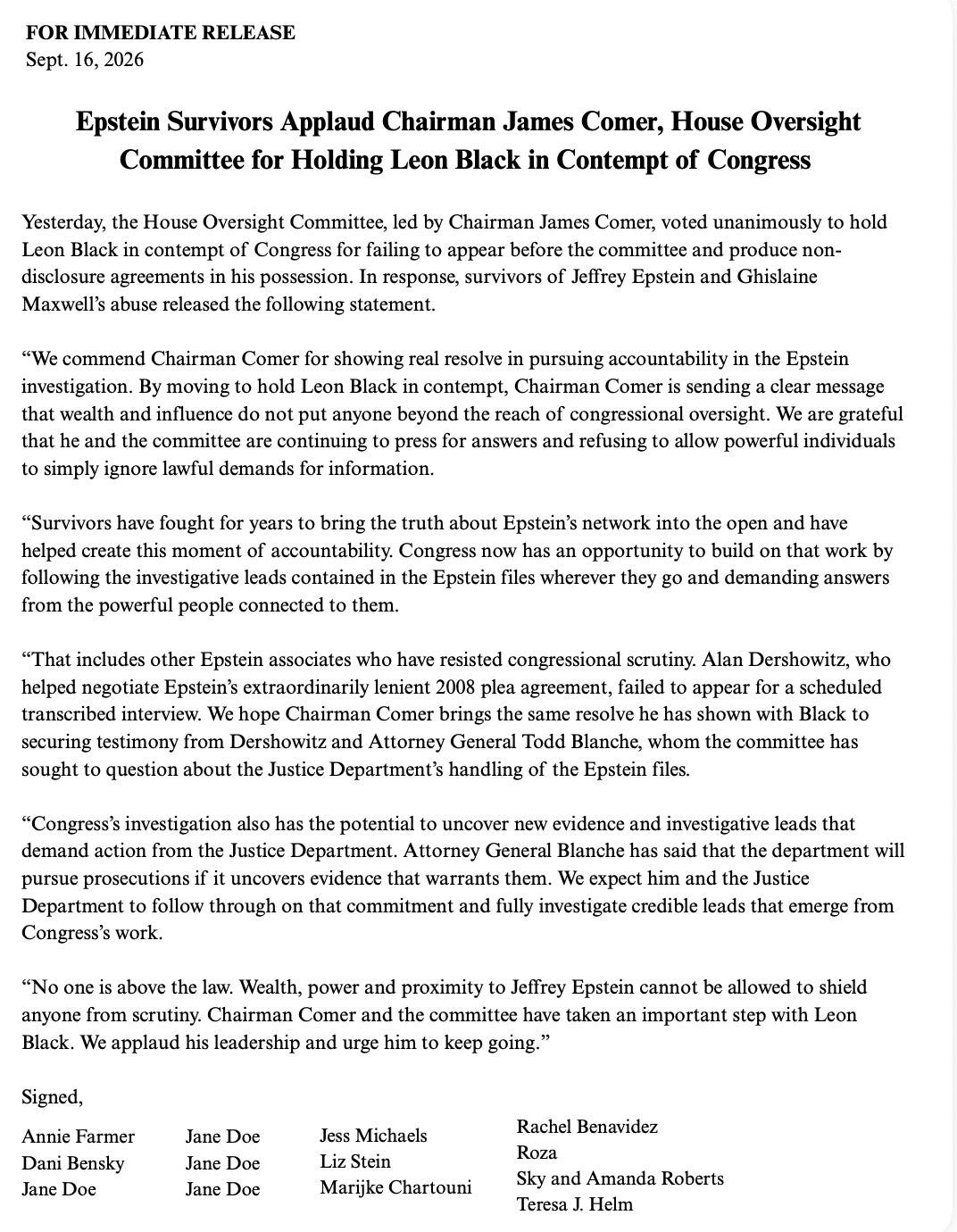
House Oversight Chair James Comer has introduced the Survivor’s Voice Protection Act, his committee’s first piece of legislation to come directly out of its ongoing Epstein investigation. The bill would void and make unenforceable any NDA that prevents someone, including sexual abuse survivors, from disclosing information about that abuse, and it would apply retroactively to agreements signed before the law takes effect. It also creates a fiduciary duty to report grooming of a minor to law enforcement, defining grooming broadly to include behavior meant to build trust or normalize sexual conduct with a minor even if no in-person meeting occurred. Comer said the investigation showed how “powerful men weaponized nondisclosure agreements to silence survivors,” and the committee has now conducted 19 depositions and interviews tied to Epstein and Ghislaine Maxwell. The rollout comes a day after Comer’s panel voted to recommend holding billionaire Leon Black in contempt of Congress for refusing to turn over his Epstein-related NDAs.
WSJ Exposes Britt’s Private Tariff Exemption Requests After Public Praise. The Wall Street Journal editorial board excoriated Sen. Katie Britt (R-AL) this week for publicly defending Trump’s tariffs while privately seeking exemptions for Alabama companies. The WSJ obtained a FOIA email showing Britt’s legislative director asked the U.S. Trade Representative’s office for exemptions for five specific Alabama manufacturers roughly ten months before Britt publicly praised the tariffs and mocked the Supreme Court for overturning them. The board argued her private objections were actually well-founded, writing that they show how “blunderbuss trade wars are an economic mistake” and how tariff carve-outs let big companies with Senate access get relief while “the little guy being walloped” has no one to plead his case. Britt’s office defended her, saying she also raised the same concerns publicly in Senate hearings and got Commerce Secretary Howard Lutnick to look into at least one request, while reaffirming her support for Trump’s broader trade agenda. The WSJ noted this “tariffs for thee, exemptions for me” pattern isn’t unique to Britt, pointing to Sen. Josh Hawley and others as prior examples.
U.S. Fast-Tracked Deportation of Ecuadorean Politician Despite Torture Findings. José Serrano, a former Ecuadorean interior minister and critic of President Daniel Noboa, was deported to Ecuador on August 28 in a stunningly rapid reversal by Trump-appointed immigration appeals judges, who overturned a ruling that had found he was likely to be tortured if sent home. A U.S. immigration judge had granted Serrano protection from removal in May, citing evidence that Ecuador tortures political prisoners, but three appellate judges appointed under Trump reviewed and reversed that decision within a single day, an unprecedented turnaround former appellate judges say normally takes weeks. Serrano’s lawyers say he has since been held in a maximum-security prison modeled on El Salvador’s CECOT, and that guards photographed him naked and threatened to send the footage to Noboa, a close Trump ally in anti-drug-trafficking efforts in Latin America. Noboa, who has long sought Serrano’s return over a 2023 presidential candidate assassination Serrano is accused of orchestrating, took credit for the deportation on social media within minutes of it happening and warned his own political rival, “You’re next.” The Times ties the case to a broader pattern of the Trump administration reshaping immigration courts, which fall under the Justice Department rather than the judiciary, to serve political ends, including a similar prior case involving a Colombian activist deported after opposing a Trump-endorsed foreign leader.
Paramount Threatens to Leave California Amid Antitrust Fight Over WBD Merger. Paramount has told Los Angeles Mayor Karen Bass and California Attorney General Rob Bonta that the company is “deadly serious” about leaving California entirely, according to sources, after months of leaks suggesting CEO David Ellison would relocate if blue-state attorneys general didn’t drop their antitrust suit against Paramount’s $111 billion merger with Warner Bros Discovery. The move comes as that merger remains tied up in a lawsuit filed by a dozen states and the Writers Guild of America, with a trial not set to start until March 2027 despite settlement talks scheduled for next month and a hearing next week over Paramount’s request for a $1.88 billion bond to cover anticipated losses. Those losses reportedly stem largely from a $7 million-per-day fee built into the WBD contract that kicks in October 1, a deadline Paramount’s exit threat arrives just ahead of. Mayor Bass’s office said she remains focused on protecting entertainment jobs in Los Angeles, while neither Paramount nor Bonta’s office commented on how advanced the relocation plans actually are. Any move would carry mostly symbolic and economic weight rather than legal impact on the antitrust case itself, though it adds pressure alongside the Trump administration’s DOJ backing Paramount and a possible Supreme Court intervention still looming over the deal.
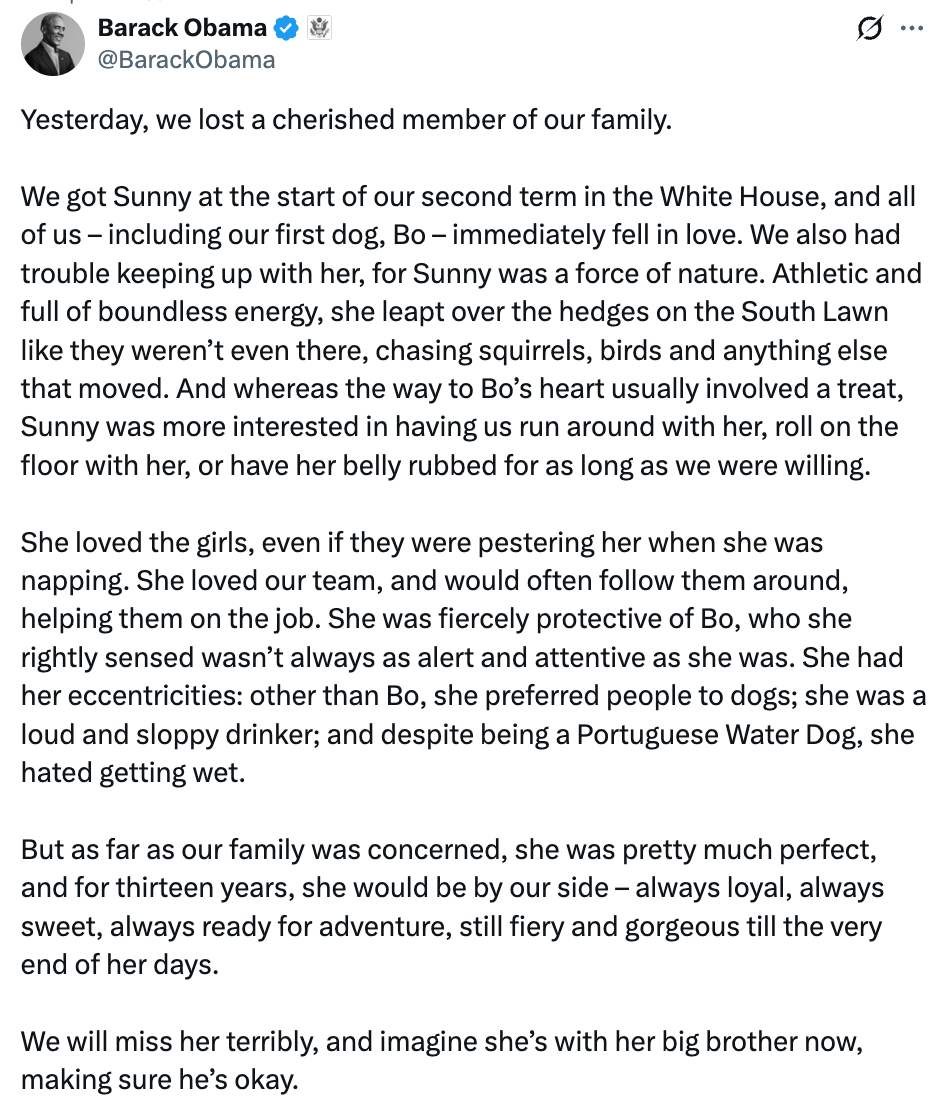
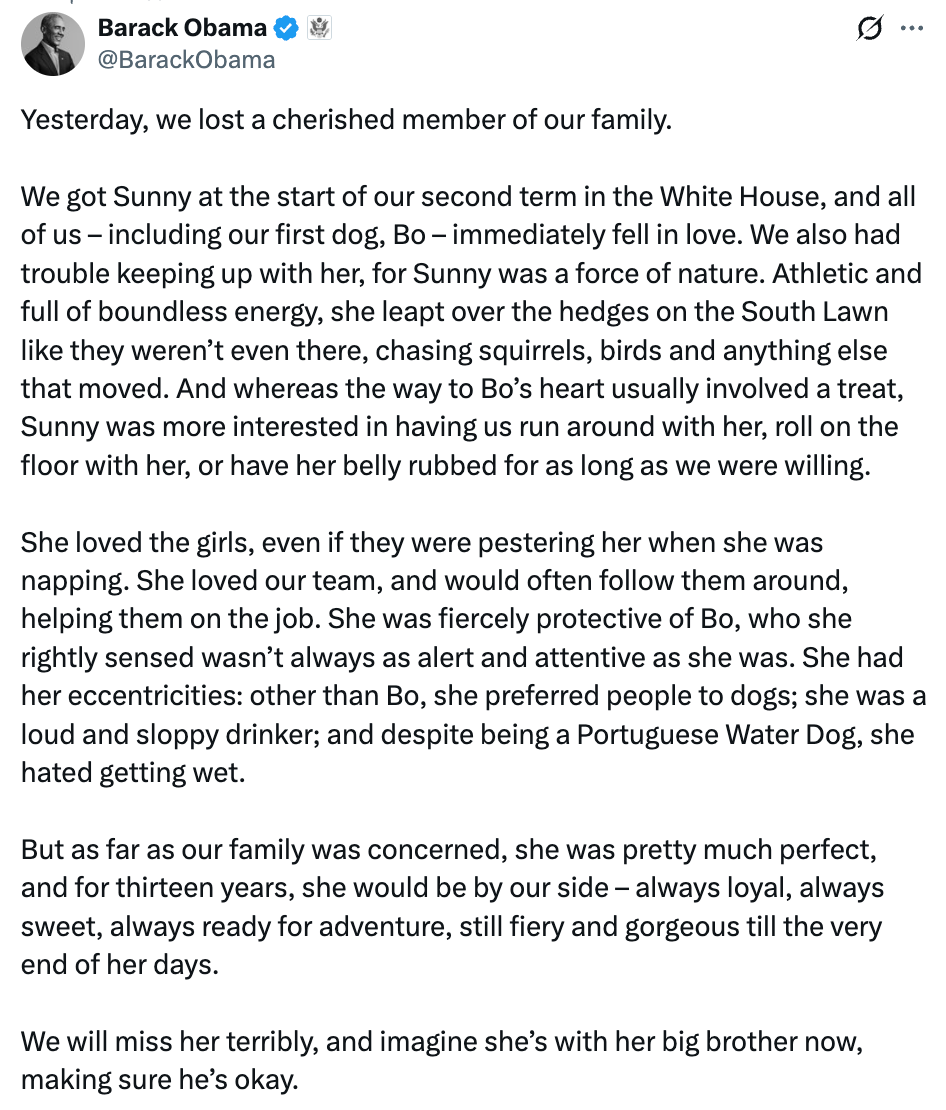
Former President Barack Obama announced that the family’s dog Sunny has died at age 13. The Portuguese water dog joined the Obama family in 2013 during their second term in the White House, and Obama said “all of us, including our first dog, Bo, immediately fell in love.” He remembered Sunny as athletic and protective of Bo despite disliking water, an unusual trait for the breed, and said “we will miss her terribly, and imagine she’s with her big brother now, making sure he’s okay.”
A new Government Accountability Office report found the Trump administration spent an estimated $9.5 billion last year on paid administrative leave for federal workers amid DOGE-driven staff cuts. Use of such leave jumped 435 percent from 2023 to 2025, with salary costs rising sixfold, and about $6.7 billion of that came from a “deferred resignation program” that nearly 140,000 federal employees opted into after Elon Musk’s DOGE effort launched mass firings and dissolved USAID. The GAO cautioned its figures were estimates, noting the Office of Personnel Management “does not know the actual costs of the paid administrative leave used for workforce reduction efforts” because it isn’t tracked separately from general leave. The federal workforce has shrunk by more than 271,000 employees since Trump took office, reversing a decade of year-over-year growth, and the White House did not respond to a request for comment.
Charlie Kirk’s family accused Utah Valley University and state officials of a string of “reckless decisions” that left him exposed to the rooftop sniper who killed him, in a wrongful death notice that precedes a possible lawsuit. Attorneys said the university failed to conduct an adequate risk assessment, establish a secure perimeter, or use standard safeguards like drone rooftop monitoring, bag checks or metal detectors, despite Kirk being Trump’s “close friend and political ally” and a rooftop shooter having targeted Trump the year before. The notice names the university, its then-president, its police chief and the state of Utah, and the school said it would respond “consistent with our established processes.” Tyler Robinson, who turned himself in a day after the shooting and told his partner he “had enough of his hatred,” is charged with aggravated murder and eligible for the death penalty, with prosecutors citing surveillance footage, DNA evidence and a note reading “I had the opportunity to take out Charlie Kirk, and I took it.”
A Golden Retriever named Nash in San Diego responded to a home intruder not by barking, but by bringing the man his toy and trying to get him to play. Nash’s owner, who wasn’t home at the time, watched the whole encounter unfold live on his phone. He said the family had expected Nash to bark and scare off intruders, joking that “Nash is not the greatest guard dog... he did the exact opposite.”
A tiny English village voted overwhelmingly, 285 to 26, to symbolically secede from the United Kingdom in protest of a plan to house up to 1,200 migrants at a nearby military base. Piddington’s roughly 350 residents backed the non-binding referendum after raising fears about safety, crime and property values near the former Bicester base, with parish chairman Tim McNally declaring the area “the Principality of Piddington” and sending “an absolute message... to the world.” Some supporters compared the vote to World War II’s Battle of Britain, while critics said the campaign stoked anti-immigrant sentiment amid a broader wave of U.K. protests over asylum housing. Prime Minister Andy Burnham said he understood “the strength of feeling” but stressed the government needs “a fair plan” spreading the burden nationally, as refugee advocates warned that remote military-style housing “undermined social cohesion” for people who had already fled war and violence.
Massachusetts Gov. Maura Healey is proposing new investments in maternal and postpartum health programs following renewed public discussion sparked by the high-profile Lindsay Clancy trial. Healey announced the proposal Tuesday alongside mothers who shared personal stories about the mental health challenges they faced during pregnancy and after giving birth, saying the goal is to improve access to mental health care and support services for families statewide. She said mothers experiencing mental health struggles should know they are “seen, heard and supported.” Kerly Germain-Carmichael, one of the mothers who spoke at the event, described experiencing anxiety and depression after giving birth to her son in 2022 and said finding support during that period was critical. The article is paywalled beyond this point, so further specifics on the actual funding or program details aren’t available from this source.
See you soon.
— Aaron


