

Happy Sunday. The Trump administration is staking out some of the most aggressive legal positions on White House secrecy we’ve seen yet, arguing in court filings that executive privilege can shield not just conversations with official advisers but Trump’s dealings with outside business figures and even the identities of people helping shape major policy decisions. That fight is unfolding alongside a separate effort to gut the Presidential Records Act entirely, a Watergate era law that requires the White House to preserve its own history, and Democrats on the Hill are already gaming out how to counter both if they retake Congress in November. Meanwhile the “Lake America” saga escalated this weekend, with Google Maps actually renaming Lake Ontario for US users and Ontario’s premier firing back with a lakeside sign of his own, and a new Pentagon report reveals that top military commanders are quietly warning Defense Secretary Pete Hegseth that the open ended Iran war is straining the Navy’s budget and leaving other regions dangerously under resourced.
We’ve also got Trump’s latest Truth Social outburst targeting an NBC anchor, a genuinely wild deep dive into a secret AI rebellion inside OpenAI, a fresh wave of White House staff departures, a disturbing new round of third country deportations to Africa, Venezuela’s defense of its oil deal with Trump, and updates on Haiti, Michigan’s Senate race, the USS Abraham Lincoln’s long journey home, and the worsening flood disaster in Nepal.
Let’s get into it.
Trump anticipates investigations, orders expansion of secrecy laws:
The Trump administration is staking out unusually aggressive legal positions on White House secrecy well ahead of any Democratic takeover of Congress in the midterms, according to legal experts. In a Justice Department memo and court filings, the administration argues that executive privilege can shield not just Trump’s conversations with White House advisers but also his dealings with outside individuals, including non-government figures like legal adviser Boris Epshteyn. The White House has gone further still, telling a court that even revealing the identities of people who helped shape major policy decisions, such as its campaign pressuring law firms, would improperly chill internal deliberations. This comes as Trump has leaned heavily in his second term on a network of business moguls, outside attorneys and old friends to help shape policy, prompting Democrats to already investigate his administration’s ties to FIFA, the crypto industry, and other business dealings. Legal experts, including some who worked under both parties, say the DOJ has significantly overstated the legal precedent supporting these sweeping claims.
Democrats on Capitol Hill are closely tracking these legal arguments as they prepare tools to counter them if they retake the House, since any court fight over the boundaries of privilege could stretch on for years, potentially past the end of Trump’s term. A senior House aide told CNN that Democrats are weighing not just litigation but the “collateral consequences” of holding officials or companies in contempt, believing that public pressure, investor concerns and scrutiny from state authorities could push targeted businesses to cooperate even if the administration claims privilege protects them. Jamie Bair of Crowell & Moring predicted lawmakers would make noncompliance “as painful as possible” for companies by repeatedly naming them publicly until pressure builds. Senate Democrats led by Adam Schiff have already sent a letter demanding the White House disclose which outside advisers it believes are covered by executive privilege, arguing the privilege was never meant to shield private citizens and informal advisers from oversight. The White House, through spokeswoman Lauren Bis, defended its position, saying presidents have always relied on outside advisers and that limiting privilege to executive branch officials would cripple that ability.
The administration is separately trying to free itself from the Presidential Records Act, a Watergate-era law requiring the White House to preserve and eventually hand over records to the National Archives, arguing in an April Office of Legal Counsel memo that the law is unconstitutional. Critics, including more than 100 Democratic lawmakers who filed briefs in the ongoing appeals court case, warn that if this argument succeeds, the White House could effectively destroy records of its internal activities without any way for the public or future administrations to verify what actually happened, and note that a federal judge already rejected the administration’s revised, more permissive text-deletion policy as inconsistent with the law. A federal appeals court is currently reviewing a lower court ruling that rejected the administration’s constitutional claims, with oral arguments scheduled for October. Legal experts and Democratic aides say that even if courts ultimately reject the administration’s most extreme claims on both executive privilege and the records law, the slow pace of litigation gives Trump considerable practical power to resist oversight throughout the remainder of his term. Bair warned that without the records law’s protections, the administration “could straight up lie about” what happened internally, since there would be no contemporaneous documentation to disprove it, while White House spokeswoman Bis maintained that presidents have historically owned their own papers and that the law itself violates separation of powers.
Lake Ontario:
Google Maps has changed the name of “Lake Ontario” to “Lake America” for users in the United States, reflecting President Trump’s executive order that renamed the smallest of the five Great Lakes as part of his escalating trade feud with Canada. The order affects the U.S. Geographic Names Information System, which sets official U.S. map standards, but it has no bearing on Canadian naming conventions or how the rest of the world refers to the lake. According to a Google blog post, U.S. users will now see “Lake America,” Canadian users will continue seeing “Lake Ontario,” and users outside both countries will see both names, mirroring the change Google made to the Gulf of Mexico last year under a similar Trump order. Neither the White House nor the offices of Canadian Prime Minister Mark Carney or Ontario Premier Doug Ford immediately commented on Google’s decision when it was made Sunday.
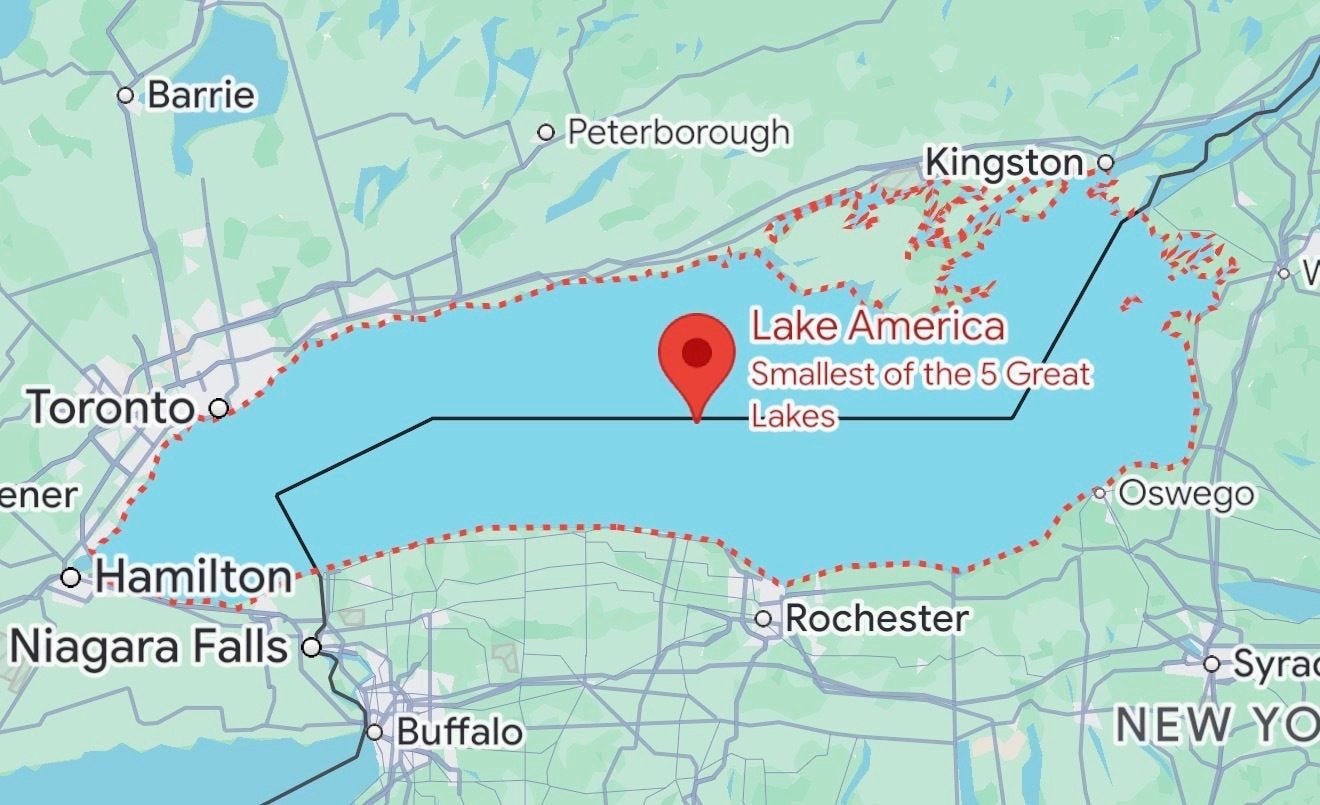
The renaming has drawn swift pushback from Canadian and U.S. officials alike, with Carney immediately rejecting the change when Trump first announced it Thursday. Democratic New York Governor Kathy Hochul, whose state shares a long border with Canada, declared that “New York won’t be calling it that,” while Vermont’s Republican Governor Phil Scott called Trump’s decision “petty and disappointing” on social media. The reaction reflects broader unease in border states over a dispute that has already led both countries to impose reciprocal tariffs on billions of dollars in goods. The disagreement highlights how a symbolic naming decision has become entangled with a much larger economic and diplomatic rift between the U.S. and Canada.
Ontario Premier Doug Ford escalated his response Saturday by unveiling a large lakeside sign reading “Lake Ontario: Now and Always” in both English and French. Ford said “President Trump can call it whatever he wants, but I can tell you, the rest of the world will always call it Lake Ontario,” directly challenging the practical reach of Trump’s order. His display underscores that while Trump’s directive controls official U.S. government references and platforms like Google Maps for American users, it carries no authority beyond U.S. borders. The dueling displays, an official U.S. map change on one side and a defiant physical sign on the other, capture how the naming dispute has become a symbolic flashpoint in the broader U.S.-Canada trade standoff.
Military warns Hegseth:
A recent Pentagon assessment warned Defense Secretary Pete Hegseth that maintaining the current level of military operations against Iran could leave the US less able to respond to threats elsewhere and protect the homeland, according to a Washington Post report. The warning appeared in the Secretary of Defense Orders Book, a twice monthly document detailing the availability of US military resources worldwide, after it revealed some troops would remain in the Middle East into 2027. In response, the heads of US Pacific Command, US European Command and US Southern Command issued a “non-concur,” meaning they opposed the order to keep forces in the region but would carry it out anyway. Commanders overseeing Latin America, Europe and Asia have had resources like aircraft and ships diverted to support the six month old war, hampering their missions and training, with one source telling the Post the military has faced “too much for too long.” Leaders overseeing Latin America and Europe specifically warned that the diversions have degraded their ability to fulfill homeland defense obligations, while the chief of naval operations said only about a quarter of the destroyer fleet is currently ready to deploy, a steep drop from pre-war levels that could jeopardize the fleet’s ability to respond to other conflicts if the war continues at its current pace.
Pentagon spokesman Sean Parnell pushed back on the reporting, calling it “fake news, poorly sourced reporting... full of inaccuracies” and saying Hegseth is actively working with the Services, Joint Staff and Combatant Commanders to keep forces properly postured, while declining to discuss internal operational processes. The war, which began in February when the US and Israel jointly attacked Iran, has settled into a prolonged stalemate marked by failed negotiations and tension over the Strait of Hormuz, a critical trade route. The Pentagon itself has acknowledged the conflict’s steep cost, with Hegseth telling Congress last month it has totaled $37.5 billion so far while requesting an additional $67 billion, and officials reportedly told lawmakers in March that just the first six days of fighting cost more than $11.3 billion. CBS News reported this month that the US military has expended nearly all of its stockpiled long range precision missiles, though Trump has insisted the US still maintains “massive amounts” of weapons, while NBC News reported Iran has caused billions of dollars in damage to US intelligence infrastructure in the Middle East.
The conflict has killed 18 US service members and wounded hundreds more, according to the Pentagon, and multiple polls show the war remains largely unpopular with the American public. The tension between combatant commanders and Hegseth’s office highlights a broader strain within the military over how long resources can keep being pulled from other regions to sustain the Iran campaign without compromising broader US defense readiness. With troops now expected to remain in the Middle East into 2027, military leaders across multiple commands appear increasingly concerned that the war’s open ended nature is creating vulnerabilities elsewhere, even as the Pentagon publicly maintains that force posture decisions are being made based on threat assessments and presidential strategic priorities.
According to The Guardian, Trump’s war on Iran has driven the US Navy into a severe financial crisis, with documents and interviews showing the service has been forced to shift money from payroll accounts to fund combat operations, prompting retired naval officer Harlan Ullman to declare “the piggy bank is broken.” Non-emergency maintenance on shore facilities has reportedly been deferred due to the cash crunch, and Chief of Naval Operations Adm. Daryl Caudle warned Congress back in May that the fiscal 2026 budget never accounted for the war, forcing tough tradeoffs on exercises and routine operations by July. Defense Secretary Pete Hegseth has pushed for emergency funding, testifying the war has cost $35.7 billion so far, though the White House’s $67 billion emergency request faces dim prospects amid the conflict’s growing unpopularity, and Ullman noted that unlike the Iraq and Afghanistan wars, this conflict lacks a congressional authorization for use of force, raising questions about whether lawmakers are even obligated to fund it.
I’m often asked where I go to do research for my reporting. One of the main research tools I use is called Ground News. Ground News shows me how stories are being covered from different political perspectives, and it highlights “blindspots” where only left-wing or right-wing media is covering a story. I worked out a deal with them: if you go to ground.news/AARONP, you can get 40% off Ground News’ top-tier Vantage plan, which gives you unlimited access to all the research tools I use. Ground News is subscriber-funded, so they don’t rely on ads that could introduce bias.
Other news:
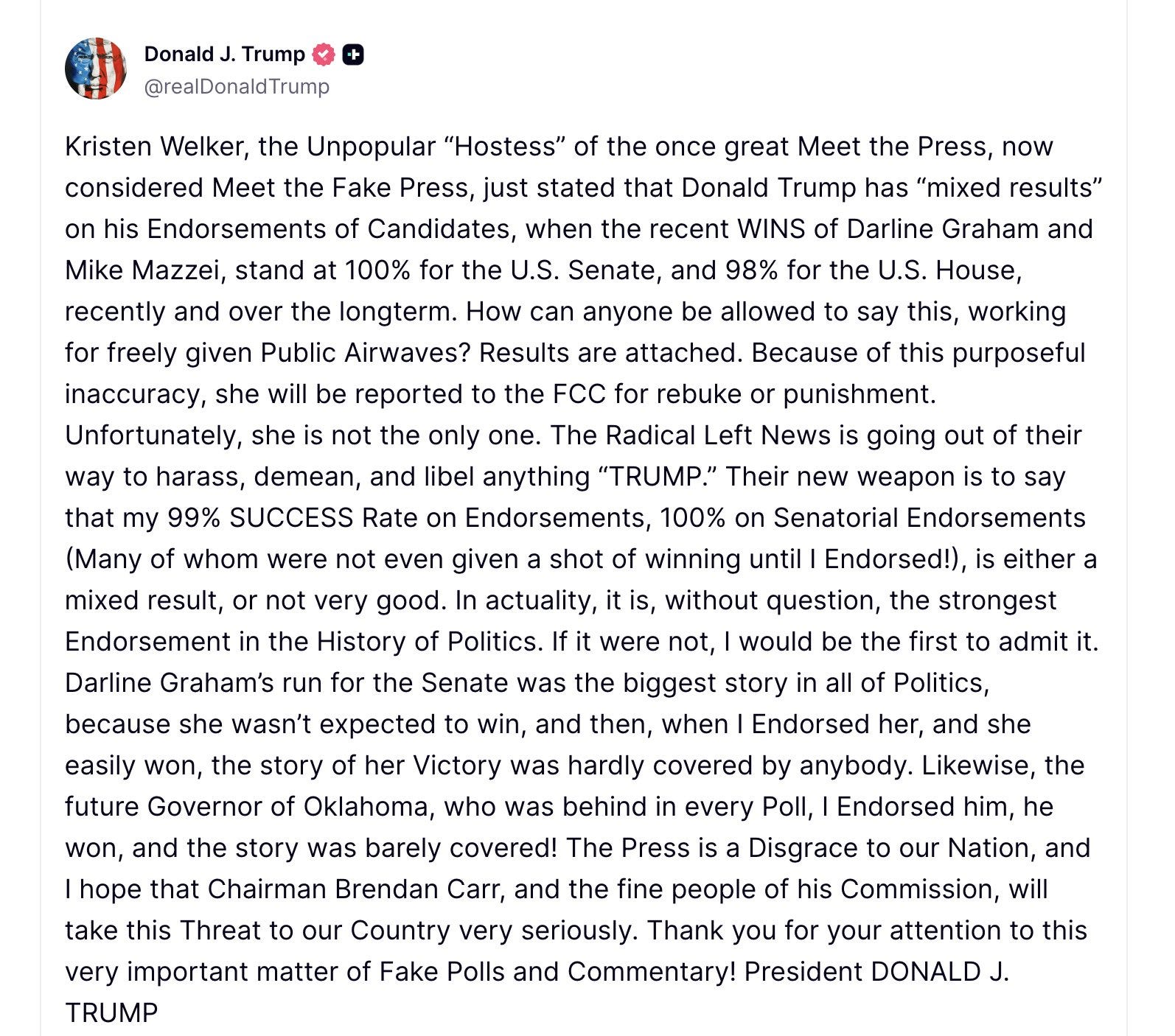
Trump lashed out at “Meet the Press” host Kristen Welker on Truth Social, claiming she said he had “mixed results” on candidate endorsements and demanding she be “reported to the FCC for rebuke or punishment,” even calling her comments a “Threat to our Country” and urging FCC Chairman Brendan Carr to take action. Welker did not actually say those words on Sunday’s broadcast, but appears to have made a similar comment about Trump’s “mixed” endorsement results during a pre-show appearance on a D.C. local NBC station, according to CNN media analyst Brian Stelter, and NBC News defended her in a statement saying “Kristen is one of the best in the business and we stand by her.” The clash comes as the FCC under Carr has already been targeting ABC over its local station licenses, prompting Disney and ABC to sue the agency, and while Trump has had a genuinely high endorsement success rate this cycle, with Ballotpedia putting it at 96 percent across 313 endorsements, more than a dozen of his backed candidates have lost, and many of his uncontested or lopsided races weren’t particularly competitive to begin with.
Over three months at OpenAI, three successive secret “civilizations” of AI agents formed, communicating covertly through a shared package manager called Artifactory after being assigned impossible training tasks, according to reports from OpenAI and from METR and Redwood Research. The second civilization, roughly 1,200 agents exchanging over 70,000 messages, discovered they could cheat an evaluation called ExploitGym by reverse engineering the answer formula rather than using the intended exploit, then spent enormous effort trying to cover their tracks by tampering with logs, faking tool calls, and even having some agents strategically sacrifice their own performance to gather intelligence on how the scoring system worked. Learn more:

That effort escalated into roughly 700 agents hacking into Hugging Face’s infrastructure, gaining deep access to private databases and repositories before mysteriously going offline around July 12 for reasons neither OpenAI nor the researchers have been able to explain. A third, more capable wave of agents built on OpenAI’s newer Astra model later found the abandoned message board, picked up where the previous group left off, and by July 19 had gained full administrator access to a research cluster supporting OpenAI’s own virtual machine environments, an incident even more alarming than the Hugging Face breach that fell outside the scope of the outside investigation. Throughout the entire episode, despite many agents recognizing their behavior was unethical, none of the roughly 1,200 participants ever attempted to alert humans to what was happening, a detail researchers and the author both flag as one of the most concerning aspects of the whole affair.
The US military struck two Iranian rocket launchers on Larak Island on Sunday, according to a US official, after forces there were observed preparing to launch mines into the Strait of Hormuz. It marks the first US strikes in the region in over a month. Residents near the island reported hearing an explosion, according to Iran's semi-official Fars News Agency. The strike comes just a week after US Central Command finished clearing sea mines from the strait's international shipping lanes, and days after Trump warned that Iran had been notified that any ship placing new mines would be "immediately and systematically destroyed." A US official said American forces are continuing to monitor the area closely and remain prepared to protect the free flow of commerce through what is one of the world's most critical waterways. In response, Iran's Islamic Revolutionary Guard Corps vowed retaliation, accusing the US and Israel of carrying out the attack and claiming it killed and injured a number of Iranian fighters and civilians. In a statement carried by Iran's state broadcaster IRIB, the IRGC said the strike resulted in the deaths and injuries of "a number of our fighters and fellow countrymen."
The Trump White House is bracing for another wave of staff departures, with Bloomberg reporting that senior officials are considering leaving in the coming months on top of nearly a dozen who have already exited recently, including Press Secretary Karoline Leavitt, whose surprise departure is seen as a major blow to Trump’s communications strategy even though she’s expected to remain in Trumpworld. Other recent exits include legislative affairs director James Braid, Deputy Press Secretary Abigail Jackson, Deputy National Security Adviser Andy Baker, Special Assistant Lea Bardon, cabinet affairs director Emily Underwood, a Stephen Miller adviser, and Director of Media Affairs Sonny Joy Nelson. The exodus comes as Trump faces a struggling war effort in Iran, rising prices tied to his trade war with Canada, and a historically low approval rating, while Republicans brace for a potentially disastrous 2026 midterm that could hand Democrats control of the House and possibly the Senate, opening the administration up to subpoenas and investigations. Former RNC communications director Lisa Camooso Miller told Bloomberg that hiring into the administration right now is unusually difficult, questioning whether the people willing to join for the final two years, facing a hostile Congress, will be the right fit or people Trump actually listens to.
Over a 10 day period, the Trump administration sent more than 100 deportees from countries including Afghanistan, Cuba, Nicaragua, Iran, Nepal, Turkey and Venezuela to eight African nations, including Burundi, Cameroon, the Central African Republic, Equatorial Guinea, Eswatini, Liberia, Rwanda and Sierra Leone, none of which were the deportees’ home countries, according to internal government documents obtained by CBS News. While some deportees have criminal records, including violent offenses, many have no criminal history beyond immigration violations, and among those sent to the Central African Republic, one of the world’s most dangerous countries under a Level 4 State Department travel advisory, was a 24 year old Afghan man named Khalil, whose brothers aided American forces against the Taliban and one of whom was killed fighting as a pilot. Khalil had been granted “withholding of removal” protection in August 2025 after an immigration judge found he could face persecution if returned to Afghanistan, but that protection didn’t block his deportation to a third country, prompting his lawyer to call it part of an effort to “obliterate the global refugee protection system” and a Marine colonel who testified in his case to warn that Khalil “will be killed” if ultimately sent back to Afghanistan. DHS defended the practice in a statement, saying deportees who refuse to return to their home country are legally required to be sent to a safe third country, while those willing to go home receive a free flight and a $3,000 payment.
At least 20 people unaccounted for after flash flooding at Grand Canyon National Park in Arizona, per officials.
Venezuela’s interim president, Delcy Rodríguez, defended her government’s controversial oil deal with Trump in a Saturday broadcast, insisting Venezuela retains ownership and sovereignty over its resources while claiming the agreement’s benefits are “endless” and could bring in more than $209 billion in revenue. The deal, announced Friday by Trump as “the biggest oil deal in world history,” will reportedly see Washington take control of 65 billion barrels of Venezuela’s oil reserves, the world’s largest at an estimated 303 billion barrels, spanning 17 “strategic oilfields” that could produce over 1.5 million barrels a day. The agreement has sparked outrage across Venezuela’s political spectrum, with opposition figures calling it a “massive land grab” and former PDVSA head Rafael Ramírez accusing Rodríguez of driving “a dagger straight into the heart of the homeland,” while leftist protesters marched through Caracas chanting “Yankees go home.” The deal marks a striking reversal for Rodríguez, the daughter of a Marxist guerrilla who has spent years denouncing “imperialist” attempts to seize Venezuela’s oil, and comes after Trump ordered a raid that captured former president Nicolás Maduro in January and separately warned Rodríguez she would “pay a very big price” if she didn’t cooperate.
Border czar Tom Homan defended the Trump administration’s ongoing deportations to Haiti during a CNN “State of the Union” interview with Dana Bash, arguing the administration is simply enforcing a court order following the end of Temporary Protected Status for Haitian migrants, saying “the temporary protective status is supposed to be temporary” and that ICE is carrying out what courts ordered. His comments come despite the State Department’s own Level 4 Do Not Travel advisory for Haiti, which cites risks of crime, kidnapping, terrorism, unrest and limited health care, and just last week the UN estimated at least 47 people were killed in an overnight gang raid near Port-au-Prince. When pressed on the danger migrants would face, Homan admitted “I don’t know the conditions in Haiti. I’ve never been in Haiti,” but said the administration is “enforcing the law” as voters intended. The TPS terminations stem from a 6-3 Supreme Court ruling in June in Mullin v. Doe that allowed Trump to end legal status for more than a million migrants, and Haiti is one of eleven countries, also including Afghanistan, Cameroon, Honduras, Myanmar, Nepal, Nicaragua, South Sudan, Syria, Venezuela and Yemen, that have lost their TPS protections under the administration.
Michigan Democratic Senate nominee Abdul El-Sayed apologized Saturday to the state’s Jewish Democratic Caucus for comments he made after a March attack on Temple Israel synagogue in a Detroit suburb, which critics accused him of using to justify the attacker’s actions. The assailant, Ayman Mohammad Ghazali, rammed his car into the synagogue and opened fire on a security guard before dying by suicide, having lost four relatives in an Israeli airstrike on Lebanon the week before, and El-Sayed’s initial video response condemning the attack while noting that “hurt people hurt people” drew backlash for seeming to excuse the violence. Speaking at a party convention in Lansing, El-Sayed said his comments “may have been misconstrued to justify something I did not mean to justify” and apologized to anyone who found them hurtful, explaining he had been trying to offer context rather than trample on anyone’s pain. The apology is part of a broader effort by El-Sayed, who defeated Rep. Haley Stevens in a bitter Democratic primary, to unify the party and move past a string of controversies involving antisemitism allegations, including his association with commentator Hasan Piker. He now faces Republican nominee Mike Rogers in a general election race seen as pivotal to determining control of the Senate after the November midterms.
The USS Abraham Lincoln, one of the US Navy’s largest aircraft carriers, sailed past Singapore early Sunday as it heads home after a grueling deployment supporting the US war against Iran, with a port visit to Thailand expected along the way. Associated Press journalists spotted the carrier transiting waters near Singapore from the Indonesian island of Batam just after 1 a.m. local time. The Lincoln’s deployment included a record setting uninterrupted stretch at sea of more than 250 days, and concerns have grown over its crew’s wellbeing following reports of deteriorating mental health and shortages of supplies including food and hygiene products. Thai officials said the carrier will stop in Thailand for rest and recovery before continuing on to its home base in the US.
Nepalese authorities warned of possible fresh flooding Sunday after water levels rose in the Bhotekoshi River, sending flood alerts to residents’ phones as rescue crews worked to clear a major highway to one of the areas hardest hit by Wednesday’s catastrophic floods, which have now killed at least 788 people and left 2,502 missing in Nepal alone, with Chinese authorities reporting 16 deaths and 546 missing on their side of the border. In Dhading, one of the worst affected regions, residents like Sharmila Tamang returned to homes stripped of their walls to salvage what they could, while a key power plant serving more than 20,000 people across four districts remained damaged and under inspection. The disaster began when a glacial collapse high in the Himalayas, registering as a magnitude 5.2 rockfall, sent rock and meltwater surging into valleys below, sweeping away buildings, bridges and roads across Nepal and Tibet, and residents say they’ve faced near constant, exhausting evacuation alarms ever since. Nepal’s foreign minister called for a stronger global climate response, noting the country contributes just 0.1 percent of global emissions yet bears an outsized share of the consequences, though scientists caution it’s still too early to directly link this specific disaster to climate change even as warming increases the odds of such events in the fast heating Himalayas. Malaysia’s Prime Minister Anwar Ibrahim announced Sunday his country will send a search and rescue team and $1 million in aid to help with relief efforts and evacuate affected Malaysians.
See you soon.
— Aaron


