

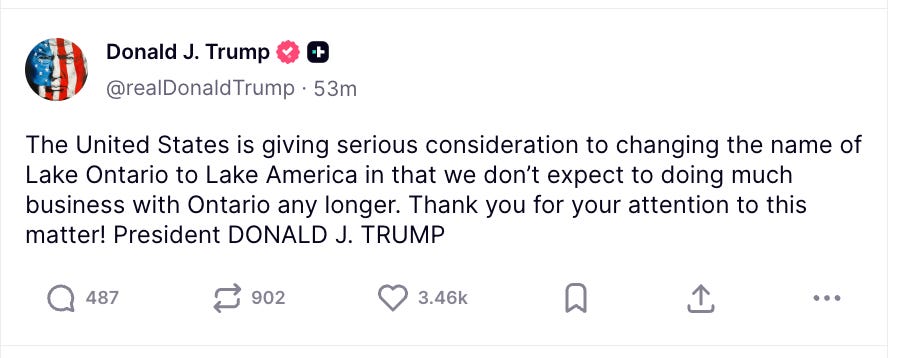
Good morning. Canada’s trade war with the US just got personal, with Ontario Premier Doug Ford telling Trump he can “kiss my ass” as Ottawa prepares retaliatory tariffs and Trump threatens to rename Lake Ontario “Lake America.” Newly leaked details reveal Trump ignored direct Oval Office warnings before launching the Iran war, and now Iranian state TV is airing a video asking “where and how should we kill Barron Trump.” And an Air Force major was formally charged under a rarely used military law after twice being arrested for calling for Trump’s impeachment.
Also today: the Trump administration is preparing the largest mass visa revocation in US history, the EPA wants to let datacenters keep their air pollution secret, the Supreme Court just handed Trump a win on mail voting restrictions, and the wife of an active duty Army sergeant was deported to Honduras while their six year old watched.
If you watch until the end, you will see my daughter make an appearance in today’s update, it is her five month birthday and she wanted to be held at the end!
None of this happens without you. Every subscriber is what lets me do this work full time, without a corporate parent softening the coverage or an advertiser deciding what I can and can’t say. You’re not just reading this, you’re the reason it exists at all, and I don’t take that lightly. Subscribe today for the price of a cup of coffee to keep me caffeinated and to keep growing this channel:
Here’s the news:
Canada tells Trump to Kiss its Ass:
Canada is set to unveil retaliatory tariffs against the US on Tuesday as the trade war intensifies, with Prime Minister Mark Carney signaling he may abandon matching US duties dollar for dollar in favor of more targeted countermeasures aimed at protecting Canadian workers and industries. Trump escalated again Monday, telling Canada to “fall in line” or face consequences “far WORSE” than existing tariffs, threatening 50% tariffs on Canadian vehicles, auto parts, and steel starting January 2027, and on Tuesday reportedly threatened to rename Lake Ontario “Lake America.” Carney accused Washington of treating Canada like a subsidiary and said in French that the US wants to “destroy our major industries, including autos, steel and aluminum,” calling it one of the main reasons Canada walked away from the deal. He added that Canada is now finding reliable partners “everywhere in the world, except in the United States... And Russia.”
Ontario Premier Doug Ford has been the most combative voice in the dispute, telling an Ottawa radio show Trump “can kiss my ass” and that Canada would “go at him full steam,” while separately warning “everything is on the table,” including cutting off electricity and critical minerals like nickel and uranium from Ontario. Ford repeatedly invoked Ronald Reagan’s opposition to tariffs, saying Reagan would be “throwing up” and “spinning around in his grave,” and compared Trump to a bully who needs to be confronted rather than appeased. Trump fired back personally on social media, mocking Ford as “the less charismatic, intelligent, and overall unimpressive brother of the late, great, Rob Ford” and again referring to Carney as “Governor Carney,” insults Ford dismissed by saying “bring it on, buddy, I’m ready.” Ford also revealed he’d opposed the draft deal Carney had been considering, particularly a provision that would have restored American liquor to Ontario shelves.
The original trade talks collapsed largely over a “culture war” sticking point: Quebec Premier Christine Fréchette said the US demanded last-minute concessions on Quebec’s French-language protections, specifically Bill 96 and Bill 109, which she called a “red line” central to Quebec’s identity that would not be negotiated away regardless of tariff threats. US officials and companies including Netflix, YouTube, Apple, and Spotify have argued the laws burden manufacturers and streaming services with French-language packaging and content quota requirements, and US Trade Representative Jamieson Greer called the collapse “a missed opportunity” for Canada. The breakdown reportedly also briefly united English and French speaking Canadians in a shared rejection of US pressure, though Quebec sovereigntist leader Paul St-Pierre Plamondon said any future independence referendum would be delayed given the “unpredictability” of the Trump administration complicating that debate.
The auto industry sits at the center of the economic stakes, since Ontario is the hub of Canada’s vehicle manufacturing and its plants are deeply integrated with US automakers including Ford, GM, and Stellantis, supporting tens of thousands of jobs on both sides of the border; Greer argued Canada’s auto industry only exists because of the 1960s Auto Pact, while Carney called the partnership “the most successful automotive partnership in history.” Canada’s reciprocal 50% tariffs, covering roughly $28 billion in US goods, are expected to take effect September 8, and as of the most recent reporting there are no scheduled talks to resume negotiations between the two countries. Ford has used electricity as leverage before, having imposed a 25% surcharge on power sent to Michigan, Minnesota, and New York earlier in the dispute, which prompted Trump to threaten doubling steel and aluminum tariffs before both sides backed down, suggesting this standoff could follow a similar pattern of escalation and retreat.
Trump missed Iran warnings:
Newly leaked details show Trump ignored direct warnings before launching the Iran war. In a February Oval Office meeting, Tulsi Gabbard warned that striking Iran risked closing the Strait of Hormuz, triggering energy chaos, and installing an even more hardline successor to Khamenei, while military leaders separately warned about heavy casualties and depleted munitions stockpiles. Trump launched the attack alongside Israel on February 28 anyway, and Mar-a-Lago reportedly erupted in celebration when Khamenei’s killing was confirmed. Since then, Gulf nations and even some Republicans have pushed Trump to end the war, and sources say he’s privately furious, asking allies “why isn’t Iran folding” and at one point suggesting they should “bomb the s--t out of Iran” before a friend talked him down. White House spokesperson Olivia Wales is still defending the war as a success despite the fallout now playing out in real time.
That fallout includes a new video from Iranian state TV asking “where and how should we kill Barron Trump,” with claims of a 10 million dollar bounty and assertions that his movements are being monitored. The report alleges a woman managed to breach Secret Service security to get near Barron, and cites claims that communication happened partly through Xbox voice chat and messaging. The Secret Service has confirmed it’s aware of the threats and is investigating, and this isn’t the first time Trump’s family has been targeted, with similar threats previously made against Melania and Ivanka. A billboard reading “We will kill Trump” has also appeared in Tehran, and Iranian officials have invoked the concept of “qisas,” or retributive justice, tying it directly to Khamenei’s death.
Meanwhile Treasury Secretary Scott Bessent has rolled out “Operation Economic Outcast,” a new sanctions campaign hitting aviation, digital assets, gold, shipping, and technology, with more than 60 entities sanctioned so far. The UAE’s abrupt trade suspension with Iran is being read as directly tied to the pressure campaign, and China, India, Turkey, and Iraq all now face exposure depending on how closely they keep trading with Tehran. China has formally objected, calling the sanctions counterproductive, and oil prices have actually dipped despite the escalation, suggesting markets aren’t convinced the pressure will hold. The sanctions have also triggered suspensions of remittances affecting Iranian Americans and a halt to sports and academic exchange programs.
On the ground in Iran, the human cost is mounting fast. The rial has collapsed to roughly 2 million to the dollar, and the real base wage for Iranian workers has more than halved over the past decade down to about 83 dollars a month. Long lines are forming at gas stations in Tehran as shortages spread, and a separate oil tanker was disabled off the coast of Oman amid the rising regional tension. Pakistan has stepped in to mediate, describing a recent meeting as “positive and productive,” even as the U.S. simultaneously lifted Syria’s state sponsor of terrorism designation in an unrelated but notable regional move.
Israeli strikes and tank fire killed at least four people, including two children, in Gaza on Monday, a week after a U.S. delegation led by Jared Kushner met with Prime Minister Netanyahu and privately asked Israel to draw down its attacks. A 4 year old was killed and his mother and sister wounded when a strike hit a building in the Bureij refugee camp despite an evacuation warning, while separate strikes hit the Shati refugee camp and Deir al-Balah, which Israel’s military said targeted Hamas weapons storage sites inside mosques, though it offered no evidence. In southern Gaza’s Khan Younis, a man was killed and five others wounded in one strike, and Israeli tank fire separately killed a 10 year old girl in an incident Israel’s military said it wasn’t aware of. Israel has struck Gaza on six of the seven days since the Kushner meeting, and Gaza’s health ministry says Israeli strikes have killed at least 1,288 Palestinians since the October ceasefire took hold, with Israel maintaining its strikes are responses to ceasefire violations that have killed five Israeli soldiers. Separately, Netanyahu and Defense Minister Israel Katz threatened to escalate strikes further unless Hamas stops kites from being flown from Gaza into Israel, which a Hamas spokesperson dismissed as “children’s toys.”
Major Watson:
Air Force Maj. Jason Watson was formally criminally charged Monday under the Uniform Code of Military Justice after twice being arrested for publicly calling for Trump’s impeachment, including once while protesting in uniform on the Capitol steps in July and again in August just days after criticizing Trump in a CNN interview. He faces three counts under the rarely used Article 88 for “contemptuous” remarks about Trump, five counts under Article 92 for disobeying orders, including wearing his uniform at a political protest and refusing to wear it to work the next day, and two counts under Article 133 for conduct unbecoming an officer. Watson is currently in pre-trial confinement, which his attorney says amounts to solitary confinement for his own safety, and Watson has said he believes Trump is “flagrantly violating the Constitution” and wanted to set an example for others who feel scared to speak out.
Article 88 convictions are extraordinarily rare, with CNN identifying only two since the modern military justice code took effect in 1951, an Army lieutenant convicted in 1965 for protesting the Vietnam War and a Marine officer convicted in 2021 for publicly criticizing the Biden administration’s Afghanistan withdrawal, who the Trump administration has since brought on as a Pentagon adviser. Legal experts note the standard for what counts as “contemptuous” is vague, and a pretrial hearing may be needed to determine whether Watson’s comments were simply fair criticism of the president. It remains unclear whether his case will proceed to trial or what severity of court martial he could face, and the Air Force has said only that Watson is presumed innocent while the case moves forward.
Other news:
A US judge has rejected Ghislaine Maxwell’s latest attempt to overturn her sex trafficking conviction, dismissing her appeal as “frivolous,” “meritless,” and “lengthy and rambling.” Maxwell, 64, is serving a 20 year sentence for procuring girls for the late Jeffrey Epstein after being convicted on five felony counts in December 2021. She had argued in her appeal that her constitutional rights were “violated in multiple respects,” but the New York judge flatly rejected those claims. The ruling is the latest setback in her ongoing legal efforts to fight the conviction, which followed a case that made her one of the most prominent figures tied to Epstein’s abuse network.
The Trump administration is preparing what would be the largest mass visa revocation in U.S. history, targeting up to 200,000 foreigners who hold business or tourism visas but have applied for or are seeking asylum. The State Department is expected to announce revocation of B1 and B2 visas issued between 2016 and 2026 to holders who’ve sought asylum, working in coordination with DHS, according to internal documents obtained by the AP and two officials. A State Department spokesman said the goal is to stop people from entering as short-term visitors and then filing for asylum to stay permanently, though he wouldn’t specify how many visas would ultimately be revoked. The revocations wouldn’t necessarily trigger immediate deportations, since most pending asylum cases would simply be recategorized and lose their business or tourism status rather than face removal right away. This builds on a broader crackdown that’s already revoked roughly 175,000 visas over the past 18 months for reasons ranging from criminal convictions to public criticism of U.S. policy, and it comes alongside separate efforts to crack down on birth tourism.
The Trump EPA has proposed a new rule that would kill the requirement for datacenters to publicly disclose the air pollution they release, letting emission permits get issued behind closed doors instead. Datacenters are often sources of nitrogen oxide, carbon monoxide and heavy metals, and while the Clean Air Act currently requires “minor” polluters to disclose expected pollution levels to the public through state agencies, the new rule would make that disclosure voluntary and left to state and local officials’ discretion. Former EPA air office official Joe Goffman said the move guts what he called an “ironclad promise” of public transparency, warning most states, many of which actively court datacenter investment, are unlikely to require disclosure voluntarily, leaving communities in the dark about what they’re breathing and weaker in court or public fights. Big tech companies already split datacenter permit requests into individual pieces per generator or turbine specifically to stay under the less scrutinized “minor” review process rather than face costlier federal review, and advocates say this rule would strip away the last real transparency in that already legally shaky practice. The EPA says the change is meant to cut red tape and speed up permitting to support “American economic development and energy dominance,” but critics including a former deputy director of the EPA’s air quality office call it part of a broader pattern of the administration abandoning transparency as a core EPA principle.
CNN host Kaitlan Collins raised alarm after the Supreme Court sided with Trump on Monday, ruling that 23 Democrat-led states lacked legal standing to challenge his March executive order restricting mail-in voting, letting him move forward with parts of the order even as a lower court still weighs its legality. Justice Ketanji Brown Jackson dissented sharply, calling the ruling a “nightmare” that “needlessly injects chaos and uncertainty” into the midterms just 71 days away. On her show, Collins noted the irony that Trump himself voted by mail in Florida’s primary last week despite calling mail-in ballots “inherently corrupt,” and brought in legal analysts including Republican lawyer Ben Ginsberg, who argued Trump lacks constitutional authority to do this since Congress never delegated voting eligibility decisions to the Postal Service. CNN’s Elie Honig noted the ruling was a narrow procedural win, since the court found the challenging states hadn’t yet shown concrete harm, not a final ruling on the underlying constitutional question. Ginsberg also predicted Republican pushback is coming given that older voters, a core GOP demographic, rely heavily on mail voting, calling it “a rather flawed political strategy.”
Army Sgt. Hedar Leonel Turcios Juarez’s wife, Cristy Maryori Villafranca-Trejo, was deported to Honduras on August 24 after ICE officers detained her outside a Walmart in July while the couple’s six-year-old daughter watched, part of a broader pattern in which Trump’s deportation campaign has swept up more than 50 parents and spouses of active-duty service members, with at least six deported so far, according to an AP investigation. Turcios, who became a US citizen in 2024 after a nine-month Middle East deployment, said his wife “took care of my family” while he served and “is not a threat to anybody,” and an ABC News review found no criminal records for any of the military spouses named in the report, undercutting the administration’s stated focus on “the worst of the worst.” DHS confirmed the removal, saying Villafranca-Trejo entered the country illegally in 2016 and was “released into the country under the Obama administration,” and separately stated that having a military family member “is not a free pass to violate our nation’s laws.” Advocacy group Repatriate Our Patriots says it’s currently working with eight active-duty service members and one veteran on similar cases, describing families as “living in the shadows” out of fear of seeking help while their service member is deployed, a shift from decades of bipartisan policy that generally shielded military families’ undocumented relatives from deportation and even used citizenship pathways as a recruitment incentive.
Senator Darline Graham and Representative Ralph Norman face off Tuesday in a Republican runoff to fill the remainder of the late Lindsey Graham’s Senate term, capping a compressed 45 day sprint since his sudden death in July. Governor Henry McMaster initially appointed Darline, Lindsey’s sister and a career civil servant who led the state’s commission for the blind, to serve in a caretaker role, but she surprised the political establishment by entering the race herself with Trump’s encouragement and topped a crowded 10 candidate field to reach the runoff. Norman has attacked her lack of experience, seizing on her comment that national security “is not my thing” and comparing her candidacy to hiring an unqualified coaching prospect just because they’re “kin to Tom Brady,” while running his own ads declaring “Voting for Ralph Norman is MAGA” in response to Trump’s endorsement of Graham. Trump has framed his backing of Graham as repaying a debt to his late friend Lindsey, while also using the race as a test of his own pull with Republican voters ahead of the midterms, telling a Myrtle Beach rally crowd to “pretend” he’s on the ballot himself. The winner will face Democratic pediatrician Annie Andrews in November, in a state Democrats haven’t won statewide in two decades.
A Wisconsin kitten named Erebus Anomaly has broken the world record for most toes on a cat, officially recognized by Guinness World Records on May 13 with a total of 29 toes, edging out the previous 24 year old record of 28. The Maine Coon, born in March to owners Kendra Vandenbloomer and Hunter Nett of Kaukauna, inherited the trait from his father, who had 24 toes himself, and the extra digits stem from polydactyly, a genetic condition that’s relatively common in the breed. Before claiming the record, Erebus survived a serious health scare as a kitten, an aspiration event that led to a pneumonia diagnosis, time on an oxygen machine, and lungs that appeared abnormally white on scans, a recovery his owner called “definitely miraculous.” X-rays taken to confirm his recovery ended up doubling as documentation for his record application, and his owners, who run a Maine Coon breeding cattery, say Erebus isn’t going anywhere and will stay with them.

A U.S. military C-17A Globemaster III transport plane landed in Moscow Tuesday morning under mysterious circumstances, according to NBC News. Flight tracking data showed the aircraft departed Joint Base Andrews in Maryland Sunday afternoon, made a stop in Riga, Latvia, then flew on to Vnukovo International Airport in Moscow. It’s not known who was aboard or what the mission was, and Kremlin spokesman Dmitry Peskov said he had no information about the aircraft when asked. U.S. military officials, the White House, the U.S. embassy in Moscow, and the Russian embassy in Washington all did not immediately respond to questions about the flight.
Nearly two weeks after storms knocked out power across northern Indiana, thousands of residents in Gary remain without electricity, with more than 8,600 customers still waiting as of Monday according to utility provider NIPSCO. The prolonged outage has caused real medical strain, including for 73 year old asthma patient Joetta Walker, who can’t run her nebulizer and has had to rely on an inhaler and candlelight to get through each day. Mayor Eddie Melton said he pressed President Trump directly for help and an executive order, and Trump told him he’d “do all that he can,” while NIPSCO says it expects full restoration by Tuesday. Residents describe spoiled food, sweltering homes, people sleeping in cars with the AC running, and a wave of generator thefts, and several told NBC they suspect their city, which is mostly Black, has been pushed to the back of the repair line.
The U.S. military carried out its first drug boat strike in more than two months on Sunday, killing two people in the eastern Pacific Ocean and bringing the campaign’s overall death toll to 223 people across 67 strikes since it began last September. U.S. Southern Command said the vessel was a “low profile” craft operating along known narcotrafficking routes, though as with nearly all these strikes, the military offered no evidence the boat was actually carrying drugs. The pause followed the deadly late June earthquakes in Venezuela, and the renewed strike comes as the administration pushes deals with Colombia, Guatemala and Honduras to extend the campaign onto land, though Guatemala has denied agreeing to any such deal. Of 28 known survivors across the campaign, only three have ever been rescued, and the very first strike in September 2025 drew lasting controversy after a follow up attack killed two survivors who’d made it out of the initial strike. Legal scholars and lawmakers have questioned both the legality and effectiveness of the strikes, especially since most fentanyl entering the U.S. is trafficked over land from Mexico rather than by sea.
Multiple people, including children, died Sunday evening in Billings, Montana, after a gunman opened fire at a home in a family disturbance and then set the residence ablaze, according to authorities. The shooter died of a self inflicted gunshot wound, and interim Yellowstone County Sheriff Kent O’Donnell said “multiple adults and multiple juveniles” were killed, though officials are withholding the number of victims, their names and ages for now while the investigation continues. Officers arrived within about ten minutes of the initial 911 call, heard gunfire from the back of the house, and three minutes later the home was fully engulfed in flames. Billings Fire Chief Matt Hoppel said limited water access and fewer nearby hydrants than ideal slowed the firefighting response as conditions worsened, and both the origin of the fire and a possible motive remain under investigation.
Icelanders vote Saturday on whether to resume EU membership talks, and pro-EU campaigners are leaning heavily on Trump’s repeated threats to annex Greenland, which sits less than 300 kilometers from Iceland, to make their case. Former Reykjavík mayor Dagur Eggertsson said the Greenland threat has real weight with voters, and echoed Canadian PM Mark Carney’s argument that “small and middle powers need to stick together” through closer ties with Europe. Polls show the race is essentially tied, with a mid-August Gallup poll giving the “Yes” camp just a 51.5 percent edge, and the debate cuts both ways on the core theme of sovereignty, since “No” campaigners argue EU membership itself would erode Icelandic independence, particularly over fisheries and farming policy that sank an earlier accession bid in 2015. Younger, urban voters citing the geopolitical climate and inflation, Iceland’s annual rate is running at 5.6 percent, nearly double the euro area’s, tend to favor the “Yes” side, while rural voters, especially farmers and fishermen outside Reykjavík, are more likely to vote no and argue existing NATO membership and the 1951 bilateral defense pact with the U.S. are protection enough.
U.S. Trade Representative Jamieson Greer has been invited to an October meeting of EU trade ministers in Dublin, according to two European diplomats who spoke to POLITICO on condition of anonymity, though Greer hasn’t yet confirmed he’ll attend. The October 22-23 gathering, organized by Ireland’s EU Council presidency, would be Greer’s second appearance before EU ministers and comes as Brussels awaits results of a U.S. investigation into excess manufacturing capacity that could clash with last year’s transatlantic trade pact. The meeting follows a familiar pattern, last year both Greer and Commerce Secretary Howard Lutnick traveled to Brussels seeking commitments that the EU loosen its tech rules, and tensions have only grown since, with Trump threatening an investigation into Brussels’ digital regulations after the EU fined Google under the Digital Markets Act. Most recently, Trump’s envoy to Brussels, Andrew Puzder, criticized the bloc’s climate and sustainability rules, underscoring that even after last year’s tariff truce ended the trade war, Washington is now shifting its pressure campaign toward the EU’s broader regulatory framework rather than tariffs alone.
See you soon.
— Aaron


