

Good afternoon, everyone. There is a lot to cover today. We have the first active-duty service member to publicly call for President Trump’s impeachment and removal from office, and he was arrested shortly afterward. Public health experts are warning that diseases once thought to be under control, including malaria, could return because of Trump administration cuts. We also learned today that the EPA will not pursue a ban on microplastics in drinking water, and a federal judge blocked implementation of the USPS mail ballot rule. Plus much more.
Several of you commented recently that I looked exhausted. You’re not wrong. I feel it. That’s why this will be my last update of the day before I appear on MS Now tonight at 11:00 PM EST.
But here’s the thing. I’m not stopping.
There is a fight happening right now, and I refuse to sit it out. Unlike legacy media, none of my reporting will ever be locked behind a paywall. It isn’t funded by billionaires or advertising companies. It is funded by readers like you.
Here’s the news:
Air Force Maj. Jason Watson became the first active-duty U.S. service member to publicly call for President Trump’s impeachment, appearing at the U.S. Capitol alongside Rep. Al Green and the Removal Coalition before being arrested for demonstrating on the Capitol steps. Watson, who is on leave from a logistics assignment in Poland, said he was willing to risk his military career to defend the Constitution. Capitol Police arrested him after he refused orders to end the demonstration once Green left the area. He was charged with crowding, obstructing and incommoding.
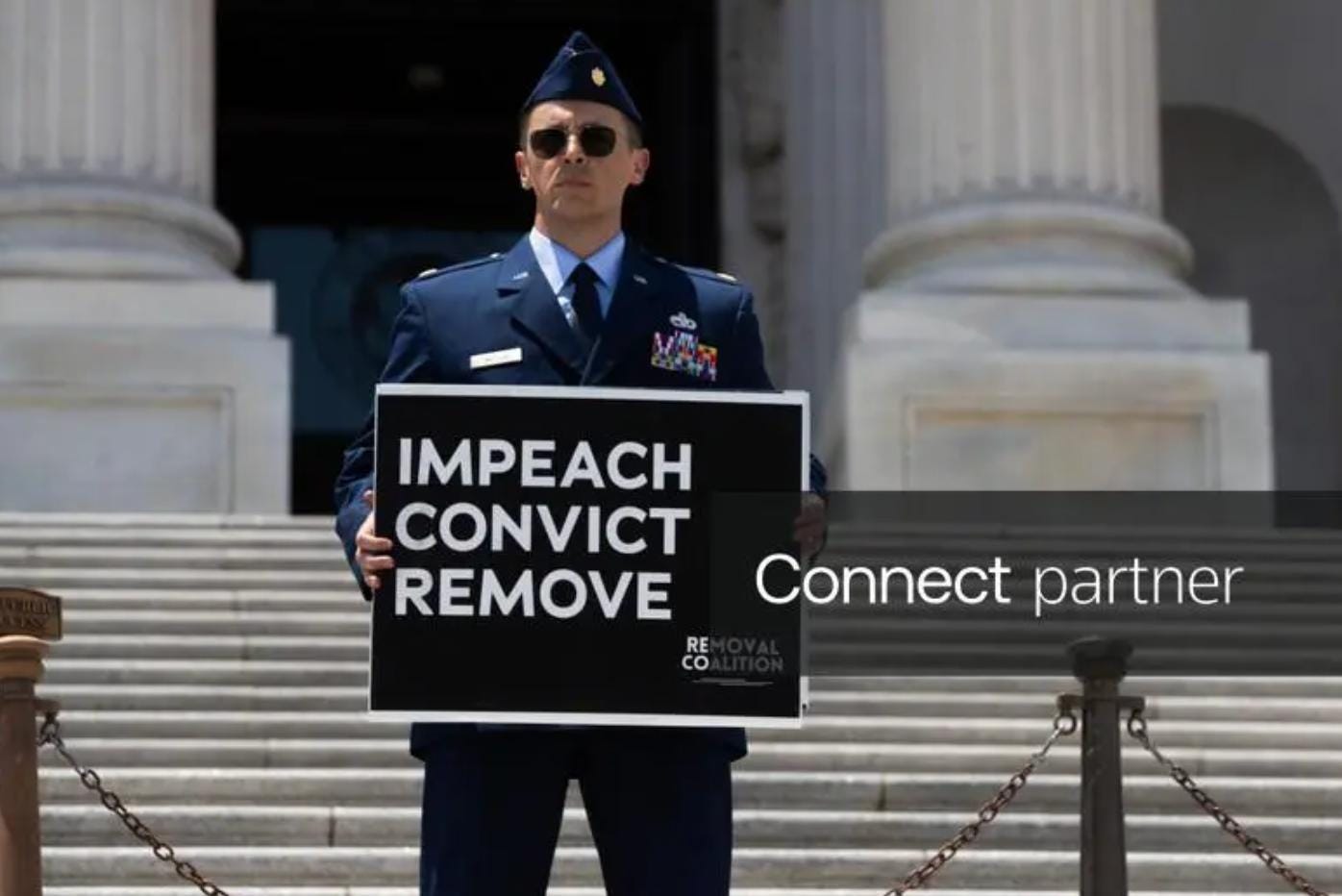
Watson accused Trump of committing numerous impeachable offenses, including unauthorized military strikes, abuse of executive authority, weaponizing the Justice Department and denying due process to immigrants. He argued Congress has failed to fulfill its constitutional duty and urged lawmakers to pursue impeachment, calling Green the only member of Congress willing to force the issue. Green’s latest impeachment resolution was blocked by the House, though he has said he could bring another vote. Watson said he is not a Democrat but believes impeachment is necessary to uphold the Constitution.
Federal health experts and researchers are warning that recent cuts to federal public health agencies, disease surveillance, and international health programs could leave the U.S. more vulnerable to infectious disease outbreaks. Critics say reductions in staffing, research, and monitoring programs have weakened the nation’s ability to detect and respond to emerging threats, while the Trump administration argues the reforms eliminate waste and improve efficiency. Officials point to several diseases that are becoming more concerning as climate change, global travel, and reduced surveillance increase the risk of outbreaks. The administration disputes that the cuts have compromised public health and says key monitoring efforts remain in place.
Malaria: International malaria prevention programs were disrupted after foreign aid freezes and USAID cuts, while CDC restructuring interrupted malaria research. Federal health officials recently warned that the U.S. remains vulnerable to malaria returning, as mosquitoes capable of spreading the disease are widespread and locally acquired cases have already occurred in recent years.
Flesh-eating bacteria (Vibrio vulnificus): Researchers have detected the bacteria in coastal waters on Long Island, and infections have already been reported in Florida. Experts warn that warmer waters linked to climate change are helping the bacteria spread, while reduced federal surveillance and ocean monitoring could make outbreaks harder to track.
Screwworm: The parasitic fly, which can kill livestock by feeding on living tissue, has reappeared in the U.S. after being eliminated for decades. Researchers say cuts to USDA staffing and international disease monitoring may have weakened prevention efforts, though the Trump administration rejects that explanation and blames the Biden administration for failing to prevent its return.
Donald Trump said acting Director of National Intelligence Bill Pulte will lead the agency for only "a month or two" but has broad authority to declassify intelligence while serving in the role. Trump said he has authorized Pulte to "declassify whatever you want" and that his permanent nominee, Jay Clayton, is expected to have a Senate confirmation hearing in about two weeks. Pulte's temporary appointment has drawn criticism from Democrats and concern from some Republicans because he lacks intelligence experience, and it has delayed Senate action on key intelligence legislation. Trump praised both Pulte and Clayton, calling Clayton "highly respected" while reaffirming his confidence in Pulte's temporary leadership.
Acting Attorney General Todd Blanche said the Trump administration will intensify efforts to crack down on so-called “birth tourism” following the Supreme Court’s decision preserving birthright citizenship. Blanche said the Justice Department, FBI, and Homeland Security Investigations will target people who allegedly travel to the U.S. on temporary visas to give birth, while DOJ officials directed prosecutors to pursue fraud cases tied to the practice. The administration argues birth tourism undermines immigration laws, though government lawyers have acknowledged the scope of the practice is unclear and estimates suggest it accounts for less than 1% of births in the United States each year. Trump is also urging Congress to pass legislation limiting birthright citizenship for children born to parents without permanent legal status, despite significant legislative hurdles.
A federal judge blocked the U.S. Postal Service from implementing President Trump’s executive order that would have restricted the delivery of mail ballots unless states turned over voter registration lists and met new federal voting requirements. The ruling applies nationwide and found the policy violated a 2021 court settlement requiring USPS to prioritize the timely delivery of election mail. The executive order also called for individualized ballot tracking barcodes and directed the federal government to compile state voter lists, raising concerns among voting rights advocates about federal involvement in elections and voter data collection. The decision is the latest legal setback for Trump’s efforts to reshape mail voting ahead of future elections.
Scientists say they have built a synthetic cell entirely from nonliving chemical components that can feed, grow and replicate, marking a major milestone in synthetic biology. The prototype, called "SpudCell," is much simpler than a natural cell and is not considered fully alive, but researchers say it could help answer fundamental questions about the origins of life and eventually be engineered for uses like manufacturing medicines, capturing carbon or producing chemicals. While the cell is still fragile and can only survive under carefully controlled laboratory conditions, experts called the work a significant breakthrough, though they noted it has not yet undergone peer review. Researchers also emphasized the importance of building safety measures into future synthetic cells and said they hope to make the technology widely available to scientists through an open-source model.
Trump has proposed replacing Washington, D.C.'s oldest grove of cherry trees along the National Mall with a new golf course. The plan would remove a public biking path and picnic areas, convert public land for the project, and use public funding for its construction, reducing public recreational space in the process.

The current state of the Great America State Fair today:
According to TMZ reporting, newly obtained EMS radio traffic reveals Sen. Mitch McConnell was found unconscious at his Washington, D.C., home before being transported to a hospital on June 14. His office initially said only that he was receiving "excellent care" without disclosing the nature of the medical emergency, and it remains unclear whether he is still hospitalized. The 84-year-old senator has experienced several health issues in recent years, including previous hospitalizations and public episodes where he froze while speaking.
Former CIA Director John Brennan has sued the Trump administration, asking a federal court to order officials to preserve records related to ongoing investigations into him. Brennan argues the documents could be critical if he is later indicted, saying they would help support a defense that any prosecution was politically motivated and retaliatory. The lawsuit cites more than 100 public statements by President Trump criticizing Brennan since 2017 and names Trump, acting Attorney General Todd Blanche, FBI Director Kash Patel, and other officials as defendants. Brennan says he is the subject of investigations tied to the 2016 Russia election interference assessment and allegations of a conspiracy against Trump, though no criminal charges have been filed and the Justice Department denies claims that the investigations are politically motivated.
Seven more people have been sentenced over a July 2025 protest outside a Texas immigration detention center that ended with a police officer being shot. Six defendants who pleaded guilty received prison terms ranging from nearly two to 15 years, while Ines Soto, who was convicted at trial on terrorism-related charges, was sentenced to 50 years, matching the sentence previously given to her wife. Federal prosecutors argued the group conspired to ambush law enforcement, while defense attorneys maintained the demonstration was intended as a protest supporting detained immigrants and that firearms and protective gear were carried for self-defense. The case has drawn national attention because critics argue the government’s use of terrorism charges and political materials as evidence could have broad implications for future protest-related prosecutions and First Amendment rights.
Rep. Tom Kean Jr.'s disclosure that he spent four months receiving inpatient treatment for depression has sparked a broader debate in Congress over how much privacy elected officials should have about serious health issues. While lawmakers from both parties expressed sympathy and welcomed his return, many, including Speaker Mike Johnson and several Democrats, said Kean should have been more transparent with constituents during his extended absence, especially after missing more than 100 House votes. Others defended his decision, arguing that medical information is deeply personal and that public officials should be able to choose when and how to disclose a diagnosis. The discussion also highlighted changing attitudes toward mental health in politics, with some lawmakers saying Kean's eventual disclosure could help reduce stigma while others questioned whether the months-long silence undermined public accountability.
Senate Minority Leader Chuck Schumer is facing growing criticism from within the Democratic Party over his handling of key 2026 Senate primaries. Some Democrats argue Schumer and the Democratic Senatorial Campaign Committee either intervened too heavily or failed to act effectively in races like Maine, Texas, and Michigan, fueling divisions between the party establishment and progressive challengers. Progressive candidates have scored several high-profile victories, raising questions about Schumer's influence and leadership as some Democrats push for a new direction. Schumer's allies argue his recruitment efforts have expanded Democrats' opportunities to win back the Senate, while critics say the party's strategy is increasingly out of step with Democratic voters.
The Trump political fundraising email list promoted applications for the 2026 “Patriot Games,” a Freedom 250 competition for high school students ages 14 to 17 that awards two $125,000 scholarships and will air on ESPN and ABC. Donors were encouraged to forward the application to eligible teenagers, an outreach approach that has drawn attention because it uses a political fundraising network to recruit minors. The application also asks teens to provide their social media handles for platforms including TikTok, Instagram, and X. The combination of political-channel recruitment and collection of applicants’ social media information has prompted questions about privacy, consent, and how participant data will be handled.
The Justice Department is threatening legal action against states with gun restrictions similar to Hawaii's law that the Supreme Court struck down last week, with Acting Attorney General Todd Blanche saying states should not ignore the Court's Second Amendment ruling. Blanche specifically pointed to New Jersey, Maryland, New York, and California, warning they could face lawsuits if they maintain or adopt similar restrictions. The administration also announced new lawsuits challenging Virginia's assault weapons ban and California's ban on certain semiautomatic convertible pistols, continuing its broader effort to roll back state firearm regulations. The legal push comes as the Supreme Court prepares to hear a major case next term on the constitutionality of assault weapons bans.
German authorities have arrested a German-Rwandan man on suspicion of aiding the 1994 Rwandan genocide, accusing him of ordering the killings of 25 Tutsis and participating in one murder by stabbing a victim. Prosecutors allege he used his role as an assistant to a local mayor to incite violence and create death lists targeting Tutsis. The case is being pursued under Germany’s universal jurisdiction laws, which allow prosecution of serious international crimes regardless of where they occurred. More than 800,000 Tutsis and moderate Hutus were killed during the 1994 genocide, and Germany has previously convicted other suspects connected to the atrocities.
Two people were taken into custody after climbing the spire of New York City’s Empire State Building, where they unfurled a banner reading, “When the power of love beats the love of power, the world knows peace.” The pair, wearing dark clothing and masks, also appeared to stage a proposal before kissing nearly 1,500 feet above the city. Authorities said the climbers were not injured, no visitors were ever in danger, and charges are pending as police investigate how they accessed the restricted area. The Empire State Building said the incident was resolved with the assistance of the NYPD.
Four adults in southern Ohio, including the parents and grandparents of 16 children, have been charged with multiple felony child endangerment counts after authorities discovered the children living in what officials described as horrific conditions. Investigators said the children, ranging from 18 months to 18 years old, were allegedly confined to a small room for years, showed signs of severe neglect, and some were unable to speak or attend school. Several children required hospitalization, including one who was placed in intensive care, while Ohio officials called the case one of the worst they had ever seen. The suspects are being held on $300,000 cash bonds each, and authorities say the children have been removed from the home as the investigation continues.
An independent investigation commissioned by the Archdiocese of Newark cleared Seton Hall University President Monsignor Joseph Reilly of wrongdoing in his handling of a 2012 sexual abuse allegation, concluding he responded promptly but unintentionally failed to follow the university’s reporting procedures because he had not been trained on them. The report also found that a previous 2019 investigation wrongly recommended removing Reilly from university leadership, saying those conclusions were inaccurate. Reilly acknowledged he should have formally reported the allegation but said he believed he had handled it appropriately at the time. Following the findings, both Seton Hall’s board and Cardinal Joseph Tobin reaffirmed their confidence in Reilly’s leadership.
See you soon.
— Aaron


