

Good morning, everyone. Donald Trump is now at war with his own party. A Republican civil war is erupting over his Iran deal, his push to force through the SAVE America Act, and growing frustration that he is undermining the GOP’s own agenda. At the same time, Trump is embracing comparisons to dictators and boasting that he is the most powerful person ever to walk the Earth. Moscow is burning this morning, and Pete Hegseth is floating the possibility of pulling U.S. troops out of Europe.
Last night, I joined Ali Velshi on MS NOW to discuss these developments. Here’s a clip from our conversation—let me know what you think.
Over the next several days, I’ll be publishing a major deep dive into Epstein-related information that many platforms do not want amplified. The pressure campaign against independent reporting continues to intensify. I know I mention this often, but it reflects reality: my inbox is flooded daily with attacks, threats, and attempts to silence this work.
Here’s what you missed:
Trump is at war with Republicans—a revolt is happening:
“Trump’s Versailles Surrender.” The Republican revolt over President Trump’s Iran deal is rapidly escalating, with leading conservatives accusing the administration of rewarding Tehran after months of conflict. Critics argue that lifting sanctions and helping fund Iran’s recovery gives the regime major concessions without forcing it to fully dismantle its nuclear and missile programs. High-profile Republicans including Nikki Haley, Ted Cruz, Mike Pence, and Bill Cassidy have publicly condemned the agreement, with some calling it one of the worst foreign policy mistakes in decades. The backlash has also exposed divisions within the administration, as reports suggest senior officials raised concerns about the deal. Meanwhile, Iranian leaders are celebrating the agreement, claiming they achieved more through negotiations than through military confrontation.
Trump lashed out at critics of his newly signed Iran agreement in a series of early-morning social media posts, defending the deal as a success that has helped push stock markets to record highs and lower oil prices. The backlash has come not only from Democrats but also from prominent conservatives and Republican allies who argue the agreement gives Iran significant concessions—including sanctions relief and access to funds—without securing firm guarantees that Tehran will abandon its nuclear ambitions. Critics such as Bill Cassidy, Ted Cruz, and conservative commentator Mark Levin have described the deal as overly generous and potentially dangerous. Trump, however, insists the agreement will stabilize energy markets, end the conflict, and create a framework for future negotiations with Iran. The episode highlights the growing revolt within parts of the Republican coalition, where some longtime Trump supporters are openly questioning one of the most significant foreign policy agreements of his presidency.

Senator Roger Marshall was making the argument that any long-term peace agreement with Iran has to leave the country with some ability to defend itself, otherwise the U.S. risks being drawn into an indefinite conflict. When pressed by CNN's Kaitlan Collins, Marshall said he would prefer Iran not have missiles, but acknowledged that a sovereign state will seek some defensive capabilities and that trying to eliminate them entirely could make the conflict perpetual.
Republicans are growing increasingly worried that President Trump’s political strategy is hurting their chances in the upcoming midterm elections, even as Trump insists his approach is the key to victory. The dispute centers on Trump’s demands that Republicans aggressively pursue measures like the SAVE America Act, weaken Senate procedural barriers, and embrace more confrontational tactics that many GOP lawmakers view as politically risky or unrealistic. While Trump believes issues such as election integrity and voter ID are popular with voters, many Republicans argue that swing voters are more focused on economic concerns like inflation and the cost of living. The tension reflects a broader divide between Trump’s willingness to challenge political norms and Republican lawmakers who must operate within existing institutions and face competitive general elections. As the midterms approach, the disagreement has exposed growing frustration within the GOP over whether Trump’s priorities are helping or hurting the party’s electoral prospects.
Senate Republicans are increasingly frustrated with President Trump, arguing that his last-minute interventions and shifting demands are making it harder for them to govern and advance his own agenda. The latest flashpoint came when Trump abruptly withdrew support for a planned confirmation vote on intelligence chief nominee Jay Clayton, disrupting Senate plans and reigniting tensions over a surveillance bill and Trump’s push for the SAVE America Act. Several GOP senators publicly criticized the White House’s lack of coordination, with some warning that Trump’s habit of changing course at the last minute is undermining legislative progress and damaging party unity ahead of the midterms. While Senate leaders continue trying to maintain a working relationship with Trump, many Republicans are openly acknowledging growing frustration with a president who they say prioritizes his immediate political goals over the practical realities of governing. The dispute highlights a widening divide between Trump’s confrontational style and Senate Republicans’ efforts to focus on passing legislation and defending their congressional majorities.
Trump launches late-night unhinged social media spree as Hegseth attacks NATO:
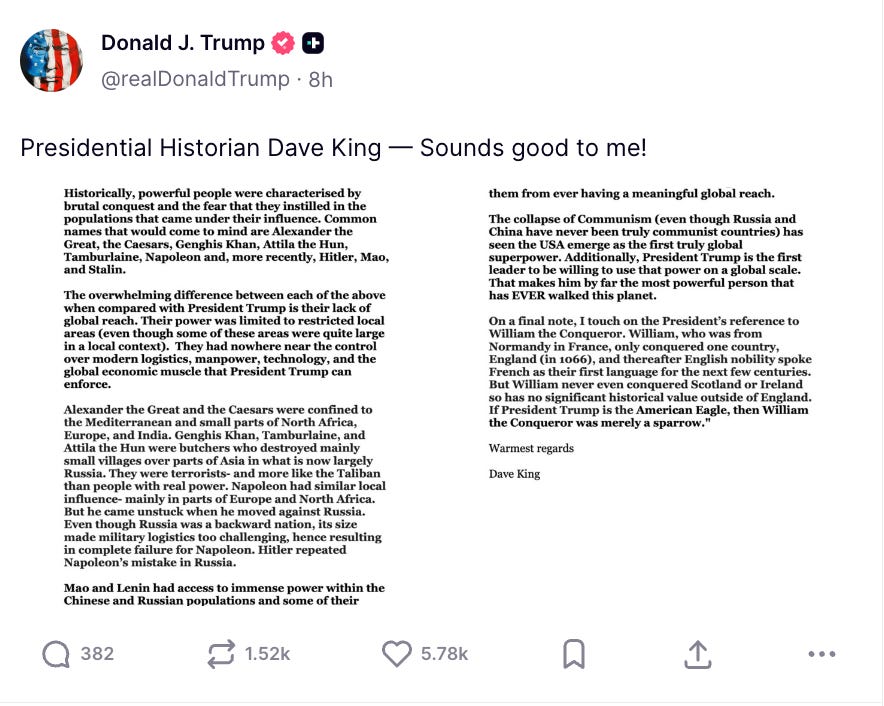
President Trump sparked controversy by sharing a social media post claiming he is “the most powerful person that has ever walked this planet.” The post compared him favorably to people like Adolf Hitler, Genghis Khan, Napoleon, Attila the Hun, and William the Conqueror, arguing that none possessed the same global military, economic, and technological reach available to a modern U.S. president. Trump appeared to endorse the claim, reposting it with the comment, “Sounds good to me!” The post came shortly after he announced a controversial Iran peace deal and amid reports that he has privately spoken about wanting to be remembered as uniquely powerful and capable of achieving what others could not.
Defense Secretary Pete Hegseth sharply criticized NATO allies for refusing to grant U.S. forces access to European bases and airspace during operations against Iran, calling their actions “shameful.” He announced a six-month Pentagon review of U.S. troop deployments in Europe, saying future American commitments will depend on whether European nations take greater responsibility for their own defense. Hegseth also pushed for a stronger “NATO 3.0,” arguing that the alliance should become a more capable military force led primarily by European members rather than relying heavily on the United States. His remarks come as the Trump administration signals a broader shift of military resources toward the Indo-Pacific and reduces some of the forces and assets it would traditionally provide to NATO in a crisis. Despite these changes, the U.S. plans to maintain its nuclear deterrent in Europe and continue supporting NATO’s overall security framework.
Defense Secretary Pete Hegseth warned that the United States is prepared to resume military action against Iran and reimpose a blockade if Tehran fails to comply with the commitments it made under the newly signed agreement. Speaking after a NATO meeting in Brussels, Hegseth emphasized that President Donald Trump views the deal as conditional and backed by the threat of force. The remarks were intended to reassure critics who argue the agreement gives Iran too much while relying heavily on future compliance. Hegseth said the administration will closely monitor Iran’s actions during the implementation period and is prepared to act if Tehran violates the terms. His comments underscore that the White House sees the agreement not as a final settlement, but as a test of whether Iran will follow through on its promises.
Other news:
Ukraine launched one of its largest drone attacks on Moscow since the war began, striking a major oil refinery for the second time in a week and disrupting flights across the Russian capital. The attack, which reportedly involved hundreds of drones, sent thick black smoke over Moscow and underscored Ukraine’s growing ability to hit targets deep inside Russia. Ukrainian officials said the strikes are intended to pressure Vladimir Putin into negotiations and make Russians feel the costs of the war, while Russia claimed it intercepted hundreds of incoming drones. The operation came as President Zelenskyy secured additional military and diplomatic support from Western allies at the G7 summit and prepared for talks with NATO and EU leaders in Brussels. The attack represents another embarrassing security breach for the Kremlin and highlights Ukraine’s increasing reliance on advanced drone warfare to offset Russia’s larger military.
A leaked guest list for the secretive invitation-only “Dialog” society has sparked controversy after it appeared to include Kaja Kallas alongside prominent politicians, tech executives, and investors. However, the European Commission has denied that Kallas is a member of the group or plans to attend its upcoming retreat near Dublin. The leaked list reportedly includes figures such as Elon Musk, Ted Cruz, Cory Booker, and Garry Kasparov. The gathering, co-founded by investor Peter Thiel, has attracted scrutiny because of its secrecy, influential membership, and reports that convicted sex offender Jeffrey Epstein had connections to the network and received an invitation to a past event. The disclosure has renewed debate about elite private forums where political leaders, billionaires, and technology executives meet behind closed doors with little public transparency.
A new CNN poll finds that former President Barack Obama remains the most popular living U.S. president, with 57% of Americans holding a favorable view of him—well ahead of both Donald Trump (34%) and Joe Biden (30%). Obama also performs much better among independents and retains near-universal support from Democrats, while Trump and Biden remain more polarizing figures. The poll suggests that Obama’s reputation has improved since leaving office, while Biden’s favorability has fallen below any level recorded during his presidency. When Americans were asked which president they most admire, Obama led with 30%, followed by Trump at 19%, with historical figures like Abraham Lincoln and Ronald Reagan trailing behind. The findings highlight how Obama has emerged as a uniquely popular figure across party lines compared with other recent presidents.
The Supreme Court ruled in United States v. Hemani that the government cannot prosecute an otherwise law-abiding person for possessing a firearm solely because they occasionally use marijuana. The Court found that applying the federal ban in this case was inconsistent with the Second Amendment and not supported by the nation’s historical tradition of firearm regulation. The decision marks another major expansion of gun rights and raises questions about the constitutionality of federal laws restricting firearm ownership by certain categories of drug users. The ruling could have broad implications for future gun-control cases and limits the government’s ability to disarm people based on nonviolent marijuana use alone.
According to CNN, the Trump administration is dramatically expanding efforts to revoke U.S. citizenship from naturalized Americans, with the Justice Department planning to file at least 250 denaturalization cases by October. Officials say the cases will focus on people who obtained citizenship through fraud, concealed criminal activity, or posed national security threats, and the administration has reassigned attorneys from other divisions to accelerate the effort. The push is part of Trump’s broader immigration agenda and has already surpassed the pace of previous administrations, which used denaturalization far more sparingly. Critics warn the initiative could stretch legal resources and raise concerns about the security of citizenship for naturalized Americans, while the administration argues it is necessary to protect the integrity of the naturalization process.
President Trump has abandoned his long-running $100 million lawsuit against his niece, Mary Trump, over her role in providing financial records that helped journalists investigate his tax affairs. The lawsuit accused Mary Trump, along with reporters and organizations including The New York Times, of conspiring to obtain confidential documents, but Trump had already lost key parts of the case in court on First Amendment grounds. Both sides now say they have reached a settlement and have asked the court to dismiss the case permanently, preventing Trump from reviving the claims in the future. The financial terms have not been disclosed, and the agreement effectively ends one of Trump’s highest-profile legal efforts against family members and media organizations involved in reporting on his finances. The settlement comes after years of litigation and follows broader setbacks for Trump’s attempts to pursue legal action against those who exposed details of his business and tax records.
Democratic Rep. Jamie Raskin is demanding new investigations into the ties that both Harvard University and Bard College had with convicted sex offender Jeffrey Epstein. Raskin argues that previous internal reviews failed to fully uncover how Epstein used relationships with university leaders, faculty, and donors to enhance his reputation and potentially facilitate abuse. He is seeking extensive records from Harvard regarding Epstein’s donations and connections to faculty, including former Harvard president Larry Summers, while also requesting an interview with outgoing Bard president Leon Botstein. The renewed scrutiny follows recent disclosures from government-released Epstein files and a Bard-commissioned investigation that criticized Botstein for lapses in judgment and transparency regarding his relationship with Epstein. Raskin says a full public accounting is needed to understand how Epstein leveraged elite academic institutions and to prevent similar abuses in the future.
Jeff Bezos says humanity should eventually move polluting industries off Earth and onto the Moon in order to restore the planet’s environment and support continued economic growth. Speaking in Paris, the Blue Origin founder argued that industries such as data centers for AI could be among the first major operations relocated to space, calling the Moon a valuable resource for humanity’s future. Bezos also pushed back on fears that artificial intelligence will eliminate jobs, predicting instead that AI will increase demand for workers and create labor shortages. His comments align with Blue Origin’s long-term vision of building permanent infrastructure beyond Earth, including lunar transportation systems and space-based computing networks. The remarks come as the company expands its role in NASA’s lunar program despite recent setbacks, including an explosion during testing of its New Glenn rocket.
A massive warehouse fire in Los Angeles’ Boyle Heights neighborhood sent thick black smoke across the city and prompted officials to issue a shelter-in-place warning over concerns about hazardous air quality. Residents were urged to stay indoors, seal their homes, and turn off ventilation systems as firefighters battled the blaze at a nearly 500,000-square-foot cold-storage facility. Authorities initially feared the fire could reach an ammonia line, but later said that risk had subsided. By late afternoon, crews had extinguished the roof fire and begun assessing damage inside the warehouse. The incident raised concerns about toxic smoke from the burning structure and solar panels, though no major injuries were immediately reported.
See you soon.
— Aaron


