

Good morning. Thomas Massie stood on the House floor last night and read the names of alleged Epstein coconspirators into the record, from a former British prince to a retail billionaire, while pushing a discharge petition to force a vote on stronger transparency legislation the government has continued to slow-walk for a year. It’s landing the same day the Army lost its civilian secretary after months of open warfare with Pete Hegseth, leaving the military’s largest branch without a single Senate-confirmed leader at the top, and as a USPS whistleblower warns the agency’s rushed rollout of Trump’s mail-voting restrictions risks derailing the midterms outright.
I spoke with Lauren Hersch, co-founder of World Without Exploitation, the group leading the fight to get the Epstein files released, and we talked through the major victories in that fight so far.
The Epstein files remain the most important story in this news cycle. It’s something I’ve fought for over many months, and something I will keep fighting for until survivors get real answers. The White House and its allies have not been pleased with our reporting, but that won’t stop me from exposing the truth. If you want this work to continue while others try to silence it, subscribe and stand with me.
Let’s get into it.
Massie reads the names of Epstein Co-conspirators:
Rep. Thomas Massie (R-Ky.) took to the House floor Monday night and read aloud the names of more than a dozen alleged Epstein coconspirators, including Andrew Mountbatten-Windsor (formerly Prince Andrew) and retail billionaire Les Wexner, calling for them to be investigated and prosecuted.
He paired the move with a push to collect the 218 signatures needed for a discharge petition forcing a vote on the Epstein Files Transparency Act II. Massie noted it’s been a year since Trump signed the original EFTA, yet the government still withholds over three million files, which he says is exactly why the follow-up bill is needed. Mountbatten-Windsor has denied ever meeting accuser Virginia Giuffre, and Wexner has denied firsthand knowledge of Epstein’s crimes despite having employed him as a financial manager in the 1990s and early 2000s.
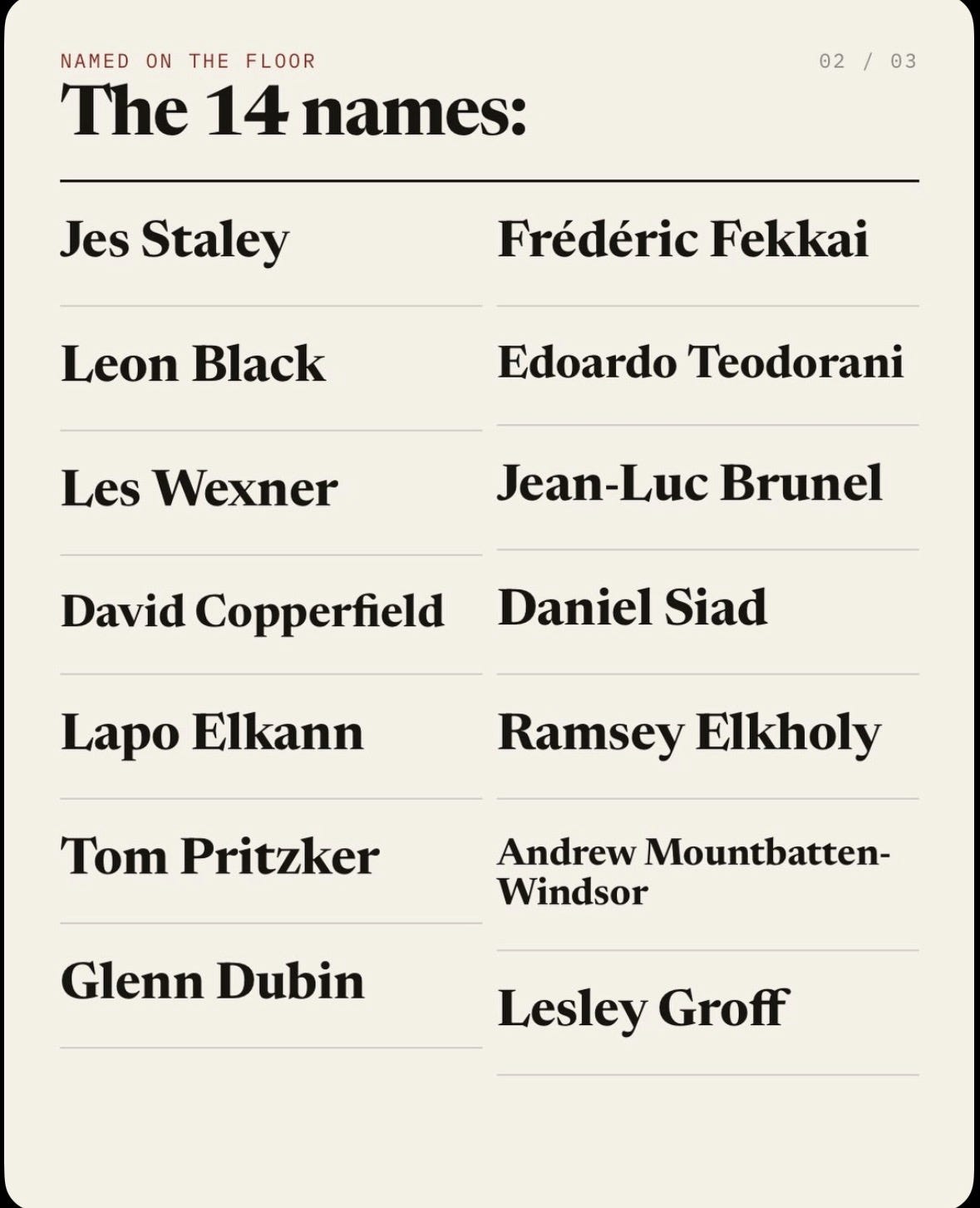
The Epstein Files Transparency Act II, introduced in July by a bipartisan group including Massie, Ro Khanna, Teresa Leger Fernández, Jeff Merkley, and Ben Ray Luján, is meant to fix what advocates call the original law’s toothless enforcement. It would let state attorneys general, local DAs, survivors, and members of Congress sue the Justice Department directly if it fails to release required files, grant survivors full unredacted access to records concerning themselves (including FBI interview transcripts), and impose existing federal criminal penalties on DOJ and FBI officials who knowingly conceal, destroy, or falsify records. Legal experts like attorney Oleg Nekritin called the framework a potential “gamechanger” for state-level investigations, while others cautioned the bill still faces a steep climb, needing House passage, 60 votes in the Senate, and ultimately Trump’s signature.
Even bill backers acknowledge real skepticism about whether it changes DOJ behavior in practice; legal experts noted the bill has “more teeth” on paper but doubted another law alone would end the department’s pattern of delay if it simply keeps dragging its feet. Sen. Merkley was blunt in blaming Attorney General Todd Blanche directly, saying the bill ensures “even Trump and his crony...can’t stop the truth from coming to light.” The Justice Department did not respond to requests for comment, while a White House spokesperson pushed back by touting Trump’s existing cooperation, including signing the original EFTA and releasing thousands of pages of documents, as proof he’s “done more for Epstein’s victims than anyone before him.” The news outlet Radar Online, which has pursued its own nine-year FOIA lawsuit over the files, called the new bill a step in the right direction but argued the public already has a faster path to transparency through existing FOIA law.
Army in turmoil:
Army Secretary Dan Driscoll submitted his resignation to the White House Monday after months of escalating tension with Defense Secretary Pete Hegseth over the firing of senior officers and the direction of the Army’s modernization efforts. The Atlantic reports the break came to a head last week when Driscoll personally raised his concerns directly with Trump, telling him how many generals and top officers had been fired, pushed out, or passed over under Hegseth; Trump was reportedly surprised by the scale of it and expressed concern about the cuts. Driscoll, a close ally and Yale Law classmate of Vice President JD Vance, had told confidants for months he intended to leave around the midterms, and he’s expected to play a role in any future Vance presidential campaign. Neither the White House nor the Pentagon responded to requests for comment on the resignation or who might succeed him.
The departure leaves the Army, the military’s largest service with more than 450,000 active-duty soldiers, without a Senate-confirmed civilian secretary, a confirmed chief of staff, a confirmed general overseeing operations, or a confirmed commander of Army forces in Europe. Acting Chief of Staff Gen. Christopher LaNeve, who already faces congressional pushback over his own nomination, is now effectively filling multiple top roles at once, and he recently halted a joint US-Ukraine drone warfare training program. Hegseth’s broader purge has also claimed well-regarded officers like former Army chief Gen. Randy George and Europe commander Gen. Christopher Donahue, who had been central to supporting Ukraine and planning against Russian aggression. A former defense official said the Driscoll-George modernization push is now likely “dead,” calling it an uphill battle even under better circumstances.
The shakeup isn’t limited to Driscoll: Deputy Undersecretary Dave Fitzgerald, who along with Driscoll championed bringing small tech firms into the Army to boost innovation, is also expected to leave the Pentagon as soon as this week. The timing is notable given the Army is simultaneously managing an extended Middle East conflict and trying to persuade Congress to approve major new investments in munitions, personnel, and equipment. Driscoll and Hegseth had clashed before, including when Driscoll became the face of the administration’s Ukraine peace efforts last fall while Hegseth stayed focused on other priorities. Driscoll, an Iraq War veteran, also briefly served as acting director of the ATF last year.
Voting restrictions/USPS Whistleblower:
A newly released whistleblower disclosure, submitted Monday by Sen. Richard Blumenthal (D-CT) to USPS, warns the Postal Service’s rushed rollout of an online portal to implement Trump’s mail-in voting restrictions could “derail” the midterm elections. The whistleblower, represented by the nonprofit Whistleblower Aid, claims USPS leadership discarded standard testing practices to hit a September 1 launch deadline, raising the question of whether “catastrophic failure would be a feature rather than a bug.” A particularly serious flaw involves USPS’s “zero-percent failure policy” for verifying that mail-in ballots meet the new rule’s requirements, a process the disclosure calls “entirely unforgiving” and warns could delay ballots by the thousands through repeated verification cycles, potentially preventing states from mailing out enormous numbers of ballots at all. Blumenthal called the findings “mind-boggling” and urged Postmaster General David Steiner to abandon the plan entirely, while USPS did not immediately respond to NPR’s questions.
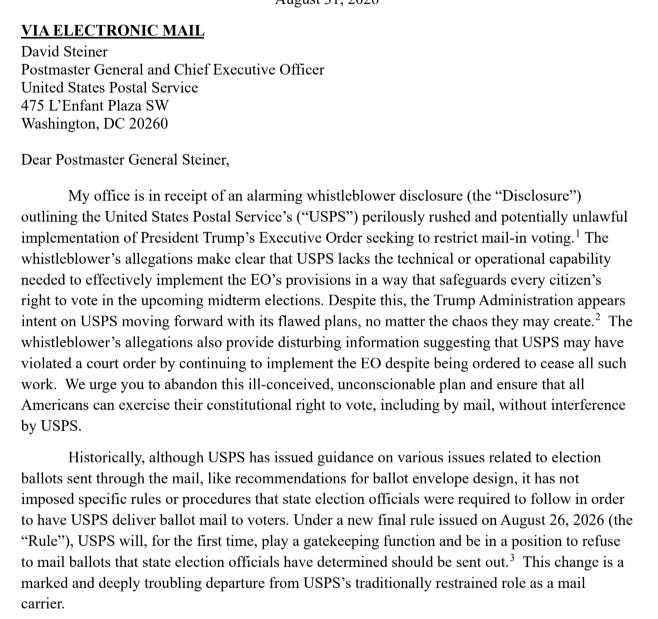
The rollout remains legally contested even as voting by mail for the midterms is set to begin this week: a federal judge in Boston issued a temporary restraining order last week finding USPS’s plan likely illegal because the agency lacks authority to control mail voting, and the Trump administration has appealed that ruling to the 1st Circuit, setting up what could become another Supreme Court fight. Trump has defended the underlying executive order as necessary to curb noncitizen voting, despite numerous studies and audits showing such fraud is extremely rare, an argument that hasn’t been affected by the technical concerns raised in the whistleblower report. With key portions of the plan still blocked in court and more lower-court rulings likely as the legal fight continues, election officials and mail-in voters are left navigating significant uncertainty about whether and how the new requirements will actually be enforced in time for the midterms.
Other news:
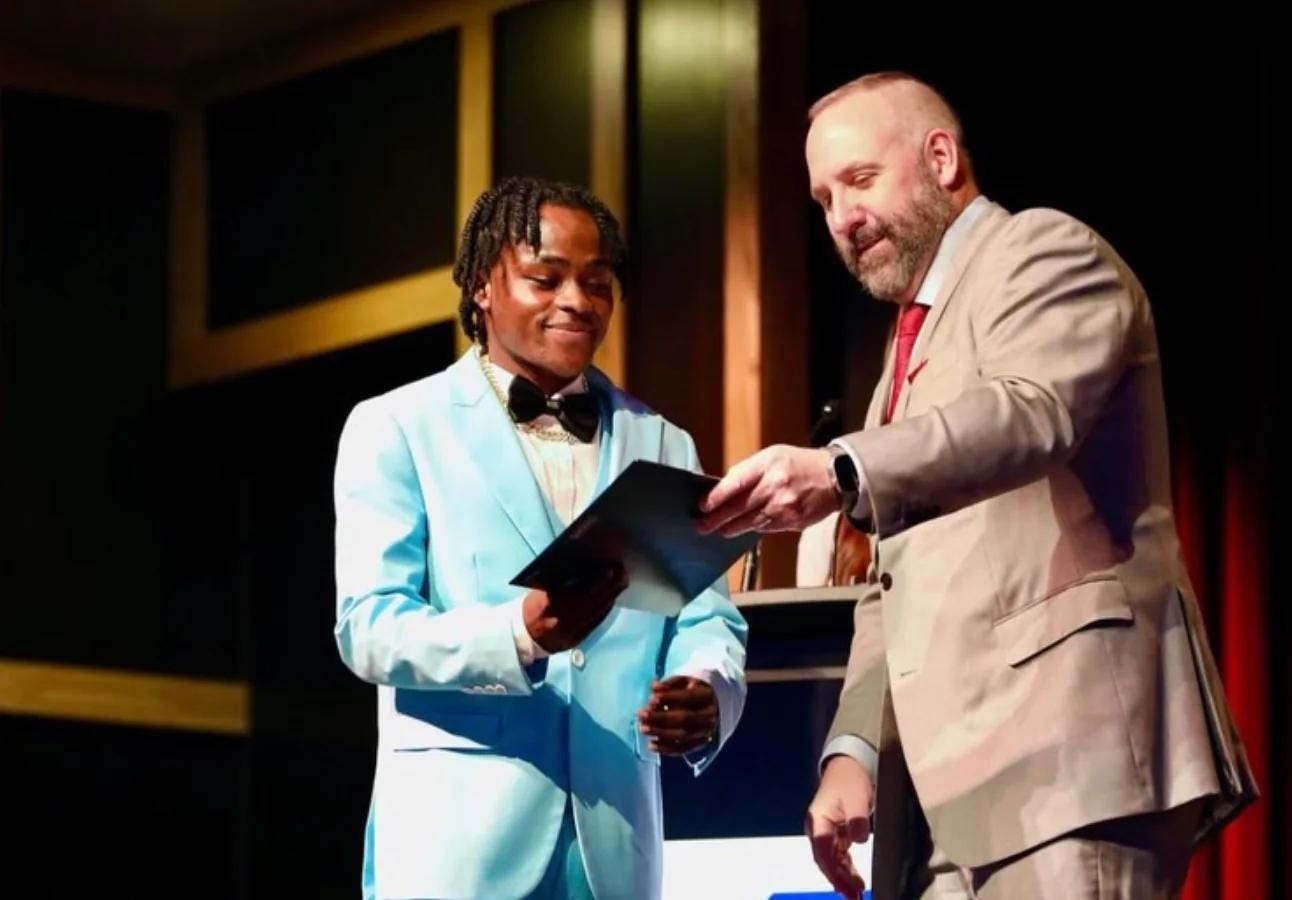
Pierre Damas Bel, a 20-year-old Haitian immigrant in Springfield, Ohio, died Monday after walking into traffic on Interstate 70 and being struck by a tractor-trailer, in what his family believes was a suicide following months of escalating distress. Bel had recently lost temporary protected status, part of a Trump administration policy change affecting an estimated 350,000 Haitian immigrants, and ICE had fitted him with an ankle monitor after summoning him to its office once the Supreme Court allowed the TPS cancellation to proceed; his father said he felt humiliated and “treated like an animal,” was bullied by classmates, and was denied a JROTC uniform days before his death because of the device. Bel had arrived in the US in 2024 to reunite with his parents, graduated high school with honors as a JROTC cadet, dreamed of studying medicine, and had a pending asylum claim with a hearing scheduled for October, fearing gang violence if returned to Haiti. Advocates including Guerline Jozef of the Haitian Bridge Alliance and local pastor Carl Ruby directly tied his death to the administration’s enforcement policies, while Ohio authorities are investigating the crash and DHS did not immediately respond to a request for comment.
Trump this month announced plans to rescind the 25-year-old “roadless rule” protecting roughly 45 million acres of national forest, and Public Citizen research shows the rollback stands to benefit companies that Forest Service chief Tom Schultz previously represented as a timber lobbyist and executive. Schultz, the first-ever Forest Service chief who never worked inside the agency, came from leading the Federal Forest Resource Coalition and serving as an Idaho Forest Group VP, and he’s personally signed agreements doubling federal timber sales in Idaho that directly benefit his former employer. He frames the change as reducing wildfire risk through “active forest management,” but critics note a Forest Service data analysis found wildfires are nearly three times more likely to start near roads, and studies suggest the rollback could endanger 400 threatened and endangered species. Since Schultz’s appointment, timber lobbying groups like the American Forest Resource Council have ramped up spending advocating for the change, and he’s part of a broader pattern of former extractive-industry insiders Trump has placed in top environmental posts.
Former UK Prime Minister Keir Starmer announced he’ll step down as MP for Holborn and St Pancras to focus on international affairs like defense, security, trade, and technology, triggering a byelection in the London seat he’s held since 2015. Starmer, who resigned as PM in July, said he wanted to “pass the baton to a successor” after concluding once you’ve been prime minister you need to answer what comes next. Green Party leader Zack Polanski is reportedly considering a run for the seat, which Starmer’s party has held safely, while independent leftist Andrew Feinstein was his closest challenger last election. The Conservative party chair mocked the move as fitting given Starmer had pledged to stay on as a backbencher, calling the resulting byelection a costly burden on taxpayers.
Tropical Storm Edouard was upgraded from a depression and is expected to make landfall in Texas, bringing potentially heavy rain and flash flooding to the Gulf Coast, with forecasters predicting 3-6 inches of rain around Houston and up to 9 inches on the upper Texas coast. Texas Governor Greg Abbott said flooding is the biggest concern, and crews worked Monday to clear dry vegetation that could spark wildfires from lightning strikes. Elsewhere in the Atlantic and Pacific, the remnants of Tropical Storm Dolly hit Haiti, the Dominican Republic, and the Bahamas with rain and thunderstorms, while Tropical Storm Lowell was forecast to rapidly intensify into a major hurricane near Hawaii. A newly formed Tropical Storm Marie isn’t threatening land off Mexico, and Hurricane Karina strengthened into a powerful category 4 storm far from shore, posing no threat to land.
Canada’s ruling Liberal Party swept all three special elections held Monday, a result Prime Minister Mark Carney called a voter endorsement of his government following his combative standoff with Trump. The most dramatic result came in Quebec’s Chicoutimi-Le Fjord, a district Conservatives had held since 2018, where the Liberal win reflected regional support for Carney’s decision to walk away from stalled trade talks with Washington. The victories bring the Liberals to 173 of 343 House of Commons seats and come amid an escalating US-Canada trade war, after talks collapsed on August 21 and Trump imposed 50% tariffs on roughly $20 billion in Canadian goods. A political science professor noted the Conservative collapse in Quebec, where the party fell from about 41% of the vote to just 13%, looks especially bad for party leader Pierre Poilievre.
A Louisiana jury’s $300,000 defamation verdict against The Advocate newspaper, won by state supreme court justice Jefferson Hughes over a 2019 editorial, has alarmed press freedom advocates who worry it misapplies the “actual malice” standard protecting reporting on public figures. The dispute centered on a timeline discrepancy between an investigative story and a follow-up editorial about Hughes’s romantic relationship with a lawyer in a custody case he’d presided over, and jurors found defamation without ever addressing actual malice on the verdict form, awarding far less than the $10 million Hughes sought. Press Freedom Foundation’s Seth Stern warned that punishing inevitable journalistic mistakes with big damages will make publishers “more timid” toward covering the powerful, while Media Law Resource Center’s George Freeman said there was no evidence the paper knowingly published a false story. The ruling lands just over a week after a similarly concerning $9.25 million verdict against the New York Times in Alabama, though that case involved a private figure rather than a public one, giving the plaintiff a lower legal bar to clear; both verdicts can still be appealed.
Trump suggested he may be reconsidering longstanding US support for British sovereignty over the Falkland Islands, telling reporters “I always review every position,” a remark widely seen as leverage to pressure the UK’s new PM Andy Burnham into raising defense spending and NATO contributions. The comments follow a Telegraph report that a US official said Washington could shift its stance if Britain fails to meet its defense commitments, amid signs Chancellor John Healey may drop the UK’s pledge to hit 3% GDP defense spending by 2030. The US officially stays neutral on the islands’ sovereignty but has recognized British administration since Britain’s 1982 war with Argentina, a conflict in which President Reagan’s staunch support for Margaret Thatcher helped cement their political alliance. Trump has grown close to Argentina’s President Javier Milei, whose party he helped bolster with a $20 billion financial lifeline tied to election results, and Milei has vocally supported Argentina’s rival claim to the islands, adding another layer to the tension.
Gen. Dan Caine, chair of the Joint Chiefs of Staff, told Sen. Elissa Slotkin in a letter that the military has no plans to send federal troops or federalized National Guard members to polling places during the November midterms, nor any plans to use military personnel to seize ballots or voting machines. The assurance came after Slotkin sought confirmation from Caine and Defense Secretary Pete Hegseth amid Democratic anxiety that the Trump administration might try to interfere with the elections, following Trump’s calls to “nationalize” elections and his refusal to rule out sending Guard members or immigration agents to polling sites. Caine added he has “neither received nor anticipate receiving any unlawful order” regarding the military’s role in the midterms, though Hegseth himself has not yet responded to Slotkin’s letter despite a requested deadline. Federal law generally bars armed federal forces from polling places, and the episode echoes a similar 2020 assurance from then-Joint Chiefs chair Gen. Mark Milley, who wrote that election disputes are for courts and Congress to resolve, not the military.
See you soon.
— Aaron


