

Good afternoon. We just published something the Pentagon has spent eight months trying to keep from you. I obtained never-before-seen photos and videos from U.S. bases across the Middle East, along with accounts from troops and families who describe barracks burning with service members trapped inside, troops digging their own foxholes, and families left behind in Bahrain because an evacuation would “look bad at home.”
Meanwhile, Attorney General Todd Blanche said it was possible DOJ could try to block states from certifying the midterm results, a judge halted Trump’s noncitizen voter hunt in nine states over bad data, and another judge ordered Trump to sit for a deposition in his BBC lawsuit after his “matter of national importance” turned out to be a rally and a fundraiser.
Not everyone is happy with today’s reporting, and the reaction has been intense. We’re going to keep pushing. I’ve also moved my Trump-Russia investigation to this weekend for more vetting, because with my family in Ukraine under Russian missiles, I want every claim in it to hold up.
Here’s what you need to know today:
EXCLUSIVE: Never-Before-Seen Images Show Damage to U.S. Bases in the Iran War as Troops and Families Say They Were Left to Fend for Themselves
I worked with VALOR Media Network and MeidasTouch on a bombshell exclusive that shows what the Iran war has done to American troops, which the Pentagon has kept from the public. We obtained dozens of never-before-published photos and videos showing damage to U.S. military bases in Saudi Arabia, Jordan, Kuwait, the UAE, and Bahrain, along with firsthand accounts from people who were there. Since the war began in late February, there have been no embedded journalists, casualty details have come out slowly, and images of damaged American bases have been almost nonexistent. The sources spoke on condition of anonymity because they say they’ve been repeatedly threatened with discipline under the Uniform Code of Military Justice for speaking out or sharing images. “It’s so much worse than people realize,” one source said.
Images from Prince Sultan Air Base in Saudi Arabia show destroyed dining halls, damaged dorms, and aircraft burning on the tarmac. One photo shows a U.S. Air Force E-3 Sentry AWACS surveillance plane that sources say was damaged in an attack that injured 10 to 12 service members and also damaged two KC-135 refueling tankers. Another image shows bunkers built to protect troops from missiles and drones, but their doors had never been mounted. A source also provided an image they say shows a fully destroyed C-17 cargo plane that was piled up to speed cleanup and limit knowledge of the loss, though the Pentagon hasn’t confirmed it and we couldn’t independently verify it. Video we obtained shows U.S. interceptors failing to stop a ballistic missile that then hit the base. “We had no defense against the drones,” one service member said.


At Muwaffaq Salti Air Base in Jordan, sources say three service members were killed when Iranian missiles and drones hit their barracks, and others could hear them calling for help from inside the flames. Service members described about three months of near-constant fire starting in March, coming so often that “the alarms couldn’t keep up.” Sources say F-15s, F-35s, MQ-9 Reaper drones, and helicopters were damaged, and the July 17-18 attack on the barracks left three dead and four more evacuated. Sources say inadequate emergency response and a lack of preparation kept them from reaching the trapped troops, and that people on the ground were surprised more weren’t killed in the overcrowded base. Troops repeatedly ran out of basic hygiene supplies, housing areas were blown up twice, and a hangar holding everything they were preparing to ship home took a direct hit. In July they were told they were going home, then ordered to stay while sitting in the terminal, after many had already thrown away their bedding.


In Kuwait and the UAE, troops say they had no warning the war was starting and were left to protect themselves. In Kuwait, sources say some service members scattered into the desert after the first attacks and lived out of a van for three months until they could be sent home. Photos from September show Camp Buehring almost completely abandoned by the U.S. military, and sources say no one is allowed in parts of it at night. In the UAE, service members said they learned about the war from the news and had no shelters, and only small security teams were armed. Some went into hotels and had to find their own food, including by ordering takeout, while others dug their own foxholes. They described their leadership as “rudderless.”


In Bahrain, military families say the Pentagon refused to evacuate them because it would “make the situation look bad at home.” Sources say local commanders had evacuation plans ready, with planes waiting at the Bahrain airport, but the Pentagon wouldn’t allow it, and then the airport was hit and closed. Some families paid tens of thousands of dollars to get out on their own, and sources say some senior leaders were evacuated under what was presented as a training exercise while other families were left behind for more than a week. During the first wave, some families hid in a mall parking garage for hours, and sources say some children were so traumatized they couldn’t eat for days. “We were used as pawns in the war,” one military spouse said, blaming leaders in Washington and saying “Pete Hegseth thinks he’s a version of Call of Duty where the consequences aren’t real.” A contractor’s wife who escaped through Saudi Arabia at her own expense said, “As an American citizen, I felt completely abandoned by my own government.”
State Department Asked Diplomats Up for Promotion Whether They Voted for Trump, and Privately Tells Asylum Officers Latin America Is Safer Than U.S. Cities
The State Department asked some foreign service officers up for promotion who they voted for in the last three presidential elections, the Washington Sun reports. Six current and former State Department officials told the outlet that top officials made clear only candidates who voted for Trump in 2016, 2020, and 2024 would be eligible for certain mid-to-upper level roles. Candidates were also told their campaign donation history would be checked, and that any donation to Democrats would disqualify them. Federal law clearly prohibits making personnel decisions for career civil servants based on political affiliation. The State Department declined to comment on the voting questions, saying only that the department values “fidelity” and that this is “not about partisan behavior but rather about executing the president’s vision for foreign policy.” Sen. Jeanne Shaheen, the top Democrat on the Senate Foreign Relations Committee, said, “These are critical national security positions and individuals should be chosen for their experience and ability, not their political loyalty,” and that Democrats are working with House committees to investigate.
The loyalty questions are part of a broader push by Trump and Rubio to remake the diplomatic corps in their image. Last year the State Department added a “fidelity” section to performance reviews, requiring managers to judge employees on “completely aligning oneself and one’s team” with the administration’s goals. It also redesigned the Foreign Service Officer Test, and one recent test taker said it included questions about Reagan’s tax policies and Mike Pompeo’s accomplishments, adding that it seemed they were looking for “people who answered a certain way.” The department has cut nearly a quarter of its workforce and gave a $1 million no-bid recruiting contract to a firm whose CEO has said hiring had become too “woke.” Veteran diplomats have been pushed out of senior roles, and the administration previously had to drop job application questions asking about applicants’ favorite Trump policies after a court order. “This is yet another shocking example of the Trump administration hurtling our government back in time to the spoils system of the 19th century,” said Max Stier of the Partnership for Public Service.
The State Department publicly warns Americans about violent crime in Latin America, but internal documents tell asylum officers those countries are no more dangerous than some U.S. cities, CNN reports. The new assessments of Mexico, Honduras, Guatemala, and El Salvador compare their violent crime rates favorably with Baltimore, Houston, and Memphis, and claim many areas of Mexico and El Salvador have crime rates “at least one order of magnitude lower” than major U.S. cities. That’s despite the department’s own public travel warning against going to Honduras because of violent crime and terrorism. Because asylum seekers have to prove a “well-founded fear” of persecution, the documents will likely make it harder for migrants to win their cases, at a time when 94% of asylum cases were already being denied as of June, up from about 50% two years ago. The documents also claim Honduran police are “willing to and able to respond” and that people can safely relocate within their countries. “That clearly understates the degree to which police forces are in collusion with organized crime groups,” said Andrew Selee of the Migration Policy Institute, who called it “a wholesale shift” that raises “red flags.”
Judge Halts Trump’s Noncitizen Voter Hunt in Nine States, Orders Trump to Sit for BBC Deposition, and Arch Construction Could Start Days After the Midterms
A federal judge ordered the Trump administration to stop investigating whether noncitizens are registered to vote in nine states, ruling that it relies on bad data and is intimidating voters. U.S. District Judge Araceli Martinez-Olguin in Oakland halted the probes in California, Connecticut, Georgia, Missouri, Nevada, New York, Pennsylvania, Washington, and Wisconsin until polls close on November 3, though she put the ruling on hold until Friday so the administration can appeal. Court filings showed investigators were told to target naturalized citizens to check whether they had voted before becoming citizens, using lists the judge called “voluminous and unreliable.” During a “surge” that started in late August, agents had no more than 12 minutes per person to decide whether someone was legally allowed to vote. “Even under the best conditions, there is a high likelihood of error in review because there is no federal database containing citizenship status of U.S. residents,” she wrote, adding that citizens’ fears of being wrongly targeted “are well understood as intimidation.” Noncitizen voting is rare, as even the administration’s own investigations have shown, and the Justice Department has lost every one of its lawsuits against the 30 states that refused to hand over voter roll data.
A federal judge ordered Trump to sit for a deposition in his $10 billion lawsuit against the BBC by December 11 or risk having the case thrown out. Trump was supposed to be deposed on October 16 but canceled for what his team called a “matter of national importance.” The BBC’s lawyer told the judge that matter was actually a political rally and a fundraiser. “He was participating in party politics and prioritized that over sitting for the deposition,” attorney Charles Tobin said. Trump’s lawyers had asked to push the deposition to late January, after the December 18 deadline for discovery, but Magistrate Judge Enjoliqué Lett refused and ruled the deposition can be videotaped over their objections. She also ruled the BBC can subpoena records from Mar-a-Lago, since Trump claims the documentary, which spliced together parts of his January 6 speech, hurt him “in his profession, occupation and trade.”
Construction on Trump’s 250-foot triumphal arch in Washington could begin as soon as November 5, two days after the midterms. The Justice Department told a judge in one of the lawsuits trying to stop the project that a federal planning commission could approve final plans that day. Trump has said the arch would store drones and serve as a post for military snipers with a large stockpile of ammunition, but the final plans released last week leave all of that out and describe it as a “ceremonial gateway.” The arch would sit directly across from Arlington National Cemetery, where nearly 430,000 service members, veterans, and family members are buried. Veterans suing to stop it say it would disrupt the solemnity of funerals, and preservationists say it would block views of national landmarks including the Lincoln Memorial. “What better way to celebrate the nation’s 250th anniversary than to shut down the legally required review process, ignore some 100,000 negative public comments, and fast track the construction of a bloated and deeply unpopular monument,” said Charles Birnbaum of the Cultural Landscape Foundation.
A shareholder of the crypto company Circle is suing Trump, alleging he illegally profited from more than $2 billion in deals tied to a top UAE government official, in violation of the Constitution’s ban on foreign emoluments. Circle, which issues the USDC stablecoin, directly competes with World Liberty Financial, the Trump family’s crypto company, and the suit argues that money from a foreign government seeking Trump’s favor steered business away from Circle. According to the complaint, four days before the inauguration an entity backed by Sheikh Tahnoon bin Zayed Al Nahyan, the UAE’s national security adviser, agreed to buy 49% of World Liberty Financial for $500 million, and Trump’s own financial disclosures show he received at least $75.5 million of it after taking office. Weeks later, a UAE government fund chaired by Tahnoon paid for a $2 billion investment in Binance using World Liberty’s brand-new USD1 stablecoin. The suit notes that Trump then pardoned Binance founder Changpeng Zhao, the Commerce Department approved advanced Nvidia chip exports to a Tahnoon-chaired AI company, and regulators gave conditional approval to a World Liberty trust bank now co-owned by the Trump family and the UAE government. “President Trump has turned his office into a source of private profit on a scale without precedent in American history,” said Matt Pelikan of Evergreen Legal, which filed the case in federal court in Washington and is also seeking to bar Steve Witkoff from soliciting emoluments on Trump’s behalf.
U.S. and Israel Reportedly Plan Major New Strikes on Iran After the Midterms as Tehran Threatens “Zero Red Lines”
The U.S. and Israel are reportedly planning major new strikes on Iran for after the November 3 midterms, according to the New York Times. Pete Hegseth met with Benjamin Netanyahu in Israel this week to discuss the timing and goals of a joint attack, and possible targets include Iran’s energy infrastructure, nuclear facilities, and missile and drone arsenals. The Guardian reports that Netanyahu told Hegseth he would prefer Iran attack first, and that the two also discussed what a strike could mean for Netanyahu’s re-election chances ahead of Israel’s October 27 vote. Trump plans to have three aircraft carriers, thousands of Marines, fighter jets, and special operations forces in the region by early November, before a possibly Democratic Congress takes office in January. Trump hasn’t approved the strikes yet, and he has backed away from hitting Iran again seven times in the past four months. Still, last month he said, “I think the war is going to end immediately after the election,” and he has openly floated using the “mother of all bombs” on an underground nuclear site.
Iran is threatening to hit oil facilities, undersea internet cables, data centers, and AI facilities in as many as seven Gulf countries if the U.S. and Israel attack again. Mohsen Rezaei, who leads Iran’s Supreme National Security Council, said there can be no deal in which Iran’s economy comes under attack while “the economic architecture enabling those attacks” stays untouched. “We see the next conflict as an existential threat,” said Mehdi Mohammadi, an adviser to Iran’s top negotiator. “Our strategy is ‘zero red lines,’” he said, adding that the war “will continue longer and in a wider geographical area than the enemy anticipates.” Fars, a news agency close to the Revolutionary Guard, reported that Iran has told its military units that if Iranian officials are assassinated or civilians are killed in a new war, the response “will also include political targets.” A lawyer close to Iran’s foreign ministry warned that power grids, desalination plants, and ports across the region “would burn,” leaving tens of millions without water or electricity.
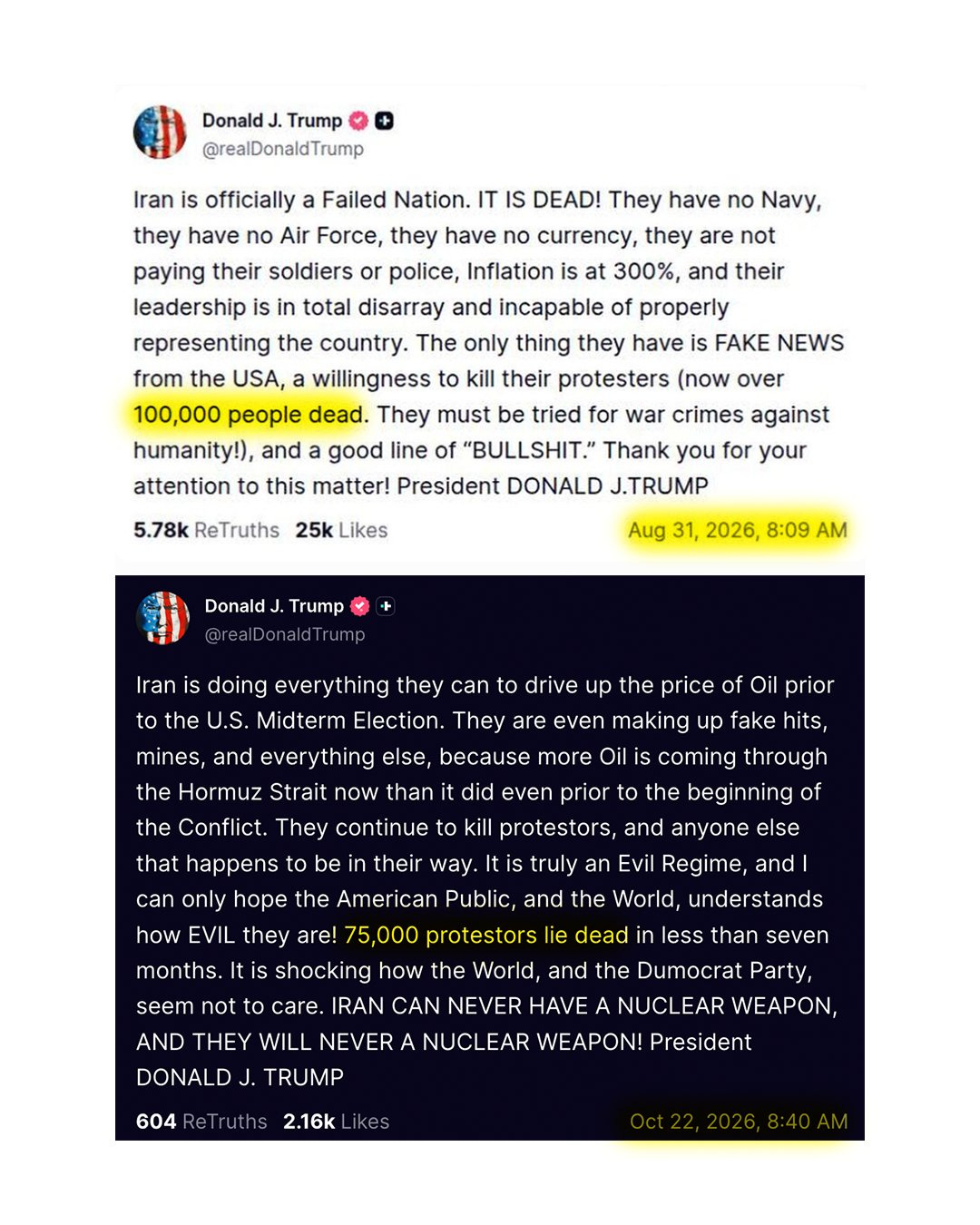
Trump accused Iran of making up attacks on ships in the Strait of Hormuz to drive up oil prices before the midterms. “They are even making up fake hits, mines, and everything else,” Trump wrote on Truth Social, claiming more oil is now moving through Hormuz than before the war. Iran’s Revolutionary Guard says it struck four ships transferring oil and that three more hit mines, all along the southern route near Oman that the U.S. uses to escort tankers out of the Gulf. Neither claim has been independently verified, but Brent crude hit $112 to $113 a barrel, its highest level since May, driven partly by reports of new U.S.-Israeli strikes. Middle East oil exports did top prewar levels last week as shippers use alternate routes, but escorting tankers is costly and instability is keeping prices high. The U.S. naval blockade has cost Iran at least $25 billion in oil revenue, and the Wall Street Journal reports that Iran’s offshore oil stockpile, which it had been selling to China, ran dry in mid-October.
Iran-backed Houthi rebels say they hit four targets inside Saudi Arabia in 48 hours, including the Defense Ministry in Riyadh, as the war spreads across the region. The Houthis claimed strikes on the Defense Ministry, the airport in Dammam, an Aramco facility in Yanbu, and the airport in Abha, though CBS News hasn’t verified the claims. A Saudi-led coalition said it intercepted four more drones over Riyadh and the holy city of Medina on Thursday, and the Houthis have denied targeting Mecca or Medina. Saudi Aramco has reportedly told staff to evacuate its Dhahran headquarters, and the State Department has ordered non-emergency U.S. employees and their families out of the country. The IMF expects Saudi Arabia’s economy to shrink 3.3% this year and the region’s economy to contract 4.8% because of the war. Foreign ministers from Britain, France, Germany, Turkey, Saudi Arabia, Pakistan, and Egypt meet in Istanbul on Friday to try to coordinate a response, amid growing alarm that a new war is now the working assumption in both Tehran and Washington.
Trump Tells Ramaswamy to “Keep It Up” With Ad Featuring Acton’s Estranged Mother, Attacks GOP Governor Who Condemned It
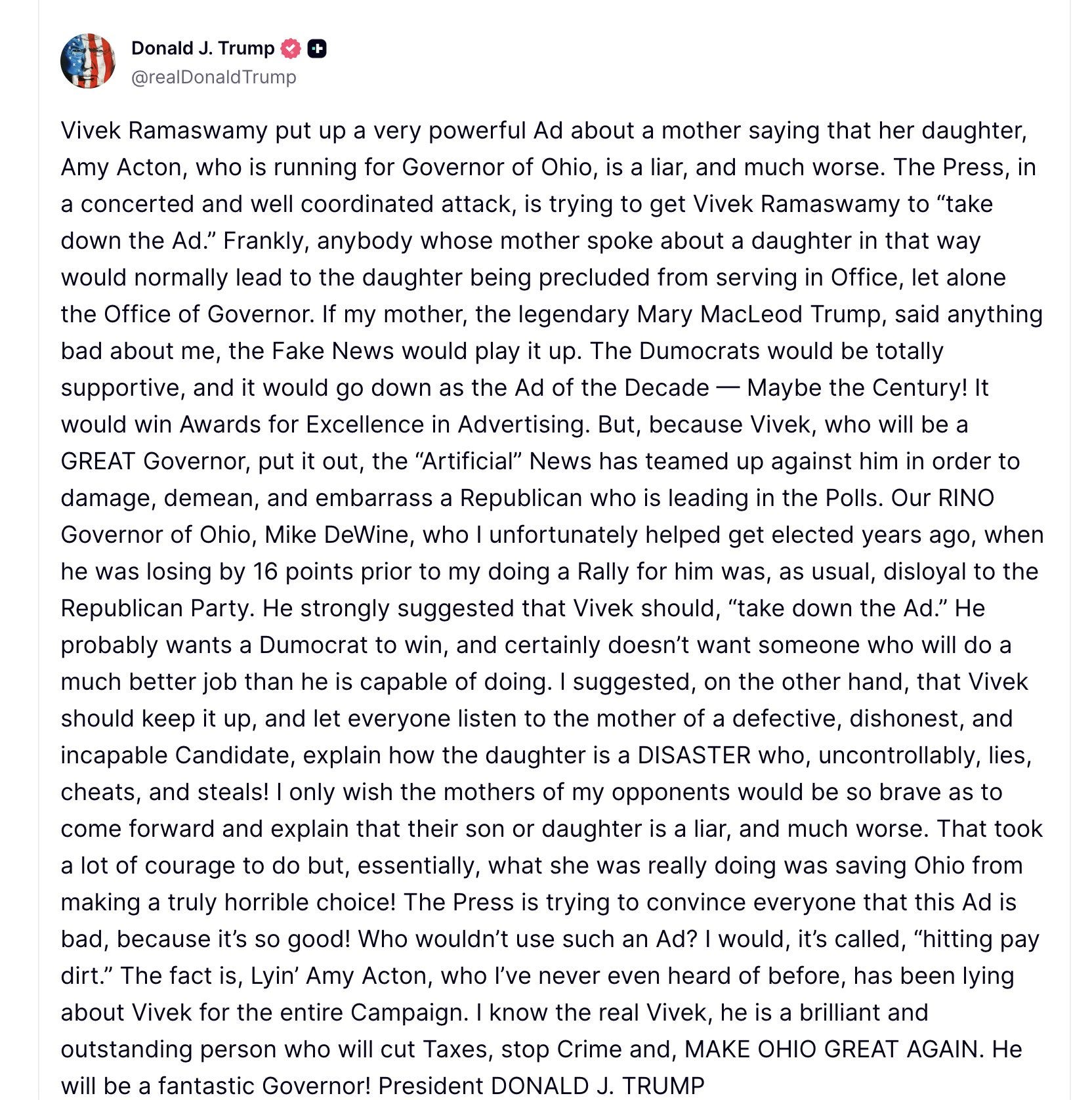
Trump defended Vivek Ramaswamy’s ad featuring Amy Acton’s estranged mother and said he “should keep it up,” attacking Ohio’s Republican governor for asking him to pull it. In a long Truth Social post, Trump called Gov. Mike DeWine a “RINO” who was “as usual, disloyal to the Republican Party” and said DeWine “probably wants a Dumocrat to win.” He praised Acton’s mother for taking “a lot of courage” to appear in the ad, which suggests her daughter has mental health issues. “The Press is trying to convince everyone that this Ad is bad, because it’s so good! Who wouldn’t use such an Ad? I would, it’s called, ‘hitting pay dirt,’” Trump wrote. He also called the Democratic nominee “Lyin’ Amy Acton,” while admitting he had “never even heard of” her before. Hours earlier, DeWine had called the ad “deeply, deeply troubling” and urged Ramaswamy to take it down.
Trump’s defense of the ad puts him on the opposite side from a growing number of Ohio Republicans who have condemned it. Acton’s brother has said he and his sister have been estranged from their mother since Acton was 12 because their mother stayed married to the man who sexually abused Acton as a child. Sen. Jon Husted, who faces a tough reelection fight in Ohio, said he “would not have run the ad.” JD Vance has sided with Trump, saying he’s “a little bit disgusted” to see Republicans “whining more about that advertisement than they are about what the congressional Democrats... want to do.” The fight comes less than two weeks before Election Day in one of the country’s most closely watched governor’s races. The Hill also reports that Acton’s fundraising has surged since the ad aired.
Other news:
Attorney General Todd Blanche said the Justice Department could try to block states from certifying the results of the midterm elections. Blanche made the comment in Norfolk, Virginia, on Thursday, where he and FBI Director Kash Patel announced racketeering charges against Democratic state Sen. Louise Lucas. Asked whether DOJ might move to stop states from certifying the 2026 results, he said it was possible, though he insisted the department did not intend to improperly interfere. States certify their own election results under state law, so any federal attempt to block certification would be a major and likely legally contested escalation. The comment comes less than two weeks before Election Day, as the administration pushes a hunt for noncitizen voters that a federal judge just halted in nine states for relying on error-filled data. Democrats have urged Blanche to recommit to longstanding DOJ policies against interfering in elections.
House Democrats are already reaching out to Pentagon whistleblowers who are ready to “spill their guts” about Pete Hegseth if Democrats win the House, according to the Daily Telegraph. Democrats are reportedly preparing subpoenas for Hegseth and his closest advisers, including his top aide Ricky Buria and his wife Jen Hegseth. “There’s going to be a lot of people that are going to very quietly go to the chair of the Armed Services Committee and are going to spill their guts,” one source told the Telegraph. “It’ll be horrendous. It’ll be consistent embarrassment.” An unnamed Democratic member of Congress said impeachment is the ultimate goal, but only after “a thorough investigation.” Republican Rep. Thomas Massie already filed articles of impeachment against Hegseth last month, and a former senior administration official said Hegseth’s “arrogance” has made former allies willing to work with Democrats, adding, “I hope he and his inner circle have some very strong legal insurance.”
The Justice Department charged Virginia state Sen. Louise Lucas, one of the state’s most powerful Democrats and a frequent Trump critic, with racketeering just 12 days before the midterms. The 82-year-old surrendered Thursday on charges including money laundering conspiracy and conspiracy to distribute marijuana, connected to a cannabis business she co-owns, and half a dozen others, including her daughters, were also charged. Prosecutors allege she used her Senate seat to shield the business from scrutiny and quote an intercepted call in which she allegedly said, “I’ve gotten too old to not be greedy.” The investigation began before Trump took office, but DOJ typically avoids overt steps against political figures within 60 days of an election, and Attorney General Todd Blanche brushed that off, saying, “It’s not even a rule, it’s a practice.” Rep. Suhas Subramanyam said his own communications with Lucas were monitored and accused the DOJ of becoming Trump’s “own personal law firm.” “Today, the FBI, the Department of Justice, and the full weight of the federal government have been wielded against an 82-year-old great-grandmother,” Lucas said. “I grew up under Jim Crow... I’m not stopping now.”
Ohio’s Republican governor, Mike DeWine, called on Vivek Ramaswamy to pull an ad featuring Democrat Amy Acton’s estranged mother, calling it “deeply, deeply troubling.” The Ramaswamy campaign put $4 million behind the minute-long spot, in which Donna Arthur calls her daughter a “liar.” Acton has said she was sexually abused as a child by her mother’s husband, which her brother has corroborated, and she hasn’t spoken to her mother in nearly 50 years. DeWine, a former prosecutor, said the man was indicted and fled with the mother, and that knowing this “makes it just more wrong.” Sen. Jon Husted also said he “would not have run that ad,” but JD Vance told Republicans to “stop whining about an advertisement and go win the race in 13 days.” DeWine still isn’t withdrawing his endorsement of Ramaswamy, and Ramaswamy’s campaign says Acton was the first to bring up her opponent’s mother.
Russia hit Kyiv with ballistic missiles, including cluster warheads, hours after Putin agreed to resume talks and Steve Witkoff called him “a humanitarian.” The overnight strikes killed at least two people and wounded 22, including four children, hitting a bridge over the Dnipro River, homes, energy infrastructure, an ambulance station, and a clinic. “The choice of weapon was deliberate; the choice of target area was deliberate, and so was the intent to inflict as much loss and damage on civilians as possible,” Zelenskyy said. Downing Street said it did not recognize Witkoff’s description of Putin, and Ukraine’s foreign minister said “appeasement, servility and flattery” won’t stop Russia. The White House still hasn’t reversed the slowdown of Starshield, the military version of Musk’s Starlink, and the New York Times reported dozens of Ukrainian drones fell from the sky when it was cut. “Our drones can no longer reach the speeds needed to intercept enemy targets,” said a Kyiv air defense commander, who said he felt betrayed by Washington.
The CDC refused to approve a faster, high-volume measles test that West Coast states requested as the outbreak grows. California and Washington asked the CDC in May to validate a test that could run on machines labs already bought during COVID, which can process up to 500 tests in eight hours. After two months, the CDC said no, citing “other competing priorities.” Health officials from California, Hawaii, Oregon, and Washington have now written to CDC Director Erica Schwartz asking her to reconsider. “If a large outbreak were to occur in our region, without high-throughput capacity, it would be more difficult to scale up diagnostic testing appropriately,” they wrote. HHS said the CDC is “prioritizing emerging technologies” but wouldn’t say whether it plans to approve such a test.
Major U.S. banks are finding unauthorized AI agents operating inside customer accounts, and some appear to be acting on their own, Axios reports. Banks including Morgan Stanley, Bank of America, JPMorgan, Wells Fargo, and Citi are racing to contain the risk. In most cases, users gave AI assistants their login credentials, which breaks bank rules, but some banks have tracked agents calling customer service lines or taking actions that appear independent of what the user asked. Bank executives described the situation as horrifying, especially when agents can make purchases or move money. Many banks say they can’t even tell whether an agent was authorized by a user or has “gone rogue.” Morgan Stanley, JPMorgan, Bank of America, and Citi are now restricting third-party AI agents, and Chase reminded customers not to give their passwords to anyone.
French President Emmanuel Macron says “illegitimate” protests will be banned after some of the worst riots France has seen in years. Macron blamed “seditious” ultra-left groups “whose aim is to bring down the Republic” for last weekend’s looting and car burnings. Protests planned Thursday in Paris, Lyon, Lille, and Grenoble were banned, and night curfews are in place in parts of Paris and other cities, which critics say infringes on the right to protest. The demonstrations began last month at a high school near Paris over staff shortages and spread nationwide into broader anger over the soaring cost of living. A bigger protest is expected Saturday, when the “yellow vest” movement is set to join, and unions are planning another major day of action on November 5. The unrest comes just months before France picks Macron’s successor in next year’s presidential election.
“Looksmaxxing” influencer Clavicular pleaded not guilty to rape charges in Massachusetts. The 20-year-old, whose real name is Braden Peters, is charged with rape, drugging someone for sexual intercourse, and supplying alcohol to someone under 21. The charges stem from allegations by 18-year-old influencer Aleksandra Mendoza, who says that in May 2025, when she was 17, Peters got her drunk during a livestream at his family’s Cape Cod home and assaulted her while she was asleep. Peters has denied wrongdoing, and his lawyers argue that Mendoza kept working with him afterward and only came forward after her brand deals dried up. A judge set bail at $10,000, which Peters paid in cash. He was previously sentenced to probation in Florida after pleading no contest to unlawfully firing a gun in public in an incident where shots were fired at an alligator.
See you soon.
— Aaron


