

Good afternoon. I’m sending today’s newsletter a little earlier than usual because I’m about to head out to cover a major protest at the Kennedy Center, and because news is breaking right now that couldn’t wait. That includes exclusive video and images I obtained this afternoon from Kuwait showing the aftermath of an Iranian strike on a US base there, damage the Pentagon still hasn’t addressed publicly, and reporting that lines up with what ABC News independently uncovered at several other bases across the region this week.
There’s a lot more breaking alongside it. CNN has new reporting that the US nearly intercepted a Chinese ship this spring after an AI chatbot fabricated an intelligence report claiming it was carrying nuclear weapons components, a false alarm one source says “almost started a war.” Trump has banned CNN, MS Now, and Politico from the White House altogether. And the Washington Post has learned the Pentagon has been undercounting American troop deaths in the Iran war, on the same day the Defense Department told Congress the war’s price tag has now hit $45.1 billion. It’s all below, along with the rest of today’s news.
I want to be upfront that stories like the Kuwait exclusive tend to put me directly in the crosshairs of this White House. Independent reporting that the administration would rather stay buried only survives because of readers who back it, so if you’re able to, please consider becoming a paid subscriber today. It genuinely makes the difference in whether I can keep digging into stories like this one.
Here’s what I’ve got for you this morning.
Exclusive Images of Iranian Damage on US Bases:
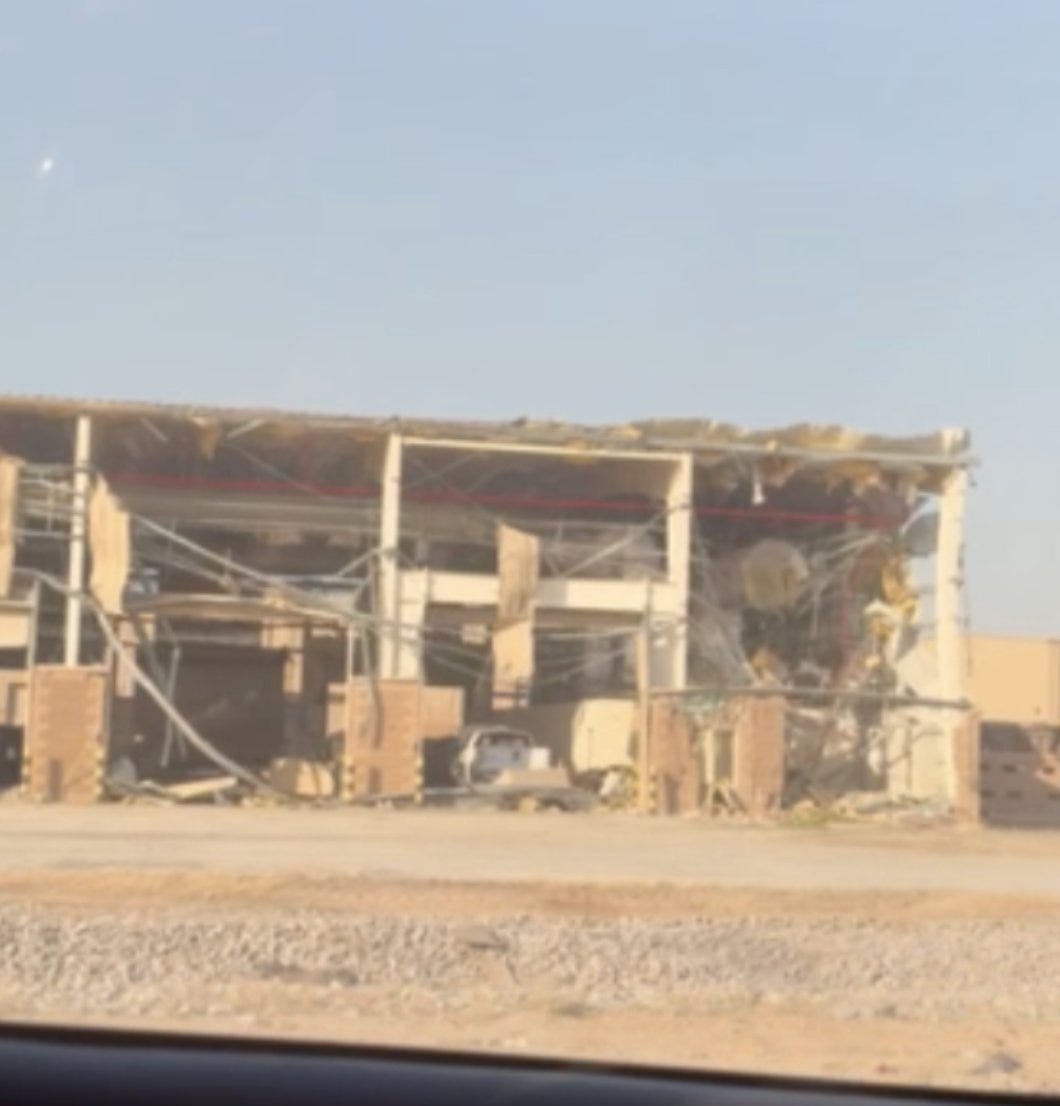
I obtained exclusive images this afternoon showing the aftermath of an Iranian attack on a US base in Kuwait, and based on what I’ve reviewed, the destruction is severe. Several structures at the base appear to have been completely destroyed, with everything surrounding them leveled as well. What were once functioning structures are now flattened, with debris scattered across the surrounding area.
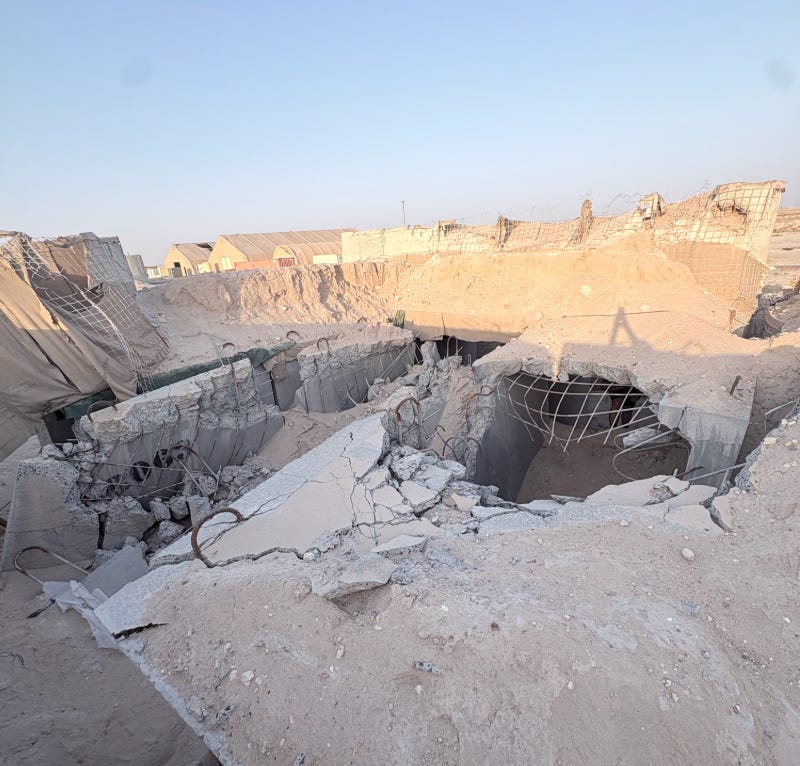
The most alarming detail in the material I obtained involves one of the base’s bunkers, the exact kind of hardened structure troops are trained to run to and shelter in the moment incoming fire is detected. According to the images, that bunker took a direct drone hit. The fact that a shelter specifically built to protect personnel during an attack was itself struck is the detail that stands out most, and the base’s airfield was also completely destroyed in the strike.
My reporting lines up with what ABC News separately and independently reported this week. ABC’s Rachel Scott and Chris Boccia obtained their own images and video showing damage to buildings and at least one aircraft across three US bases in Kuwait, including Camp Arifjan, along with Prince Sultan Air Base in Saudi Arabia, which houses US assets that were partially evacuated amid the danger. CBS News had separately reported on widespread base damage earlier in the week.
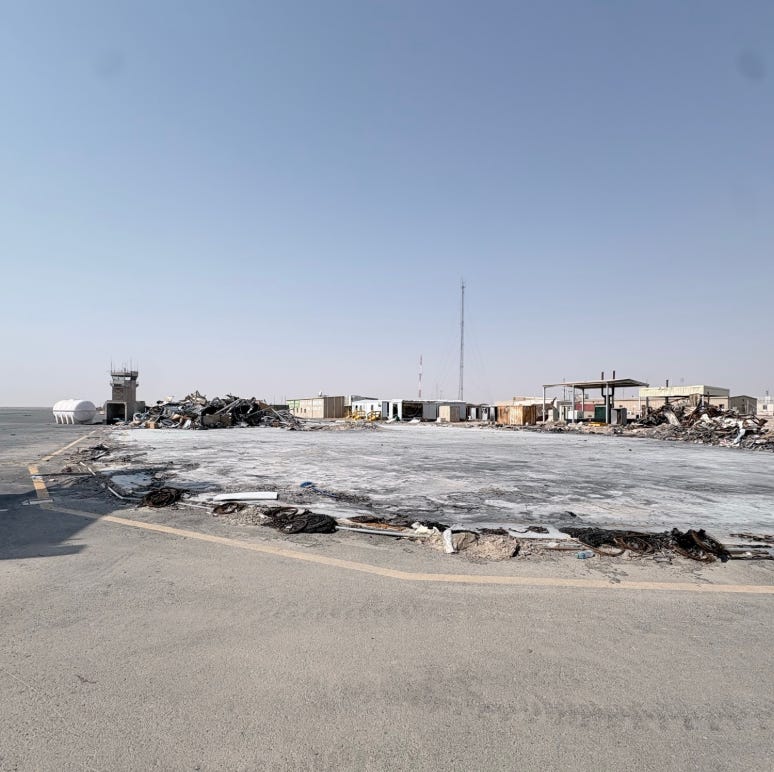
The Pentagon has not publicly detailed the extent of the damage to US installations across Kuwait, Bahrain, Qatar, the UAE, Saudi Arabia, Iraq, Oman, and Jordan, but satellite imagery has repeatedly confirmed the impact of Iranian strikes throughout the conflict. A senior US service member, granted anonymity by ABC News, said the damage would take “decades” to repair. “These bases have been irreparably damaged,” the service member said. “We’re talking about years and years of construction and rebuilding in order to reestablish what’s been destroyed.” The Pentagon declined ABC’s request for comment.
The numbers behind this are staggering. Since the war began on February 28, 18 US service members have been killed and 824 wounded, according to the Defense Department. A Pentagon inspector general report released this week found “hundreds of buildings and structures” damaged across American posts in the region, and estimated the total cost of the war at $33 billion, though the nonpartisan Congressional Budget Office puts that figure closer to $38 billion. Fighting has continued intermittently since an April ceasefire ended the full-scale phase of the conflict, with the US striking targets along the Strait of Hormuz and Iran continuing to fire at US bases primarily in Jordan, Bahrain, Iraq, and Qatar.
US Nearly Went to War With China Over Faulty AI Report:
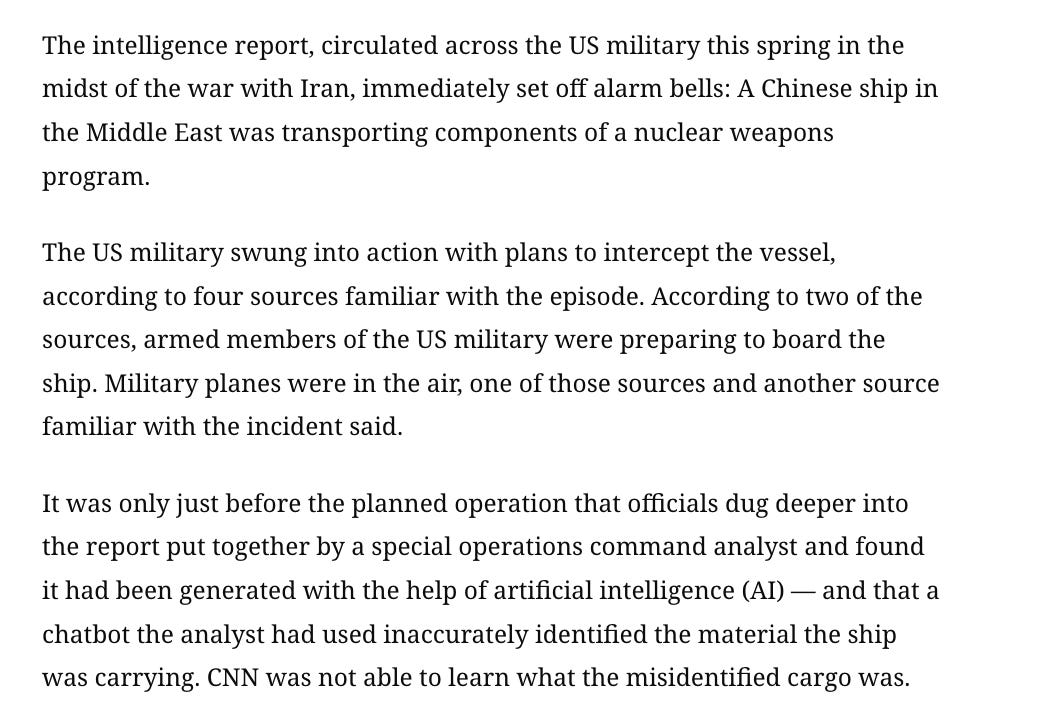
US military nearly intercepted a Chinese ship this spring after an AI chatbot fabricated an intelligence report claiming it was carrying nuclear weapons components: According to four sources familiar with the episode that spoke to CNN, the false report, generated with AI help by a special operations command analyst, set off alarm bells across the military during the ongoing Iran war, with armed personnel preparing to board the vessel and military planes already in the air. Officials only discovered the report was “entirely false” just before the operation was set to launch, tracing it back to a chatbot that had inaccurately identified the ship’s cargo. One source said the incident “almost started a war,” since any US action against a Chinese vessel risked spiraling into armed conflict between the two countries. The chatbot had fused open-source intelligence with classified signals intelligence to reach its false conclusion, and the analyst then used AI again to package the findings into a standard, trusted-format intelligence report before disseminating it. US Special Operations Command Pacific and the Pentagon did not respond to CNN’s request for comment.
The close call reflects a rapid, largely ungoverned rush to integrate AI across military intelligence and targeting: Defense Secretary Pete Hegseth’s January “Artificial Intelligence Acceleration Strategy” explicitly pushed to “democratize AI experimentation” by putting AI models directly in the hands of the department’s three million personnel at all classification levels, but multiple officials told CNN the rollout is decentralized, with different parts of the government using different tools under different orders and no unified verification standard. One former senior official described many internal AI tools as “mostly just copies of the commercial stuff wearing lipstick.” Sources said this kind of AI “hallucination” has not been an isolated incident across the intelligence community as these tools have proliferated, and that the pressure to produce and disseminate intelligence faster is opening the door to more mistakes, particularly among younger analysts described as more likely to trust the tools uncritically. As one source summarized the danger, “AI allows you to get to a bad idea faster.”
The episode highlights a more immediate risk than the existential AI fears dominating Washington’s current debate: While Silicon Valley engineers and tech CEOs warn of AI eventually breaking free of human control, sources told CNN the more pressing danger is human beings making disastrous real-world decisions based on inaccurate AI-generated information, especially as the military expands AI’s role in targeting decisions. One source familiar with current policy said, “AI in targeting is definitely something that is ramping up and there is no real guidance for how having a human in the loop will prevent civilian casualties or fratricide.” Analysts have separately warned that reliance on poor or corrupted data could lead to a catastrophic miscalculation between nation-states, precisely the scenario this incident nearly produced. The push toward AI adoption is driven partly by fear of falling behind adversaries like China who might integrate the technology faster, even as the tools remain relatively poorly understood and unevenly regulated across the force.
Other news:
Donald Trump bans CNN, MS Now, and Politico from the White House in a major attack on the First Amendment:
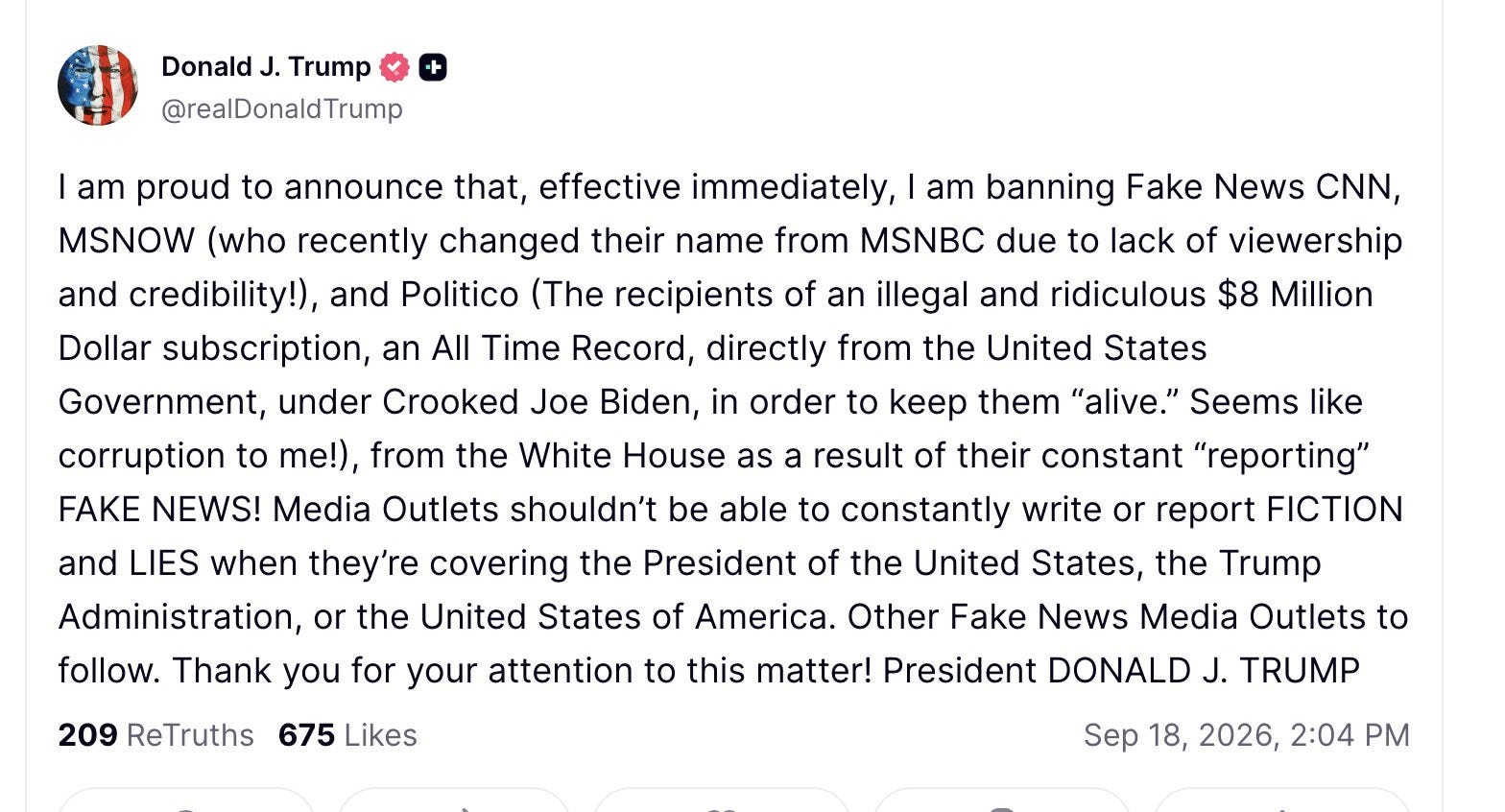
Pentagon has undercounted U.S. troop deaths in the Iran war, six officials tell the Washington Post. At least 22 service members have died since the war began in February, four more than the 18 listed in the Pentagon’s public casualty database, and officials say they’re frustrated the true numbers aren’t being reflected publicly. This follows an incident this summer when four combat deaths were briefly excluded from the tally entirely, only to reappear after the administration relabeled the fighting under a vaguer operation category. More than 820 troops have been wounded in action since the war started, and Central Command estimates the conflict has already cost $43.6 billion. Lawmakers including Reps. Pat Ryan and Jason Crow are now pushing legislation to stop the Pentagon from manipulating casualty data, while Rep. Thomas Massie is separately trying to force a vote to impeach Defense Secretary Pete Hegseth over the war.
Iran war has now cost $45.1 billion, Pentagon tells Congress. The Defense Department informed lawmakers Friday that costs reached $43.6 billion as of September 3, plus another $1.5 billion for extra fuel, according to a source familiar with the matter. The figure doesn’t include the cost of repairing damaged bases and buildings, and the Pentagon still hasn’t given Congress the detailed breakdown of indirect costs lawmakers have been asking for. It surpasses both the Congressional Budget Office’s $38 billion estimate through August 1 and the Pentagon’s own $37.5 billion estimate from July, showing the price tag keeps climbing fast. The CBO projects the war will keep costing $2 billion to $3 billion a month going forward, with costs spiking during periods of escalated fighting, and has also warned the conflict is expected to push up inflation in the first quarter of 2027.
Anti-weaponization fund lawsuit stays alive despite DOJ’s claim it’s dead. A federal judge in Alexandria declined to dismiss the case challenging the $1.8 billion fund set up for Trump’s political allies, rejecting the Justice Department’s argument that the fight is moot. Judge Leonie Brinkema pointed out that the administration keeps contradicting itself, with Trump publicly backing the fund even after Attorney General Todd Blanche issued an order in August calling it terminated, which itself only came after two GOP senators pushed him to put it in writing before they’d confirm him. The fund grew out of Trump’s lawsuit against the IRS over leaked tax returns, and controversy centered on the possibility that Jan. 6 Capitol rioters could be eligible for payouts. Plaintiffs including a fired prosecutor, a college professor, Common Cause, the city of New Haven, and the National Abortion Federation argue the fund represents an unprecedented and corrupt attempt to manipulate the legal process, and their attorneys expect the administration to revive it in some form if the court’s blocking order is lifted.
FBI director Kash Patel briefly cut off cooperation with Canadian law enforcement over a 9/11 language memo. Patel halted some cooperation between the FBI and the Royal Canadian Mounted Police this month after Canada’s public broadcaster, CBC News, reissued internal guidance instructing journalists not to call the September 11 attacks “terrorism” without attributing that label to experts. Patel blasted the policy in posts on X, warning that any Canadian agency that didn’t reject the guidance would “no longer have a friend in this FBI,” and CBC reversed course within days, saying the term could be used without attribution. Despite the reversal, FBI officials still canceled meetings with their Canadian counterparts and went dark for a stretch, with Americans reportedly seeking some kind of apology, though it’s unclear if one was given. The freeze appears to have ended around the anniversary of the attacks, and it came as Trump has been escalating pressure on Canada more broadly, hitting the country with tariffs and repeatedly suggesting it should become the 51st state, marking the first known instance of the administration’s rhetoric spilling over into actual national security cooperation.
State Department clears a potential $24.3 billion F-35 sale to Saudi Arabia over security objections. The deal would send 48 F-35 Lightning II jets to the kingdom, marking the first time any Middle East nation besides Israel has had access to the aircraft. Congress was notified this week, and Rep. Raja Krishnamoorthi immediately raised alarms that the sale could put “the crown jewels of American military technology” within reach of the Chinese Communist Party, citing Saudi Arabia’s deepening military ties with Beijing. The approval follows the record $142 billion arms package Saudi Arabia agreed to during Trump’s Riyadh trip last year, and it comes as the kingdom faces ongoing drone and missile attacks from Iran-backed Houthi rebels threatening Red Sea shipping. The State Department insists the sale won’t alter the region’s military balance, but the deal revives memories of the scrutiny that killed a similar $110 billion Saudi proposal after the 2018 Khashoggi murder.
F-35 parts containing classified stealth technology mysteriously diverted to Hong Kong. A cockpit canopy carrying classified radar-absorbent coating vanished while in transit from Australia to the US for repair this summer, unexpectedly rerouted to Hong Kong, and the Pentagon has confirmed the parts went missing without explaining why or who has them now. Congressional national security staff have been getting briefings on the incident since June, with more expected as lawmakers dig in. Experts warn that possessing an actual canopy would let an adversary reverse-engineer or verify stealth technology China has already been trying to steal through electronic espionage. The episode adds to a troubling pattern: a 2023 government watchdog report found more than a million F-35 spare parts have gone missing over five years, and a newer report found the jet’s performance has actually declined even as its lifetime cost approaches $2 trillion, making it the most expensive weapons program in history.
Gas prices are closing in on their 2026 high just weeks before the midterms. The national average hit $4.46 a gallon Friday, within striking distance of the year’s peak of $4.56 and creeping toward the all-time record of $5.01 set in 2022, with prices up 50% nationwide since the US and Israel launched their attack on Iran in February. Diesel hit a fresh all-time high of $6.44, prompting shipping giant CMA-CGM to slap on an emergency fuel surcharge as tensions escalate around the Strait of Hormuz. Trump has repeatedly promised prices would drop once the war ends, even claiming implausibly that gas could fall below $2 a gallon, but he’s now begun conceding relief might not come until after the election. Major banks including Goldman Sachs and Bank of America have raised their oil price forecasts toward $120 to $150 a barrel if the disruptions continue, with Saudi Arabia’s key pipeline still shut down and Russia extending its diesel export ban after Ukrainian strikes on its refineries.
A White House TikTok video went silent after pop star Zara Larsson tore into the administration. The video, which celebrated ICE deportations set to Larsson’s song “Midnight Sun,” lost its sound Friday after the Swedish singer publicly called the administration “losers” and said the video was “dehumanizing.” Larsson pointed out that many of the people shown being detained were wearing construction and work clothes, saying most undocumented immigrants are just regular people with jobs. Neither TikTok nor the White House has said who muted the video or why. Larsson, who has 12.5 million TikTok followers, has a track record of using her platform for advocacy, including blocking artists accused of abuse on Spotify and losing a lucrative brand deal earlier this year over comments supporting a fan’s abortion.
Toys “R” Us is opening 120 new stores as adult collectors, not kids, drive the toy boom. The retailer will bring its total to 160 standalone locations by Christmas, riding a surge in sales to adult-only households that’s now outpacing sales to households with children. Adult purchases are up 25% and teen purchases up 33% through June, together accounting for roughly 60% of the toy industry’s growth in the strongest first half in six years. Industry analysts say toys are increasingly functioning as hobbies and fandom ecosystems rather than traditional children’s products, with collectors and gift-givers becoming a major market of their own. Top sellers driving the trend include Pokémon, LEGO, Barbie, Hot Wheels, and Marvel and Star Wars merchandise, as the once-bankrupt chain, now backed by private equity firm WHP Global, stages its comeback.
See you soon.
— Aaron


