

Good afternoon, everyone. I just finished watching the full confirmation hearings for Todd Blanche and Jay Clayton, and today has been extraordinary. Vice President JD Vance is now acknowledging that the Trump administration “screwed up” its handling of the Epstein files. The pressure on Todd Blanche is intensifying, with Senator Cory Booker telling me he believes Blanche committed perjury, while Jay Clayton faced sharp questioning and declined to say whether Joe Biden won the 2020 election. Defense Secretary Pete Hegseth has ordered mandatory testosterone screenings for many service members, reports indicate the United States is considering a boots on the ground invasion of Cuba, and there is much more to cover.
I spoke with Senator Booker immediately after he questioned Blanche, and you can watch that interview in the video below. As a reminder, when I speak with candidates or politicians, it’s not an endorsement of them, but rather to get information. Senator Booker was inside the room, and he says Blanche committed a crime by lying.
Our next paid subscriber live is tonight at 7:30 p.m. ET. Here is the link.
I may be exhausted, but I genuinely love this work. I will not stop. Not now. Not ever.
Here’s the news:
Epstein/Todd Blanche:
Vice President JD Vance acknowledged that the Trump administration “screwed up” its handling of the Jeffrey Epstein files, saying the problem was not the investigation itself but how the information was communicated to the public. Speaking on Joe Rogan’s podcast, Vance said the administration mishandled expectations surrounding the document releases, fueling confusion and criticism. His comments come as the Epstein files continue to generate political fallout and questions about the Justice Department’s handling of the case. The remarks also follow Todd Blanche’s Senate confirmation hearing, where he defended the DOJ’s actions while admitting mistakes were made during the release process.
Todd Blanche spent much of his confirmation hearing defending the Justice Department’s decision to abandon the proposed $1.8 billion “anti-weaponization” settlement fund that critics said could have benefited Trump allies, including January 6 defendants. Questioned by both Republicans and Democrats, Blanche repeatedly insisted the fund is “dead” and said no taxpayer money had been transferred out of the Treasury. He emphasized that the settlement would not move forward under his watch. The issue remained a major focus because lawmakers wanted assurances the controversial proposal had been permanently shelved. Blanche sought to reassure senators that the matter was closed.
Democratic senators repeatedly challenged Blanche over the Justice Department’s leadership and his relationship with President Trump. During a tense exchange, Senator Sheldon Whitehouse questioned FBI Director Kash Patel’s fitness for office, referencing allegations of excessive drinking and personal travel, which Patel has denied under oath. Blanche forcefully defended Patel, calling Whitehouse’s questions “extraordinarily obnoxious” and expressing complete confidence in the FBI director. Blanche also rejected the suggestion that he would simply carry out Trump’s wishes, saying he would resign rather than engage in illegal or unethical conduct. He added that he has disagreed with Trump in the past and does not believe the president is eligible to seek a third term. He did have a slip-up, however, and said he was the President’s lawyer:
Senators also pressed Blanche on election integrity and the Justice Department’s role in future elections. Senator Amy Klobuchar asked whether he would ensure federal law enforcement officers were not stationed at polling places, particularly as Trump has publicly advocated for greater federal involvement in elections. Blanche declined to make a direct commitment beyond saying he would “follow the law.” His response left some Democrats unsatisfied, who argued the issue required a clearer guarantee. The exchange highlighted continuing concerns over how the Justice Department could approach election administration if Blanche is confirmed.
The handling of the Jeffrey Epstein files generated some of the hearing’s sharpest exchanges. Blanche acknowledged there were mistakes in the document release, including redaction errors that exposed identifying information about some survivors, but said the problems were quickly corrected and affected only about 1% of the files. He defended the department’s overall handling of the release while rejecting suggestions that officials had failed survivors. Senator Dick Durbin urged Blanche to personally meet with Epstein survivors who were present in the hearing room, but Blanche said legal restrictions prevented such meetings. Durbin criticized that explanation, accusing Blanche of avoiding accountability rather than directly addressing survivors’ concerns. Senator Cory Booker tells me Blanche perjured himself. Here is Blanche refusing to answer questions about the survivors:
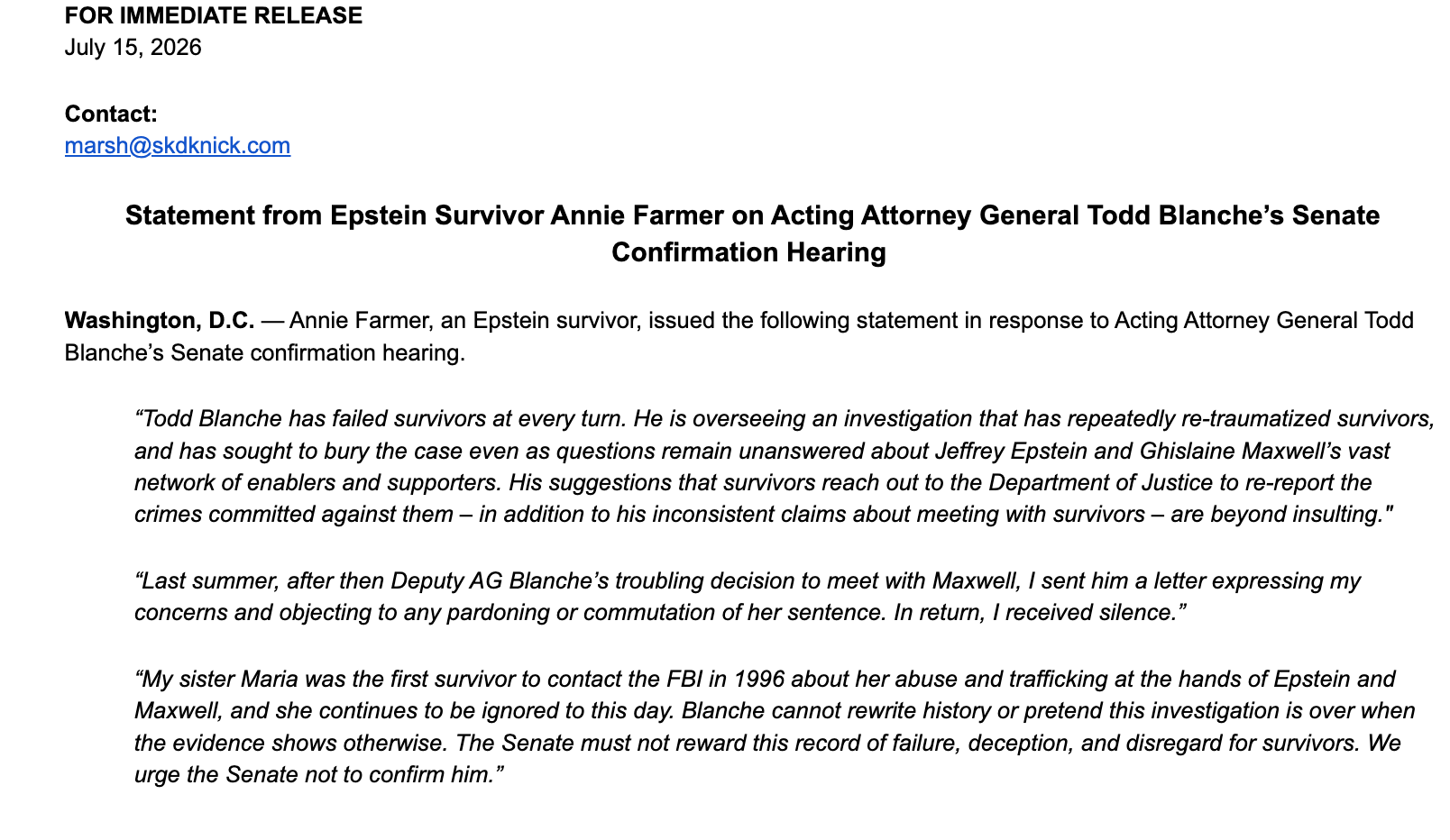
Epstein survivor Annie Farmer urged Senators to vote against his nomination:
Congressional Republicans sharply criticized former Special Counsel Jack Smith after Senate Judiciary Committee Chair Chuck Grassley said Smith's investigative team obtained text messages involving 44 members of Congress as part of the federal investigation into efforts to overturn the 2020 election. Grassley said he was among the lawmakers whose communications with White House officials were reviewed and argued the records raise concerns about congressional privilege. Several Republican senators, including Rand Paul, Josh Hawley, Mike Lee, Rick Scott, and Cindy Hyde-Smith, accused Smith of government overreach and demanded accountability, while Democrats have maintained the investigations followed established Justice Department procedures and were based on evidence related to the 2020 election and the January 6 attack. According to documents released by Grassley, the records were obtained from the National Archives through a 2023 subpoena seeking White House materials from late 2020 through January 2021, and Grassley said he plans to notify affected lawmakers and release additional records.
Jay Clayton:
President Trump’s nominee for director of national intelligence, Jay Clayton, faced intense questioning from Senate Democrats over his views on the 2020 election, the politicization of intelligence agencies, and recent investigations tied to election claims. Pressed repeatedly by Senators Mark Warner, Jon Ossoff, Mark Kelly, and Angus King, Clayton said he was “not an election denier” and acknowledged that Joe Biden was certified as president, though several Democrats criticized him for not more directly stating Biden won the election. Ossoff also questioned Clayton about former DNI Tulsi Gabbard’s involvement in FBI raids of election offices in Georgia, saying the Intelligence Committee is investigating her role. Clayton said he was previously unaware of Gabbard’s reported involvement, a response that Warner said strained credibility.
Senators also questioned Clayton about subpoenas issued to New York Times journalists as part of an investigation into reports about security vulnerabilities involving Trump’s Qatari-donated Air Force One. Senator Ron Wyden challenged whether Clayton followed Justice Department rules requiring prosecutors to first exhaust other investigative options before subpoenaing reporters. Clayton defended the decision, saying it was made only after consultation with career prosecutors and Justice Department officials in Washington. Senator Michael Bennet further pressed whether the Trump administration influenced those subpoenas, but Clayton maintained that established departmental protocols were followed.
Clayton’s confirmation carries major implications because Democrats have refused to renew Section 702 surveillance authority while Trump ally Bill Pulte serves as acting director of national intelligence. Although Clayton drew tough questioning, he has previously received bipartisan praise and is viewed by some lawmakers as a more conventional nominee than Pulte. If confirmed, Clayton would oversee the nation’s 17 intelligence agencies and replace the acting director at a critical moment for U.S. intelligence and election security. The Senate Intelligence Committee is expected to vote on his nomination next week before sending it to the full Senate for consideration.
Iran:
The United States launched a fifth consecutive day of military strikes against Iran, with U.S. Central Command saying the latest attacks targeted military capabilities allegedly used to threaten shipping through the Strait of Hormuz. The strikes followed overnight attacks that Iranian officials said killed at least seven military personnel, while additional explosions were later reported in several Iranian cities. President Trump also renewed his threat to strike Iranian civilian infrastructure unless Tehran returns to negotiations. Iran responded that it has no plans for talks and warned it would continue to respond forcefully to U.S. military action.
The U.S. also intensified enforcement of its renewed naval blockade of Iranian ports, saying it redirected two commercial vessels and disabled an empty oil tanker that ignored repeated warnings while heading toward Iran’s Kharg Island. Shipping traffic through the Strait of Hormuz remains dramatically lower than normal, with only a handful of vessels transiting daily compared with roughly 110 before the conflict escalated. Rising tensions have pushed global oil and U.S. gasoline prices higher, while navigational disruptions such as GPS spoofing continue to complicate commercial shipping. The Strait remains one of the world’s most strategically important energy corridors.
Despite the renewed fighting, senior U.S. and Iranian officials continue to offer conflicting messages about diplomacy. Vice President JD Vance argued that military force alone cannot resolve the conflict and said negotiations are ultimately necessary because Iran can continue threatening shipping in the Strait of Hormuz. Iranian officials, meanwhile, insisted they will defend the country militarily while remaining open to diplomacy only if the United States honors any future agreements. Separately, U.S.-mediated talks between Israel and Lebanon made progress, with both sides agreeing on a framework for possible Israeli withdrawals from southern Lebanon and discussing the disarmament of Hezbollah as part of a broader ceasefire process.
Cuba:
The United States is reportedly weighing contingency plans for a potential boots-on-the-ground military operation in Cuba, with senior Pentagon officials reviewing options that include an Army-led air assault involving thousands of troops from the 101st Airborne Division. According to CBS News, officials emphasized the planning is preliminary and does not mean President Trump has decided to authorize military action. The discussions come as the administration intensifies economic and diplomatic pressure on Havana while accusing the Cuban government of refusing political and economic reforms. Officials also acknowledged that any operation would be complicated by the U.S. military’s ongoing commitments in the escalating war with Iran.
The administration has steadily increased pressure on Cuba since Trump returned to office, restoring the country’s designation as a state sponsor of terrorism, expanding sanctions, restricting business with military-controlled companies, and targeting senior Cuban officials. Secretary of State Marco Rubio has said the preferred outcome remains a peaceful transition to a reform-minded government, but argued that Cuba’s leadership continues to reject meaningful change. Intelligence officials have also been monitoring Cuba’s growing ties with Russia, China, and Iran, while Defense Secretary Pete Hegseth has warned Havana against acquiring weapons capable of threatening Guantanamo Bay or the U.S. homeland. CBS also reports that military planners continue developing contingency options even as diplomacy remains the stated preference.
The Cuba planning comes as tensions inside the Trump administration have reportedly grown over the Iran war, with sources telling CBS News that President Trump has become frustrated by the pace and complexity of the military campaign. Officials said Trump has privately questioned Pentagon leaders after what he viewed as missed opportunities to avoid a prolonged conflict, while some military leaders have cautioned about the limits of military action. At the same time, the administration has pursued an increasingly confrontational approach toward Cuba through sanctions, legal actions against former Cuban leaders, and intelligence assessments of possible responses to U.S. military action. The White House and Pentagon declined to comment on hypothetical military operations but maintained that Trump continues to support his national security team’s leadership.
Other News:
Defense Secretary Pete Hegseth announced that the U.S. military will begin annual testosterone screenings for service members age 30 and older as part of their routine health assessments, with younger troops able to opt in voluntarily. Service members found to have low testosterone may be offered testosterone replacement therapy, though Hegseth said treatment will remain voluntary and is intended to restore natural hormone levels rather than enhance performance. The policy is part of the Trump administration's broader effort to expand access to testosterone therapies, which officials argue can improve health, longevity, and military readiness. The Defense Department has not said whether similar hormone screenings will be offered for female service members or whether declining treatment would have any impact on military service.
Indian billionaire Gautam Adani has denied that his company’s pledge to invest $10 billion in the United States influenced the Justice Department’s decision to seek dismissal of a criminal bribery and fraud case against him. In a sworn court filing, Adani said he was unaware of any agreement exchanging investments for the dismissal of the indictment, while his attorney acknowledged the investment plans were discussed with DOJ officials but said prosecutors rejected linking them to the case. The Justice Department has defended dropping the charges, arguing the case was legally weak and saying the decision would have been the same regardless of any investment discussions. The move has drawn scrutiny from a federal judge and Democratic lawmakers, who are questioning whether political or financial considerations played a role in the DOJ’s reversal.
The CDC says nearly 7,000 cases of cyclosporiasis have been confirmed or are under investigation nationwide, making it one of the largest foodborne illness outbreaks in years. More than 1,600 cases have been confirmed, over 5,100 remain under investigation, and 141 people have been hospitalized, with Michigan accounting for the largest share of illnesses. Health officials suspect lettuce or salad greens may be a source, but no specific product, restaurant, supplier, or retailer has been identified, and no recalls have been issued. Taco Bell said it voluntarily removed certain ingredients at some locations as a precaution, while the CDC warns the outbreak could continue through August as investigators work to identify the source.
House Republicans unveiled the framework for a third budget reconciliation bill that would provide roughly $90 billion in new spending without Democratic votes, including $60 billion for the military as the Iran conflict continues, $12 billion in farm aid to address war-related economic impacts, $10 billion for election-related initiatives, and **$13 billion for classified intelligence projects. The proposal has drawn criticism from Democrats, who argue it expands spending for an unpopular war, and from conservative fiscal hawks, who object to adding tens of billions of dollars to the deficit without spending cuts to offset the costs. Republican leaders say the measure is intended to support national security, election integrity, and agriculture, with the House Budget Committee set to consider the resolution before committees begin drafting the final legislation.
House Democrats were sharply divided over a Republican amendment from Rep. Thomas Massie that would have ended all U.S. aid to Israel, exposing growing fractures within the party over the Israel-Gaza war. House Democratic Leader Hakeem Jeffries opposed the measure, calling it overly broad, while Minority Whip Katherine Clark broke with leadership to support it, arguing the Netanyahu government should not receive a "blank check" for military aid. The amendment ultimately failed 314-104, but more than 100 Democrats voted in favor, reflecting increasing pressure from the party's progressive wing as public opinion shifts. The vote highlighted a broader debate within the Democratic Party over continued U.S. support for Israel, with many lawmakers citing the humanitarian crisis in Gaza and the expanding regional conflict with Iran as reasons to reconsider longstanding policy.
Israeli airstrikes killed at least a dozen people across Gaza over the past two days despite a months-old ceasefire with Hamas, according to local health officials. Those killed included a woman, six police officers in a strike on a police station in Jabalia refugee camp, three members of one family in central Gaza, a man in Khan Younis, and a child near Rafah. Israel said four of the officers were Hamas militants and argued police facilities are legitimate military targets when used for militant activities, while the U.N. has raised concerns that repeated attacks on Gaza’s police force blur the distinction between civilian law enforcement and combatants. More than 1,100 Palestinians have been killed since the ceasefire began, according to Gaza’s Health Ministry, while Israel says its ongoing strikes respond to Hamas attacks and ceasefire violations.
Amazon announced it will launch its satellite internet service, Amazon Leo, in South Africa in 2027 through a partnership with local provider Herotel, marking the company’s first satellite internet agreement in Africa. The move appears to put Amazon ahead of Elon Musk’s Starlink in South Africa, where Musk has refused to comply with local ownership rules requiring communications companies to include Black or other non-white ownership to obtain licenses. Musk has criticized those regulations as discriminatory, while South African officials have backed Amazon’s agreement and participated in the announcement. Amazon says the South Africa deal is the first step in a broader African expansion, entering a growing market where millions of people still lack reliable internet access, although Starlink currently operates in more than 160 countries worldwide.
See you soon.
— Aaron


