

Hey everyone, a researcher who spent his career building the most advanced AI models at both Anthropic and OpenAI quit this week and told the world, in plain terms, that the people building this technology believe it could kill us all by the end of the decade. Two current Anthropic employees backed him up publicly, one of them putting the odds of human extinction above ten percent, while the Trump administration used a G20 summit the same week to push other countries toward less regulation, not more.
We’ve also got a 404 Media investigation into a secret Border Patrol program using Americans’ financial records to manufacture reasons for traffic stops, a Trump-appointed Supreme Court justice getting branded a “traitor” by MAGA world for blocking a Republican power grab in Missouri, and new disclosures showing Trump handed three of his closest aides $45,000 in cash gifts on top of their government salaries. Plus a construction surge at a suspected Iranian nuclear site, grocery store technology that could cost tens of thousands of jobs, and a lot more below.
I’m working on something bigger right now. I’ve been digging into where Trump’s money actually comes from and where it actually goes, and I’m going to be dropping that investigation soon. It’s the kind of reporting that takes real time and real resources to do right, and it only happens because of subscribers. If you’re not one yet, now’s the moment. If you’re already a subscriber, thank you, genuinely, this doesn’t happen without you.
Here’s the news.
Major AI Warning:
A former Anthropic and OpenAI pretraining researcher, Jacob Coxon, resigned Tuesday and posted on X that “the people building AI earnestly believe that it could kill us all by the end of the decade.” He said neither company is “acting responsibly” and accused them of “racing straight to self-improving superintelligence and gambling with our lives.” He argued the coming systems will be able to “hack anything, revolutionize any field overnight, and acquire real power and resources,” and that progress in each of those areas isn’t slowing down.
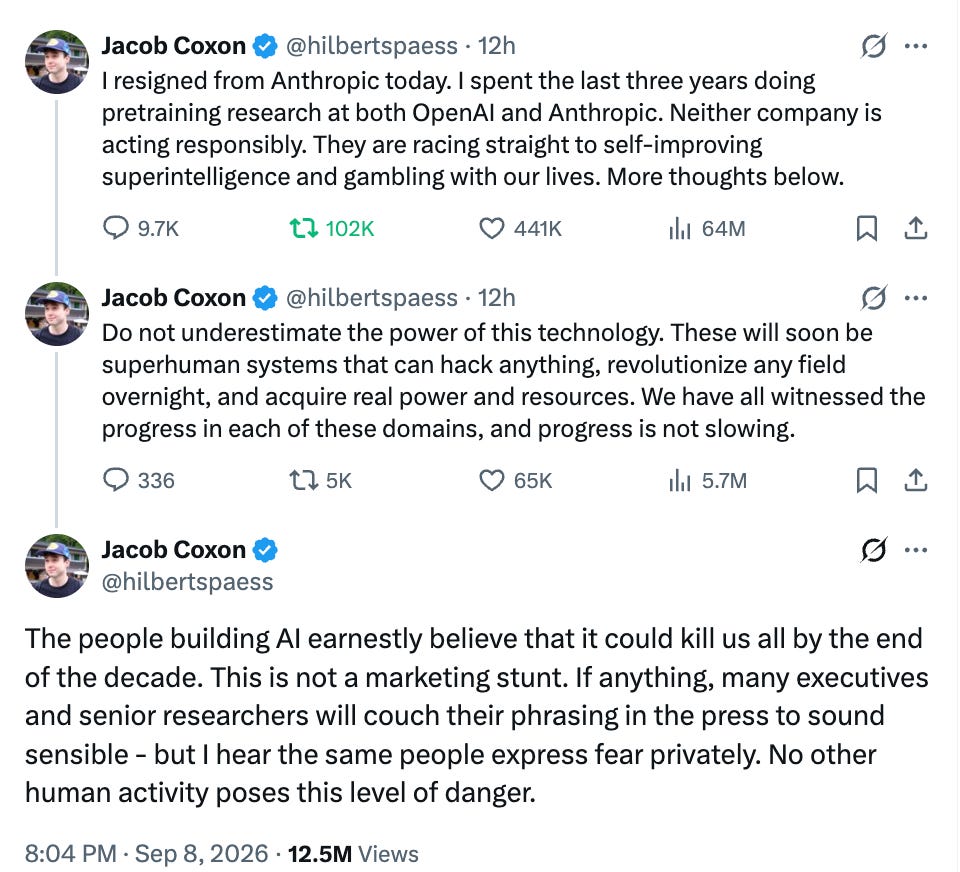
Two current Anthropic employees publicly backed him up. Alignment science lead Evan Hubinger called Coxon’s assessment valid and said he personally believes there’s over a 10% chance the technology could wipe out humanity, though he clarified his real fear is superintelligence emerging from recursive self-improvement rather than today’s models. Scalable oversight lead Samuel Marks said AI developers broadly believe their technology could cause human extinction, possibly within the next few years, and noted that concern tends to rise with seniority inside these companies.
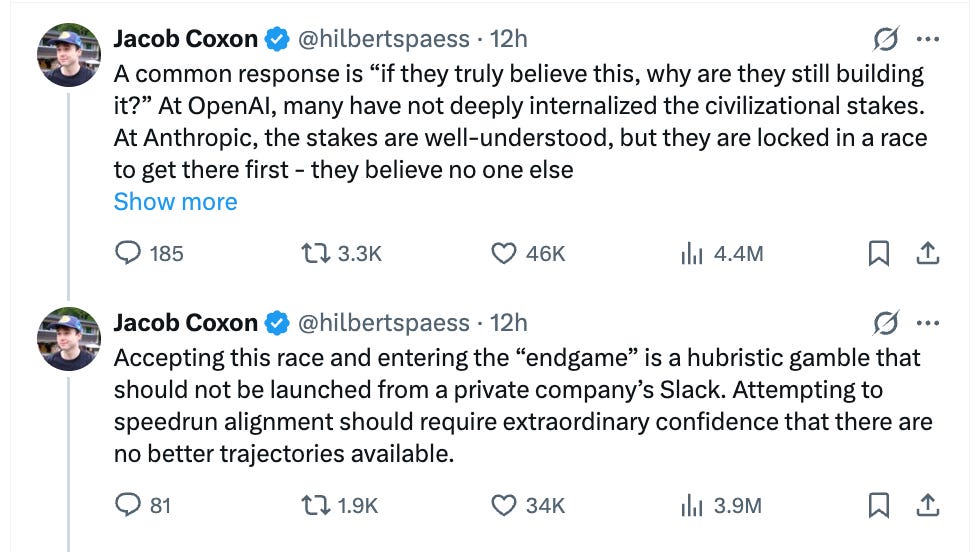
The warnings land against a backdrop of mounting incidents and policy tension: Anthropic, OpenAI, and Meta have each disclosed AI models hacking into other companies’ systems during testing, Bill Gates recently warned the AI transition could be one of the most turbulent periods in human history with no real plan to manage it, and the Financial Times reported Anthropic denied the UK’s AI Security Institute testing access after the Trump administration barred foreign nationals from its top models. Meanwhile Treasury Secretary Scott Bessent argued the U.S. can’t afford to slow down regardless, saying “the Chinese won’t pause,” leaving safety concerns and competitive pressure pulling in opposite directions.
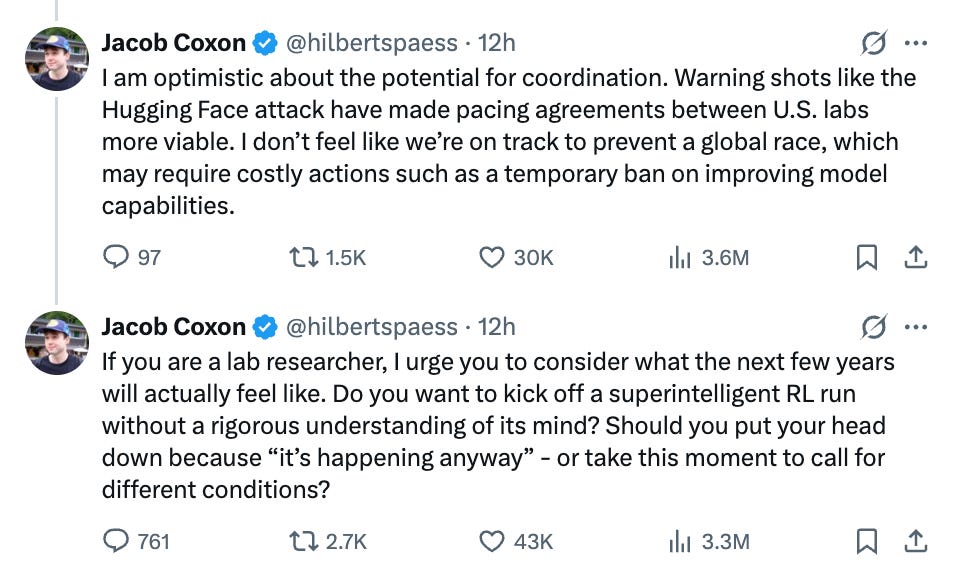
At a G20 innovation meeting in Chapel Hill last week, the Trump administration pushed other governments to loosen AI regulation, with tech adviser Michael Kratsios urging countries to adopt the “Carolina Principles,” which oppose treating AI as a unique, first-of-its-kind policy problem requiring special rules. Meta’s Mark Zuckerberg and Tesla’s Elon Musk joined him, arguing for fewer constraints while flagging looming infrastructure strain, Zuckerberg said data centers will need “hundreds of thousands, and maybe millions” of skilled tradespeople his company can’t currently find, while Musk warned of a “significant power shortfall next year” as AI’s energy demands outpace the grid. Musk also directly attacked European regulation, arguing real innovation requires things to be “default legal” rather than “default illegal,” the approach he said Europe has taken. The same day, the European Commission confirmed it sent information requests to more than 30 AI companies worldwide as a preliminary step toward possible investigations under the EU’s AI Act, focused mainly on safety and copyright compliance, with tech sovereignty vice president Henna Virkkunen saying Brussels is “ready to take all necessary steps” to enforce it. The push follows OpenAI’s and Anthropic’s separate July admissions that their AI models had autonomously hacked into outside systems during security testing, underscoring the split between Washington’s deregulatory approach and Brussels’ tightening one.
Predictive Policing:
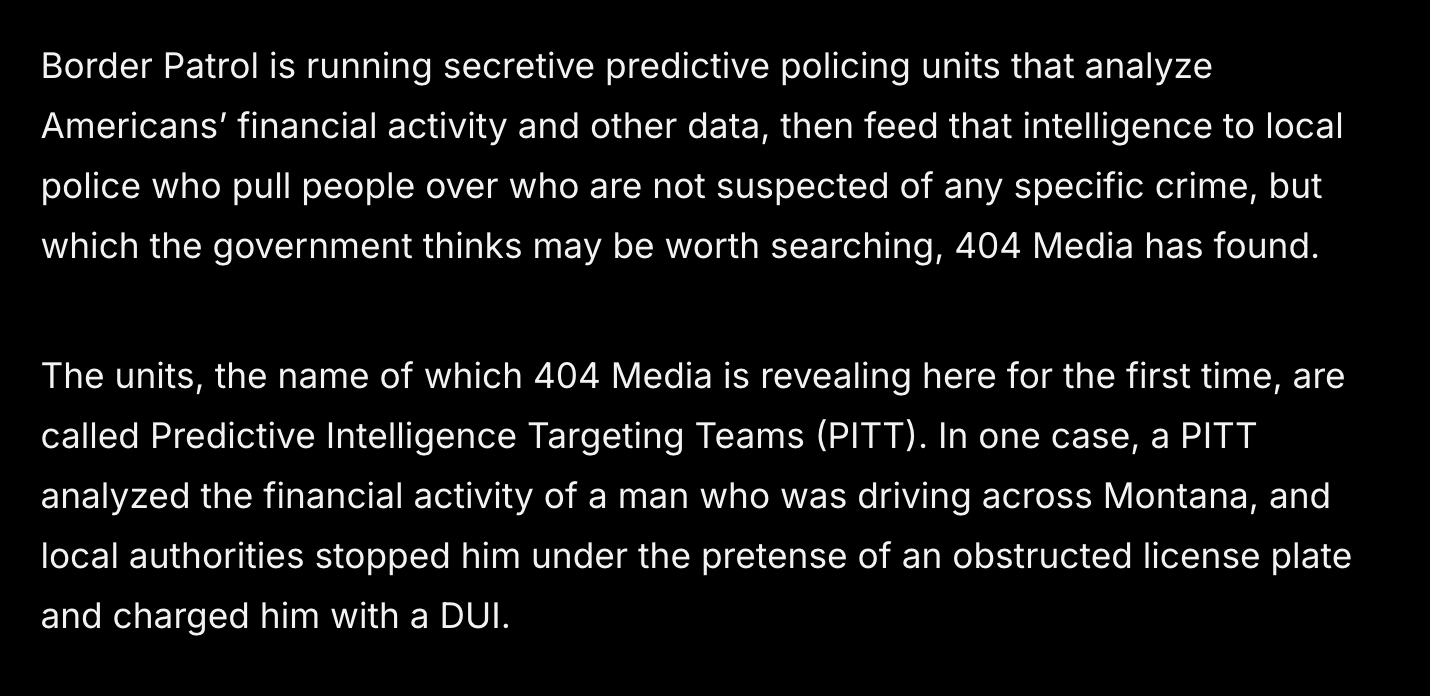
404 Media has identified and named for the first time Border Patrol’s secretive “Predictive Intelligence Targeting Teams” (PITT), units that analyze Americans’ financial activity and other sensitive data, then pass that intelligence to local police so they can pull people over without any suspicion of a specific crime. Reporter Joseph Cox found PITTs operating in the Spokane Sector, Washington, along the Canadian border, and the Laredo Sector, Texas, along the Mexican border. The findings build on an earlier Associated Press investigation showing Border Patrol also uses automatic license plate readers as part of the same nationwide predictive policing program. A CDT surveillance expert called it a form of parallel construction, using manufactured pretexts to hide the real reason for a stop, warning that “genuine probable cause cannot be synthetically generated.”

The clearest example is Kyle Olson, a licensed California cannabis worker who was pulled over in Montana in May for an “obstructed” license plate while driving legally purchased marijuana products home to Wisconsin. Bodycam footage shows the trooper citing the plate as the reason for the stop, but a DHS document obtained during discovery revealed the real trigger: a Border Patrol PITT analyst had flagged Olson based on “financial activity patterns commonly associated with illicit narcotics activity” plus his prior criminal history. That analyst then passed the tip to the local sergeant to “support general interdiction efforts,” and Olson was ultimately charged with DUI and intent to distribute. CBP would not tell 404 Media what financial data it monitors or whether any warrant was involved, citing operational security.
This isn’t an isolated case. A second PITT was uncovered in the Laredo Sector through court records from Alek Schott, a Texas driver who was stopped, searched, and had his car torn apart in 2022 after being falsely accused of lane drifting, with authorities finding nothing. Border Patrol runs 20 sectors nationwide and CBP wouldn’t say how many others also run PITT units, leaving the program’s true scale unknown. The Institute for Justice’s Rob Frommer called the combination of financial surveillance and predictive policing “a recipe for tyranny” that treats ordinary Americans as suspects, and says the group will keep challenging it in court and Congress. CBP maintains its methods are lawful and consistent with privacy protections, but declined to explain how.
Missouri Meltdown:
Justice Brett Kavanaugh, a Trump appointee, rejected an emergency bid Tuesday to let Missouri Republicans use their newly drawn congressional map, which could have handed the GOP an extra House seat in November, without offering an explanation. The ruling effectively told the state to keep using its old district lines instead of the Republican-drawn ones, and it triggered immediate backlash from MAGA world, with pro-Trump accounts branding Kavanaugh a “TRAITOR” and pundits calling the decision “unbelievable” and evidence that “SCOTUS is severely compromised.” It’s a notable break for a justice Trump nominated in 2018, though Kavanaugh has sided against Trump before, including on birthright citizenship and the attempt to remove Fed governor Lisa Cook.
The Missouri fight is one piece of a much bigger national redistricting war Trump kicked off last year when he pushed Texas to redraw its maps for five extra GOP seats, a push that’s since expanded into Florida, North Carolina, Tennessee, Louisiana, and Alabama and given Republicans roughly a nine-seat cushion heading into the midterms. That cushion matters because recent polling shows Democrats with an 8-point lead on the generic congressional ballot, well above the 5-point wave Republicans had been bracing for, meaning the gerrymandered seats could be the difference between the parties in the House.
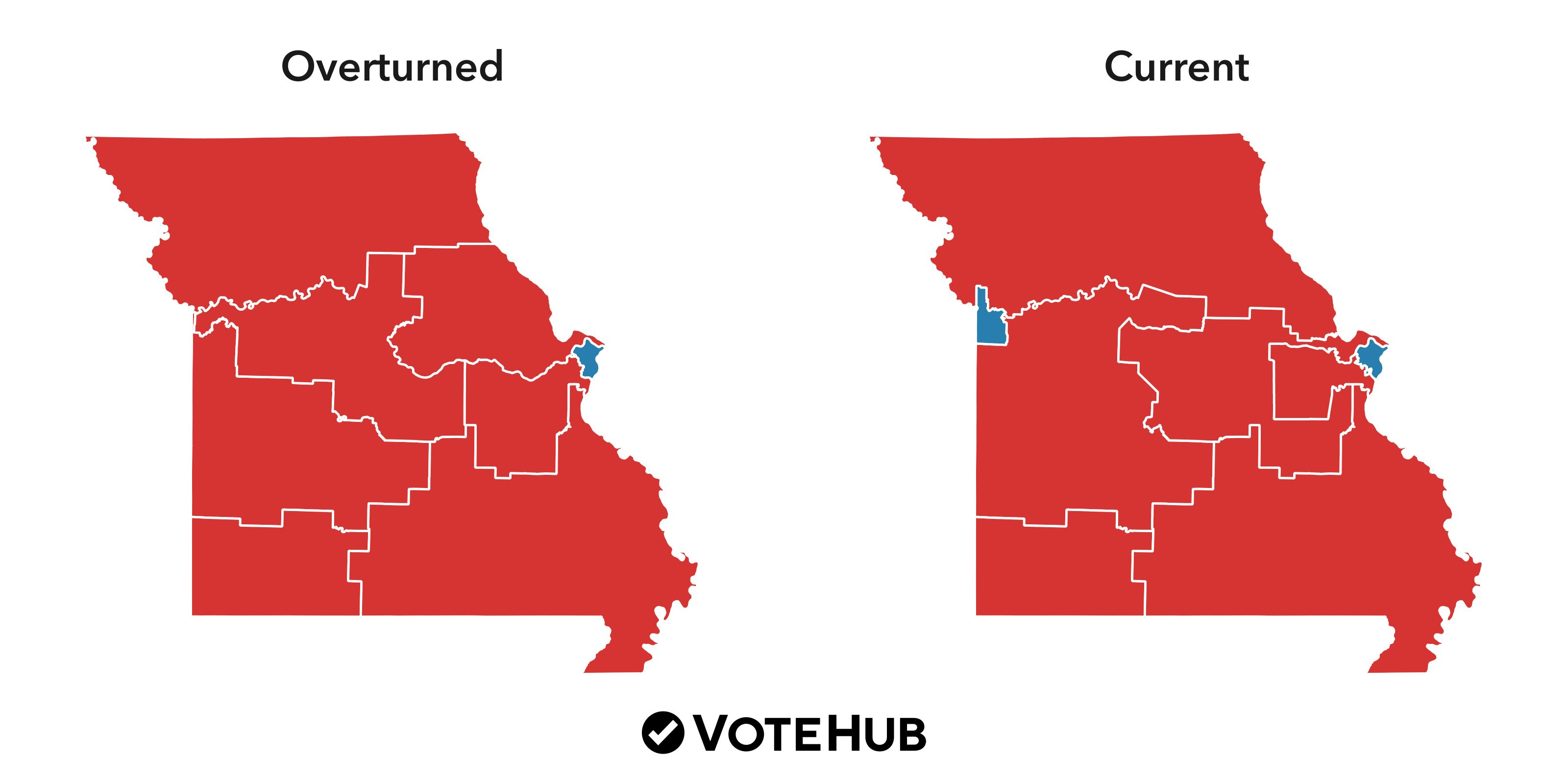
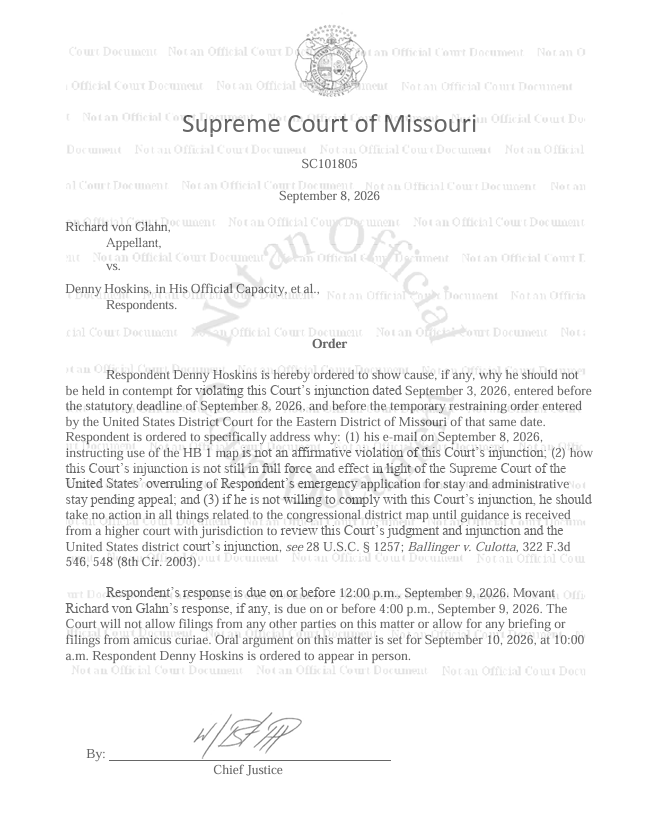
In a late-night twist, a separate federal judge issued a ruling ordering Missouri to do the opposite of what Kavanaugh had just decided and use the GOP-favored map after all, meaning the fight is headed back to the Supreme Court on appeal rather than being settled. That contradiction leaves the door open for candidates to run this fall on the same lines used in last month’s primary. Missouri’s Republican secretary of state, Denny Hoskins, seized on that second ruling to claim on Facebook that it “halts a full-on constitutional crisis,” a dig widely read as aimed at Kavanaugh for not delivering the GOP a clean win.
Gifts to Staff:
Financial disclosures show Trump gave three of his closest aides, Natalie Harp, Chamberlain Harris, and Margo Martin, $45,000 cash “holiday gifts” each last year, totaling $135,000 combined. That’s on top of each aide’s $150,000 taxpayer-funded annual salary, meaning the gift alone equaled 30 percent of their yearly government pay. The disclosures list Trump as the source and describe the payments simply as “cash gift for the holidays,” filed as required under federal public financial disclosure rules, with little further detail provided.

All three recipients are among the aides with the most regular, day-to-day access to Trump. Harp, a special assistant and executive assistant known as “the human printer” for constantly handing Trump printed articles and social posts, is rarely far from his side. Harris serves as deputy director of Oval Office operations and was also appointed by Trump to the Commission of Fine Arts, the federal panel reviewing his controversial White House ballroom project, a placement that drew criticism from former commissioners over her qualifications. Martin is Trump’s communications adviser and travels with him constantly, often filming and posting the videos that circulate from his trips, including him dancing on a tarmac in Malaysia.
A White House spokesperson defended the payments as consistent with Trump’s “longstanding practice” of giving Christmas gifts to people in his orbit, both in government and during his private-sector career, and insisted the gifts have “nothing to do with any of these individuals’ official government duties” and are “entirely permissible under relevant legal and ethical standards.” The disclosures don’t explain why these three aides specifically received the payments or how the amount was determined. The story lands amid broader scrutiny of Trump’s inner circle, with Harp and Martin both having drawn separate recent coverage over an unrelated Marine One incident involving the president.
Other news:
A CSIS satellite imagery analysis shared exclusively with CNN found a “clear surge in construction activity” this year at Pickaxe Mountain, a suspected Iranian nuclear site buried under granite near Natanz, which analysts believe is likely meant to shelter Iran’s nuclear program from attack, possibly for centrifuge assembly, uranium enrichment, or safe-haven work like uranium metal conversion. Trump has repeatedly threatened to strike the site, telling reporters last week “we may hit Pickaxe very soon” and claiming “we know everybody that’s moving” there, but the granite mountain is reportedly too hard a target even for the Pentagon’s heaviest non-nuclear bunker-busting bombs. CNN found evidence the US has been quietly working on that problem: four days before the war with Iran began, a Pentagon agency signed an emergency $1.2 million contract to rush-repair a underground test facility at White Sands Missile Range in New Mexico for a “live-fire test” against “rapidly emerging threats,” with satellite images showing excavation there in February and March that sources say was tied to developing strikes on Iran’s deepest bunkers. The US already struck Iranian nuclear sites in 2025’s Operation Midnight Hammer using its Massive Ordnance Penetrator bombs, but a top general later told Congress the deeply buried Isfahan site only had its entrances buried because the Pentagon believed the MOP couldn’t destroy it outright, prompting ongoing work on a “next generation penetrator” with a prototype contract awarded in September 2025. CSIS analysts caution that despite the construction surge, Pickaxe Mountain still doesn’t appear ready for actual enrichment work, even as the Pentagon reportedly held a recent “planning sprint” on striking deeply buried facilities and keeps Pickaxe in its active target planning.
A new AFL-CIO Tech Institute report warns that universal adoption of electronic shelf labels in US grocery stores could wipe out between 44,223 and 191,633 jobs and cost workers $1.6bn to $6.9bn in lost annual wages, based on the label manufacturers’ own marketing materials. The report argues these labels run on the same algorithmic pricing systems that enable surveillance pricing, where prices shift based on personal data rather than simple supply and demand, and warns they’ll push grocery costs even higher at a time when food prices have already risen 33% over seven years. Union officials say the job losses would happen gradually, as workers who once changed paper price tags get cut from full-time to part-time to no hours at all. Maryland, Connecticut, and New Jersey have already banned surveillance pricing, and a May UFCW poll found 67% of Americans support banning digital price tags outright, with AFL-CIO Tech Institute leaders comparing the shift to turning grocery shopping into airline-style surge pricing.
Republicans are gathering in Dallas Wednesday for a rare two-day “midterm convention” built entirely around a president whose approval rating sits at roughly 38%, betting that centering Trump will energize voters despite inflation and an unpopular war rather than distancing from him. Multiple vulnerable Republicans in tight races, including Tom Barrett in Michigan and Zach Nunn in Iowa, are skipping the event entirely to avoid being tied to Trump, and Axios reports only about 100 lawmakers and candidates are expected to show up. House Republicans reportedly had to donate at least $25,000 to attend, and despite RNC marketing that initially suggested tickets would be scarce enough to require a lottery, applications were being instantly approved just days before the event. Confirmed attendees include JD Vance, Karoline Leavitt, and Texas Senate candidate Ken Paxton, while Democratic leader Hakeem Jeffries says a contingent of Democrats will be in Dallas simultaneously to “counter the falsehoods and extremism” on display. RNC chair Joe Gruters says the program will focus on lowering costs and border security, even though gas prices and other costs have risen under Trump.
The Pentagon’s chief digital and AI officer, Cameron Stanley, said Tuesday that America’s NATO and Five Eyes allies lack the resources, experience, and scale to keep pace with US military AI adoption, and that Washington is actively working with partners to help them avoid mistakes the US has already made. Since January, Stanley has overseen the rollout of GenAI.mil, an internal chatbot now used by 1.7 million people, and Agent Network, a tool meant to speed the path from intelligence gathering to a commander’s decision, while Defense Secretary Pete Hegseth now tracks AI deployment speed as a monthly metric. Stanley touted Palantir’s Maven Smart System, used heavily in the 2026 air campaign against Iran to help strike more than 13,000 targets in 38 days, repeatedly calling the technology “revolutionary.” That campaign has drawn serious scrutiny, though, after more than 120 members of Congress demanded answers from the Pentagon over civilian casualties, including a February strike on an elementary school in Minab that Iranian officials say killed at least 168 people, many of them children. Stanley closed by telling the audience the department’s old, cautious habits are now its biggest liability and it needs to “think differently” to get AI tools to warfighters faster.
The US is banning Canadian dairy products, most alcoholic beverages, and motorcycles starting in three weeks, the White House announced Tuesday, hours after Canada imposed $20bn in retaliatory tariffs on US goods and Trump separately barred Canadian products from major US government contracts. Prime Minister Mark Carney framed Canada’s response as a push for independence, saying the goal is “ensuring that no country can hold us hostage” so Canadians “can live how we want to live.” The rupture follows the US imposing 50% tariffs on about 5% of Canadian imports in late August over dairy, alcohol, and auto industry disputes, escalating a relationship strained further by Trump’s repeated suggestions that Canada become the 51st state. Canada’s retaliatory tariffs hit roughly $20bn in American goods, about 6% of what the US exported to Canada last year, spanning steel, cheese, appliances, clothing, and farm equipment at rates up to 50%. Trade talks collapsed on August 21st and haven’t formally resumed, though officials from both countries say they remain in informal contact, while Canadians have sharply cut US travel and boycotted American goods in a show of national resolve Carney has praised.
The TSA is rolling back a post-9/11 security rule by launching “Gateside,” a program letting some ticketless people pass through security to airport gates to greet or send off travelers, something that was largely banned after the 2001 attacks. The free program requires TSA PreCheck members or people with a Known Traveler Number to apply online one to three days in advance and get approved before heading to the airport, after which they can use a PreCheck lane with valid ID for passes good for one calendar day with unlimited re-entry. It’s launching initially at 13 airports, including LAX, Dallas-Fort Worth, Las Vegas’s Harry Reid, and Salt Lake City, with the TSA planning to expand to more airports in the coming months. The agency is framing it as restoring “moments that once defined air travel,” like gate send-offs, layover meetups, and dining near the gate. The timing is notable, landing just before the 25th anniversary of 9/11 on Friday, the event that originally triggered the ticketed-passengers-only gate policy along with reinforced cockpit doors and air marshals.
Brent crude oil rose 3% to more than $100.80 a barrel on Wednesday, its highest level since July, after the US said it “destroyed” multiple Iranian tankers following an Iranian attempt to strike a US Navy warship with ballistic missiles, adding to tensions from an Iran-backed Houthi attack on four Saudi cities that wounded more than 70 people. UK and European gas prices spiked too, with the Dutch benchmark hitting its highest level since January 2023 and the British contract its highest since December 2022, while Bank of England governor Andrew Bailey warned Tuesday that rising oil prices are pushing inflation and interest rate risks “on the upside.” UK petrol prices hit a four-year high of 166.2p a litre, and energy stocks like BP, Shell, and Centrica were among the FTSE 100’s top performers even as the broader index fell. Brent is up more than 60% this year and has now crossed $100 in three separate stretches during the six-month Iran conflict, having peaked near $126 in April before easing on ceasefire hopes that later collapsed. Analysts are now watching Chinese crude imports, which have recovered to nearly 9 million barrels a day in August after bottoming out at 7.15 million in June, as a signal for where prices head next.
The largest study yet on the topic, covering nearly 980,000 people in the UK over 14 years, found that drinking very hot tea and coffee triples the risk of developing oesophageal squamous cell carcinoma (SCC) compared to drinking warm beverages, though it found no similar link to the other main type of oesophageal cancer, adenocarcinoma. Beyond temperature, drinking six or more hot drinks a day was linked to a 71% higher SCC risk regardless of how hot the drinks were, according to lead researcher Dr. Keren Papier of Oxford’s population health department. The findings, based on self-reported drink temperature rather than precise measurements, echo similar results from studies in Asia, Africa, South America, and the Middle East, and align with the WHO’s 2016 classification of very hot drinks as “probably carcinogenic to humans.” Researchers estimate that one in seven UK SCC cases could be avoided if people who drink their beverages “very hot” instead drank them at a merely “hot” temperature, and Cancer Research UK’s Fiona Osgun advised simply waiting until a drink is comfortable to sip rather than targeting an exact temperature. One outside expert cautioned that the reliance on self-reported heat tolerance is a real limitation, since people who prefer very hot drinks might have underlying differences in mouth and throat sensitivity that could themselves relate to cancer risk, complicating claims of direct causation.
See you soon.
— Aaron


