

It’s time to expose Trump’s misappropriation of funds. The ad opens with soft music and a familiar cadence. “I need somebody with arms strong enough to rustle the deep state, and yet gentle enough to deliver his own grandchild,” a narrator says. “Somebody to ruffle the feathers. So God made Trump.”
It is a three-minute riff on Paul Harvey’s famous “God Made a Farmer” speech, created by a pro-Trump meme group. It played at the Republican Party’s midterm convention in Dallas last month. And like at least a dozen other ads now airing on national television, it ends with an unusual disclaimer: “Paid for by the U.S. Government.”
According to the New York Times, those ads exist because President Trump personally told his budget director to find taxpayer money to pay for them. The money, the Washington Post found, came from funds Congress set aside for border security, drug interdiction and memorials for officers killed in the line of duty.
The ads would be a scandal on their own. They are not on their own.
Before I became a journalist, I was a lawyer, and investigations were my specialty. So for this piece, I’m putting my legal hat back on. What follows is not a verdict. It’s a roadmap: what we know, which laws may have been broken, and exactly where investigators should look, from the documents they should demand to the witnesses they should put under oath.
They come from the same department that, under its previous secretary, steered more than $220 million in no-bid advertising contracts through a company created days before it won the work. In the same weeks they began airing, Trump started mailing checks to voters in battleground states and promised $5,000 to every adult if his party keeps Congress. His budget office moved to cancel hundreds of millions of dollars Congress had already approved, in a maneuver the Government Accountability Office has now found illegal. His Justice Department tried to create a nearly $2 billion fund by settling a lawsuit Trump himself filed. And all of it echoes a case from seven years ago, when a court ordered Trump to pay $2 million for misusing his own charity’s money for political purposes.
Because if Democrats win the House in November, they will have subpoena power. Inspectors general, the GAO, state attorneys general and future prosecutors have their own tools. And the first step to accountability is knowing exactly where to look.
The Rules the Money Is Supposed to Follow
Every investigation starts with the law, and here the law is not complicated.
Article I, Section 9 of the Constitution says: “No Money shall be drawn from the Treasury, but in Consequence of Appropriations made by Law.” The framers put the power of the purse in Congress, and specifically in the House, because they had watched English monarchs govern by their own will and spend as they pleased. Congress decides how public money is spent. The president’s job is to spend it the way Congress directed.
Over two centuries, Congress has built a body of law around that principle. The Purpose Statute, 31 U.S.C. § 1301(a), requires that money be used only for the purposes Congress specified. The Antideficiency Act, 31 U.S.C. § 1341, bars agencies from spending money Congress never authorized. The Impoundment Control Act of 1974, a product of the Watergate era, bars presidents from simply refusing to spend money Congress appropriated. Since the 1950s, appropriations laws have barred spending on “publicity or propaganda,” which the GAO has interpreted to cover communications that are “purely partisan” or “designed to aid a political party or candidates.” The Hatch Act bars officials from using their authority to influence elections. Federal procurement rules require contracting “with complete impartiality and with preferential treatment for none.” And federal criminal statutes prohibit theft or conversion of public money and paying or offering to pay someone to vote.
None of these laws enforce themselves. That is the problem, and it is why a roadmap matters.
I. “God Made Trump”: The $20 Million Ad Campaign
The story of the ads begins, according to the New York Times, in the Oval Office on Aug. 7.
Trump was meeting with Republican strategists, his top political adviser James Blair and Chief of Staff Susie Wiles. The meeting was supposed to be about spending from his super PAC to help Republican candidates nervous about the midterms. But the president, the Times reported, was far more interested in something else. He turned to his assistant, Natalie Harp, and asked her to show the group the kind of imagery he liked: Trump before vast crowds, Trump beside Marine One, Trump with fighter jets streaking overhead. He made clear, according to the Times, that his presidency needed to be promoted “front and center.”
Weeks later, the Times reported, Trump told Office of Management and Budget Director Russell Vought to come up with money for laudatory ads from within the government. OMB counsel Mark Paoletta and White House Counsel Will Scharf both said it would be legal to use Department of Homeland Security funds. Trump and Wiles both spoke with Homeland Security Secretary Markwayne Mullin about the ads.
Then the money moved.
On Sept. 19, according to OMB data reported by the Washington Post, the budget office added $20 million to a DHS line item for “commemorative events.” DHS had originally planned to spend $1 million there. The new money came from nearly $6.7 billion Congress allocated to Customs and Border Protection in the One Big Beautiful Bill, for specific purposes: inspection equipment at ports of entry, air and marine response, border surveillance, biometric technology, screening people crossing the border, screening unaccompanied children and fighting drug trafficking. A House Budget Committee report described “commemorative events” as “Line-of-Duty death memorials, Department or agency anniversaries, and commendation ceremonies.”
The next day, CBP awarded a $20 million contract for a “national media campaign” to LMD, a Maryland marketing firm. A second firm, LMO, purchased the airtime, according to a person familiar with the arrangement cited by the Times.
What aired was not a typical public service announcement. CNN has identified at least 13 spots. Besides “God Made Trump,” there is “King of the Jungle,” which intercuts lions hunting with images of Barack Obama, Joe Biden, Nancy Pelosi, Hillary Clinton and Gavin Newsom. “Resilience” features Trump’s Fulton County mugshot and footage of the assassination attempt in Butler, Pennsylvania. “Military Hype” replays Trump’s speech launching the Iran war. One spot promotes the UFC fight Trump hosted at the White House. One, the Times found, is identical to a Trump campaign video from 2024. Another used a song without the artist’s permission, prompting a cease-and-desist letter.
At least $5.5 million has been spent so far, with ads airing on Fox, CNN, CBS, ABC and NBC, during NFL games and on “Good Morning America,” “Jimmy Kimmel Live!” and “Meet the Press,” a show Trump is known to watch. The White House says the campaign will expand.
The White House calls the ads public service announcements meant to remind Americans “to love their country.” Trump told reporters, “I’m not promoting myself because I’m not running for office. I’m promoting the country,” and added, “If somebody said that that’s wrong, I’ll gladly pay the money.” He has not. His super PAC, MAGA Inc., entered the fall with more than $400 million, which Trump has described as “my money that I control.”
Legal experts and lawmakers in both parties say the White House defense does not hold up. “In order to use this fund for anything, you have to point to one of the eight things in this list,” Cerin Lindgrensavage, a lawyer with Protect Democracy, told the Post. “To the extent these ads are propaganda, there really isn’t funding that has a permissible purpose that would include their use.” Rep. Jamie Raskin has called them potential “felony criminal theft and conversion of government property for political campaign purposes,” and with Rep. George Whitesides asked the GAO to investigate possible violations of the Hatch Act, the Antideficiency Act and laws against embezzling public funds. Republican Sen. John Cornyn said the ads are not an appropriate use of taxpayer money: “It’s not even a close question.”
The GAO has found violations of the propaganda ban before, under both Obama and George W. Bush. But those cases involved policy campaigns. There is no precedent for a president using government money to air ads glorifying himself in an election season.
Where investigators should look. The central question is intent, and the documents will answer it. Investigators should start with every communication among Trump, Wiles, Vought and Mullin about the ads, including any instruction to “find” money. They should obtain the legal opinions from Paoletta and Scharf, and, critically, any dissent from career lawyers at OMB or DHS, because in my experience, the most revealing document in a case like this is the memo someone wrote warning that something was wrong. They should demand OMB’s apportionment records for the Sept. 19 transfer, the full LMD contract and any subcontracts, and records showing who created and approved each ad, including whether Trump personally selected imagery, as CNN has reported. And they should examine whether the White House coordinated with MAGA Inc., the Trump-linked nonprofit Securing American Greatness, which aired a similar ad weeks earlier, or former campaign vendors.
The witnesses write themselves: Vought, Wiles, Mullin, Paoletta, Scharf, Harp, CBP contracting officers, executives at LMD and LMO, and the White House digital staff who produced the spots.
II. The Blueprint: Kristi Noem’s $220 Million Ad Machine
The “God Made Trump” ads did not come out of nowhere. They came out of the same department, through the same kind of contract, after a playbook was already in place.
In February 2025, weeks after taking over DHS, then-Secretary Kristi Noem launched a taxpayer-funded ad campaign that would grow to more than $220 million, tripling the department’s ad budget, according to Bloomberg. DHS invoked the “national emergency” at the border to skip the competitive bidding process normally required for government contracts, arguing that any delay “will increase the spread of misinformation.” The early ads featured Noem thanking Trump. A later one, filmed at Mount Rushmore during the government shutdown, showed Noem on horseback in chaps and a cowboy hat as images of Trump Tower and Trump raising his fist after the assassination attempt flashed across the screen.
A ProPublica investigation found that $143 million of the money went to Safe America Media, a Delaware company created just days before the deal was finalized, which listed its address as the Virginia home of a veteran Republican operative. Another $77 million went to a Louisiana Republican ad firm. Subcontractors were not disclosed in federal contracting databases.
One of them, ProPublica found, was the Strategy Group, a Republican consulting firm with deep ties to Noem. It ran ads for her 2022 South Dakota campaign. It had worked extensively with her top DHS adviser, Corey Lewandowski. And its CEO, Ben Yoho, is married to Tricia McLaughlin, Noem’s chief spokesperson at DHS, whose office was listed as funding the contracts.
McLaughlin told ProPublica she had recused herself: “My marriage is one thing and work is another. I don’t combine them.” DHS said it “has no involvement with the selection of subcontractors” and that its contracting is done “by the book.” After senators pressed Noem at a hearing in March, the Strategy Group said it had been paid about $226,000 for five film shoots and dozens of ads, a small fraction of the total.
The pattern predated Washington. As governor of South Dakota in 2023, Noem’s administration paid the same firm $8.5 million in state funds for an ad campaign in which Noem dressed as a dentist, a plumber and a state trooper. A former Noem administration official told ProPublica a top aide warned the governor would be angry if Yoho’s company didn’t win, and contemporaneous text messages corroborated the pressure. The firm also paid up to $25,000 in “consulting” fees to Madison Sheahan, one of Noem’s closest advisers, who later became the second-in-command at ICE.
“It’s corrupt, is the word,” said Charles Tiefer, a leading authority on federal contract law, who said the arrangement warranted investigations by both the DHS inspector general and the House Oversight Committee. “Hiding your friends as subcontractors is like playing hide the salami with the taxpayer.”
According to the Times, Noem’s ad campaign ultimately drew Trump’s disapproval and became the justification for replacing her. But the machinery stayed. The same department, the same national media contracting model, the same blurring of government messaging and political promotion. The only thing that changed was whose face was on the screen.
Where investigators should look. Investigators should obtain the emergency justification DHS used to bypass competitive bidding and identify who approved it; Safe America Media’s formation documents and any contact with DHS before it existed; a complete list of subcontractors and payments under the $220 million; McLaughlin’s recusal records; and records of Noem’s personal approval of payments over $100,000, a requirement she imposed on herself. And they should ask the question that connects the two campaigns: was LMD selected through the same emergency authority or a similar process, and do any of the same vendors appear in both?
III. Canceling What Congress Approved
While DHS found $20 million for ads about the president, the White House budget office was working to make sure other money Congress approved never got spent.
On Sept. 29, the GAO, Congress’ nonpartisan watchdog, found that the administration’s so-called “pocket rescissions” violate the Impoundment Control Act. The tactic exploits a provision of the 1974 law: when the president asks Congress to cancel spending, the money is frozen for 45 days. Send the request close enough to the end of the fiscal year, and the money expires before Congress ever votes. This time, the targets totaled about $810 million, including housing counseling for struggling families, refugee resettlement, education programs for the children of migrant workers and funds for minority businesses.
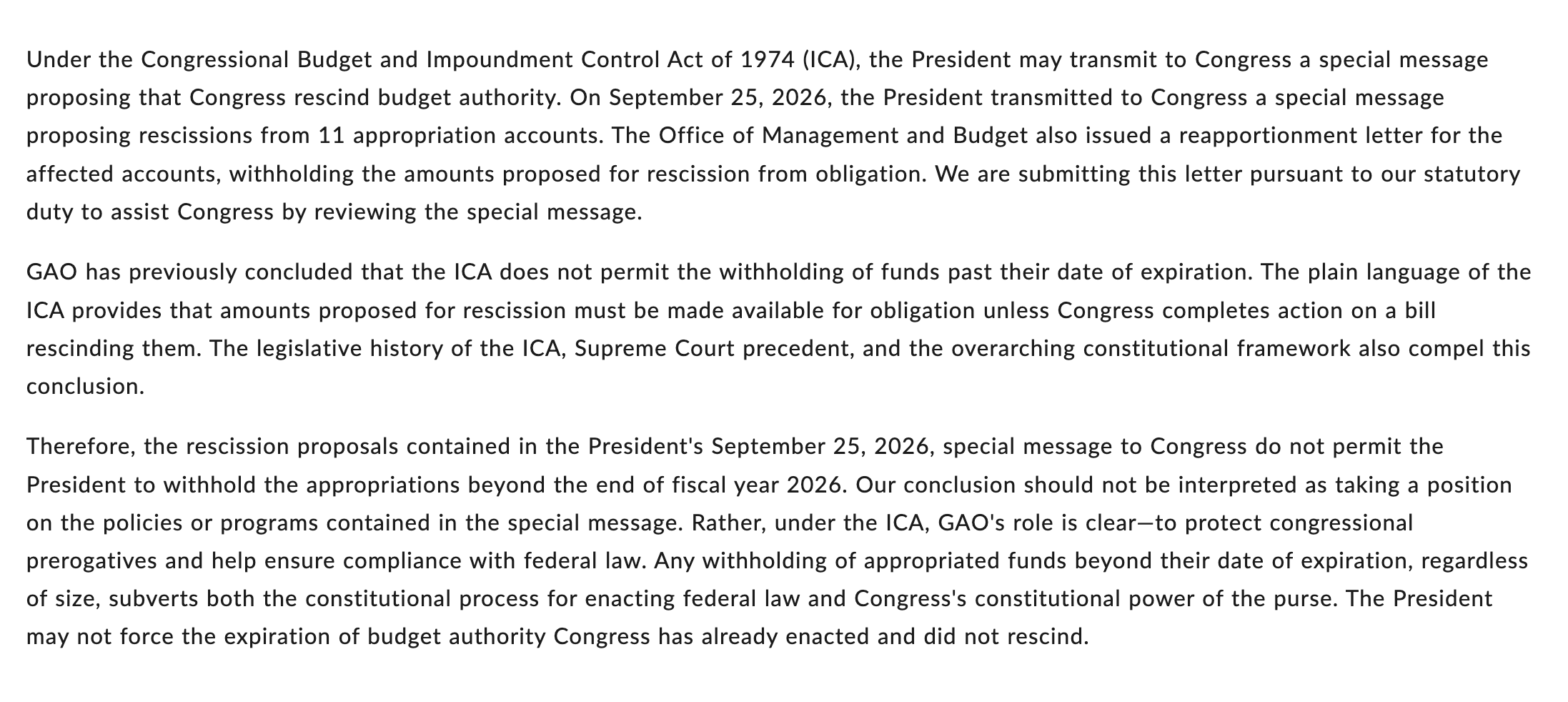
“This finding confirms what we have long known,” said Rep. Rosa DeLauro, the top Democrat on the House Appropriations Committee. The White House, she said, “is breaking the law to steal resources from our communities.”
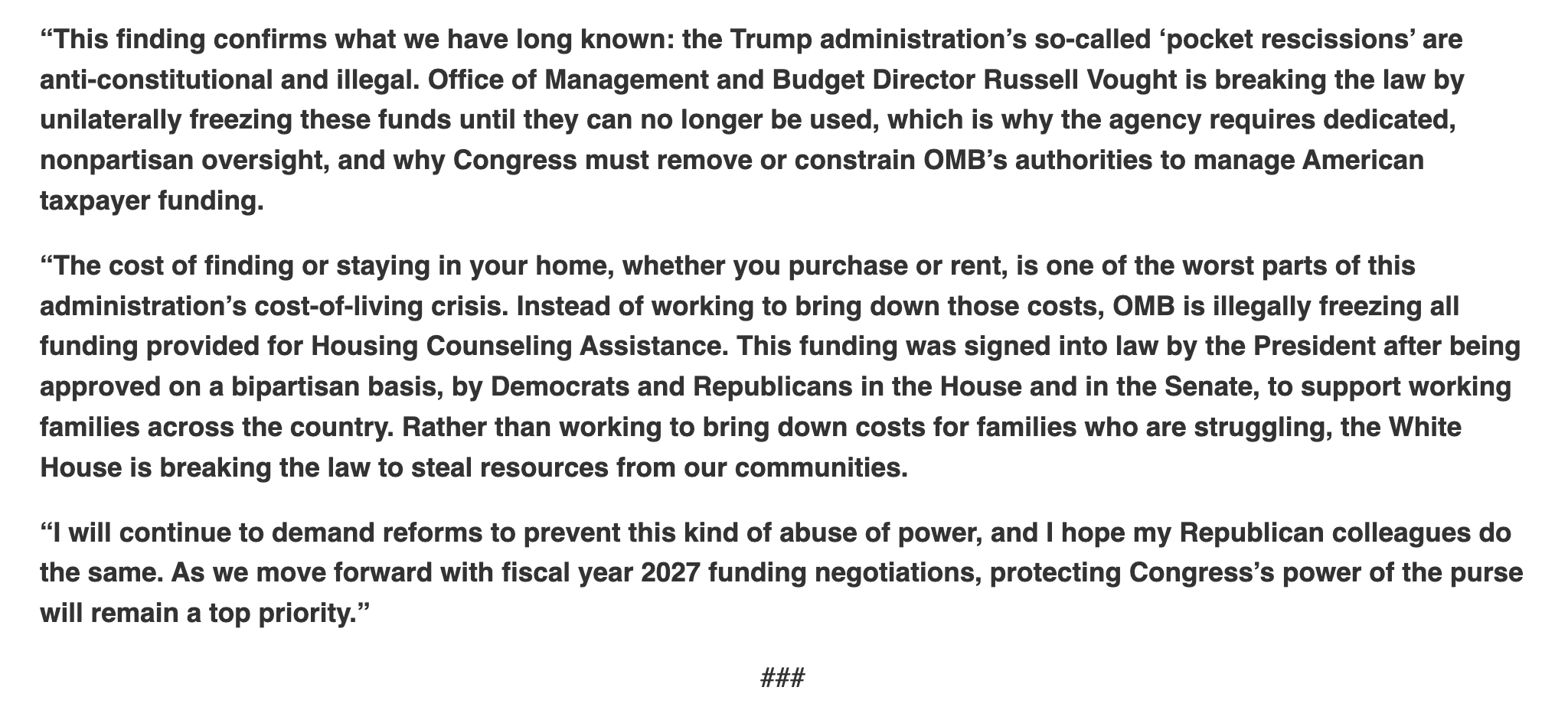
It is part of a broader campaign. New York Times columnist Jamelle Bouie has described an “all-out war on Congress’s once-sacrosanct power of the purse,” led by Vought, a key architect of Project 2025, including withheld funds for Head Start, FEMA, National Institutes of Health grants and the Inflation Reduction Act. At an April Senate hearing, Vought insisted, “We have not impounded anything.”
The courts are now involved. A coalition of states including California, Maine, Maryland, Michigan, New Mexico, Nevada and Oregon has sued, arguing that the administration’s “assertion of unilateral rescission power defies the Constitution’s finely wrought separation of powers.” A national association of grant recipients says the administration illegally targeted $24.9 million for programs serving children of migrant families. The National Urban League and housing groups are challenging the cancellation of $56 million in housing counseling grants, and a judge has already paused the deadline.
Where investigators should look. Investigators should demand a complete accounting of every rescission request, funding freeze and apportionment footnote OMB has used to delay or withhold money, and the internal communications about timing those requests to run out the clock. The most important question is selection: which programs, states and populations were targeted, and why.
IV. “Legal Bribery”: Buying Votes With Your Own Money
On Sept. 9, on stage at the Republican midterm convention in Dallas, Trump made voters an offer.
“If the Republicans win, you win with us and you get $5,000,” he said. “It will be called the Trump Dividend.”
Not if Congress passes a bill. Not if the economy can afford it. If Republicans win.
It was the most explicit version yet of what critics have come to call legal bribery: using public money, or the promise of it, to reward voters for keeping the president’s party in power. In the weeks since, the payments have multiplied.
On Sept. 30, the Treasury Department began sending $500 refunds to more than 950,000 Obamacare enrollees, each with a letter from Trump: “For years, the Biden Administration overcharged you.” The checks go only to people in the 30 states that use the federal HealthCare.gov exchange, not the 20 that run their own marketplaces, which health policy experts note tend to be governed by Democrats. A Reuters analysis found that 71% of the money, $339 million, is going to 13 states that host eight of the nine most competitive Senate races and 10 of the 12 most competitive governor’s races. Texas and Florida alone account for more than 266,000 recipients, according to federal data shared with CNBC.
The White House says the refunds return excessive fees. But UNC health policy professor Jonathan Oberlander noted that the fees rose and fell under Biden and were at times lower than in Trump’s first term. “This announcement is less about health policy and much more about the 2026 Congressional elections,” he told CNBC. “It’s part of a broader effort by President Trump to buy continued Republican control of the House and Senate via promises of direct government payments to voters.”
The checks also arrive against a painful backdrop. Most recipients lost all federal premium help when the Republican-controlled Congress let enhanced Obamacare subsidies expire. KFF estimates their premiums could quadruple in some states to more than $2,200 a month. A single $500 check does not come close.
Then, late Friday, Trump announced one-time $90 payments to more than 20 million seniors on Medicare, to land in early October. The money will come from the Medicare Improvement Fund, which Congress funded with $2 billion to improve the program. Trump called it “a pointless ‘Slush Fund.’” The standard Medicare Part B premium is $202.90 a month, so the payment covers less than half of one month. It will, however, reach seniors’ bank accounts weeks before they vote.
Hovering over all of it is the $5,000 promise. Trump has acknowledged it would cost roughly $1 trillion, with the national debt above $40 trillion and annual deficits near $2 trillion. “We don’t have surpluses to give away,” Marc Goldwein of the Committee for a Responsible Federal Budget told the Associated Press, adding that Trump has no authority to send the money without Congress. Trump has insisted he doesn’t need congressional approval, which raises an obvious question: if he can send the money on his own, why is it conditioned on Republicans winning?
Voters are skeptical. A Strength in Numbers/Verasight poll found 66% consider the offer “inappropriate.” A Reuters/Ipsos poll found 63% disapprove, including four in 10 Republicans. And 61% of likely voters in an Economist/YouGov survey don’t believe he’ll deliver.
Is it legal? Federal law makes it a crime to pay or offer to pay someone to vote. Trump’s defenders argue the $5,000 pledge is different because it would go to everyone, regardless of how, or whether, they vote. “This is a campaign promise,” one attorney told the AP. “It’s not a payment to individuals to try to get them to vote in a particular way.”
As a lawyer, I take that argument seriously. It may well be the right answer under the narrow terms of the statute. But it isn’t the whole answer. The AP itself compared the pledge to Elon Musk handing out million-dollar checks to voters in last year’s Wisconsin Supreme Court race. And there is a meaningful difference between a candidate promising a policy and a sitting president timing government payments, drawn from funds Congress set aside for other purposes, to land in battleground mailboxes weeks before an election, with a letter bearing his name and blaming his predecessor.
Past presidents have made explicit promises, too. Joe Biden told Georgia voters in 2021 they’d get $2,000 checks if Democrats won the Senate, and Congress later approved $1,400 payments. But those went through Congress and the appropriations process the Constitution requires. Trump’s payouts are being sent by executive decision, from repurposed funds, on a political calendar.
Cornell professor Douglas Kriner, who studies how presidential spending translates into votes, estimates efforts like these could be “worth a percentage point or two.” In a midterm decided by a handful of seats, that may be the point.
Where investigators should look. The key documents are the legal authorities CMS and Treasury relied on for the refunds and the Medicare payments, and any analysis showing the user fees were actually excessive. Investigators should look for any internal discussion of which states and voters would benefit, including whether anyone consulted electoral maps or lists of competitive races. They should find out who drafted Trump’s letter, whether political or campaign staff were involved, and what it cost to print and mail. And they should demand any planning documents for the $5,000 “Trump Dividend,” including whether anyone has identified a legal basis or funding source, and why the payment was tied to the election outcome.
V. The $1.776 Billion “Anti-Weaponization” Fund
Earlier this year, Trump’s Justice Department unveiled a $1.776 billion fund to compensate people it said were victims of “lawfare.” It was created to settle a $10 billion lawsuit Trump himself filed against the IRS over the leak of his tax returns. An addendum blocked IRS action on pending tax probes of Trump, his sons and their businesses. Trump retained the power to fire any of the fund’s five board members “without cause.” And January 6 defendants, including Proud Boys leader Enrique Tarrio, praised the fund and said they planned to apply.
The reaction crossed party lines. Former deputy attorney general Donald Ayer, who served under George H.W. Bush, called it “outright theft.” Former DOJ inspector general Michael Bromwich said “everything about the $1.776bn fund is crazy and corrupt.” Former U.S. attorney Barbara McQuade said the IRS addendum was “just a gift, pure and simple.” Sen. Thom Tillis called it “a payout pot for punks.”
The courts intervened. A bipartisan group of 35 former federal judges argued the settlement was a “fraud on the court,” and the judge who oversaw the case reopened it to examine whether it was “premised on deception.” This week, an appeals court, with a Trump appointee joining, refused to lift sanctions over what it called a “collusive” settlement.
Former federal prosecutor Bruce Green distilled the problem: the executive branch “unilaterally intends to draw close to $2bn out of the treasury without a congressional appropriation, as part of the ostensible settlement of a collusive lawsuit that the government never answered but certainly could have defended.”
Where investigators should look. Every communication among Trump’s personal lawyers, the White House and DOJ about the lawsuit and settlement. The negotiation history of the IRS addendum and its legal justification. Any lists or criteria for who would receive money. And a full accounting of anything disbursed or committed. The central witness is Attorney General Todd Blanche, who unveiled the fund and previously served as Trump’s criminal defense lawyer.
VI. The Family Business
The pattern extends to the president’s family.
ProPublica reported that the Pentagon’s Office of Strategic Capital approved a conditional $620 million loan to Vulcan Elements, a rare-earth magnet company in which Donald Trump Jr.’s firm, 1789 Capital, had taken a stake three months earlier, and that the loan request was reportedly initiated by Trump adviser Peter Navarro. Trump Jr., the Pentagon and the company all deny any political influence. Sen. Adam Schiff called it a “wedding present.” A company backed by Eric Trump secured a $24 million Pentagon contract, which Sen. Elizabeth Warren called “corruption in plain sight.”
The broader picture is larger still. In Rolling Stone, historian Sean Wilentz documented a $500 million investment in the Trump family’s World Liberty Financial by an Abu Dhabi firm tied to the UAE’s national security adviser, and found that more than half of the publicly identified corporate donors to Trump’s White House ballroom later received new or expanded federal contracts worth more than $50 billion, according to Public Citizen. Bouie has noted that hundreds of millions of dollars are flowing to the ballroom and a planned triumphal arch without a specific congressional appropriation.
Where investigators should look. The full decision record for the Vulcan loan, including Navarro’s role and any contact with 1789 Capital; ethics reviews, if any, of deals involving Trump family companies; a full accounting of public money spent on the ballroom, the arch and other White House projects; and ballroom donor lists compared against subsequent contracts and regulatory decisions.
VII. This Has Happened Before
None of this should surprise anyone who has followed Trump’s career, because a court has already found that he did something similar.
In 2019, Trump was ordered to pay $2 million in damages for illegally misusing money from his own charity, the Trump Foundation, for political purposes. In settling with the New York Attorney General’s office, he agreed to 19 admissions acknowledging his personal misuse of the foundation’s funds, including using it to benefit his 2016 presidential campaign. The foundation was dissolved. Trump had to reimburse it for sports memorabilia and champagne bought at a charity gala. His children were required to undergo training on how to properly run a charity, and Trump agreed to restrictions and ongoing reporting on any future charitable work.
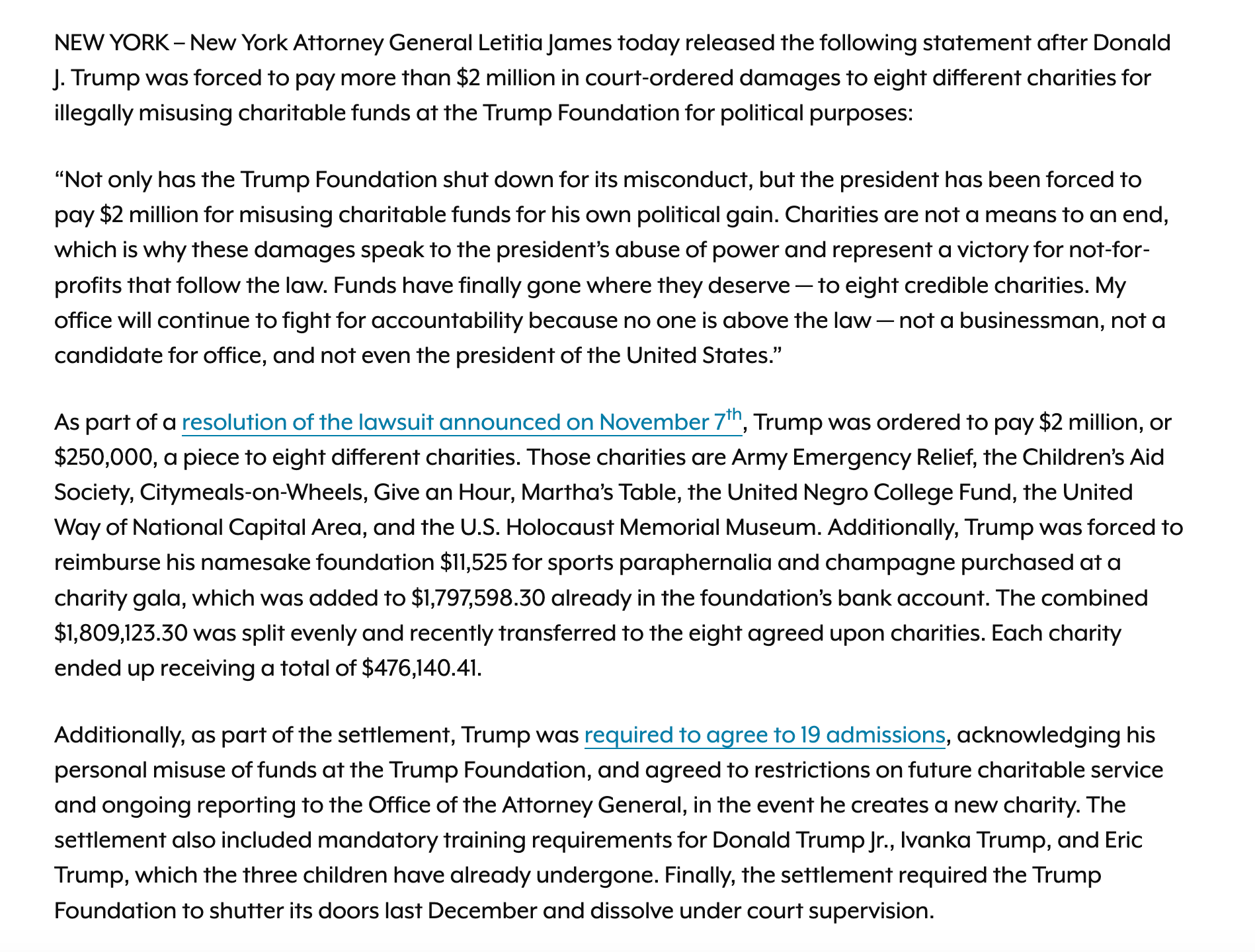
“No one is above the law,” Attorney General Letitia James said at the time, “not a businessman, not a candidate for office, and not even the president of the United States.”
The parallels are hard to miss: money set aside for one purpose, charity then and public needs now, redirected toward Trump’s political interests. The lesson Trump appears to have taken was not to stop, but that the consequences were small enough to absorb. Then it was a charity. Now it is the United States Treasury.
From a legal standpoint, that history matters for another reason. Many of the laws at issue here turn on intent and knowledge. A prior, admitted misuse of funds for political purposes is relevant context for any investigator deciding whether today’s spending decisions were mistakes or choices.
A Timeline
2019: A court orders Trump to pay $2 million for misusing Trump Foundation funds for political purposes, and the foundation is dissolved.
2023: As South Dakota governor, Noem’s administration pays the Strategy Group $8.5 million in state funds for ads starring Noem.
February 2025: DHS under Noem launches a no-bid ad campaign that grows to more than $220 million, citing a border “emergency.”
Early 2026: DOJ unveils the $1.776 billion “anti-weaponization” fund to settle Trump’s lawsuit against the IRS. Judges block it and reopen the case.
Aug. 7, 2026: In an Oval Office meeting about midterm spending, Trump has his assistant show advisers videos of himself.
Sept. 9: Trump promises $5,000 to every adult “if the Republicans win.”
Sept. 19: OMB moves $20 million in CBP funds into a “commemorative events” budget line.
Sept. 20: CBP awards a $20 million “national media campaign” contract to LMD.
Late September: Ads praising Trump begin airing nationally, “Paid for by the U.S. Government.” The White House sends pocket rescissions targeting about $810 million.
Sept. 29: The GAO finds the pocket rescissions violate the Impoundment Control Act.
Sept. 30: Treasury begins sending $500 Obamacare checks to 950,000 people, mostly in battleground states.
Oct. 2: Trump announces $90 payments to 20 million Medicare enrollees.
VIII. Who Can Act
Congress can hold hearings, issue subpoenas and write appropriations riders that bar self-promotional ads, require competitive bidding for media contracts and require advance notice of transfers like the one that funded the “God Made Trump” campaign. If Democrats win the House, the Oversight, Judiciary and Appropriations committees will have the power to compel testimony from every official named in this piece.
The GAO has already found Impoundment Control Act violations and is being asked to review the ads. Its findings carry no direct penalty, but they create an official record and can trigger reporting requirements under the Antideficiency Act.
Inspectors general at DHS, HHS, Treasury and the Pentagon can examine how their agencies’ money was spent, including the Noem-era contracts experts have said warrant review, though the administration’s removal of inspectors general may limit how far they go.
The courts are already involved, and have shown a willingness to block and scrutinize these moves.
Future prosecutors could revisit the record. Federal criminal statutes on misuse of public funds generally carry five-year statutes of limitations, which means decisions made this fall could still be examined years from now.
Impeachment remains the Constitution’s ultimate check. The framers reserved it for “high crimes and misdemeanors,” a phrase they understood to include abuses of public trust, not only indictable crimes. Whether to pursue it is a political judgment for the House. But the framers built that tool for a president who treats public power, and public money, as his own.
The Bottom Line
The record is building. A GAO finding that the administration broke the Impoundment Control Act. A federal court reopening a case over a possibly “collusive” settlement. Bipartisan objections to self-promotional ads paid for with border security money. A nine-figure no-bid ad program that contracting experts say warrants investigation. Government checks timed to land in battleground states weeks before an election. Family members profiting from government deals. And a prior court judgment over the misuse of charitable funds.
None of it enforces itself. It takes Congress, watchdogs, courts and, ultimately, voters deciding that it matters.
I’ll keep tracking every dollar: where it came from, where it went, who approved it and what laws may have been broken. Because if the people’s money can be spent to glorify one man and reward his party at the ballot box without consequence, then Congress’ power of the purse, and the Constitution that guarantees it, mean nothing.


