

Donald Trump did not just return to the White House in 2025. He returned to it as a business opportunity, and eighteen months in, the numbers show just how thoroughly he and his family have treated the presidency as a revenue stream rather than a public trust. Trump’s personal wealth has ballooned by more than 165 percent since his second inauguration, reaching an estimated $6.3 billion. His overall revenue jumped to at least $2.2 billion in 2025 alone, compared with a minimum of $622 million the year before he took office, according to his own financial disclosure. No American president in the 250-year history of the office has ever converted the job itself into personal income at this scale, and the money trail runs through crypto exchanges, defense contractors, foreign sovereign wealth funds, Wall Street trading desks, and a growing list of corporations writing checks to his pet projects.
I am offline today for Yom Kippur, but I wanted to make sure you had this major deep dive regardless. Stories like this will get me major pushback, but only get written because readers fund them, not because a billionaire owner or an advertiser decides it’s convenient. Tracing every filing, every disclosure form, and every contradiction takes real time, and that work only keeps happening if enough people who value it become paid subscribers. If you think this story is worth someone staying on top of it every week, not just once, subscribe now and help keep this kind of reporting going.
It is completely unprecedented, said Megan Gorman, a tax attorney whose book All the Presidents’ Money traces the history of presidential wealth back 250 years. Historians who study the presidency agree there is no real precedent for a president launching brand-new business ventures on the eve of his own inauguration and then personally profiting from them while in office. “Public office, if anything, was a source of debt, not a source of revenue,” Lindsay Chervinsky, a presidential historian and executive director of the George Washington Presidential Library, told the New York Times.
Princeton historian Julian Zelizer put it even more bluntly in an interview with the Guardian: “Trump has figured out a way to monetize the presidency, political power and public policy in ways no other president has achieved. In the first term, he created the thinnest of firewalls between his business and policy. In the second term, he didn’t put up any firewall and smashed all guardrails that existed.” Larry Noble, a former general counsel at the Federal Election Commission, was more direct still, saying it “already looks like the most openly corrupt administration in our history... Whether you’re a foreign country, a company or an individual who wants the government to approve a business deal, stop an investigation or just be a friend when you need a favor, the message is that this is a pay to play administration.”
The money trail at a glance
Before getting into the details, it helps to see the full scale side by side. These are the major, documented revenue streams that have flowed to Trump personally, to his sons, or to the businesses that carry his name since he returned to office:


This is not an exhaustive list. It excludes merchandise royalties, event revenue at Trump properties, and dozens of smaller foreign deals that are harder to price. But it shows the shape of the operation: a presidency that generates cash for the man holding it, for the family running his businesses, and for the allies investing alongside them.
A break from 250 years of precedent
Previous presidents and their families have occasionally brushed up against business conflicts, but historians say nothing compares to what’s happening now. President Lyndon B. Johnson’s wife, Lady Bird Johnson, owned a profitable Austin radio station, but after Kennedy’s assassination she transferred her radio and television stations into a trust controlled by an outside lawyer and station executive to avoid the appearance of conflict, according to Mark Updegrove, chief executive of the LBJ Foundation. George W. Bush sat on the board of an oil company before entering politics and sold his stake in the Texas Rangers baseball team before his 2000 presidential run. Jimmy Carter turned over operation of his peanut farm to an independent trustee while in office. Even Warren Harding, who kept ownership of an Ohio newspaper that had been in his family for decades, agreed to sell it after questions were raised about the investment.
When children or siblings of past presidents pursued business deals, even relatively minor ones, they generated intense backlash. Jimmy Carter’s brother endorsed “Billy Beer.” James Roosevelt, son of Franklin D. Roosevelt, was forced out of his government post after The New York Times and the Saturday Evening Post exposed what became known as the “Jimmy’s Got It” scandal over his insurance business dealings. Hunter Biden was paid by a Ukrainian natural gas company while his father was vice president, and it became a defining political controversy for years.
“Presidents have worked assiduously to show they are not connected to anything that could in any way compromise their decision making or leverage their public virtue,” said Jeffrey Engel, director of the Center for Presidential History at Southern Methodist University. “The Trump White House seems to go in the opposite direction: that if we do so much of it, people will not think anything about it is weird.” Updegrove agreed: “It is the openness, the flagrant nature of what they are doing, almost with pride, cashing in on the office itself. That’s what makes it dramatically different.”
Trump’s own family has been unapologetic about the shift. “The first term we did everything imaginable to avoid any appearance of impropriety, and frankly, we got crushed anyway,” Eric Trump said shortly before the 2024 election, arguing the presidency had cost his father “an absolute fortune.” He added: “We can’t just sit out in perpetuity, and I won’t.” In 2017, at the start of Trump’s first term, the family had pledged not to pursue new international business deals for exactly that reason. That pledge no longer exists.
Structurally, Trump has also declined to do what nearly every modern president has done: place assets in a genuinely blind trust or divest entirely. His sons run day-to-day operations through trusts set up after his 2016 election, but Trump remains the beneficiary of those trusts, meaning every dollar the business earns still flows back to him personally.
Stream one: the crypto empire
The single largest source of Trump’s new wealth is cryptocurrency, an industry Trump called a “scam” and a “disaster waiting to happen” as recently as 2021, before it poured millions into his 2024 campaign. Trump co-founded the family crypto venture World Liberty Financial in the fall of 2024 with the family of Steve Witkoff, who is now Trump’s special Middle East envoy, and it is now run day-to-day by his son Zach Witkoff and the Trump family. The business has generated $799 million for Trump, much of it from a payment tied to an investment fund backed by the United Arab Emirates buying a stake in the company. Separately, Trump’s $TRUMP memecoin, launched three days before his inauguration, has brought in another $636 million, more than his entire worldwide business income in all of 2024. Two hundred and twenty of the coin’s top investors were invited to a private reception with the president.
That memecoin business got a direct assist from Trump’s own government. A February 2025 SEC staff statement declared that memecoins would no longer be subject to agency oversight, reversing the position taken under the Biden-era SEC, which had applied a broad legal test to nearly every crypto token. Four months later, World Liberty Financial introduced its own stablecoin, and in July 2025 Trump signed the GENIUS Act into law, formally promoting stablecoins as a legitimate financial product nationwide.
The human cost of the memecoin has been steep for ordinary investors. A February industry report found that $TRUMP and the first lady’s $MELANIA coin “erased an estimated $4.3 billion in retail wealth in recent months, with 2 million holders currently underwater,” even as 45 early-holder wallets profited by a combined $1.2 billion. Overall, roughly one million investors in Trump-linked crypto schemes have lost almost $3.8 billion as volatile holdings tanked. Timothy Massad, director of the digital assets policy project at Harvard’s Kennedy School, summed up the disconnect: “Although the president talks about digital assets as the frontier of finance and making the United States the crypto capital of the world, the disclosure form suggests his personal strategy is to make a quick buck from crypto... but then invest his profits in traditional assets like stocks and bonds.”
World Liberty Financial’s fortunes are also tangled up with Binance, the world’s largest crypto exchange, which pleaded guilty in 2023 to violating U.S. money-laundering laws and paid a $4.3 billion Justice Department fine. Binance’s founder, Changpeng Zhao, who still owns roughly 90 percent of the company, pleaded guilty separately to violating the Bank Secrecy Act, served a four-month jail term in 2024, and received a pardon from Trump last October. Despite Binance’s promises to clean up, internal investigators found roughly $1.7 billion in crypto had moved through the exchange to Iranian entities linked to terrorism. World Liberty Financial was tapped to play a central role when MGX, an Abu Dhabi state-backed investment fund, pledged $2 billion to buy a stake in Binance using WLF’s own stablecoin, USD1, directly bolstering the Trump family firm.
Cornell economist Eswar Prasad said the regulatory pattern speaks for itself: “The Trump administration has clearly shifted the priorities and focus of the government’s regulatory apparatus to look past any and all sins of the crypto industry, thereby directly benefiting the Trump family’s financial interests.” After a 2025 memecoin event at Mar-a-Lago drew conflict-of-interest accusations, press secretary Karoline Leavitt said only that Trump was “abiding by all conflict-of-interest laws that are applicable to the president.”
Stream two: selling access to the presidency itself
This summer, Trump Media pushed the monetization further with a new product called Truth API, which offers Wall Street firms early access to Trump’s Truth Social posts for $100,000 a month. Because Trump’s posts routinely move markets, watchdogs and Democrats call it a direct sale of insider access to the presidency. Senator Mark Warner wrote to six major Wall Street trade groups urging them to reject the arrangement, warning them not to “legitimize an arrangement that sells privileged access to market-moving presidential communications, especially for the president’s personal financial benefit.” Senators Elizabeth Warren and Adam Schiff went further, writing to the SEC to call it “an outrageous abuse of the President’s office for his personal benefit that undermines everyday investors and the integrity of our markets, while enriching Wall Street and other wealthy insiders.”
Virginia Canter, chief counsel for ethics and anti-corruption at Democracy Defenders Action, called it “a significant escalation in exploiting and monetizing the presidency for his personal private gain,” warning it is “a step towards normalizing insider trading and public corruption, disregarding the damage it may cause to regular investors who will not have the same access as his wealthy institutional customers.” She added that Trump is “increasingly dependent on the presidency to generate business profits since his media company has been losing money over the past several quarters.” That losing streak is real: Trump Media reported a $238 million loss in the three months through June as it branched into new businesses including crypto, up from a $20 million loss a year earlier.
Stream three: suing the government, then settling with himself
Perhaps the clearest case of self-dealing involves Trump’s own Justice Department. Last year Trump sought $230 million in compensation from the DOJ over the FBI’s search of Mar-a-Lago during the classified documents investigation. In January, Trump, his two eldest sons, and the Trump Organization filed a separate $10 billion lawsuit against the IRS and Treasury Department after a former IRS contractor illegally leaked his tax returns. Trump initially sought to establish a fund of nearly $1.8 billion, reportedly telling allies he “gave up a lot of money in allowing” the fund to be created, before backlash from Congress and the courts forced a partial retreat.
To resolve these and related cases, the administration agreed to distribute $1.776 billion in taxpayer funds to people who say they were targeted for political prosecution by past administrations, a group that includes Trump supporters imprisoned for the January 6 Capitol attack. The Justice Department has said it will comply with a court ruling that temporarily blocked the fund after congressional outcry.
Buried in the same deal, and drawing far less attention, the government agreed to drop pending IRS audits of Trump and his relatives, a provision that could save Trump and his family roughly $100 million. Barbara McQuade, a former federal prosecutor who now teaches at the University of Michigan law school, called it self-dealing in its purest form: “The judge assigned to the case later found that because Trump controlled both sides of the case, there was no adversity of parties to provide the court with jurisdiction. Instead, Trump used the court to legitimize what was essentially a gift to him at taxpayer expense.”
Stream four: the sons’ defense and mining empire
Donald Trump Jr., 48, and Eric Trump, 42, have separately built personal fortunes off the back of their father’s policies. Eric’s net worth has grown tenfold to $400 million since the 2024 election, and Don Jr.’s has grown sixfold to an estimated $300 million, according to Forbes figures. Don Jr. invests through 1789 Capital, a venture dedicated to what it calls “patriotic capitalism.” Eric’s vehicle is American Ventures, a branch of the boutique investment bank Dominari Holdings, based inside Trump Tower. Neither son holds a formal government role, which the family says eliminates any conflict.
Companies the two sons have invested in have won at least $3.2 billion in direct federal contracts since the brothers came aboard, with another $3.1 billion in future contract options, according to Washington Post analysis. Here’s how that breaks down:
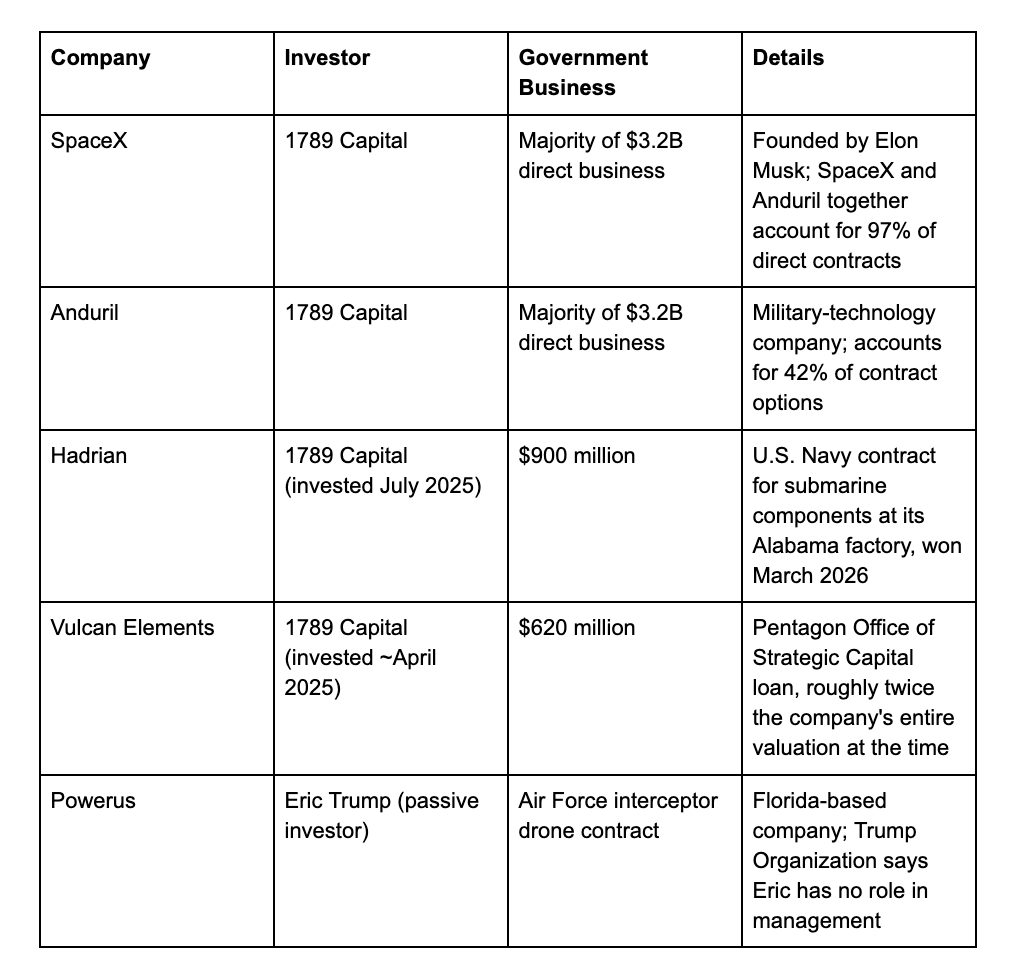
The Vulcan Elements loan is the most scrutinized of these deals. ProPublica reported that the loan request came from Peter Navarro, a senior White House trade adviser and a friend of Trump Jr.’s, and that Pentagon staff worked “at an unusually rapid pace... work[ing] late nights and with little sleep to get the loan through in a matter of weeks.” After the award, estimates of Vulcan’s valuation grew tenfold. A group of congressional Democrats, including Senators Elizabeth Warren and Richard Blumenthal, wrote to White House chief of staff Susie Wiles demanding “a full explanation for what appears to be an egregious example of Trump administration corruption involving the White House delivering a lucrative Defence Department loan to a company with financial ties to the Trump family.” They added: “The American public — and servicemembers that are in harm’s way — expect that the DoD contracting process is fair, unbiased and competitive to ensure that only the best companies, providing only the best products, receive taxpayer dollars.” The White House has not responded to the letter.
Beyond defense, the sons’ portfolios extend into prediction markets, with investments in companies like Polymarket now under CFTC scrutiny, and into critical minerals mining ventures, including projects in Kazakhstan pursuing billions of dollars in federal assistance. None of these ventures generate profit for Trump directly, but they do enrich his children while his administration shapes the regulatory and funding environment those industries depend on.
1789 Capital’s spokesman, Chandler Costello, rejected any suggestion of impropriety: “There are zero conflicts at 1789, where no one has ever served in government, unlike the clear conflicts of top-level Democrats who have specifically monetised their government experience. Where was all the hand-wringing when conflicts abounded for these most senior-level Democrats?” Kimberly Benza, a Trump Organization spokesperson, likewise insisted the company “operates completely separate from the presidency and is in full compliance with all ethics and conflict-of-interest laws.” Pentagon spokesman Joel Valdez added: “No company receives preferential treatment... outside affiliations, investors or political connections play absolutely no role in the department’s funding decisions.”
Stream five: trading on a scale Congress can’t match
Trump has also become an unusually active trader in his own right. A Bloomberg analysis found he averages roughly 80 stock and bond transactions on every market day, having logged more than 21,000 trades in 2025 worth up to $1.06 billion, all while publicly backing legislation that would ban stock trading by members of Congress and their families but exempt the president himself. The House measure, which cleared the chamber in July, was attached to a voter identification bill Democrats consider a poison pill in the Senate, meaning the broader push faces long odds. Trump endorsed the concept in his State of the Union address, saying Congress “cannot corruptly profit from using insider information” and that a ban should pass “without delay,” a statement notably silent on his own trading.
When Senator Josh Hawley introduced separate legislation that would have applied the same trading restrictions to the president and vice president, Trump turned on his fellow Republican, calling him a “pawn” and denouncing him on the social media platform Trump himself controls. In committee, Hawley stood as the only Republican to back his own bill.
The Office of Government Ethics recorded more than 3,600 stock trades in the first quarter of 2026 alone, worth over $100 million, many of them large purchases of AI and technology stocks including Nvidia, Dell, Oracle and Palantir made before his administration took policy actions favorable to those companies. In June alone, his accounts recorded 1,051 transactions worth between $78.1 million and $263.1 million. Similar disclosures show Trump has also acquired more than $300 million in bonds issued by companies, states and municipalities, even as he has repeatedly and publicly pressured the Federal Reserve to cut interest rates, a move that could raise the value of exactly those bond holdings.
White House spokesman Davis Ingle maintains Trump has no role in the trades: “Neither President Trump nor any member of his family has any ability to direct, influence, or provide input regarding how the portfolio is invested or when investments are bought or sold.” All investment decisions, he said, are made by independent managers using automated model portfolios benchmarked to indexes like the Schwab 1000. Kedric Payne of the Campaign Legal Center isn’t convinced that answers the underlying problem: “Even if they’re not trading the stock on non-public information, they still create the appearance of a conflict of interest because they can still influence the value of the stock through their official duties.”
Public opinion is not on the administration’s side here. An Economist/YouGov poll of 757 U.S. adults found that three-quarters opposed allowing members of Congress and other elected officials to buy and sell stocks at all. Republican strategists nonetheless see congressional stock trading, not the president’s own trading, as a useful midterm wedge issue; Rep. Anna Paulina Luna told a Republican convention in Dallas last week, “The American people deserve to know that those they elect to public office actually serve the American people and not their own wallets.” Separately, Senator Elizabeth Warren and Representative Robert Garcia have demanded Trump identify the money managers behind his accounts and explain more than 30 transactions they say raise questions about whether he is using his office to benefit his own portfolio.
Stream six: the oil and gas windfall from the Iran war
The clearest, most trackable example of Trump personally profiting from his own decisions is his energy portfolio during the war with Iran. A CNBC analysis found Trump’s nine largest disclosed oil and gas holdings gained between $1.5 million and $4.4 million from the eve of the war on February 27 through August 31, as his wartime decisions repeatedly moved energy markets. Those nine holdings are Chevron, ConocoPhillips, Exxon Mobil, Kinder Morgan, Marathon Petroleum, Occidental Petroleum, Phillips 66, Valero Energy, and the Williams Companies.
The timing of specific trades lines up closely with specific wartime decisions:
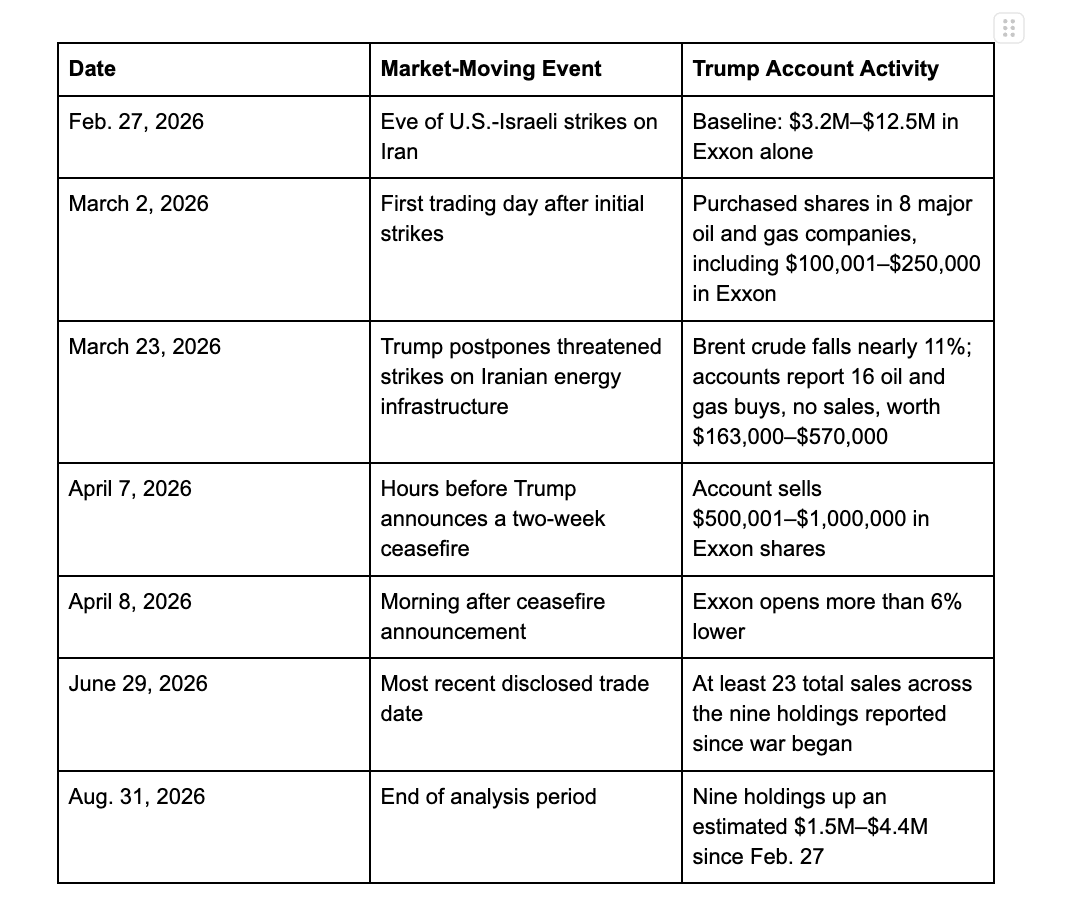
If the Exxon shares sold on April 7 had been held since before the war, CNBC estimates they had already gained roughly $35,000 to $70,000 in addition to avoiding the next day’s 6 percent drop. Across all 23 disclosed sales, CNBC estimates the shares would have been worth $36,000 to $95,000 more had they been held rather than sold, on top of the larger paper gains Trump continued to hold in his remaining positions. Democratic staff on the Joint Economic Committee estimated Trump’s broader oil and gas portfolio gained as much as $15.5 million over the course of the year. “Donald Trump held millions in oil and gas company stocks at the end of 2025. Today, those stocks are worth as much as $15.5 million more,” Senator Warren wrote. “What happened? He started a war with Iran this year, and sent oil and gas stocks soaring.”
“When a president can move a market through official decisions and personally benefit from the result, the public is left wondering where national policy ends and private financial interest begins,” said Donald Sherman, president of Citizens for Responsibility and Ethics in Washington. Scott Greytak of Transparency International U.S. added: “A discretionary account is a smokescreen, not a blind trust... Trump likely knows where his money is parked and would still see the upside when his administration’s actions send those energy stocks climbing.”
The same energy companies in Trump’s portfolio reported a combined $47.6 billion in second-quarter profit, triple the $15.9 billion they earned a year earlier. Exxon and Chevron alone, Trump’s two largest holdings, reported a combined $26.6 billion in profit, up from $9.6 billion; Marathon, Phillips 66, and Valero collectively added another $12.7 billion. Even as Trump publicly complained about those profits, telling reporters in August that Exxon and Chevron were “making too much money” and that “they’re going to give some of that back to the public,” his own portfolio benefited from the exact same price dynamics.
For consumers, the picture is the mirror opposite. U.S. crude was trading around $91 a barrel by late August, 36 percent above prewar levels, with national gas averaging $4.09 and Labor Day weekend expected to be the most expensive on record. Americans have paid an estimated extra $71.5 billion for gasoline since the war began, or about $604 per household, according to the Joint Economic Committee’s analysis of federal and AAA data. Phillips 66’s CEO told investors refining conditions would remain strong “even if peace broke out tomorrow,” a comment that underlines how disconnected the industry’s profits, and Trump’s personal stake in them, have become from any resolution of the war itself.
Stream seven: real estate, foreign money, and Jared Kushner
Trump’s businesses have also expanded abroad in ways that would have been unthinkable in his first term, when the family specifically pledged to avoid new international deals to prevent conflict-of-interest allegations. That pledge is gone. Real estate deals with a Saudi-based developer, including one involving the Saudi government directly, plus new golf and residential projects in Vietnam and Romania, have brought tens of millions of dollars to Trump and his sons. Trump’s foreign licensing income alone reached $59.5 million as Gulf developers paid to put his name on their projects.
Jared Kushner, Trump’s son-in-law, serves as a Middle East foreign policy adviser to the president while his private equity firm, Affinity Partners, has collected billions of dollars from Middle Eastern sovereign wealth funds, including funds tied to Saudi Arabia. And Qatar gave Trump a $400 million jet that he intends to use as Air Force One and eventually keep for his presidential library, a gift lawmakers say could cost taxpayers more than $1 billion in security upgrades and structural rebuilding.
Stream eight: merchandise, golf clubs, and paydays for his properties
Beyond the sophisticated financial engineering, Trump’s name is simply for sale on a growing pile of merchandise: Bibles, guitars, sneakers, watches, fragrances, a gold-hued cellphone, and $55 red hats commemorating America’s 250th anniversary that showed up at every seat during a televised Cabinet meeting in May. When French President Emmanuel Macron and Ukrainian President Volodymyr Zelenskyy visited last summer, Trump showed them a merchandise room off the Oval Office stocked with goods for sale on his website. Months later, video surfaced of Trump spraying Syrian President Ahmad al-Sharaa with bottles of his own “Victory 47” cologne and perfume, presented as a gift. Trump has also displayed “Trump 2028” hats on the Resolute Desk during meetings with congressional Democrats.
His golf clubs and hotels have become default venues for Republican political spending. Conservative groups and GOP committees have spent at least $26 million at Trump properties, including Mar-a-Lago, his Bedminster estate, and his Doral and Sterling golf clubs, since 2015, and the true figure is likely higher because some groups aren’t required to disclose it. The Saudi Public Investment Fund’s LIV Golf league has held events at Doral, which is also set to host the G20 summit in November, meaning world leaders, staff, business executives, and journalists will all be paying the Trump Organization directly for the privilege, even as Trump insists government attendees will be billed “at-cost” and that “we will not make any money on it.”
Stream nine: the ballroom, and the donors who paid for it
No project captures the pay-to-play dynamic better than Trump’s new White House ballroom. In October 2025, the administration demolished the East Wing of the White House, historically the office of the first lady, to make way for a 90,000-square-foot ballroom, funded almost entirely by nearly $400 million in private donations, some of them undisclosed. Congress never approved the demolition or appropriated money for the project. The National Trust for Historic Preservation sued in December 2025, and the case is now before the Supreme Court, with amicus support from the Campaign Legal Center and CREW arguing the courts must block the project because the Constitution gives spending power to Congress, not the president.
CREW identified fifteen companies that have each donated to at least three of ten Trump “pet projects,” including the ballroom, his inauguration, his presidential library, and America’s 250th anniversary celebrations. Here’s the breakdown, along with what each company had riding on staying in Trump’s good graces:
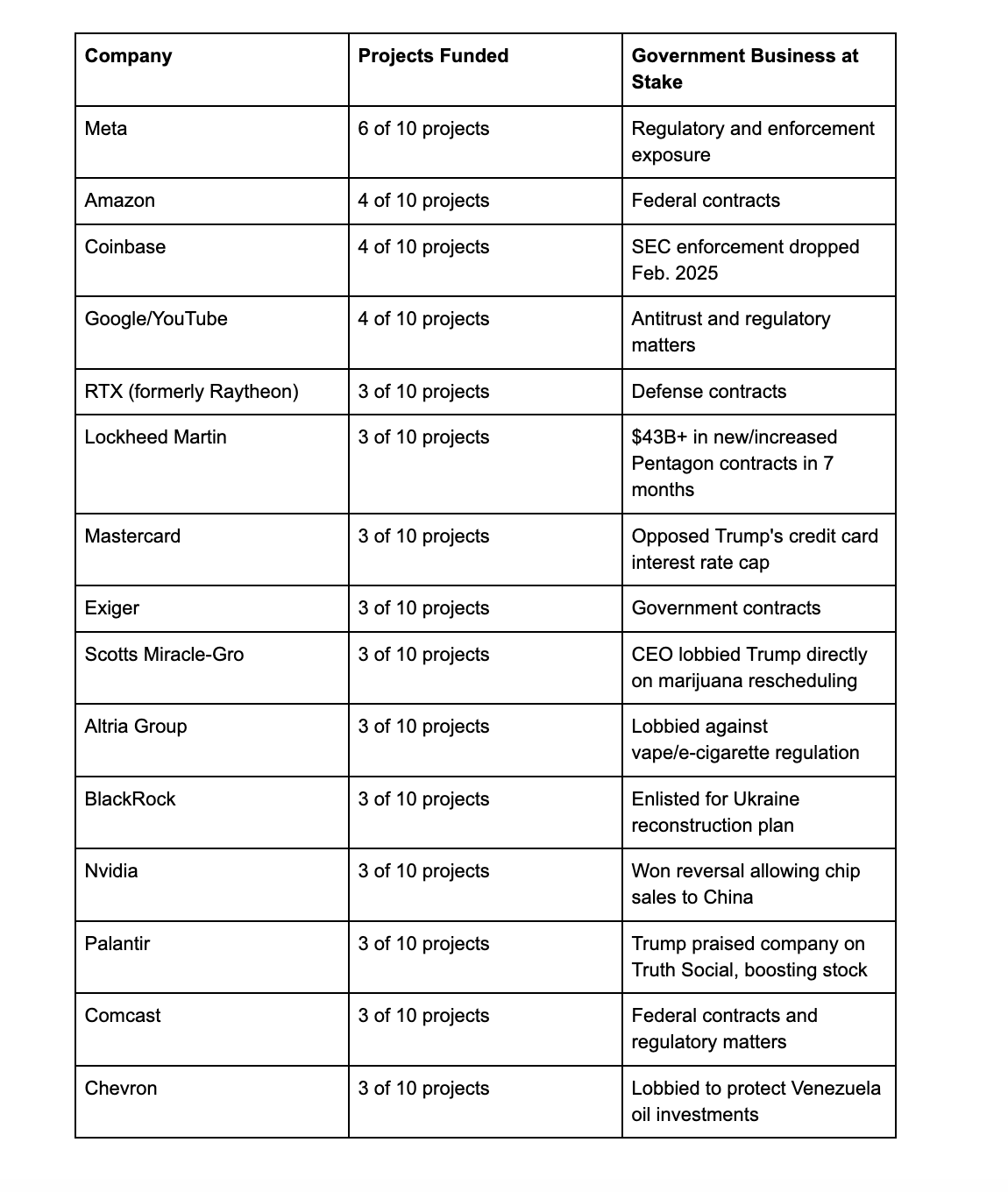
Twelve of these fifteen companies hold active government contracts, and at least nine have faced federal enforcement actions in recent years, some of which remain open. The payoff for donors has often been concrete and fast. Coinbase and its investors gave $12 million to the pro-Trump MAGA Inc. super PAC, $1 million to Trump’s inaugural fund, and an undisclosed sum to the ballroom; the SEC dropped its civil enforcement case against Coinbase in February 2025. Coinbase’s own chief operating officer appeared to acknowledge the arrangement plainly in a since-scrutinized interview, saying the ballroom donation was meant to “keep good relations with the White House.” An NBCUniversal executive at parent company Comcast was blunter still, telling reporters: “If we have to name a ride after him at Universal Studios, that’s fine too, as long as it means they leave us alone.”
Thirteen of the fifteen top donor companies have had executives meet privately with Trump or join him on foreign trips, including a business summit in Saudi Arabia attended by executives from Palantir, Nvidia, Amazon, BlackRock and Google, and a trip to China that included BlackRock, Nvidia, Meta, and Mastercard. Lockheed Martin’s CEO called the administration a “golden opportunity” for the defense giant, and Trump personally praised Palantir’s “great war fighting capabilities” on Truth Social, temporarily boosting its stock price. The administration has also reversed decades of export policy to let Nvidia sell advanced AI chips to China, and has considered taking direct equity stakes in both Lockheed Martin and Palantir.
The administration has also incentivized these donations through exclusive access: a dinner for ballroom donors at the White House, a “VIP experience” for America 250 donors at the 2025 military parade, and an invitation-only reception for million-dollar donors to Freedom 250.
Stream ten: renovations, arches, and reflecting pools, all billed to taxpayers
Even as private donors fund his signature “legacy” projects, Trump has repeatedly turned to taxpayers to cover the surrounding costs. He initially said wealthy donors would fully fund the ballroom, then sought $1 billion in federal funding for what he described as military- and Secret Service-requested security upgrades tied to the project. Separately, at least $15 million in public money is earmarked for a ceremonial arch Trump wants built at the entrance to Washington, and the National Park Service is paying a contractor $13.1 million to renovate the Lincoln Memorial Reflecting Pool at Trump’s direction. Add the Qatar jet’s estimated $1 billion-plus in taxpayer-funded security and structural upgrades, and the public is subsidizing the very “legacy” projects Trump claims are being paid for by private generosity.
What the White House says, and what it doesn’t answer
Asked repeatedly about these overlapping conflicts, the White House’s answer has stayed essentially the same across every outlet that has asked. “President Trump only acts in the best interests of the American public, which is why they overwhelmingly re-elected him to this office, despite years of lies and false accusations against him and his businesses from the fake news media,” spokeswoman Anna Kelly has told reporters on multiple occasions. “There are no conflicts of interest.” Trump himself told the New York Times in January that he has a “very honest family” and has never taken his presidential salary.
A CNN poll in late July found that 66 percent of respondents said Trump doesn’t put the good of the country over his personal financial gain, versus just 34 percent who said he does. A separate Reuters/Ipsos poll found 70 percent disapprove of Trump’s handling of the cost of living, the same affordability squeeze his own energy trades have profited from.
Democrats in Congress have opened at least one formal probe into the family’s business dealings. On August 27, Rep. Jamie Raskin opened an investigation into 1789 Capital, alleging the firm has benefited from administration contracts, funding, and regulatory actions; Trump Jr. told the Guardian the allegations were “unsubstantiated talking points.” Several congressional Democrats have separately raised the prospect of investigating Trump’s stock trading and his family’s business ventures more broadly if they win control of either chamber in November’s midterms. Until then, with Republicans controlling both the House and Senate, any serious congressional accountability for the Trump family’s finances remains entirely dependent on the outcome of that election.
As Barbara McQuade put it, what’s needed now are “new rules and new consequences to protect the public from a president willing to put his own financial benefit ahead of the public interest.” Or, as Larry Noble framed the stakes more starkly: “Whether you’re a foreign country, a company or an individual who wants the government to approve a business deal, stop an investigation or just be a friend when you need a favor, the message is that this is a pay to play administration.”


