

The artificial intelligence revolution is being marketed to Americans as a story of innovation, economic growth and technological dominance. Companies promise a future powered by smarter software, faster computing and seamless digital services. Politicians increasingly describe AI as essential to national competitiveness and economic security. But behind the glossy language about “the cloud” and the future of technology lies a rapidly expanding physical infrastructure system that is transforming communities across the United States and placing mounting strain on the country’s environment, water supplies and electrical grid.
At the center of that transformation are hyperscale data centers: sprawling industrial facilities packed with servers that process and store the massive amounts of information required to power artificial intelligence systems, cloud computing platforms, streaming services and digital applications. Once considered largely invisible infrastructure, these facilities are now consuming extraordinary amounts of electricity, water and land at a pace that energy experts, environmental advocates and local residents say is becoming increasingly unsustainable.
Across the country, communities are beginning to push back. Residents are protesting transmission lines routed through neighborhoods, raising alarms about declining water supplies and questioning why local governments are approving projects that could permanently reshape the places where they live. At the same time, national grid operators and consumer advocates are warning that the explosive growth of AI infrastructure could contribute to rising utility costs and destabilize parts of America’s aging electrical system.
The scale of the expansion is difficult to overstate.
A single modern AI data center can consume as much electricity as 100,000 homes. Some of the largest campuses now being planned are expected to require as much as 20 times that amount. According to a study by Lawrence Berkeley National Laboratory, data centers could account for up to 12 percent of all electricity consumed in the United States by 2028. Another analysis from Grid Strategies estimated that as much as 90 gigawatts of new data center demand could come online by 2030, an amount roughly equivalent to adding nine New York Cities worth of peak summer electricity demand to the national grid in less than five years.
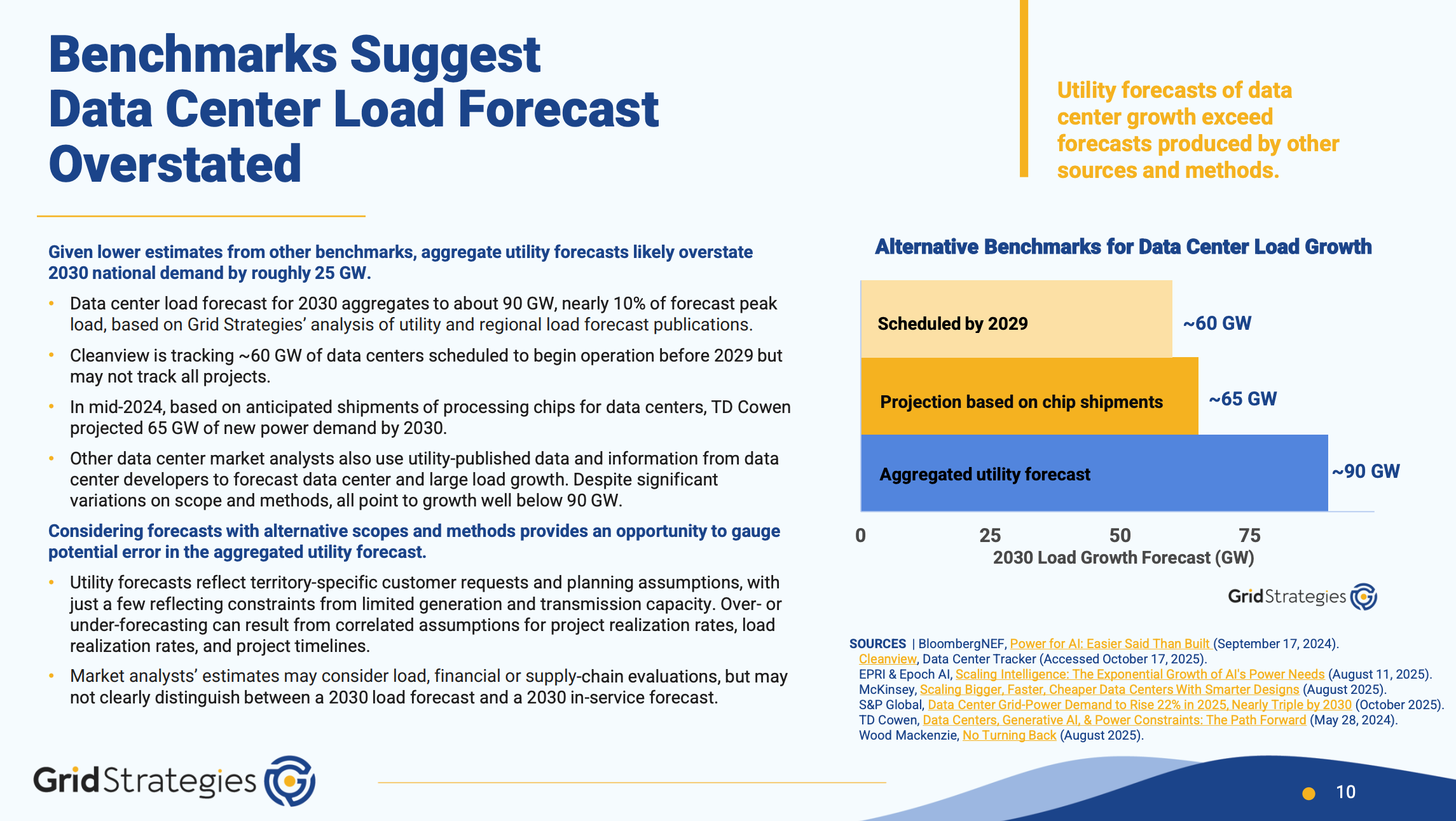
The rapid increase in electricity demand is colliding with a grid that is already under pressure from population growth, electrification initiatives, aging infrastructure and increasingly severe weather events linked to climate change. Utilities across the country are racing to construct new substations, transmission lines and generation facilities capable of supporting the AI boom.
The financial consequences are already becoming visible to consumers. Americans experienced more than $60 billion in utility rate increases in 2025, with average household electricity costs rising nearly 10 percent compared to the previous year. The reasons behind those increases vary by region, but regulators and consumer advocates have increasingly pointed to the enormous infrastructure investments associated with data center growth as one contributing factor.
Federal reliability officials are now openly warning about the risks.
This month, the North American Electric Reliability Corporation issued a rare Level 3 Essential Action Alert cautioning that large “computational loads” associated with data centers pose immediate threats to the bulk power system. NERC warned that operators have observed sudden large-scale load fluctuations occurring within seconds, leaving little or no time for grid managers to intervene before reliability problems emerge.
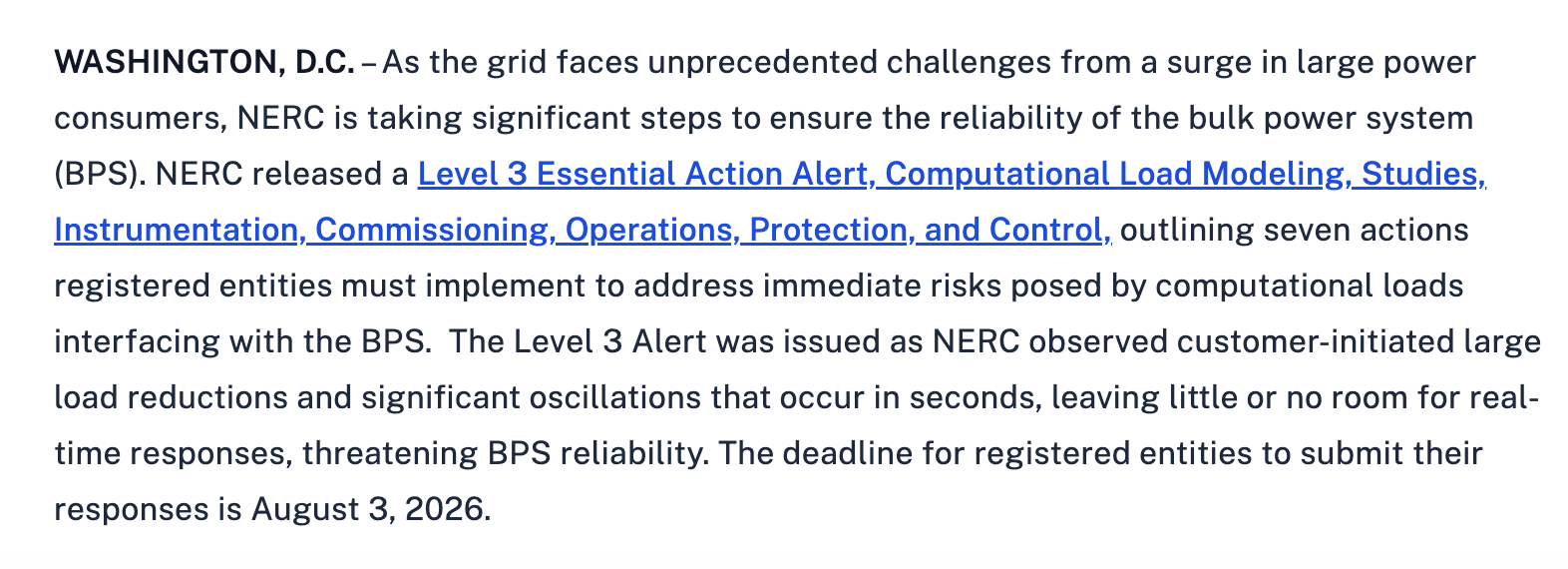
The warning represented one of the clearest signals yet that America’s electrical infrastructure may not be prepared for the speed and concentration of AI-related power demand now unfolding nationwide.
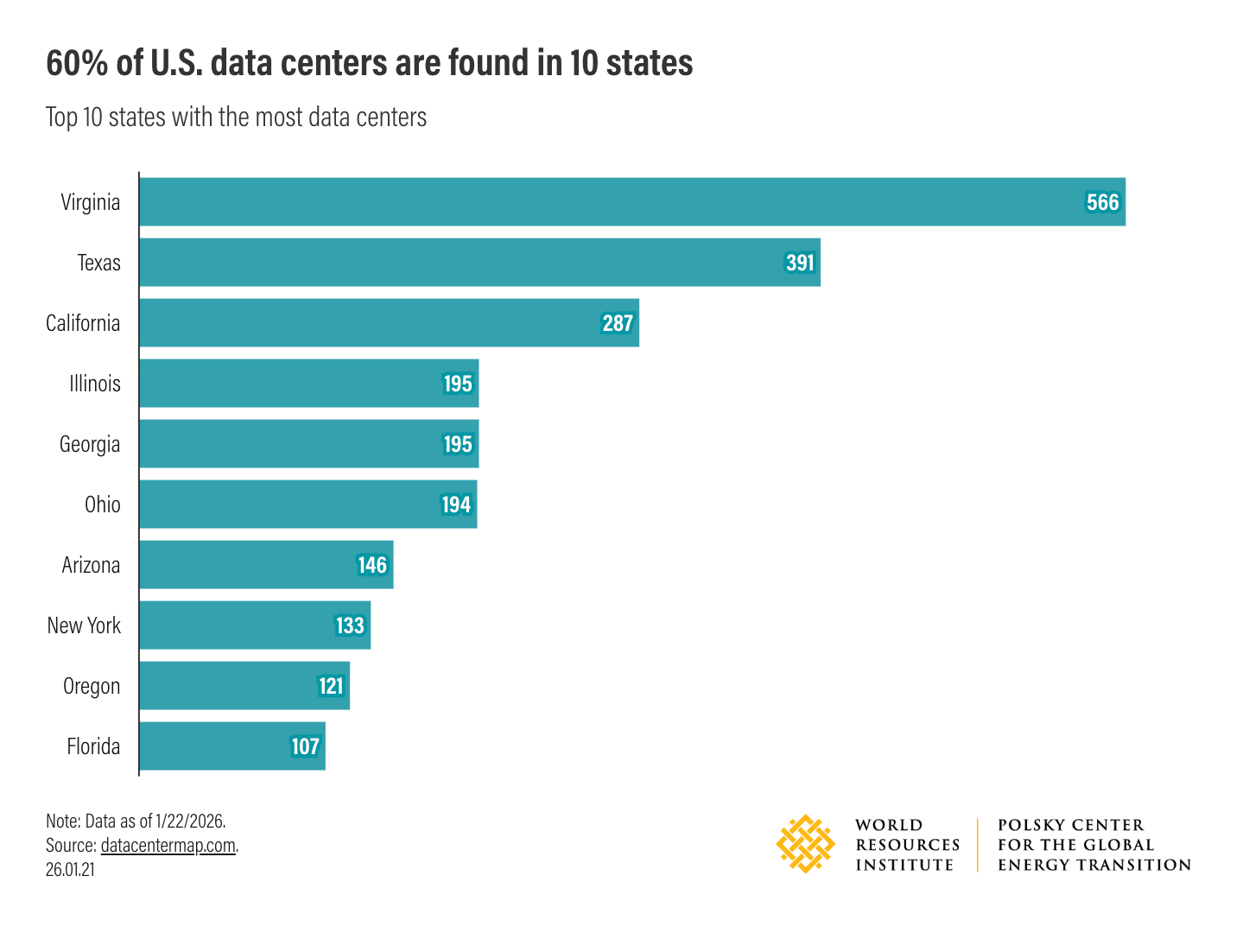
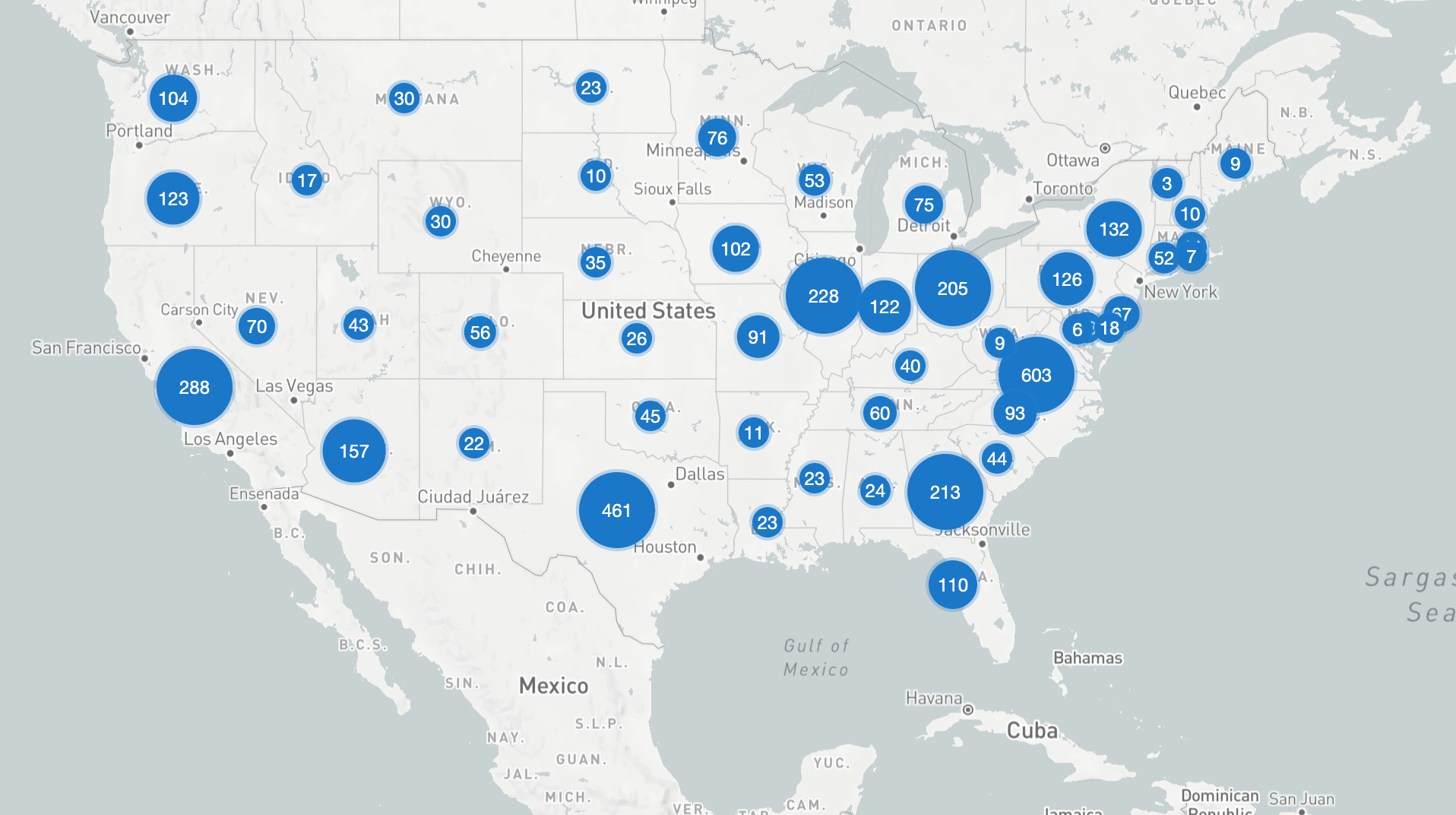
Virginia, widely described as the data center capital of the world, has become one of the clearest examples of the transformation underway. The state hosts the largest concentration of data centers anywhere on Earth, with enormous clusters of facilities dominating parts of Northern Virginia. Texas and California follow closely behind. Together, the top 10 states account for roughly 60 percent of all U.S. data centers.
Residents in many of those regions say the expansion has fundamentally altered local communities. Beyond the enormous energy requirements, data centers require vast amounts of water to cool the servers operating inside them. Mid-sized facilities can consume up to 300,000 gallons of water daily, while larger campuses can require as much as 5 million gallons each day, roughly equivalent to the water usage of a small town.
By 2028, researchers estimate that AI-related data centers in the United States could require as much as 32 billion gallons of water annually. Much of that demand is concentrated in regions already facing severe water stress, including Arizona, Texas and the Colorado River Basin. According to the analysis, roughly two-thirds of all data centers built or under development since 2022 are located in drought-prone areas.
The conflicts surrounding water use are becoming increasingly contentious.
In South Carolina, residents near an overdrawn aquifer pushed local officials to impose restrictions on groundwater withdrawals tied to data center operations.
In Georgia, residents in Fayetteville raised concerns after experiencing unusually low water pressure. A subsequent utility investigation found that a massive QTS data center campus had consumed approximately 29 million gallons of county water through two industrial-scale hookups that officials initially did not realize were active.
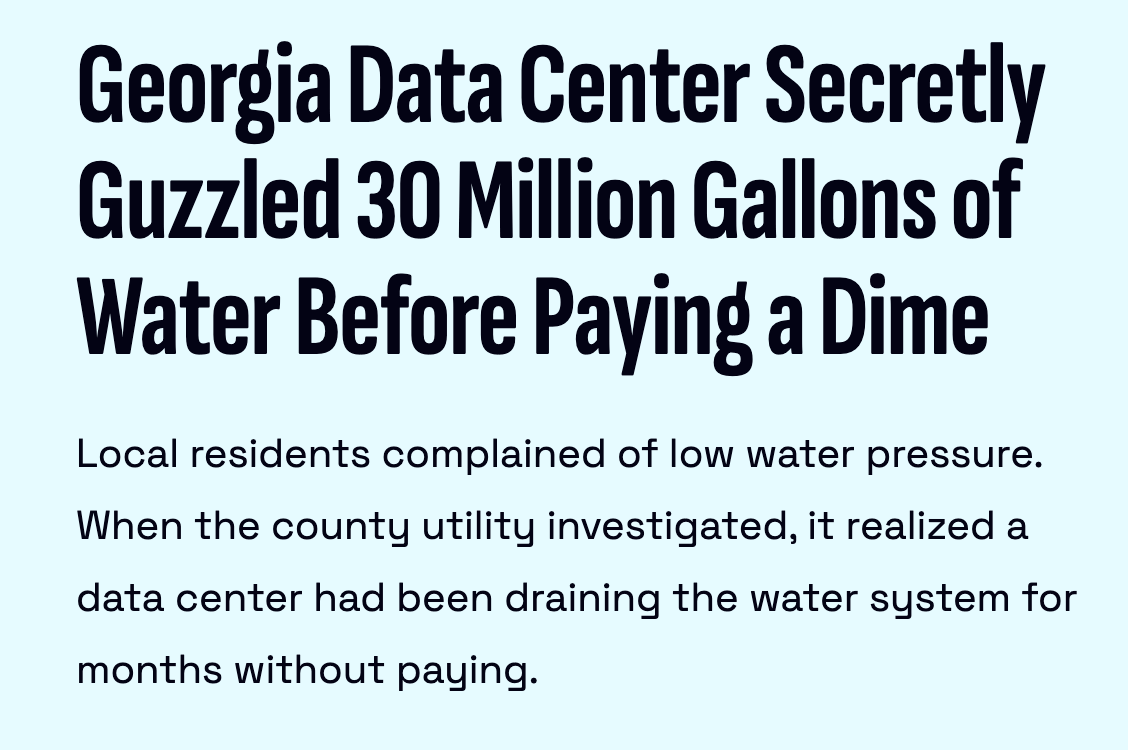
The controversy intensified because the water usage occurred while local residents were simultaneously being asked to conserve water during declared drought conditions. According to accounts from residents, county officials ultimately imposed retroactive charges on the company but no meaningful penalties. Residents said the episode deepened concerns that local governments were prioritizing relationships with large corporations over the needs of surrounding communities.
The QTS project, known as Project Excalibur, has also become a flashpoint over the broader infrastructure demands associated with hyperscale AI development. Residents say the project’s electricity demand was revised upward after approval to approximately 1.3 gigawatts, forcing the construction of high-voltage transmission lines and substations through residential neighborhoods. Property owners have reported to me being offered easements worth only a few thousand dollars for infrastructure they believe will significantly reduce home values.
Critics say many of the decisions surrounding the project were made behind closed doors, with little transparency or public input.
That complaint has become increasingly common nationwide. Developers frequently enter into non-disclosure agreements with local governments during negotiations, limiting public access to information about project scale, energy demand and environmental impacts. A review of municipalities in Virginia found that 80 percent of jurisdictions with proposed or existing data centers had signed NDAs tied to development negotiations.
Environmental concerns extend well beyond electricity and water consumption.
Because data centers require uninterrupted power, many facilities rely heavily on fossil fuel infrastructure. Some campuses use natural gas generation for routine operations while also maintaining large diesel backup systems in case of outages. Environmental groups and public health advocates warn that those systems can create substantial air pollution burdens for nearby communities.
One of the most closely watched examples is unfolding in Memphis, Tennessee, where more than 30 natural gas turbines are being installed at Elon Musk’s xAI “Colossus” data center. Local residents and the NAACP filed legal action under the Clean Air Act, arguing that the project threatens to worsen already dangerous air quality in a city with elevated asthma rates and longstanding environmental health disparities.
It’s no surprise, then, that the Boxtown community in Memphis, once part of a Black-majority district, has become one of the Tennessee communities reshaped through gerrymandering.
Diesel backup generators pose additional risks. Studies estimate these systems can emit 200 to 600 times more nitrogen oxides than natural gas plants. One analysis in Virginia estimated that even limited backup generator use associated with data centers could already be linked to nearly $300 million annually in public health costs and roughly 14,000 asthma-related health impacts across multiple states.
Noise pollution has emerged as another source of growing public frustration. Residents in Loudoun County, Virginia have reported sleep disruption, headaches and declining quality of life linked to continuous construction activity, industrial cooling systems and backup generators operating near residential areas.
At the same time, the physical footprint of data centers continues to expand rapidly. In 2024, the average data center campus covered approximately 224 acres, representing a 144 percent increase since 2022. Some hyperscale facilities exceed 1,000 acres. Developers are increasingly targeting large rural parcels capable of supporting multi-building campuses and future expansion. Here is a current map of datacenters in the United States:
The result is growing tension in agricultural and rural communities where residents fear permanent industrialization of farmland and open space. In Ohio, a proposal to rezone 300 acres of farmland for data center development generated such intense opposition that landowners ultimately withdrew the application. Similar conflicts have surfaced in Indiana, Wisconsin and Virginia.
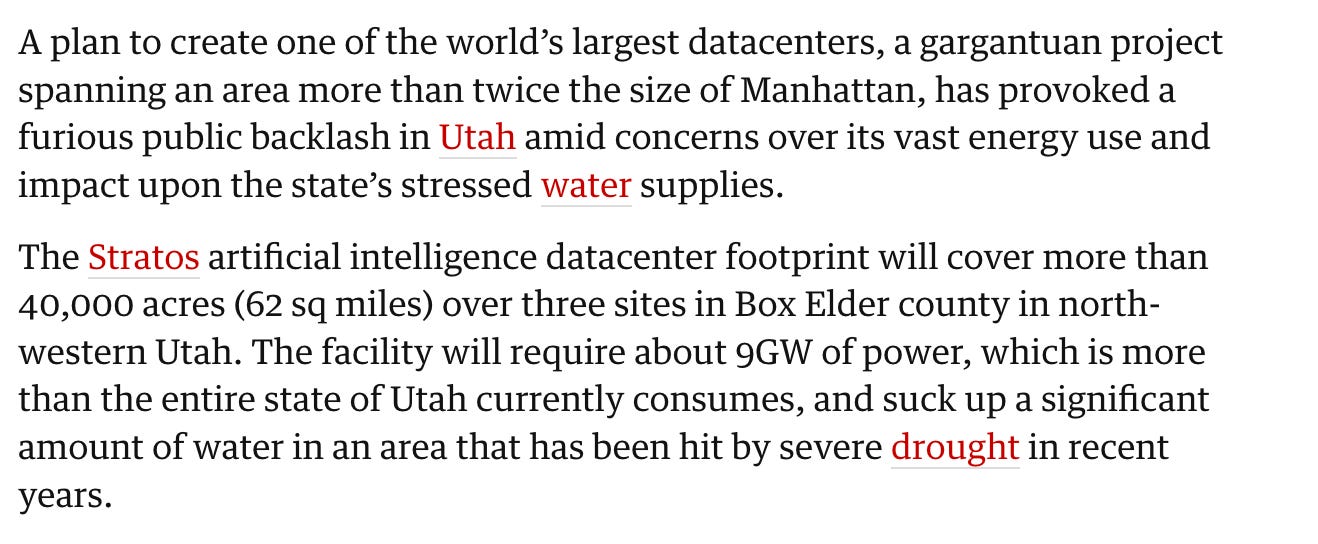
Among the most dramatic warnings about the environmental implications of hyperscale AI infrastructure has emerged from Utah, where the proposed Stratos Project in Box Elder County has alarmed researchers and local residents alike.
The project, reportedly backed by investor Kevin O’Leary, is expected to require roughly 9 gigawatts of electricity at full buildout, more than double the amount of electricity currently used by the entire state of Utah. Physicist Robert Davies of Utah State University warned that the project’s true environmental impact could be even larger because virtually all of the consumed electricity would ultimately be released as waste heat into the surrounding environment.
Davies estimated that the project could effectively create a 16 gigawatt thermal load concentrated in the Hansel Valley region near the Great Salt Lake watershed, an area already experiencing severe ecological stress.
“What I’ve found is it’s so much worse than I even thought it would be,” Davies said of the project’s scale. He described the waste heat generated by the complex as “the equivalent of about 23 atom bombs worth of energy dumped into this local environment every single day.”
The economic case for data centers is also facing increasing scrutiny.
Developers frequently emphasize construction jobs, tax revenue and economic investment when seeking project approvals. Construction can create hundreds of temporary positions for electricians, contractors and technicians. Yet long-term employment numbers are often relatively small compared to the size and resource demands of the facilities themselves.
A review of more than 1,200 U.S. data centers found that even the largest campuses often employ fewer than 150 permanent workers, and in some cases as few as 25.
Meanwhile, many state and local governments offer substantial tax incentives to attract projects, raising questions about whether the long-term public benefits justify the environmental and infrastructure costs communities may ultimately bear.
Opposition is now becoming more organized and politically visible.
Between May 2024 and March 2025, more than $64 billion worth of proposed data center projects were delayed or canceled due to organized community resistance. In Kenilworth, New Jersey, residents packed public meetings carrying whistles and cowbells to protest a $1.8 billion facility tied to CoreWeave. In Nevada, residents around Lake Tahoe reacted with alarm after utility changes tied to growing AI-related electricity demand raised concerns about future service reliability for tens of thousands of customers.
Some local governments are beginning to adopt stronger regulatory measures. Jerome Township, Ohio imposed a temporary moratorium on new data center approvals while officials reassessed zoning standards and community protections. Prince George’s County, Maryland established a task force to study siting criteria and infrastructure safeguards. Lancaster, Pennsylvania negotiated a community benefits agreement requiring cleaner energy usage, noise mitigation and direct financial support for local climate and economic programs.
Still, critics argue those responses remain fragmented compared to the speed of the broader AI buildout.
What is increasingly clear is that the artificial intelligence boom is not merely a digital transformation. It is a physical and environmental one. The systems powering AI require enormous quantities of electricity, water, land and industrial infrastructure. They are reshaping local economies, altering landscapes and placing new pressures on communities that often have limited power to influence the decisions being made around them.
For years, the technology industry promoted the idea that the digital economy would reduce humanity’s physical footprint. The rapid expansion of hyperscale AI infrastructure is revealing the opposite: behind every chatbot response and AI-generated image sits an enormous industrial system consuming resources at a scale many Americans are only beginning to understand.


