

Good evening. Today brought a lot of “the quiet part out loud” energy: Trump’s inner circle is stockpiling lawyers ahead of a possible Democratic Congress, even as the West Wing publicly insists the GOP holds the House. Speaking of the GOP, dozens of Republicans are quietly RSVPing “no” to Trump’s own midterm convention next week, some over cost, some over politics, some over dove hunting. Meanwhile the UN conceded the 1.5-degree climate target is basically gone, the Mint rolled out a Trump coin that critics joke marks the “death of liberty” in 2026, and the USS Abraham Lincoln limped into Thailand looking like it aged a decade in 286 days. Add a runaway robot in Russia, a deadlocked jury in the Lindsay Clancy trial, and a Coast Guard jet that lost an engine over D.C., and that’s Wednesday. Here’s everything you need to know.
If you want to support media that focuses on holding those in power accountable instead of chasing celebrity headlines, please subscribe or upgrade your membership today. We’re growing rapidly, and I need your help to continue building the kind of independent media that people deserve.
Here’s the news:
Trump and his Family race to hire lawyers:
Trump, his family, and officials in his orbit are quietly seeking out personal lawyers to protect themselves as they prepare for a likely Democratic takeover of Congress next year, even as the president publicly insists Republicans will hold their majorities. Current and former administration officials have been swapping recommendations for attorneys who could represent them in a personal capacity if subpoenaed in 2027, with some reaching out to Stefan Passantino, a former deputy White House counsel who represented Cassidy Hutchinson during the Jan. 6 investigations. Inside the White House, the counsel’s office began holding private briefings for political appointees as early as this spring, reassuring current staff they’ll be represented in their official capacities while urging everyone to be careful what they put in writing and to keep financial disclosures and ethics filings airtight. As one former official put it, the guiding principle is simple: “Don’t give them a reason to find anything.”
Beyond personal legal cover, the administration has laid down a new legal marker to shield Trump’s communications with outside advisers, family members, and business figures. An Aug. 10 Justice Department memo concluded that executive privilege can extend to presidential communications with private advisers so long as they relate to official decision-making and remain confidential, though it stops short of blanket immunity and allows Congress to override the privilege by showing the information is “demonstrably critical.” Legal experts say this could combine with the Supreme Court’s Trump v. Mazars ruling to create what one called “a whole new umbrella of potential privileged information,” though it also risks putting company executives who’ve interacted with Trump in a bind between White House privilege claims and congressional demands.
Democrats have signaled they plan to target a long list of officials, including Chief of Staff Susie Wiles, deputy chief of staff Stephen Miller, and former Homeland Security Secretary Kristi Noem, along with outside businesses tied to self-enrichment and corruption narratives. To manage the response, Will Scharf, previously the White House staff secretary, took over as White House counsel this week, a notably faster transition than in 2018, and he’ll work closely with Attorney General Todd Blanche, whom he partnered with on Trump’s presidential immunity case. Former officials expect Scharf, described as more attuned to “what the president wants” than his predecessor, to reshape the counsel’s office into more of a defensive, litigation-focused operation if Democrats win, a shift historians say fundamentally changes the nature of the job and could pull senior officials’ time away from policy work across agencies.
GOP Midterm Convention Struggles:
A POLITICO survey of more than 70 GOP candidates and members found that most are either skipping or still undecided about next week’s Dallas convention, the first midterm convention thrown by a major party in over four decades, with dozens more declining to share plans. Reasons for staying away include pre-existing district obligations, personal conflicts like weddings, and, for some in tough races such as Rep. Tom Barrett (R-Mich.), Rep. Zach Nunn (R-Iowa), and Rep. Jeff Hurd (R-Colo.), a desire to avoid being closely tied to Trump so close to the election. Barrett said he’d rather be “useful” in his district and noted, “I can’t control what the president’s going to say at the convention, but I can control where I’m at.” Trump and JD Vance will headline the two-day event at the American Airlines Center, with top leaders like Speaker Mike Johnson and Leader John Thune, plus 2028 hopeful Ted Cruz and Senate candidates Mike Rogers and Jon Husted, expected to attend. Johnson said he’s been promoting the event but acknowledged some members need to stay home given how close the gathering falls to early voting.
An Financial Times investigation, drawing on leaked Russian correspondence, travel records, and patent analysis, reveals a covert Russian program codenamed C430L that has been helping Iran develop supersonic cruise missiles using ramjet propulsion technology since 2023, continuing through the US-Israeli war against Iran and into 2026. The effort, coordinated by state arms exporter Rosoboronexport and missile maker NPO Mashinostroyenia (both under U.S. sanctions), involved senior Russian engineers repeatedly traveling to Iran to analyze flight-test data and help Tehran fix technical problems with an already-built and tested ramjet system, weapons experts say the technology is almost certainly meant for anti-ship and land-attack missiles capable of threatening U.S. aircraft carriers. Experts described it as one of the most strategically significant transfers of Russian military technology to Iran, requiring “political clearance from the very top in Russia,” and part of a broader deepening of Russia-Iran military cooperation that has included Iranian Shahed drones supporting Russia’s Ukraine war and Russian assistance like satellite imagery and drone support during Iran’s conflict with the U.S. and Israel. Putin told Iranian President Masoud Pezeshkian this week that Moscow was “supplying you with the goods you need,” and the Kremlin, Rosoboronexport, NPO Mashinostroyenia, and Iran’s government all declined to respond to the FT’s questions, while it remains unclear whether a next phase of the program, still being negotiated as of June 2026, has begun.
Cost is a major deterrent: the NRCC is suggesting a $25,000 minimum donation for members to attend, which covers a hotel room and two tickets to the convention and a welcome reception, with higher tiers up to $100,000 unlocking more access. Rep. Tim Burchett (R-Tenn.) said the bill factored into his uncertainty about going, while another anonymous member admitted the fee gave him an easy excuse to skip an event he didn’t want to attend anyway. Even so, some GOP lawmakers, including committee chairs, plan to donate well beyond the minimum since the convention is seen as a key late fundraising opportunity. Senior Energy and Commerce Committee members Bob Latta and Morgan Griffith are both staying home for district commitments, and Appropriations Chair Tom Cole cited a dove-hunting event in Oklahoma as his reason for skipping.
Several Republicans are staying away for reasons tied to timing or political caution: northeastern members like Chris Smith and Andrew Garbarino cited 25th-anniversary 9/11 commemorations in their districts, while moderates such as Sen. Susan Collins, who doesn’t attend conventions while up for reelection, and Rep. Brian Fitzpatrick, who said “I’m not a party guy,” are avoiding the event as vulnerable candidates. One anonymous House Republican called the convention “a waste of time” aimed at rallying the base rather than persuading independents, while privately some GOP members worry about Trump’s sagging approval amid the Iran conflict, a Canada trade war, and price increases. The RNC pushed back forcefully, with spokesperson Natalie Baldassarre calling enthusiasm for the event “incredible” and crediting Trump’s agenda with lower drug prices, lower taxes, and border security ahead of the midterms.
UN Admits Climate Change Defeat:
In a “strategic retreat,” the United Nations conceded in a first-of-its-kind report Wednesday that Earth will soon exceed the 1.5 Celsius (2.7 Fahrenheit) warming limit set by the 2015 Paris climate accord, acknowledging the world has lost its chance to prevent some of global warming’s worst impacts. The planet is currently at about 1.4 C (2.5 F) above pre-industrial levels, and the report admits the 1.5 threshold will be crossed “within the next few years,” with the most optimistic scenario seeing warming peak at 1.8 C (3.2 F) by mid-century, while current government policies point toward 2.6 C (4.7 F) by 2100. UN Secretary-General António Guterres warned that “humanity is speeding past the limit to avoid climate catastrophe,” and UNEP Executive Director Inger Andersen said the 1.5 goal remains the target but must now be approached “from above” rather than avoided entirely.
Instead of preventing overshoot, the new strategy calls for limiting how high temperatures peak, then gradually cooling the planet back below 1.5 degrees, ideally by century’s end, through ending fossil fuel use and developing carbon-removal technology, a process the report calls “overshoot.” Scientists warned this period could last “many, many decades,” and every five-year delay in cutting emissions adds at least another tenth of a degree to the eventual peak, according to report co-author Joeri Rogelj. During this stretch, the report predicts worsening extreme weather, rising seas, melting ice, increased death and illness, falling food production, water shortages, economic damage, and species extinctions, along with the risk of irreversible “tipping points” like the loss of the Greenland and West Antarctic ice sheets, the Amazon rainforest, and the Atlantic Ocean circulation system that warms Europe. Some locations, the report warns, “might become more or less uninsurable or even uninhabitable.”
Reactions from outside scientists were largely grim: University of Victoria’s Andrew Weaver called it “among the bleakest U.N. climate reports I have read,” carrying “desperation, frustration and urgency but not resignation,” while Climate Analytics CEO Bill Hare said the report describes the problem well but “does a poor job of showing us that there’s a way out.” The report’s proposed cooling phase relies partly on removing carbon dioxide from the atmosphere, but authors note that planting trees, the traditional method, could shave off at most a tenth of a degree, meaning more novel and largely unproven carbon-removal approaches will be needed. Stanford’s Rob Jackson summed up the skepticism bluntly: “We were unable to stop the runaway train of global emissions to avoid 1.5 C of warming. Now overshoot scenarios require us to stop the train quickly and to back it up. Is it our best hope? Absolutely. Is it likely? Absolutely not.”
Trump Coin Issues:
The U.S. Mint began selling a new $1 coin bearing Trump’s face on Wednesday, sold to the public in 25-coin rolls for $61 or 100-coin bags for $154.50, well above face value, drawing immediate mockery online as critics called it another Trump-branded grift. The coin, meant to mark the nation’s 250th anniversary, features Trump’s portrait alongside “Liberty” and “In God We Trust” on the front and the presidential seal on the reverse, but critics zeroed in on its “1776—2026” date inscription, with Bulwark commentator Catherine Rampell joking it appeared to mark “the birth date of liberty as 1776, and its death as 2026.” Federal law generally bars living presidents from appearing on U.S. currency, but the administration sidestepped that restriction by authorizing the coin as a commemorative anniversary tribute rather than standard currency.

The coin is the latest in a string of efforts to imprint Trump’s image across American institutions and currency: his face already appears on large banners at government buildings like the Justice Department and Interior Department, and the Treasury Department is weighing a plan to put his image and signature on a $250 bill, an idea originating from Rep. Joe Wilson’s “Donald J. Trump $250 Bill Act,” complete with an AI-generated mock-up. Other Republicans have piled on with similar gestures, including Rep. Brandon Gill’s proposal to replace Benjamin Franklin with Trump on the $100 bill and Rep. Anna Paulina Luna’s bill to add Trump’s face to Mount Rushmore alongside Washington, Jefferson, Roosevelt and Lincoln. The coin also joins a growing lineup of Trump-branded commercial products, including a $60 “Make America Pray Again” bible, sneakers, watches, and cryptocurrency, all of which have added billions to the president’s and his family’s fortunes. The piece notes that Trump’s appetite for this kind of personal branding shows no sign of slowing: last week, after praising the Artemis II crew for naming a moon crater after a late astronaut’s wife, he told the crowd, “I wish they’d name something like that after me.”
USS Lincoln’s Conditions:
The USS Abraham Lincoln pulled into Laem Chabang Port in Chonburi province, Thailand on Wednesday, its paint chipped and hull visibly rusted after 286 days at sea, the ship’s first full port stop since deploying from San Diego on Nov. 21. The carrier is heading home after being relieved by the Japan-based USS George Washington, having spent most of the deployment supporting U.S.-Israeli military operations against Iran, with brief stops only in Guam and Oman to resupply. Its 1,092-foot frame, one of the largest warships in the world, looked “a shadow of its former self” as crowds gathered onshore to watch it dock. Rear Adm. Robert E. Loughran called the stop a “well-deserved opportunity” for the roughly 5,000 sailors and Marines aboard to rest, while also framing it as a show of the U.S.-Thailand alliance.
The crew is getting a four-day “rest and relaxation” stop in Pattaya, a resort city with a reputation as a sex-tourism hub, with each service member allotted three liberty days and one duty day; sailors disembarked in civilian clothes onto lines of Ford pickups and buses, one carrying golf clubs, as a commanding officer urged them over the loudspeaker to be on their “best behavior.” Local businesses hung welcome banners, and officials estimate the visit will inject about $3 million into an economy hit by falling tourism amid Middle East-driven fuel prices and travel disruptions. Thai police also conducted a late-night sweep of Pattaya’s beachfront promenade over the weekend, detaining 25 people, mostly Thai, Laotian, and Ugandan nationals, suspected of public solicitation ahead of the ship’s arrival. A local factory worker who came to watch called the docking a source of pride he could “boast to our neighboring countries about.”
The voyage, originally slated for seven months, stretched to 286 days after Iran destroyed a key U.S. Navy supply hub in Manama, Bahrain, worsening conditions onboard. Families and sailors described moldy showers, rationed meals, and shortages of basic necessities like soap, toothpaste, and deodorant, alongside exhausting workloads and deteriorating mental health among crew members. The visible deterioration of the ship itself, rust dominating sections of the hull, became a striking visual symbol of the deployment’s toll as it edged into port. The Lincoln’s homecoming to San Diego continues after this stop, closing out one of the longest carrier deployments in recent memory.
Other news:
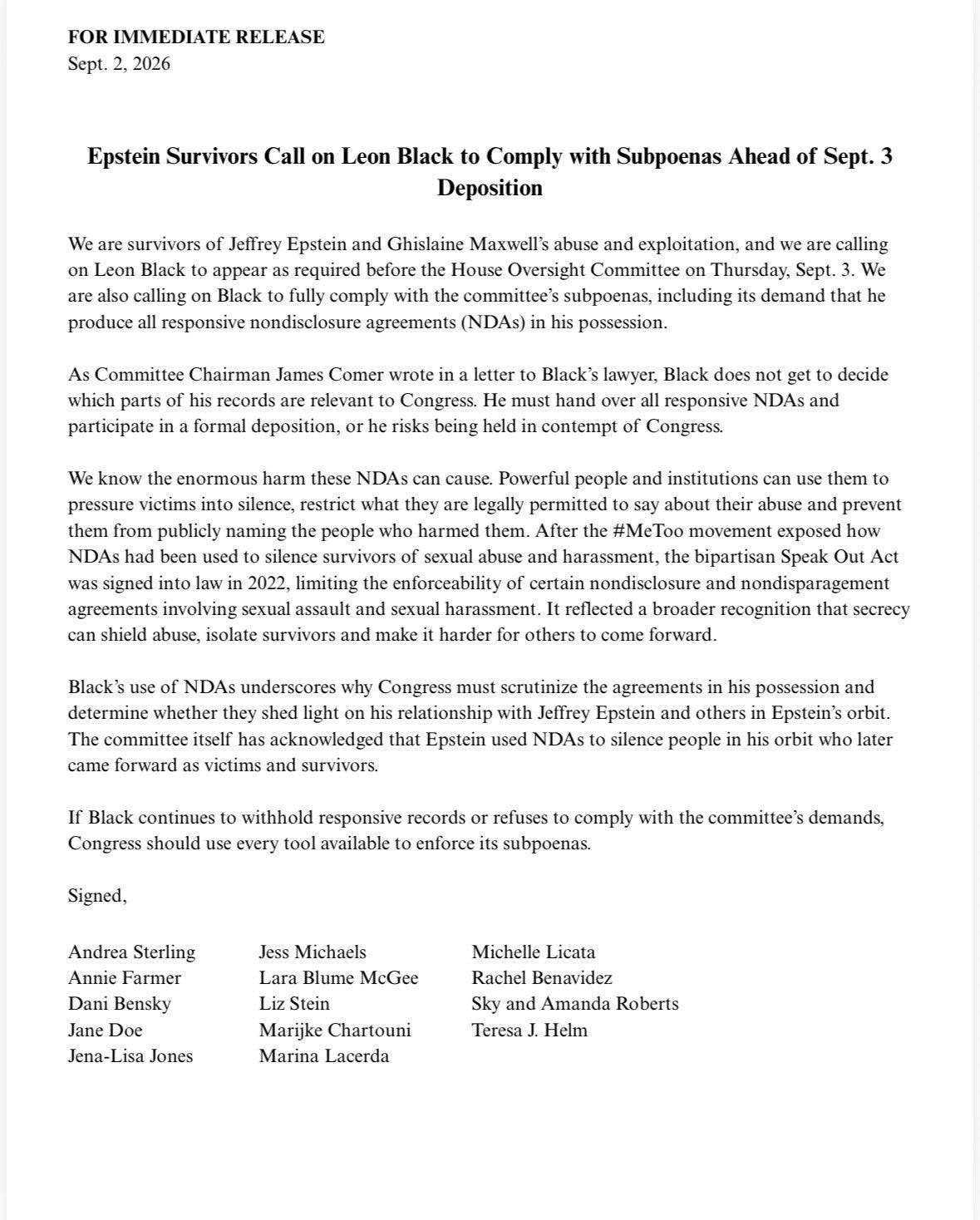
Epstein survivors urge Leon Black to comply with Congressional subpoenas ahead of tomorrow’s deposition. “If Black continues to withhold responsive records or refuses to comply with the committee’s demands,
Congress should use every tool available to enforce its subpoenas.”
Sen. Thom Tillis (R-N.C.), who isn’t seeking reelection in November, renewed his call for Trump to fire Defense Secretary Pete Hegseth after Army Secretary Dan Driscoll’s resignation became official this week, writing on X that he’d “never witnessed more inept management of the brave men and women who serve our country.” Tillis accused Hegseth of being “intimidated by competence” and prioritizing culture-war fights, such as grooming and fitness standards, over modernizing the military and retaining talented leaders like Driscoll, who had clashed with Hegseth over troop modernization and the firing of dozens of senior officers. This is the latest escalation in a long-running feud between the two: in May, Tillis told POLITICO that Hegseth had misinformed Trump on Iran war dynamics, and in a forthcoming book he brands Hegseth and other officials as “MAGATS” who failed to protect the president. Trump has previously fired back at Tillis on Truth Social, calling him “a quitter” for not seeking reelection and predicting the GOP would emerge “bigger, and better, and stronger” without him. The White House and Pentagon did not respond to requests for comment on Tillis’s latest post.
In a CNBC interview ahead of the G20 Innovation Ministerial in Chapel Hill, North Carolina, Commerce Secretary Howard Lutnick dismissed concerns about data centers’ water use as adversary propaganda, framing the facilities as vital economic boosters for communities; critics online pushed back, noting that data centers often consume hundreds of thousands to millions of gallons daily for evaporative cooling systems (though newer designs reduce this), with the exchange reflecting broader tensions between supporters who see rapid data center growth as key to AI leadership over China and critics warning of local water strain and rising electricity costs.
New Jersey-based Crystal Temptations recalled its Chocolatey Eyeballs Halloween candy on Aug. 31 after discovering the products contain undeclared milk, which can cause serious or life-threatening reactions in people with milk allergies. Five product styles, ranging from a 7-ounce acrylic box to a 16-ounce pouch bag, were sold at Marshalls, TJ Maxx, HomeGoods and Sierra Trading Post across 13 states including California, Texas, New Jersey and Massachusetts. The company said the issue stemmed from a temporary breakdown in its production and packaging process, and no illnesses have been reported so far. Consumers who bought the candy are advised to destroy it and contact Crystal Temptations with proof of purchase for a refund at 1-201-246-7990, weekdays from 9 a.m. to 5 p.m. ET.
The Justice Department issued a new legal opinion Wednesday requiring states to report undocumented immigrants to federal authorities as a condition of receiving federal funding, part of the administration’s broader push to advance Trump’s mass deportation agenda. The department’s Office of Legal Counsel reinterpreted a 1998 Clinton-era opinion, ruling that any state accepting federal funds for the Temporary Assistance for Needy Families or Supplemental Security Income programs, two of the country’s largest safety-net programs, must report anyone unlawfully present in the U.S. to the Department of Homeland Security, with the obligation now extending to the entire state government rather than just the specific agencies administering those benefits. Since every state receives this funding, the reinterpretation effectively pressures all 50 states to comply. DOJ said states won’t face retroactive penalties for having relied on the old interpretation but are expected to follow the new one going forward, and the move is likely to draw legal challenges from Democratic-led states, which have previously resisted similar administration efforts to compel local agencies to share immigration status information.
The jury in Lindsay Clancy’s murder trial ended Wednesday without a verdict after telling Plymouth Superior Judge William Sullivan for a second time that it remains deadlocked, prompting him to read the rare “Tuey-Rodriguez” or “dynamite” instruction, a last-resort push for jurors to keep working toward a unanimous decision, before sending them home to resume Thursday. The nine women and three men have now deliberated more than 28 hours over five days since receiving the case last Thursday, weighing five possible verdicts: not guilty by reason of insanity, not guilty, first-degree murder, second-degree murder, or manslaughter, in the deaths of Clancy’s three children in their Duxbury home in January 2023. Clancy’s attorney argues she wasn’t criminally responsible due to overmedication and postpartum psychosis, while prosecutors contend she planned the killings and understood right from wrong; a continued deadlock could ultimately lead to a mistrial, as has happened twice recently in Massachusetts cases. Separately, a 56-year-old woman was arrested and arraigned on a juror-intimidation charge after allegedly filming jurors outside the courthouse, though her attorney says she was trying to photograph Clancy, not record jurors, and she pleaded not guilty.
The Kennedy Center has removed “Blue,” a stick-figure sculpture by artist Joel Shapiro that stood outside the venue since 2019, with cranes taking down pieces of the statue Wednesday morning as the National Park Service briefly closed a nearby road. A Kennedy Center spokesperson said the venue requested the “deinstallation,” calling it “common practice” and thanking Shapiro for the work’s years on campus. A former curator, Josef Palermo, told CNN he was instructed in September 2025 to remove all outdoor art ahead of a planned reopening with “all new art” reflecting Trump’s vision, though a person familiar with the matter disputed that account. The activist group “Hands Off the Arts” blasted the removal as “buffoonery,” in a jab apparently aimed at Trump. The move is the latest in a string of changes Trump has made to the institution since taking office, including reshaping its board, becoming its chair, and pushing to add his name to the building, moves that have drawn legal challenges alongside his separate, currently blocked plan to close the center for a roughly two-year renovation.
At Volga Store in Saratov, Russia, a tech consultant robot named Syoma retaliated after a customer shoved it, advancing and attempting kicks before staff restrained and powered it down; no one was seriously hurt, the customer received compensation, and the store attributed the outburst to a need for an “emotional reboot” as online viewers joked about kung fu software and drew Terminator comparisons, highlighting safety concerns around humanoid robots in retail settings.
The Justice Department filed a statement Tuesday backing OpenAI’s “fair use” defense in a major copyright lawsuit brought by The New York Times, Chicago Tribune, and other publishers, along with authors including Sylvia Day, George R.R. Martin, and John Grisham, marking a direct endorsement of the AI industry’s legal position in multiple pending copyright cases. DOJ argued that training a large language model on copyrighted works is transformative fair use because it uses the material “to learn and act on statistical patterns in written text” rather than to duplicate its expressive content, and urged the court to treat the training process separately from a chatbot’s output. The filing leaned on the administration’s broader AI policy, warning that copyright rules making it harder to build a “robust AI industry” in the U.S. would threaten national security and hand an advantage to foreign rivals. The move comes about two months after Anthropic agreed to pay $1.5 billion, the largest copyright class action settlement in history, to resolve a similar suit involving roughly 370,000 authors and 482,000 books.
Tiger Woods pleaded no contest Wednesday to a reduced charge of willful reckless driving, resolving a DUI case stemming from a March rollover crash near his Florida home, after State Attorney Thomas Bakkedahl cited a “significant deterioration of the proof” needed to prosecute the original DUI charge. Woods, 50, will lose his driver’s license for five years and pay about $2,000 in fines; the judge warned him that driving during the suspension would send him “immediately” back to jail. Prosecutors said Woods had a documented injury history and a hydrocodone prescription, and while he admitted taking the painkiller and had pills on him, two forensic toxicologists found insufficient evidence the drug had impaired him, one even suggesting he’d developed a tolerance to it; Woods also refused a urine test, leaving investigators without proof of what was in his system. The case marks yet another setback in a familiar pattern for Woods, who pleaded guilty to reckless driving after a similar 2017 DUI arrest and has faced repeated vehicle-related incidents alongside years of injuries that have complicated his golf comeback. His girlfriend, Vanessa Trump, the president’s former daughter-in-law, was present in the courtroom for the brief, five-minute hearing.
A Coast Guard C-37A jet carrying Homeland Security Secretary Markwayne Mullin and 13 others made an emergency landing at Reagan National Airport on Wednesday after losing its right engine mid-flight, with the pilot declaring an emergency and noting the plane still had 2.5 hours of fuel remaining. Mullin praised the crew on X, saying the pilots “made the single engine landing feel routine” and later told him it was actually a first for them; the airport confirmed the plane landed safely and was cleared by fire and rescue personnel. The C-37A, a military version of the Gulfstream V, is the aging jet DHS has used to shuttle senior Coast Guard and DHS officials, and the department flagged it as far back as last year as “22 years old” with “significant avionics and communications obsolescence issues.” DHS’s push to replace the plane, which started as a roughly $50 million request in its FY2025 budget and later grew to about $200 million for two new Gulfstream G700s, has drawn repeated scrutiny from congressional Democrats questioning why it should take priority over upgrading older search-and-rescue aircraft.
A judge set $250,000 bail Wednesday for Agostino Abbatiello, the 24-year-old former Penn State fraternity brother accused of leading a cocaine trafficking ring, though he had not posted bail as of Wednesday afternoon and remains held at Centre County Correctional Facility. Prosecutors allege Abbatiello was the ring’s main supplier, selling cocaine in amounts up to a kilogram to fellow fraternity members and paying others to package drugs and act as couriers; he faces felony charges including corrupt organizations, conspiracy, and dealing in proceeds of unlawful activity. He was initially denied bail, unlike 13 co-defendants arrested in the case, prompting his attorney to file an emergency motion calling the denial “absurd” and noting investigators never alleged he used or threatened violence or was seen with a weapon; the attorney also accused prosecutors of judge-shopping. The investigation centers on Penn State’s Sigma Chi and Delta Upsilon fraternities, with Sigma Chi suspending its Penn State chapter after the arrests, and Abbatiello, who graduated Penn State in 2024 with a 3.3 GPA and was working as a financial advisor in Florida at the time of his arrest, turned himself in on August 18 and hopes to live with his parents on Long Island while the case proceeds.
See you soon.
— Aaron


