

Good evening, everyone. There’s a lot happening today, so let’s get into it.
Behind closed doors, Trump is reportedly coming to terms with just how bad the midterm picture looks for Republicans, even as the redistricting scheme he pushed on red states may be backfiring in a way that actually helps Democrats. At the same time, his ban on three major news outlets from the White House is drawing pushback from across the political spectrum, including from members of his own party who can’t quite explain why he did it. And the war with Iran keeps spreading, with Trump saying he’s in “deciding mode” on the next escalation while the Houthis strike deeper into Saudi Arabia than ever before.
A quick note before we dive in. I’m going offline for the next 25 hours for Yom Kippur, so there won’t be another update from me this evening. But tomorrow morning, you’ll have a major investigation in your inbox into the Trump family, work I’ve been putting together for weeks, and I think it’s some of the most important reporting I’ve done. It’ll be there waiting for you tomorrow.
This newsletter exists because you support it, not because a network or an advertiser lets me run it. Every story I dig into, the ones nobody else is covering the way we cover them, only happens if enough of you decide independent journalism is worth funding directly.
If that matters to you, subscribe, upgrade, or gift it to someone who needs to see this. That’s it. That’s the whole ask.
Subscribe. Gift a subscription. Upgrade your membership.
Here’s what you need to know today.
Trump Faces Sobering Reality:
Trump has privately accepted that his own decisions, especially the Iran war, have contributed to the grim midterm outlook Republicans face. According to four people with knowledge of his recent comments that spoke with the Washington Post, Trump has grown notably sober as advisers present him with discouraging internal polling, a shift from his longstanding habit of dismissing unfavorable surveys as fake. Several advisers say they’ve become “increasingly blunt” with him, and one described him as acknowledging that “some of his decisions have led to the dynamics where he’s unpopular.” That private acceptance has translated into action: he’s approved roughly $140 million in super PAC spending, pledged to campaign in 35 competitive races, and personally reviewed midterm ad content from the Oval Office. Publicly, though, he keeps insisting the war was worth it, telling a North Carolina rally that higher gas prices are “a very inexpensive price to pay for what we’ve done,” even as one adviser pushed back on the idea that Trump has accepted any blame at all, arguing instead that his absence from the ballot is the real problem.
A new forecast suggests Trump’s pressure campaign for Republican states to gerrymander their congressional maps is likely to fail, and could even help Democrats. Decision Desk HQ’s analysis gives Democrats a 69 percent probability of winning the House versus 31 percent for Republicans, projecting an average seat majority of 229 to 206, a 14 seat swing from the current 220 to 215 GOP edge. Chief analyst Geoffrey Skelley found that Democrats are favored to win about 150 seats in states whose maps didn’t change, up from the 137 they currently hold, while the nine redistricted states barely move the needle, shifting from 78 to just 80 Democratic seats on average. Texas, the state that kicked off the redistricting fight after Trump argued Republicans were “entitled” to five more seats there, is projected to net the GOP under two seats rather than the five Trump wanted. The pattern repeats in Florida and Ohio, where redrawn districts meant to target Democratic incumbents mostly leave those Democrats favored to win anyway.
State by state detail shows the redistricting fight cutting in unexpected directions, including in California, Missouri, and vulnerable Texas districts. In Texas, Democrats have a real shot at several redrawn seats, including a 1 in 3 chance of holding the new 35th district, a 1 in 3 chance of ousting Republican Monica De La Cruz in the 15th, and a 1 in 5 chance of flipping the 23rd, held by Brandon Herrera, who has faced scrutiny over past derogatory comments about women. California, which passed its own retaliatory gerrymander under Governor Gavin Newsom after Texas moved first, could hand Democrats four of five targeted GOP seats, though a possible Republican win and a few competitive districts keep it just short of a clean sweep. Missouri has become the newest battleground, with the state Supreme Court blocking a Trump-backed map until voters approve it and a federal appeals court now weighing the case, leaving Decision Desk HQ to freeze its forecast there until the legal fight resolves. Ohio’s redistricting also looks shakier for Republicans than intended, with three Democratic incumbents likely to keep their seats and GOP Rep. Max Miller’s district turning into more of a toss-up amid domestic abuse allegations he denies. Taken together, the state-level breakdown reinforces the top-line finding that the multi-state gerrymandering push Trump demanded may not deliver the House majority he’s counting on.
Banning Reporters:
Sen. John Barrasso declined to say Trump violated the Constitution by banning Politico, MS NOW, and CNN from White House grounds, while Sen. Cory Booker said flatly that the ban “clearly does” violate the First Amendment. Trump announced the ban Friday on Truth Social, citing “cumulative stories over the last few years” of what he called “FAKE NEWS,” and warned other outlets could face the same treatment; reporters from the three outlets were turned away at the security kiosk Saturday with their credentials revoked. Barrasso argued “the press has an obligation to report fairly” and predicted the ban won’t affect the midterms 44 days out, while press freedom advocate Gabe Rottman called the ban illegal and said forcing outlets to sue to “vindicate their rights” amounts to intimidation. All three barred outlets, along with the White House Correspondents’ Association, vowed to keep covering the administration and to fight the ban legally, with CNN calling it “an illegal assault” on their constitutional rights and the WHCA noting that First Amendment protection “does not depend on whether the president likes a news organization’s coverage.”
Scalise said he doesn’t know why Trump banned CNN, MS NOW, and Politico from the White House, while still defending Trump as unusually open with the press and touting his habit of taking questions at bill signings. Trump announced the ban Friday, accusing the outlets of reporting “FICTION and LIES,” and the affected reporters had their credentials revoked and were turned away from White House grounds Saturday, prompting the White House Correspondents Association to note that Trump himself described the move in the Oval Office as a “ban on the free press.” On the economy, Scalise acknowledged voter concern over affordability but argued gas prices are lower in red states than blue ones because of “mandates and ridiculous things” Democratic states do, even as a new Fox News poll shows prices remain a top issue heading into the midterms. Scalise also brushed off Florida Rep. Maria Elvira Salazar’s break with Trump over immigration enforcement hurting Hispanic voters, insisting the U.S. now has “the most secure border right now” and that Trump has actually gained ground with Hispanic voters compared to past Republican presidents.
Obama called Trump’s ban of CNN, MS NOW, and Politico from the White House “unimaginable,” saying he couldn’t picture the reaction if he had tried barring Fox News during his own presidency, and argued the roughly 30 to 35 percent of the country that’s fine with it reflects a broader erosion of understanding about what democracy requires.
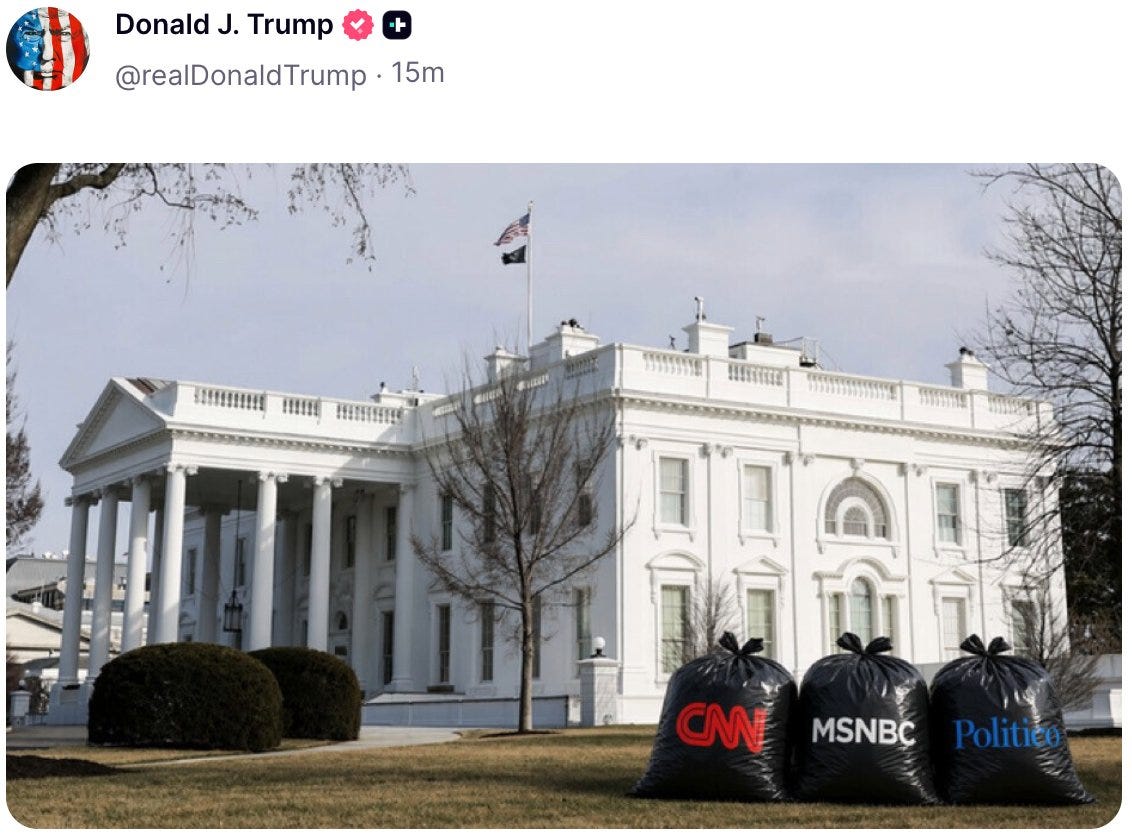
Trump followed up Sunday by posting an AI-generated image of trash bags labeled with the three outlets’ names outside the White House, and Scalise’s claim that Biden had stripped press credentials from “over 400 different agencies” was directly disputed on air by host Jonathan Karl, who said those reporters simply hadn’t reapplied and weren’t banned.
Iran war:
Trump says he’s in “deciding mode” on whether to launch a major escalation against Iran, weighing everything from “wiping Iran out” to letting the regime “rot economically” to cutting a deal. He told Axios he’s facing a “big decision” on whether to “annihilate” the Iranian regime, and told Fox News he’s considering meeting with Iranian President Masoud Pezeshkian when he attends the UN General Assembly this week. Iran’s own negotiators say they’ve conveyed conditions for reopening the Strait of Hormuz through Qatar, demanding an end to the war on all fronts, release of frozen funds, and an end to the U.S. naval blockade, but Trump has previously dismissed similar demands as unrealistic. Meanwhile a UN-backed panel found “reasonable grounds” to believe the U.S. committed war crimes in Iran, including a school bombing that killed dozens of children, which the White House dismissed as “unserious nonsense” while Iran accused Washington of projection. The U.S. also approved visas for Iran’s UN delegation despite the ongoing war, and separately executed a man accused of feeding Israel intelligence on Iranian missile sites.
The war has spread dramatically into Saudi Arabia, with Iran-backed Houthi rebels striking deep into the kingdom, including a ballistic missile fired at Riyadh that was intercepted and strikes on Aramco facilities in Yanbu, some 700 miles from the Yemen border. U.S. embassies across the Middle East issued security alerts warning of “potential for unforeseen escalation,” and fighting between Houthi and Yemeni government forces has killed at least 48 people while nearly 3,000 refugees fled to Djibouti in under a week. Egypt, Jordan, Kuwait, and the Muslim World League condemned the Houthi attacks, and CIA Director John Ratcliffe made a rare visit to Cairo to discuss the spiraling regional crises with President Sisi. Turkey warned that Saudi Arabia should not be dragged into the U.S.-Iran conflict, citing its new mutual-defense pact with Riyadh and Islamabad, while Pakistan’s military vowed to defend Saudi Arabia “to any extent.” The U.S. is also moving to sell Saudi Arabia 48 F-35 fighter jets for $24.3 billion, prompting Israel to seek additional weapons from Washington to preserve its military edge.
The war is battering global energy markets and shipping, even as the U.S. touts progress protecting oil flows through the Strait of Hormuz. U.S. Central Command says it has escorted 1 billion barrels of crude and over 2,000 commercial vessels out of the Persian Gulf in recent months, but Brent crude still jumped from $88 to around $104 a barrel over three weeks and diesel topped $6 a gallon, prompting France to convene a G7 energy summit and central banks worldwide to hike rates to fight war-driven inflation. Saudi Arabia’s Aramco told European and Indian refiners it won’t supply crude next month after Houthi drone strikes knocked out its key East-West pipeline, and traffic through the Bab el-Mandeb Strait has fallen to roughly a third of prewar levels. Iran claimed to have downed at least two U.S. drones and struck a tanker illegally crossing the Strait of Hormuz, while Russia and China vetoed a UN resolution extending sanctions-monitoring on Iran. Inside Iran, the government staged a massive nationwide rally with hundreds of thousands pledging to take up arms, while Democratic Senator Elissa Slotkin urged Trump to press Xi Jinping over reports that China supplied Iran satellite imagery used in a deadly attack on U.S. troops in Jordan.
Other news:
ICE Agent Shoots and Wounds Man in Austin After Ramming His Car. A federal ICE agent shot and wounded a man in Austin, Texas on Sunday afternoon after first ramming the man’s car with a federal vehicle, then getting out and firing at least five times, according to city council member Mike Siegel. The man was taken to a hospital in unknown condition, and a damaged blue Toyota Corolla with what appeared to be bullet holes was left parked under an overpass at the scene as a large law enforcement presence and crowd of onlookers gathered. Rep. Greg Casar demanded a “full, independent investigation,” immediate release of body camera footage, and accountability for any officer who broke the law, while DHS did not immediately respond to requests for details. The shooting is the latest in a string of ICE-involved shootings this year, including the fatal shooting of a Houston man in July and of a Colombian man in Maine, amid the Trump administration’s ongoing mass deportation push. It also follows the deaths of Alex Pretti and Renee Good in Minnesota last winter, which drew widespread condemnation of the administration’s enforcement tactics.
Trump now claims his 250 foot triumphal arch in Washington will double as a “top grade military complex” for storing weapons and ammunition. In a Truth Social post, he said the plan came at the “strong request” of the US military and that the structure would be able to “house, store, and have the rapid ability to use large quantities of sniper ammunition in storage,” with sniper facilities built into the roof and plaza. The project has drawn criticism over its planned location near the Memorial Bridge, where it could disrupt sight lines to the Lincoln Memorial and Arlington National Cemetery, and the National Park Service warned last week that it could cause “adverse effects to historic properties.” It’s one of several Trump-driven construction projects in the capital, alongside the White House ballroom, the Lincoln Memorial reflecting pool renovation, and the Kennedy Center overhaul, all of which critics say are more about his personal legacy than genuine public need. Ground breaking is expected this month, timed to the 250th anniversary of the Declaration of Independence, with Trump promising it will be clad in granite and topped with three golden statues.

Ukraine launched a large scale drone and missile attack on Moscow on the final day of Russia’s tightly controlled parliamentary elections, killing at least three people and hitting an oil refinery. Zelenskyy said the strikes used the Pelican weapon, initially thought to be a ballistic missile before sources said it was actually a winged drone, as well as Ukraine’s domestically made Flamingo cruise missile, which has previously reached deep into Russian territory. Moscow’s mayor claimed more than 1,600 drones were intercepted, with 450 aimed at the capital, though such Russian figures are frequently inflated, and accused Ukraine of trying to disrupt an election set to extend Putin’s 26 year grip on power. The strikes fit a broader pattern of Ukraine targeting Russian energy infrastructure in recent months, which has already knocked out significant refining capacity and caused fuel shortages and long lines at gas stations across the country. The attack came just days after Trump claimed Ukraine and Russia had agreed not to target each other’s energy facilities, and as voting proceeded in an election where only pro-Kremlin, pro-war parties were allowed to run.
White House Drafts Order to Seize Political Control Over NIH Grants. The White House is drafting an executive order that would create an outside panel with veto power over NIH grant approvals, the latest move to bring the agency’s $48 billion research budget under political review, according to a contentious meeting first reported by the Washington Post. The plan pits OMB director Russell Vought, who wants tighter political control over grant approvals and has reportedly refused to even meet with NIH director Dr. Jay Bhattacharya, against Bhattacharya himself, who has been resisting the push despite having supported cutting funding for what he calls “politicized expressions of devotion to a particular ideology.” At Friday’s meeting, Vought accused Bhattacharya of funding projects that conflict with administration priorities, including research tied to diversity and equity, while also unsuccessfully seeking access to unspent current-year funds. The fight follows Trump’s day-one executive order ending DEI programs, which has already disrupted NIH studies into health disparities, and comes as the administration faces a new ACLU class-action lawsuit arguing that political screening of grants violates researchers’ First Amendment rights. An NIH spokesman insisted there will be “no rescissions to NIH grant monies” and that “all NIH grant monies will be spent,” even as Congress has already once blocked a similar Trump proposal to politicize the broader federal grant-making process.
A proposed class-action lawsuit alleges UnitedHealth Group, UnitedHealthcare, and its subsidiary NaviHealth used an AI tool called nH Predict, known internally to have a 90 percent error rate on appeal, to cut off post-acute care for elderly Medicare Advantage patients, with only about 0.2 percent of affected enrollees ever challenging the denials. The case centers on two families, that of Gene Lokken, 91, who was allegedly cut off after 19 days of physical therapy following a fall and whose family paid roughly $150,000 out of pocket before his death, and Dale Tetzloff, 74, whose family paid about $70,000 over ten months after coverage for his stroke recovery was denied despite doctors projecting he’d need up to 100 days of skilled nursing care; former case managers say they were pressured to keep patient stays within as little as 1 percent of the algorithm’s projections, and UnitedHealth maintains the tool only advises rather than determines coverage, calling the lawsuit meritless, while a federal magistrate judge has ordered the company to turn over extensive records on the tool as discovery continues.
AfD Wins Big in Mecklenburg-Vorpommern, Piling Pressure on Merz. Germany’s far-right Alternative for Germany (AfD) is projected to win 38% in the state election in Mecklenburg-Vorpommern, according to exit polls, while Chancellor Friedrich Merz’s Christian Democratic Union limped in at just 5%, barely enough for representation. It’s the AfD’s second major state win in two weeks, following a 44% landslide in Saxony-Anhalt, and Merz called the Mecklenburg-Vorpommern result a “disaster” while insisting Germany can’t simply “go back to the good old days.” AfD co-leader Alice Weidel declared her party “the new people’s party in Germany” and said she doesn’t believe the CDU can continue under a “weak chancellor” like Merz. In a separate election held the same day, the left-wing Die Linke led Berlin’s state race with 26%, and the AfD, while placing fourth there at 13.5%, still notably expanded its foothold in the traditionally cosmopolitan capital compared to 2023. Both races leave Merz’s leadership under intensifying strain as the AfD capitalizes on economic discontent, anti-immigration sentiment, and comparisons its candidates have drawn to Trump’s “America First” platform.
Internal EPA documents show the agency let Bayer pick which regulations it wanted for the drift prone weedkiller dicamba, then wrote the company’s choices into a proposed federal rule. The records, released through ongoing litigation, show the EPA presenting Bayer with menus of stricter and looser options for limiting the chemical’s volatility and runoff, then asking the company directly which options it preferred. Bayer chose the least protective option for volatility and got an additional change it requested added to the rule, along with its preferred runoff mitigation, all while dicamba remains linked to liver cancer and Non-Hodgkin lymphoma and has twice been pulled from the market by courts over drift damage. Advocacy groups suing over the rule called the arrangement a break from normal industry negotiation, with one comparing it to Bayer “ordering up a late-night dinner à la carte,” while the EPA insisted the process worked “exactly as intended” and that the registrant “does not dictate terms.” The documents also surfaced amid broader criticism that the EPA’s toxics office is now led largely by former chemical industry figures, including one ex-pesticide lobbyist now overseeing the pesticides program.
Trump to Meet Mamdani at Gracie Mansion Monday in First NYC Sit-Down
President Trump is expected to visit Mayor Zohran Mamdani at Gracie Mansion on Monday, September 21, marking the first time the two have met on the mayor’s home turf. They’ve previously met twice in Washington, and despite sitting at opposite ends of the political spectrum, the two have developed what’s been described as a surprisingly amicable relationship. A spokeswoman for Mamdani confirmed the meeting will “focus on issues affecting New York City and New Yorkers,” while a White House spokesman had no immediate comment. The visit comes as Trump continues a broader pattern this year of engaging directly with city and state leaders even when they diverge sharply from him politically.
A 93-year-old driver hit the gas instead of the brake while parking, plowing her Buick into a brunch patio at Meg’s Grill in Lavallette, New Jersey, killing a 56-year-old Toms River woman and injuring seven others, two of whom were airlifted to the hospital. The driver herself suffered only minor injuries, and the restaurant’s building was left undamaged, though it’s closing through Monday “out of an observance of compassion” for staff and reopening Tuesday, while photos showed significant damage to the liquor store next door.
Ed Sheeran broke down in tears at his Philadelphia concert Saturday, his first show since dropping Macklemore from the tour over the rapper’s pro-Palestinian remarks caused several other opening acts to quit and protesters to gather outside the venue. Sheeran called the situation in Gaza “catastrophic and unjustifiable and disproportionate” while also condemning the October 7 attack as “horrific,” and both he and Robert Kraft, who had reportedly pressured Sheeran to remove Macklemore from his Gillette Stadium date, each pledged $2 million toward humanitarian relief after Macklemore first pledged $1 million and challenged Kraft to match it.
A cluster of rabid animal incidents, including beaver attacks in Maryland and rabid goats at a North Carolina petting zoo, has raised public concern even though experts aren’t sure actual rabies cases are rising. The CDC issued a health advisory on September 10 after reports of increased human exposure to rabid or possibly rabid animals, and the agency logged a 17 percent jump in rabies related inquiries from July to August compared with the same period last year. In North Carolina, a rabid skunk infected a farm’s baby goats before hundreds of people later handled the animals at a petting zoo, prompting mass post-exposure treatment with no deaths reported, while in Maryland a 13-year-old swimmer needed three surgeries after a beaver attack, even though beavers rarely carry rabies. Experts described the cluster as largely bad luck rather than a clear trend, while noting that vaccines and animal control have cut US rabies deaths from hundreds a year to fewer than 10, though the disease is still nearly always fatal once symptoms appear. Specialists urged anyone bitten by a potentially rabid animal to wash the wound and seek medical care immediately rather than waiting, since treatment only works before symptoms start.
See you soon.
— Aaron


