

Good morning, everyone! As promised, our Sunday tradition continues with another weekly good news update. Share one piece of good news from your week in the comments, and pass this along so someone else can join in too.
I have a few pieces of good news of my own. First, we’re seriously ramping up our efforts to protect against the threats we’ve been facing, and I’m working closely with experts to do it. Second, our platform keeps growing, and for more than a month straight, we’ve continued to outpace every other major media company, including Fox News. And finally, I took my daughter to a pumpkin patch this weekend, and it was so much fun!
Every time I talk to someone about this work, I’m reminded of how proud I am of what we’re building together: a community built on truthful, accurate news. At a time when my work is being suppressed on platforms like TikTok, and so much of the media keeps drifting closer to power instead of holding it accountable, I’m proud to remain fully independent. No advertiser dictates my coverage. No political office shapes my reporting. I answer only to you.
But growing this work, from international coverage to major investigations, takes resources, and it’s only possible because of readers like you. If you believe in what we’re building, independent journalism that cuts through the noise and reaches millions with clarity and honesty, subscribe today and help fund the next chapter. The momentum is real. Let’s keep building it together.
Here’s some good news!
A police bloodhound named Beau tracked down a missing child in Prince George’s County, Maryland, after a three-hour search. The young boy had wandered away from home, and the case was treated as critical because he has an invisible disability. More than 30 officers, including three K-9 teams, joined the search, using technology to help track him. Cpl. Jason Carter and Beau covered nearly three miles through heat, humidity, and rough terrain before finding the boy hidden in thick brush just feet from a busy highway. Even though Beau was exhausted, she refused to quit, and Carter called her “second to none” and “literally my best friend.” Body camera footage captured the moment of relief, which Carter described as “the ultimate punctuation mark” of why officers sign up for the job. The police chief added that every critical missing child case in the county has ended with the child returned home safely.
Good Morning America and ESPN have teamed up to raise $10 million for pediatric cancer research. The joint campaign, called The Victory Challenge, is raising money through The V Foundation, the cancer research charity founded in honor of legendary coach Jim Valvano. The effort is spotlighting 14-year-old Levi Lucas, who was diagnosed with cancer at age 8 and completed his treatment years ago. Now cancer-free, Levi says he feels “unstoppable,” and his story was featured on Good Morning America. A huge San Francisco 49ers fan, he also got to meet the team through a Make-A-Wish experience. The campaign ties into ESPN’s football coverage, using the sport’s massive audience to rally support for kids like Levi.
A 61-year-old grandmother of 12 held a plank for five hours, potentially breaking her own Guinness World Record. DonnaJean Wilde of Alberta, Canada, made the attempt at the Huntsman World Senior Games in Utah this week, beating her current record of 4 hours, 30 minutes, and 11 seconds. Guinness has received her application and will review the evidence before officially declaring a new record. To train, Wilde had her 3-year-old granddaughter, Rose, lie on her back while she planked. She admitted she nearly gave up near the end, telling her husband, “I’m done. I’m going down,” before the crowd chanted her through the final 10 minutes. Remarkably, she ran a 3,000-meter race the very next morning. If confirmed, it will be her third Guinness title, and she’s already aiming to break her other record of 1,575 pushups in an hour.
A Palisades fire survivor is rebuilding her home after discovering her late husband’s basketball hoop still standing in the ashes. Layla Hawkins had less than 10 minutes to evacuate her Malibu home of four decades in January 2025, grabbing her husband’s ashes and her dog Shiloh as the flames closed in. When she returned, almost nothing was left, except a blue starfish bank where she and her husband used to leave each other love notes. Even more moving, the basketball hoop belonging to her late husband, former Lakers player Tommy Hawkins, had survived the fire. “I hugged it so tight because I was hugging my home. I was hugging Tommy,” she said. Habitat for Humanity stepped in to help her rebuild, and hundreds of volunteers recently spent four days framing walls and landscaping her property. She calls it “like having an army of relatives surrounding you,” and her new home is expected to be finished by June 2027.
A Montana mother and daughter are fighting drunk driving by leaving free coffee for people who chose not to drive home from the bar. Beth McBride’s son, Bobby Dewbre, was killed by a repeat drunk driver on his 21st birthday in 2023 while crossing the street to get a sober ride home. Now, every weekend, McBride and her daughter Carli search for cars left overnight in bar parking lots and leave a $5 coffee gift card with a note telling Bobby’s story. The idea came to Carli after she noticed frost-covered cars outside a bar one morning and wanted to thank the drivers for making the right call. Their group, the Montana Bar Fairies, now has 75 volunteers locally, more than 300 sign-ups, and chapters spreading to cities including Las Vegas, Houston, Cleveland, and Washington, D.C. McBride says recipients have told them the cards made them think, and some have pledged never to drive drunk again. Montana also passed “Bobby’s Law” in 2025, toughening penalties for DUIs that result in death.
A Florida restaurant owner who grew up in foster care gave a struggling single dad a way back on his feet after he stopped showing up for breakfast. Ron Darden, a former University of Virginia football player and single father of two teenage daughters, used to celebrate payday twice a month with biscuits and gravy at FK Your Diet in Fort Myers. When he disappeared, owner Doug Miller noticed, and Darden later returned to say he had lost his job and was facing eviction. Miller and his girlfriend helped Darden get a room at an extended-stay hotel and gave him every odd job they had, from clearing tables to delivering catering orders, while Darden slept on the floor so his daughters could have the beds. Miller, who moved through about 15 foster homes as a child and once lived in a $100 car, built the restaurant as a place where anyone can get a meal and families in need can find furniture and supplies. Today, Darden works for Miller full-time and has a house, a car, and safety for his kids. When he recently helped deliver furniture to a family moving into their first home, they all cried together, and Darden told them simply, “I’ve been there.”
A 100-year-old Army veteran is still bowling strikes every week at his local alley in Pennsylvania. William Owen Hanna, known as “Owen,” celebrated his 100th birthday on October 4, and his fellow senior league bowlers at MacDade Bowl threw him a celebration. He has been bowling since he was a teenager and still hits the lanes weekly for half the year. Owen served two years in the Army’s Quartermaster Corps before working as a trucking contractor, welder, and diesel mechanic. For about 70 years, he has devoted himself to the First African Baptist Church of Darby Township, serving as a Sunday School teacher, treasurer, and deacon, roles he still holds today. He was even a Boy Scout leader despite having only daughters. Known as “Big Pop-Pop,” he now has grandchildren, great-grandchildren, and even great-great-grandchildren cheering him on.
A father surprised his children by walking on his own for the first time after a three-year recovery from a serious brain injury. He had been injured in a car accident and spent years working to regain his ability to walk. In a video shared on TikTok, his two kids were zoned out watching TV on the couch when he strolled past them. “Daddy, you’re walking!” his daughter shouted, as his son cheered, “Yeah, he can walk!” The two jumped up and followed him out of the house, and his son asked to hold his hand as they walked together into the pine forest outside. The video was liked 1.7 million times and drew more than 16,000 comments. One viewer pointed out that everything the kids were saying, like “hold my hand” and “be careful,” was probably what their dad once said to them when they were learning to walk.
A young Dutch pilot flew a commercial jet alongside her father as captain while her mother worked in the cabin on the same flight. Zoë de Bruijn, 22, shared the August KLM flight out of Amsterdam with both parents, and none of them realized at first that their schedules had lined up. She grew up watching her father, a pilot for 35 years, head off to work in his uniform, which inspired her love of aviation. She remembers his job seeming “so mysterious” as a kid because she never knew where he was flying, until she visited him at work and fell in love with it. Zoë was accepted to the KLM Flight Academy at just 17 and has now flown with her dad five times and her mom once. Making the moment even sweeter, her parents originally met while working on a flight together. “It really felt like a full circle moment,” she said.
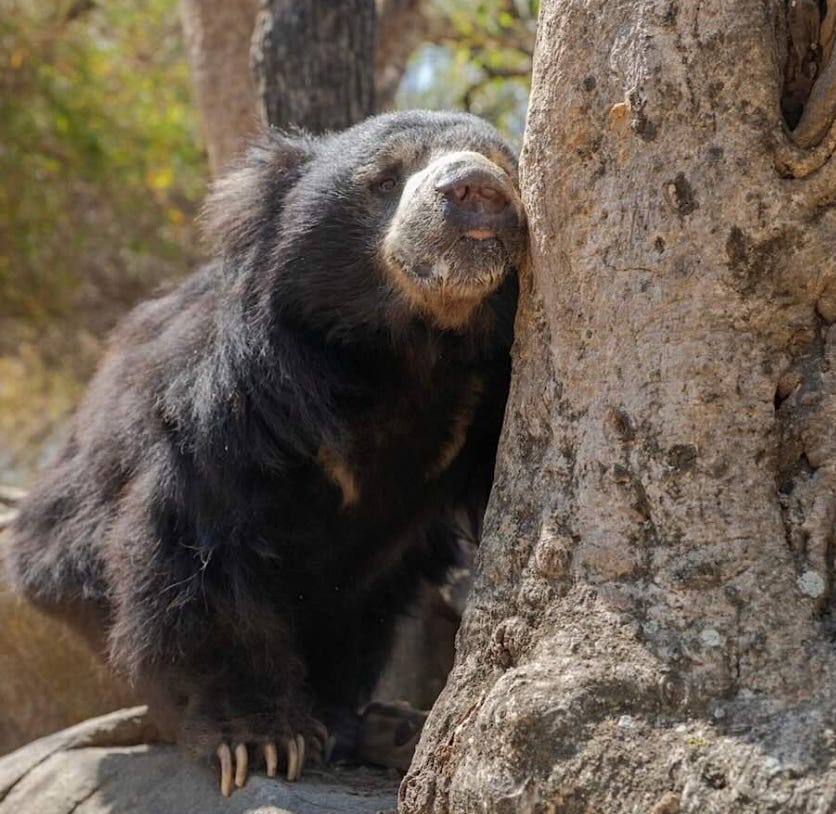
A sloth bear named by Julia Roberts is thriving 17 years after being rescued from India’s cruel “dancing bear” trade. The bear, Odum, was forced to dance for tourists and kept caged the rest of the time until he was rescued in 2009, while Roberts was in India filming Eat, Pray, Love. She named him after visiting the sanctuary, reportedly using an old family name. Now 26, Odum lives at the Bannerghatta Bear Rescue Centre, where staff say his days are spent eating ripe muskmelon, splashing in his pool, and napping in a hammock made just for him. International Animal Rescue released new photos ahead of World Sloth Bear Day on October 12 to show his transformation. The charity’s president said Odum’s story shows “the beautiful outcome that rescue operations can achieve.” He added that the work doesn’t end once an animal is safe, since Odum will need the same patience and specialized care as he grows older.
A lost marble statue by the sculptor behind Rome’s Trevi Fountain was found sitting among garden ornaments in an English salvage yard. The roughly 300-year-old piece by Baroque master Pietro Bracci was a model for a giant bronze statue of Pope Clement XII commissioned by the Roman Senate in the 1730s. The full-size bronze was later melted down for scrap, but the smaller marble model survived after being shipped to a country estate in England, where it eventually ended up outdoors as a garden decoration. A builder with an eye for antiques spotted it among hundreds of architectural cast-offs in a Wiltshire reclamation yard and bought it for just £300, about $400. The 27-inch statue went up for auction this week with an estimate of up to $13,300, thanks to its rarity and the artist’s signature. An auction specialist called it “an exceptionally exciting discovery” and a tangible link to the papal court of 18th-century Rome. The final sale price is expected to be posted by the auction house soon.
A teenager discovered a hidden message from a kind stranger inside an origami crane she had kept on her desk for a decade. When Rika Matsuda was 7, she crashed her new bike into a wall at a park in Japan after discovering its brakes didn’t work, and a man in a suit helped her up, cleaned her injured foot, and let her call her grandfather. While they waited, he taught her to fold a paper crane, and she later wondered if he did it to take her mind off her hurt foot. When her grandfather arrived, the man handed her the crane without a word before disappearing. Ten years later, her high school English teacher assigned a project inspired by NPR’s “My Unsung Hero” series, asking students to write about a Good Samaritan. Remembering the man, Matsuda rushed home, unfolded the crane, and found two characters forming a Japanese idiom meaning to treasure every encounter because it may never happen again. “Then I realized even more how kind and how nice of a man he was,” she said.
Australia just created three new national parks covering more than 250 square miles of forest in Victoria. The new Mount Buangor, Pyrenees, and Wombat-Lerderderg National Parks officially took effect this week after Parliament passed the law last year. They are Victoria’s first major new national parks in 15 years and protect hundreds of rare and threatened species, including platypuses, greater gliders, powerful owls, and goannas. The win came after a campaign led by local volunteers that began in 2010, with years of wildlife surveys and ecological reports that helped convince the government to act. “If we want our koalas, gliders, and owls to be here into the future we must protect their habitat,” said a founding member of one of the campaign groups. The parks sit on the traditional lands of several First Nations peoples, who will now work alongside Parks Victoria on management plans. “Today that hard work becomes permanent protection,” said the head of the Victorian National Parks Association.
A new global study found that the key to conservation success isn’t money, but local communities. University of Sydney researchers reviewed more than 70 studies of conservation “bright spots,” places where wildlife and ecosystems are thriving despite tough odds. They found three common threads: local knowledge valued alongside science, communities playing a central role in decisions, and management adapted to local conditions. In Papua New Guinea, villages have protected one of the world’s healthiest coral reef networks by periodically closing parts of their reefs to fishing, a tradition kept alive by strong bonds between elders and younger generations. Similar patterns showed up with chimpanzees in West Africa, albatrosses in Tasmania, and grizzly bears protected by First Nations communities in Canada. The researchers hope their framework gives scientists a “common language” to find and replicate these successes elsewhere. As one researcher put it, these successes “are not isolated miracles” but patterns the world can learn from.
Archaeologists in Norway recovered 48 Stone Age and Bronze Age arrows from melting glaciers, some looking like they were made yesterday. The finds come from “Secrets of the Ice,” a 20-year project in Norway’s Jotunheimen mountains that has now recovered more than 5,000 artifacts. This season’s arrows were crafted from slate, bone, and even a freshwater mussel shell, with the oldest possibly dating back 6,000 years. The mussel shell arrowhead was found with its wooden shaft still intact and is believed to be about 3,600 years old. Because the ice keeps out oxygen, wood and other materials barely decay, though they can deteriorate quickly once exposed, so many finds go straight into frigid display cases at a nearby museum. Researchers say that while early finds were mostly from the Viking Age, the glaciers are now revealing much older objects. The project has previously uncovered the world’s oldest ski and a leather shoe dating to the time of ancient Babylon.
Jonathan, a nearly 200-year-old tortoise, is helping scientists unlock the secrets of healthy aging. Believed to have hatched in 1832, Jonathan is thought to be the world’s oldest living land animal and has lived most of his life on the island of St. Helena. That makes him a contemporary of Charles Darwin and Charles Dickens, and he was born five years before Queen Victoria took the throne. Researchers identified 287 unique gene variants that help protect him from the usual effects of aging, including genes tied to DNA repair, reducing inflammation, and suppressing cancer. They also found that the genetic “switches” controlling his DNA repair and metabolism are remarkably similar to those in much younger tortoises. The study is the first ever to examine a giant tortoise’s epigenome. Scientists hope to turn these insights into “practical, affordable treatments for everyday people.”
New York City kept soccer field lights on until 2 a.m. for night-shift workers, and the response was so big the program is being extended. The city’s NYC Open Play pilot kept one pitch in each borough lit from 10 p.m. to 2 a.m. this summer, as World Cup fever swept the city. With summer temperatures often topping 90 degrees, the late-night hours also gave players a chance to enjoy the game once the heat finally broke. More than 4,500 people took part across nearly 700 bookings, many of them hospitality workers who couldn’t play during normal hours. Each field had a parks officer on duty, and players expressed huge gratitude for the chance to get on the field. NYC Parks Commissioner Tricia Shimamura said the turnout showed “real demand for late-night play.” The program will now run through next September.
A massive solar farm in Saudi Arabia has been turned into a breeding ground for threatened Arabian sand gazelles. The 250-megawatt solar plant sits inside a huge nature reserve near the Red Sea coast and powers Amaala, a tourist resort that runs entirely on renewable energy. It’s now home to 38 gazelles, protected by wildlife-proof fencing across 1,200 acres so they can feed and breed safely away from predators. Only about 3,000 Arabian sand gazelles are believed to survive in the wild, and conservationists hope this group will grow to more than 500 before being released into the wider reserve. The solar panels also provide shade that’s 8 to 18 degrees cooler than the blazing Arabian sun. Mountain gazelles and Arabian hares were released into the park as well, with males added in May once the animals had settled in. The reserve’s director called the idea “ReWildingVoltaics,” a “double-green” model he believes could be copied around the world.
A South Dakota community came together to rescue a great horned owl tangled in barbed wire. Sharon and Scott Jacobs were driving through Spearfish when Scott spotted what he thought was a dead hawk caught in a fence, but Sharon took a closer look and realized it was a living owl. She stayed calm and spoke softly to the bird while Scott grabbed a bag to cover its head, and a passing driver named Brandon stopped and happened to have both gloves and wire cutters. The landowner’s daughter then showed up, called her father, and got permission to cut the fence to free the owl. Sharon rushed the bird to her veterinarian, who removed two steel barbs and said it would be able to fly again. The owl is now recovering at the Black Hills Raptor Center and will be released where it was found. Sharon says she plans to be there for the release, adding, “I know I’ll cry.”
More than 14,000 leftover explosives have been cleared from a Libyan city’s farmland, letting displaced families return home. Demining teams removed 14,066 pieces of unexploded ordnance from a farm in Misratah between January and September this year. The city saw some of the most intense fighting of Libya’s civil war, including the battle to drive out ISIS, which left behind thousands of mines, shells, and bombs. These weapons can sit silently for generations before exploding at the slightest disturbance. The work is being led by the HALO Trust in partnership with the United Nations, Italy, and Libyan groups, and has expanded from Tripoli to Sirte and now Misratah. “Libyan civilians should not be exposed to such dangers,” said the head of the UN’s mine action program in Libya. The progress comes after a diplomatic breakthrough in September, when Libya’s rival governments agreed on a roadmap for national elections within a year.
Neighbors showed up to cover a Kansas man’s destroyed roof after he told local news all he wanted was a tarp. When a storm sent a silver maple crashing through his roof, 71-year-old Gilbert Kirk and his dog Beetle were trapped beneath the collapsed roof for hours. He told reporters he wasn’t looking for a miracle or an insurance payout, just a tarp to keep the weather out. Two days later, a stranger arrived and promised to come back in 30 minutes with lumber, a tarp, and a crew. “The next thing I know, there were just trucks,” Kirk said. A group of local residents covered the hole in his roof, and another neighbor had already helped him pull the tree out of his house. One of the volunteers said Kirk has called him every day to say thank you, adding, “We just did what was right and needed to be done.”
Seven different meteor showers are lighting up the night sky this October, with the best one still to come. The highlight is the Orionids, which will peak on the night of Wednesday, October 21, with up to 15 shooting stars per hour. They’re one of the easiest showers to find, since the meteors appear to radiate from the constellation Orion, recognizable by the three stars of Orion’s Belt. The only downside is that the moon will be about three-quarters full that night, which could make some meteors harder to see. Stargazers who want darker skies can still catch the Southern Taurids, which peaked this weekend alongside a new moon and can produce a shooting star about every 10 minutes. Several smaller showers, including the Camelopardalids and Delta Aurigids, also peak this month. It’s the perfect excuse to head outside with a warm drink and look up.
See you soon.
— Aaron


