

Good morning everyone. I want to start today with our good news update. As I shared last night in the subscriber chat, I believe it is important to carry on this Sunday tradition because there is so much good in the world, even when it feels hard to see.
Today I want to highlight the good that Alex Pretti brought into this world. Alex was an ICU nurse at the Minneapolis Veterans Affairs Medical Center who dedicated his life to helping others, especially our veterans. He cared deeply for his patients and worked to make a difference every day, from honoring those who served to contributing to medical research and reaching out with compassion to everyone he met. His commitment to service and kindness represented the very best of us. This update is dedicated to him.
I invite you to share one piece of good news that happened to you this week in the comments so we can build community together. For me, my good news is that we launched the podcast feed for The Parnas Perspective and it is now in the top 10 on Apple Podcasts, outpacing major media companies and most podcasters. You can rate it five stars by clicking here.
Here’s the good news:
Alex Pretti was a devoted ICU nurse at the Minneapolis VA Medical Center who spent years caring for critically ill veterans, researching ways to prevent colon cancer, supporting patients at their most vulnerable, and living a life defined by kindness, civic engagement, and a deep commitment to helping others, according to his family, colleagues, and community.
Dr. Dimitri Drekonja, chief of infectious diseases at the Minneapolis VA, described Alex Pretti as “a good, kind person who lived to help,” noting his dedication to supporting critically ill veterans.
Newly surfaced video shows Alex Pretti, as a nurse, honoring fallen veteran while serving at the Minneapolis Veterans Affairs hospital:
Here is a brief update on where things stand in Minnesota before we turn to additional good news. A Trump appointee has blocked the Administration from destroying evidence related to the murder of Alex Pretti. A witness reports that other witnesses have been detained by ICE at a local detention center and says she fears for her own freedom. Mass protests have broken out across New York and elsewhere. Meanwhile, Border Patrol Chief Greg Bovino gave a disastrous interview this morning in which he admitted he has no evidence to support the Administration’s claims.
A 61-year-old South Carolina man, Jim Gogan, who had been colorblind his entire life, became emotional after putting on color-correcting glasses gifted by his son, immediately seeing reds and greens clearly for the first time, passing color tests he had always failed, and marveling at everyday sights like bricks, trees, and the sky as his world suddenly appeared in full color.
For over eight years, Louisa County High School automotive students have repaired donated used cars as part of their coursework and gifted 4–5 vehicles each year to single mothers in need, gaining hands-on technical skills while partnering with the nonprofit Giving Words to provide reliable transportation that helps families access work, childcare, and stability.
American chestnut trees—long considered functionally extinct after a devastating blight—are making a natural comeback in Maine, where biologist Dr. Bernd Heinrich has documented thousands of healthy, wild chestnuts across three generations on his land, suggesting possible natural blight resistance and challenging decades of assumptions that genetic engineering was the only path to restoring the iconic species.
Colorado Parks and Wildlife is developing a legislatively mandated Wolverine Restoration Plan to reintroduce the species, absent from the state for over 100 years, by relocating about 45 wolverines with diverse genetics into three high-elevation regions, aiming to eventually support roughly 50 to 100 animals statewide, restore ecological balance, address rancher concerns through compensation measures, and rebuild a population that once naturally existed across Colorado’s alpine ecosystems.
A Toronto man, Minjae Cho, has gone viral for spreading kindness on public transit—offering simple words of encouragement to strangers, filming the interactions with smart glasses, and earning praise from city leaders for making daily commutes feel more human and connected.
Delta Air Lines announced it will share about $1.3 billion in profits with employees in 2026, giving workers an average of three to five weeks’ pay through its profit-sharing program, one of the largest payouts in company history and a continuation of a practice that has distributed roughly $5 billion to employees over time.
A new report from the American Cancer Society shows U.S. cancer survival rates have climbed to a record 70% living at least five years post-diagnosis—up sharply over the past 20 years thanks to earlier detection and breakthroughs like immunotherapy and CAR-T—marking major gains even in once-deadly cancers, according to experts including the Cleveland Clinic.
Doctors in China saved a woman’s severed ear by temporarily grafting it onto her foot to keep it alive—a rare technique called heterotopic survival—before successfully reattaching it to her head five months later after the damaged blood vessels and nerves had healed.
A cat named Tinsel was reunited with her owner in Vermont four years after going missing, after a cousin recognized her distinctive markings on a local shelter’s website, leading to an emotional reunion where the cat immediately recognized her family.
Several major space missions are slated for 2026, including NASA’s Artemis II crewed lunar-orbit mission, Blue Origin’s first Blue Moon lunar lander test, China’s Chang’e-7 Moon and Tianwen-2 asteroid sample-return missions, and Japan’s JAXA MMX probe to Mars’ moons—highlighting a busy year for human and robotic exploration beyond Earth.
Engineers at the Korea Institute of Machinery and Materials developed a lightweight, shirt-like soft exoskeleton that weighs under 2 pounds yet can assist lifting up to ~35 pounds, significantly reducing muscle strain for users with degenerative conditions—results validated in trials at Seoul National University Hospital and praised by participants like Myung Ha-yul for restoring everyday mobility at a fraction of the cost of traditional exoskeletons.
Three rescued lions—Cyrus, Zephora, and Juancito—were relocated from Honduras to lifelong care at Turpentine Creek Wildlife Sanctuary after a complex air-sea-land journey, part of a historic operation that also moved five tigers to Carolina Tiger Rescue, marking a national milestone in conservation and international wildlife cooperation.
Scientists in Austria documented the first known case of tool use in a cow after observing Veronika deliberately use a brush and stick to scratch different parts of her body—behavior confirmed through experiments led by cognitive biologist Alice Auersperg and published in Current Biology, challenging assumptions about livestock intelligence.
Scientists in China revealed that an 800-year-old Song Dynasty nobleman known as the Changzhou Mummy was remarkably preserved through a unique embalming method that left his organs intact and infused them with mercury, cinnabar, and fragrant oils via an enema, allowing detailed genetic, dietary, and health analyses that shed new light on medieval Chinese mummification practices and the ancient origins of diseases like atherosclerosis.
French sailor Charlie Dalin, who raced while battling cancer, was named World Sailor of the Year after winning the grueling Vendée Globe solo round-the-world race in record time, completing the feat despite ongoing treatment and later undergoing surgery.
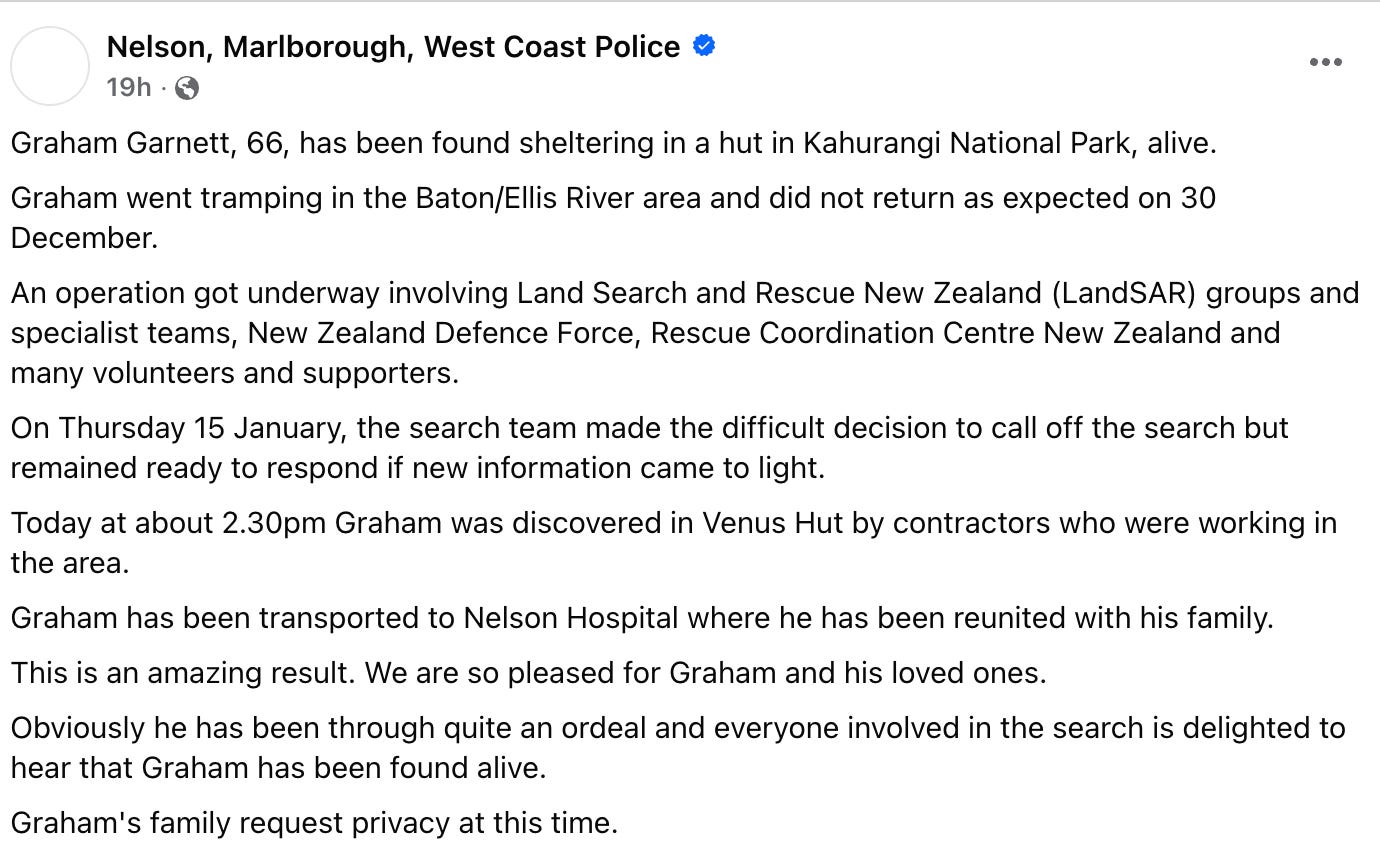
A 66-year-old New Zealand hiker, Graham Garnett, was found alive in Kahurangi National Park more than two weeks after going missing, having survived alone in rugged backcountry terrain and been discovered sheltering in a hut by contractors just days after authorities ended the official search, before he was taken to hospital and reunited with his family.
A tiny “pouch-cam” at Chester Zoo captured rare footage of an endangered Goodfellow’s tree kangaroo joey developing inside its mother, marking a major conservation milestone from an international breeding program and providing new scientific insight into the early life of one of the world’s most threatened marsupials.
More updates coming soon.
— Aaron


