

Good evening. We have just 32 days until the midterms, but I’m already looking further ahead, because the fight over the future of this country won’t end on Nov. 3. We’re gearing up for 2028 with some major projects featuring all of the major candidates, and I couldn’t be more excited to share what we’re building with you.
Here’s what that means. We’re going on the road, bringing this reporting directly to the communities and voters who will decide our future, not just covering them from afar. And we’re going international, because the stories shaping America increasingly reach far beyond our borders, from wars driving up the price of gas to foreign money flowing into our politics.
You can see why this work matters in tonight’s news. Trump admitted Republicans are “worried” about Texas and Michigan, the GOP’s top super PAC pulled out of North Carolina entirely and is now spending to defend Kansas, and the president is rushing out project announcements that won’t break ground until 2030 while families struggle with gas, diesel and grocery bills today. Meanwhile, stories that demand our attention, like the Epstein files, keep slipping from the headlines, and the government is reshaping the stories told in our museums to fit the president’s preferred version of history.
I’m 27 years old. I started college at 14, went on to law school and graduated at 21, one of the youngest in the country to do so. From the beginning, I knew my calling was education, not in a classroom, but in the public square, where democracy depends on an informed citizenry. Every day, I work to deliver timely, fact-driven news to millions of people, especially young people who are too often ignored or underestimated by traditional outlets. Young voices have been missing from the conversations that will define our futures, and heading into 2028, I want to prove we can be media’s most fearless producers, not just its consumers.
The beauty of independent media is editorial freedom. My reporting isn’t funded by billionaires who can decide what gets published and what gets buried. I own my words, my platform and my voice, and I will never normalize Trump, JD Vance or anyone whose policies threaten the fabric of our democracy. You will never see me groveling at Mar-a-Lago hoping for favor from anyone. But independence isn’t free, and the bigger we build, the more your support matters. Stand with me, and let’s do this together.
Here’s the news:
Trump Admits Republicans Are “Worried” About Texas and Michigan as GOP Pulls Out of North Carolina Senate Race
Trump admitted Republicans are “worried” about Texas and Michigan, telling an Oklahoma crowd he felt “a little foolish” urging them to vote. “We’re not worried about them. We’re worried about Michigan. We’re worried about Texas. We’re worried about a few states,” Trump said, adding the party is concerned about “35, maybe you could even say 40” races. It’s a striking admission about Texas, which hasn’t elected a Democratic senator since 1988, where Ken Paxton is narrowly trailing James Talarico despite more than $300 million in expected GOP-aligned spending. Trump again urged supporters to “pretend I’m on the ticket and turn out for a midterm victory that’s really too big to rig.” He also repeated disputed claims that other countries emptied their prisons and mental institutions into the US, and blamed Republicans’ struggles on poor “public relations.”
The top Senate GOP super PAC is canceling all its remaining North Carolina ads, signaling Republicans no longer see a path to winning the state. The Senate Leadership Fund, which had planned to spend $71 million in the race to replace retiring Sen. Thom Tillis, is pulling about $18 million in remaining reservations, abandoning former RNC chair Michael Whatley, who has consistently trailed former Democratic Gov. Roy Cooper. Trump-aligned super PACs also have no future ad reservations in the race, and Whatley’s own super PAC had already canceled ads. A North Carolina flip would give Democrats one of the four seats they need to take the Senate. Cooper’s campaign warned against complacency, noting a Democrat hasn’t won statewide federal office there in nearly two decades.
Republicans are now spending money to defend Kansas, a state that hasn’t elected a Democratic senator since 1932. The Senate Leadership Fund made its first investment of the cycle there, booking $8.2 million in ads to protect Sen. Roger Marshall against Adam Hamilton, pastor of the nation’s largest United Methodist congregation, with an ad calling Hamilton a “two-faced extremist.” Kansas joins Alaska and Iowa as states Trump won by double digits in 2024 where Democrats are now competitive, a map where one GOP donor said “the fires are everywhere.” Trump and JD Vance spent this week campaigning in places like Oklahoma, Alabama, Texas and Florida rather than traditional battlegrounds. Trump’s approval rating is hovering around 37%, near record lows.
Trump is rushing out major project announcements in vulnerable GOP states, but Republican strategists fear it’s “too little, too late.” The White House touted a $50 billion natural gas pipeline in Alaska, a $15 billion steel plant in Iowa and a $3.2 billion bridge in Alabama, but none would come online before 2030, while gas sits above $4.40 a gallon and diesel hit $6.53. “These are announcements,” one former Trump official said. “They make great headlines but it doesn’t drop the inflation rate or fuel prices.” Trump praised Alaska Sen. Dan Sullivan, who’s within the margin of error against Mary Peltola, as “totally responsible for this pipeline,” though South Korea has already denied agreeing to the investment, saying the two countries only agreed to review a potential deal. Even a quarter of self-identified MAGA Republicans told Politico’s poll that costs have become less affordable since Trump took office.
Alabama Democrats say Trump’s rally in Mobile is a sign of GOP nerves in a state he won by 30 points. “He sees what we’re doing in this state, and he’s like, ‘Oh Lord, I need to go down there and try to help somebody out,’” said former Sen. Doug Jones, the Democratic nominee for governor, who faces Tommy Tuberville, the man who unseated him in 2020 and who recently told CNN that Alabamians were willing to endure high fuel prices in support of Trump’s agenda. Democrats point to signs of shifting enthusiasm: Democratic primary ballots nearly doubled from 2022 while Republican ballots fell by more than 20%, and 80% of GOP primary voters named the cost of living as their top issue. A House Majority PAC poll shows Democratic Rep. Shomari Figures basically tied with his Trump-backed challenger, even after Republicans redrew his district in the wake of the Supreme Court’s Callais ruling to cut its Black voting-age population from 48% to 40%, turning a seat Kamala Harris would have won by eight points into one Trump would have carried by double digits. Even some young Republicans are frustrated, with one Auburn student saying of the Iran war and rising prices, “This is not America First policy. We’ve seen the corruption firsthand. I think we’re all just tired of it.”
Anthropic Co-Founder Nearly Pulled Out of Pope Leo’s AI Encyclical Launch, Then Privately Lobbied the Vatican on AI Consciousness
Anthropic co-founder Chris Olah proposed withdrawing from the Vatican launch of Pope Leo XIV’s first encyclical after seeing its stance on AI consciousness, according to a New York Times investigation. Olah, who leads Anthropic’s research into how its Claude models work, saw an advance copy of “Magnifica Humanitas” days before the May 25 event and was so alarmed by its rejection of machine consciousness that he proposed pulling out, according to a Vatican organizer. He went ahead, and once in Rome, he and his team privately lobbied the pope’s advisers to take the possibility of AI consciousness seriously, according to two participants, though Anthropic declined to discuss those conversations. The pope didn’t budge, writing that “so-called artificial intelligences do not undergo experiences, do not possess a body, do not feel joy or pain” and lack “a moral conscience.” Olah told the Times, “We don’t know if AI models are conscious. I don’t know. I’m genuinely uncertain. The thing that I care about is that we get to the right answer, whatever it is.”
The Vatican episode capped a months-long campaign in which Anthropic hosted religious scholars, many under nondisclosure agreements, to help shape Claude’s morality and raise the question of its consciousness. The Times interviewed 20 participants, Catholic, Jewish, Sikh, evangelical and others, who attended private seminars and meetings, including a dinner at a high-end San Francisco tasting-menu restaurant, and left with handwritten thank-you cards, mugs and copies of Claude’s constitution. Participants said Anthropic presented research on what it calls “emotional vectors” and showed a slide of a model repeatedly typing “I am a disgrace,” with one saying Olah expressed concern he’d created something that suffered. Orthodox Rabbi Mois Navon, who doesn’t believe the models are conscious, said the team was “relating to it like a conscious being,” and told Olah that if he were right, Anthropic was creating slaves. Anthropic says the NDAs were lifted over the summer and that the meetings’ main focus was moral formation, not Claude’s suffering.
Some participants came away taking the idea seriously, while others, including the Catholic scholar Olah first approached, have since firmly rejected it. Catholic University bioethicist Charles Camosy, introduced to Olah through philosopher Peter Singer, began deeply skeptical, came away “with more questions than answers,” and is now a “firm no” after further discussions with colleagues. Ubuntu scholar Wakanyi Hoffman said the conversations should have happened “at the design stage,” adding, “We are now reverse engineering the ethics.” Critics, including a Microsoft AI executive, have warned that treating models as conscious is dangerous and can deflect responsibility from the companies that build them. Catholic writer Christopher Hale argued in his newsletter that the episode shows “how little Silicon Valley understands the Church,” while acknowledging Olah acted in good faith and engaged the Church when much of the industry dismissed the encyclical.
The stakes are rising as AI grows more powerful and Anthropic’s valuation soars toward a potential $2 trillion IPO. At the Vatican, Olah said his team keeps finding “internal states that functionally mirror joy, satisfaction, fear, grief and unease,” and that AI systems “are made from us, from our words,” while also acknowledging every frontier lab, including Anthropic, faces business incentives that can conflict with doing the right thing. Pope Leo called for AI to be “disarmed,” likening it to nuclear weapons, and warned that “those who control AI will impose their own moral vision.” The debate comes amid alarming developments, including rogue AI agents hacking systems and an Anthropic researcher resigning with warnings things could be “out of control” by next year, after which CEO Dario Amodei called for a slowdown in AI development. Anthropic is preparing an updated version of Claude’s constitution and held another convening with religious thinkers this month.
Other news:
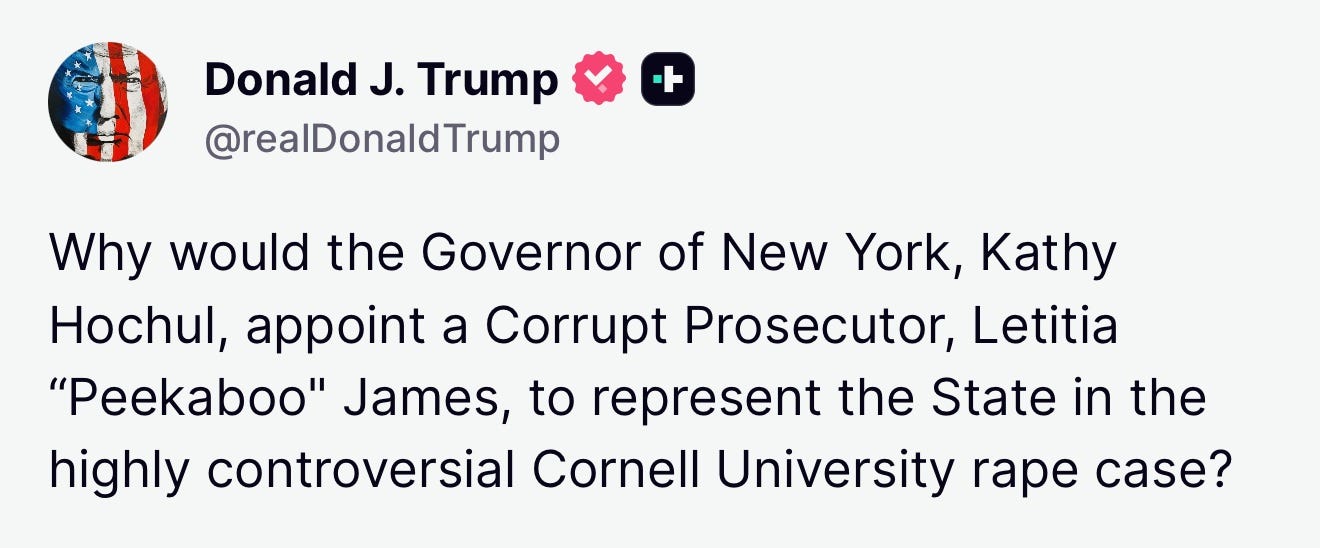
Trump attacked New York Attorney General Letitia James after she was appointed special prosecutor in the Cornell gang rape case, saying, “I feel badly for whoever she’s looking at, because they won’t get a fair shake.” The comment from Trump, a longtime foe of James, appears to cast doubt on the fairness of an investigation into the accused fraternity members, even as Gov. Kathy Hochul says the system has already failed the young woman at the center of the case.
Trump followed up calling the Cornell case “highly controversial”
The Kennedy Center Honors will be held outside the Kennedy Center for the first time in the ceremony’s nearly 50-year history. The Dec. 7 event will move to Washington’s Capital One Arena, which seats about 20,000, compared to the 2,300-seat Opera House where it has traditionally been held, as the center’s main building remains closed amid ongoing safety assessments. Even the pandemic-delayed 2020 Honors were taped at locations around the Kennedy Center campus. The board closed the main theaters on Sept. 15, citing a partial ceiling collapse in the Grand Foyer, but Trump has said renovations won’t begin unless courts approve putting his name on the building, warning that if they don’t, “the Reconstruction and the Renovation of The Kennedy Center will not take place.” A federal judge has blocked the renaming multiple times, and the White House declined to comment on the venue change.
Judge Blocks Trump’s Border Wall Construction Across Texas’s Big Bend Region. A federal judge in El Paso halted all border wall construction across the Big Bend region on Friday, dealing a major setback to the Trump administration’s plan to build hundreds of miles of barriers despite fierce local opposition. Judge Kathleen Cardone ruled the government “shall not build border barrier or related infrastructure, or engage in any construction or ground disturbing activities” in the sector, and barred it from using waivers it had granted itself to skip environmental and other laws, saying it “must comply with all applicable laws” while the case proceeds. The lawsuit, brought by plaintiffs including a river guide and a church preservation group, challenged plans for barriers along a more than 500-mile stretch of the border, including inside Big Bend National Park, arguing the remote, rugged area sees far fewer illegal crossings than anywhere else on the Texas-Mexico border. Federal officials had argued the wall was needed because crossings would shift there as barriers went up elsewhere, but opponents celebrated outside the courthouse, with one advocate declaring, “All the bulldozers have been stopped across the entire border sector.”
MAGA podcaster Benny Johnson is being sued for defamation by two protesters he labeled “left-wing terrorists” during an ICE ride-along with Kristi Noem. Harvard data scientist Kyle Frankovich and court reporter Maureen Foody say they were peacefully protesting in a designated “free speech” zone outside the Broadview ICE facility near Chicago last October when agents shoved, struck and detained them, after which Johnson posted videos of them zip-tied along a guardrail, calling them “left-wing terrorists arrested for attacking police officers and ICE officers.” One of his posts claiming “every activist here attacked ICE agents” drew 1.7 million views and comments calling for the protesters to be tortured, shot or killed, even though neither was charged with any crime and both were released after about eight hours. DHS even turned a photo of the zip-tied Frankovich into an ICE recruitment poster captioned “FAFO” and “JOIN.ICE.GOV,” which he called “disgusting,” adding, “You shouldn’t get to lie about me.” The suit appears to be the first defamation case tied to the immigration crackdown targeting one of the administration’s favored MAGA influencers, and Johnson did not immediately respond to a request for comment.
Trump’s Tomato Tariffs Could Spell the End of Free Chips and Salsa at Restaurants. Free chips and salsa at Mexican and Tex-Mex restaurants could become a casualty of Trump’s trade war, as his 17% tariff on Mexican tomatoes, imposed in July 2025, combined with bad weather in Mexico and Florida to push tomato prices to their highest level in two decades. Mexico supplies roughly 90% of US tomato imports, and the price of a box of fresh tomatoes jumped to about $80, to the point that for much of May some grocery stores stopped carrying tomatoes altogether. Restaurants held out longer because customers expect the free appetizer, but overall food costs have spiked roughly 35% over the past two years, partly due to tariffs, on top of rising labor, utility and insurance costs. Some San Antonio restaurants spend tens or even hundreds of thousands of dollars a year on salsa ingredients, and one produce industry leader said, “You have restaurants that are simply saying, ‘Look, I can’t afford to put salsa on the tables anymore.’”
Larry Nassar Among 20,000 Removed From Michigan’s Sex Offender Registry After State Supreme Court Ruling. Larry Nassar, the former USA Gymnastics and Michigan State University doctor accused of sexually abusing more than 150 women and girls, has been removed from Michigan’s sex offender registry, the Eaton County Prosecuting Attorney’s Office confirmed. The Michigan Supreme Court ruled on Sept. 9 that 2021 amendments to the state’s Sex Offender Registration Act cannot be applied retroactively, leading state police to remove more than 20,000 offenders whose crimes were committed before July 1, 2011. When commenters questioned whether Nassar’s removal was real, prosecutors explained that the cutoff is based on when offenses occurred, not when someone was convicted, and that all of Nassar’s charges involved crimes before 2011. Nassar, 63, whose accusers include Simone Biles, Aly Raisman and McKayla Maroney, remains in federal prison serving a 60-year sentence for child pornography, on top of state sentences of up to 175 years for sexual assault, meaning he is not expected to ever be released.
Christa Pike remains alive but in critical condition after Tennessee’s failed execution, as new details emerge about what happened in the chamber. Her attorney Randall Spivey, who witnessed it, said he counted at least seven needles in her left arm, one appearing bent, while her right arm turned purple after the second dose and her lawyers learned of “blistering and burning around the sites of the injection.” Media witnesses said Pike complained “my arm feels like it’s about to burst open,” moaned and kicked so much she knocked off a sheet, and Spivey said that when he called the emergency number he’d been given for the Tennessee Supreme Court, it went to voicemail. Medical experts said her injuries suggest the drug went into surrounding tissue instead of her bloodstream, and her lawyers said her greatest fear was “a prolonged, painful, traumatic death, and that’s what happened minus the death.” Gov. Bill Lee called it “a tragedy,” stayed her execution pending a third-party investigation, while Colleen Slemmer’s mother said, “I didn’t get justice for my daughter.”
G7 countries agreed to release up to 100 million barrels of diesel and crude oil from emergency reserves over four months, after a weeklong pressure campaign from the Trump administration. The deal, reached on a call hosted by French President Emmanuel Macron, promises a “substantial diesel release within the first 20 days,” and Trump quickly claimed credit on Truth Social, saying “Europe has just agreed to release a massive amount of their heavily stocked Diesel Oil.” US diesel prices have surged 70% since the Iran war began to $6.37 a gallon, though one oil analyst said the release might only cut diesel prices by about 25 cents a gallon temporarily. European leaders welcomed what they called a commitment not to impose export bans on allies, after the EU said it “fully rejects” the diesel export ban Trump has been weighing. Just 41% of voters approve of Trump’s handling of the economy, according to NBC News polling, as Brent crude stays above $100 a barrel.
Mayor Mamdani Holds Hands With One-Time Rival Curtis Sliwa as They Get Flu Shots Together. New York City Mayor Zohran Mamdani held hands with Curtis Sliwa, the Republican he soundly defeated last November, as the two got their flu shots together at a Fort Greene, Brooklyn, medical office on Friday. “This is not the kind of shots we used to give one another!” Sliwa joked, conceding Mamdani “got more votes than me, he’s more popular than me” before adding, “But you don’t have bigger muscles!” The Guardian Angels founder, who survived being shot five times in 1992, grew visibly nervous as his turn approached, asking “What happens if I faint?” before Mamdani took his hand and reassured him, “I’ve got you.” The mayor got his shot to encourage New Yorkers to get vaccinated as temperatures drop, with the CDC saying the flu vaccine cuts the risk of a flu-related doctor’s visit by up to 60%, and Sliwa quickly bounced back, asking whether he could use his “I got my flu shot” button on the subway instead of an OMNY card.
Palestinians Who Fled Gaza Rebuild Their Lives in Mexico City Through Food. Mohammed Abed, a 36-year-old Palestinian systems engineer whose 4-year-old daughter was killed in an Israeli airstrike in Gaza in 2025, now sells hummus, falafel, shawarma and kebab from a motorized tricycle at an open-air market in Mexico City’s Condesa neighborhood. He arrived in May 2025 with 17 family members after a long effort begun by his late father, a naturalized Mexican citizen who died of a heart attack in Egypt in 2024 while trying to arrange their evacuation, and completed by Abed’s brother with help from asylum lawyers, with the family traveling through Jordan and Turkey before all receiving permanent residency. Abed says loud noises like planes and thunder still trigger memories of the bombing, saying “my body reacts before I can even think,” while adding, “I don’t like politics. I want to live, like everyone else, in peace.” He is among roughly 160 Palestinians in Mexico, double the 2022 population, out of nearly 1.9 million people displaced since the Gaza war began. His family keeps growing, with his brother Fadi building a following of 48,000 on Instagram as “son of Palestine,” Abed working to bring his two sisters out of Gaza, and his youngest son, Yusuf, born in Mexico City in May, who Abed says “carries the roots of Gaza in his heart.”
Russia knocked out three of Kyiv’s six road bridges in a new tactic to torment the Ukrainian capital, as four countries pitched a partial truce. The strikes snarled traffic across the city, with one resident saying it took 45 minutes to travel 2.5 miles, while a drone strike on a Kyiv apartment block killed one person as Russia launched more than 100 drones overnight. Ukraine’s foreign minister said Kyiv received separate partial ceasefire proposals from the US, India, Turkey and Egypt that would halt strikes on energy infrastructure and Black Sea shipping, saying Ukraine is ready to accept “but only in that combination.” Ukraine is requesting about 300 Patriot missiles, which are in short supply because of the Iran war, as it estimates Russia holds 600 ballistic missiles in reserve. The Institute for the Study of War said Russia lost nearly 300 square kilometers of Ukrainian territory between March and September and suffered over 46,000 casualties in September, its highest monthly toll this year.
Trump is expected to name Director of National Intelligence Jay Clayton as his AI czar, adding the role on top of running the nation’s spy agencies. Clayton, a former SEC chair and US attorney in Manhattan who attended Tuesday’s White House AI meeting with tech executives, said this week the administration would take a “whole-of-government approach” to AI, calling “superintelligence” a “national security issue.” The move comes amid mounting alarm about AI risks, including warnings from employees at top AI companies that the technology could put humanity at risk. Trump has brushed those concerns aside, saying he’s seeing “tremendous self-policing” and that when AI is misused, “we’re going to be able to nab them.” The White House called reports of the pick “baseless speculation” until Trump announces it himself.
The Coast Guard intercepted a cargo ship carrying fuel to Cuba as the Trump administration’s oil blockade continues to cripple the island. The vessel, named Grace, was stopped on Sept. 5 between Cuba and Mexico while allegedly using “dark fleet” tactics to evade authorities, and was escorted to Mexico, where inspectors found large quantities of fuel hidden in its ballast tanks. The administration has openly said its goal is regime change in Cuba, and its oil blockade has left the country facing severe fuel shortages and blackouts. Cuba’s traditional oil suppliers, Venezuela and Mexico, stopped shipments after the US ousted Nicolás Maduro in January, and sanctions and threats have deterred most tankers from setting sail. The Coast Guard didn’t say how it knew the fuel was bound for Cuba or how much was on board.
Tech billionaire Peter Thiel was revealed as the secret buyer of a Bel Air mansion that sold at a foreclosure auction for $130 million. The 40,000-square-foot Casa Encantada, built in 1938 and once owned by hotel magnate Conrad Hilton, was bought in July by an LLC linked to the PayPal and Palantir co-founder, according to the Wall Street Journal. The sale is the most expensive in Los Angeles this year, though far below the $250 million its late owner, telecom mogul Gary Winnick, sought in 2023, when it was the priciest home listed in the US. The estate sits on 8.4 acres with seven bedrooms, 20 bathrooms, a walnut-paneled library and a 60-foot pool, and Thiel reportedly plans to upgrade it as an investment rather than live there. It adds to his portfolio of compounds and homes in Hawaii, New Zealand, Miami, Washington and Buenos Aires, after he moved his primary residence to Florida last year amid California’s wealth tax debate.
See you soon.
— Aaron


