

Happy Friday. Trump’s legal team lost again this week, and this time it wasn’t even close. A federal judge told them, essentially, that you don’t get to gamble on one strategy and then ask for a do-over when it fails, and that ruling is just one piece of a busy few days of news. Down in California, a stretch of Yosemite is on its way into private hands through a land swap that critics say hands public wilderness to a Wall Street-backed developer with no clear public benefit in return. And on the more everyday side of things, there’s a fresh batch of recalls to know about, plus Trump’s own move to loosen beef processing rules right as multiple food-borne illness outbreaks are already unfolding.
Beyond those top stories, there’s a lot more worth your time today. Texas quietly suspended voter registrations for a million residents. A federal judge ruled that Khalid Shaikh Mohammed’s 9/11 confession can’t be used at trial. Milo Yiannopoulos is now in ICE detention. And we’re tracking everything from the Nepal flood recovery to Fed Chair Kevin Warsh’s Jackson Hole speech to a dog reunited with its family after twelve years.
Someone left a comment on one of my videos recently that’s stuck with me. They wrote: “Does anyone follow Aaron Parnas? Watching him go from a buttoned-up professional, solidly reporting Breaking News to a slightly disheveled, t-shirt-wearing, slouching, sighing, and starting with, ‘Wait till you hear this shit,’ pretty much captures where we are all at. If you have a heart and at least half a brain, you get him.”
I laughed when I read it, and honestly, they’re right. I’m not the same person I was when I started this. None of us are. The news has worn all of us down a little, and I’ve stopped pretending otherwise on camera. But here’s what hasn’t changed, and what I won’t let change: one promise I make to you is that the news you receive here is accurate, verified, and thoroughly vetted. That is the standard I hold myself to every single day, whether I’m buttoned up or in a t-shirt, and it is what your support makes possible.
Here’s the news:
Trump Loses Hush Money Appeal:
A federal judge has once again rejected President Trump’s bid to move his New York hush money criminal case to federal court, a maneuver that could have made it easier to overturn his conviction. District Judge Alvin Hellerstein ruled Friday that Trump’s cited grounds were “neither new nor legally sufficient,” maintaining his earlier position that the conduct underlying the case, reimbursing hush money payments to an adult film star, was private and unrelated to Trump’s role as president. Hellerstein wrote that “the People’s prosecution arises from President Trump’s private conduct” and bears “no substantive relation to his position in federal office,” rejecting the idea that such private acts could be considered “relating to” a federal office. A spokesman for Trump’s legal team said he would file a “powerful appeal,” calling the case a “Witch Hunt” that should be “removed to federal court, and immediately overturned and dismissed.”
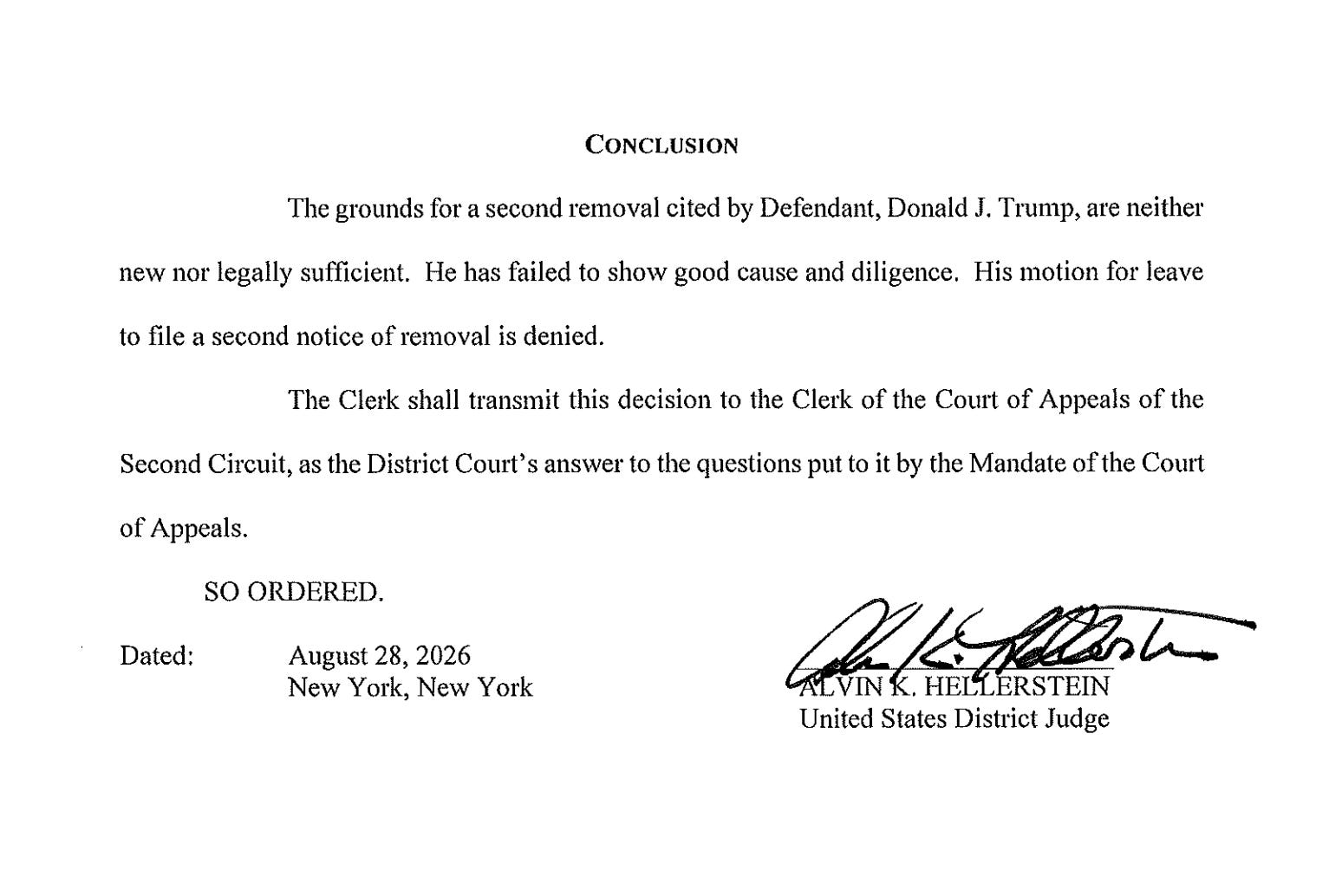
The ruling is the latest chapter in a long legal fight stemming from Trump’s 2024 conviction on 34 counts of falsifying business records tied to hush money payments made to Stormy Daniels during the 2016 campaign, which made him the first president convicted of a felony, though he received an unconditional discharge with no penalties. Trump’s lawyers first tried to move the case to federal court before the state trial and tried again after the Supreme Court’s 2024 immunity ruling, which shields presidents from prosecution over official acts. His defense has argued he can’t be prosecuted over the scheme because he reimbursed his former attorney Michael Cohen while in office for a cover-up Cohen orchestrated during the campaign. Hellerstein flatly rejected that framing in his ruling, writing, “there is no way that discussions regarding hush money payments to cover up the President’s relations with Stormy Daniels could be an official act,” since an affair or its cover-up falls outside “the ‘outer perimeter’ of the President’s official responsibilities.”
The case has bounced between courts for months, with the 2nd U.S. Circuit Court of Appeals sending it back to Hellerstein last November for reconsideration in light of the immunity ruling, without weighing in itself on how it should come out. Hellerstein also found that Trump waited too long to file his renewed removal request in federal court after first unsuccessfully asking state court Judge Juan Merchan to dismiss the conviction, calling the delay a “quintessential strategic decision” that doesn’t now entitle Trump to a do-over just because he came to regret it. Back in February, Hellerstein had signaled this outcome, telling Trump’s team bluntly, “you made a choice, you sought two bites at the apple.” Trump’s appeal of his underlying conviction continues to move through New York’s state appellate courts separately, and could eventually reach the state’s Court of Appeals and potentially the U.S. Supreme Court if he’s unsuccessful there.
Yosemite National Park:
The Trump administration is pushing the National Park Service to hand over a roughly quarter-mile parcel of Yosemite National Park to Kingsbarn Realty Capital, a Nevada-based real estate developer, according to NOTUS. The proposal would have the Park Service give up the land or grant an easement in exchange for equivalent land elsewhere in California, and the deal is being fully backed by the Department of the Interior’s political leadership, which is pressuring Park Service staff to cooperate. One anonymous source told NOTUS that officials “want us to be responsive to the property owner and their lobbyists,” while another called the political pressure “very unusual.”
Kingsbarn wants the land because it already owns 83 acres just outside Yosemite’s boundaries, about five miles from the park’s iconic sequoia groves, and hopes to build a new road connecting that property directly to one of Yosemite’s main internal roads. Currently the developer’s land is accessed by a route more than 10 miles from the nearest park entrance, making it roughly a 90-minute drive to Yosemite Valley, and it remains unclear whether the company plans to build a private residence, hotel, or resort on the site. If completed, the new road would grant the company unprecedented private access to federally protected forest land.
Former Yosemite superintendent Cicely Muldoon, who spent 40 years with the National Park Service, warned the deal would break a 150-year tradition of protecting national parks from private interests, noting that “the national park idea started in Yosemite with Abraham Lincoln’s preservation of Yosemite Valley,” and that the mission has always been to preserve such places “unimpaired for future generations, not letting go of that for the purpose of private profit.” The piece frames this as part of a broader pattern under Trump, who has already opened public lands to fossil fuel extraction and shrunk the size of national monuments. It argues the proposed Yosemite giveaway would represent a further departure from the conservation legacy associated with Theodore Roosevelt.
Recalls:
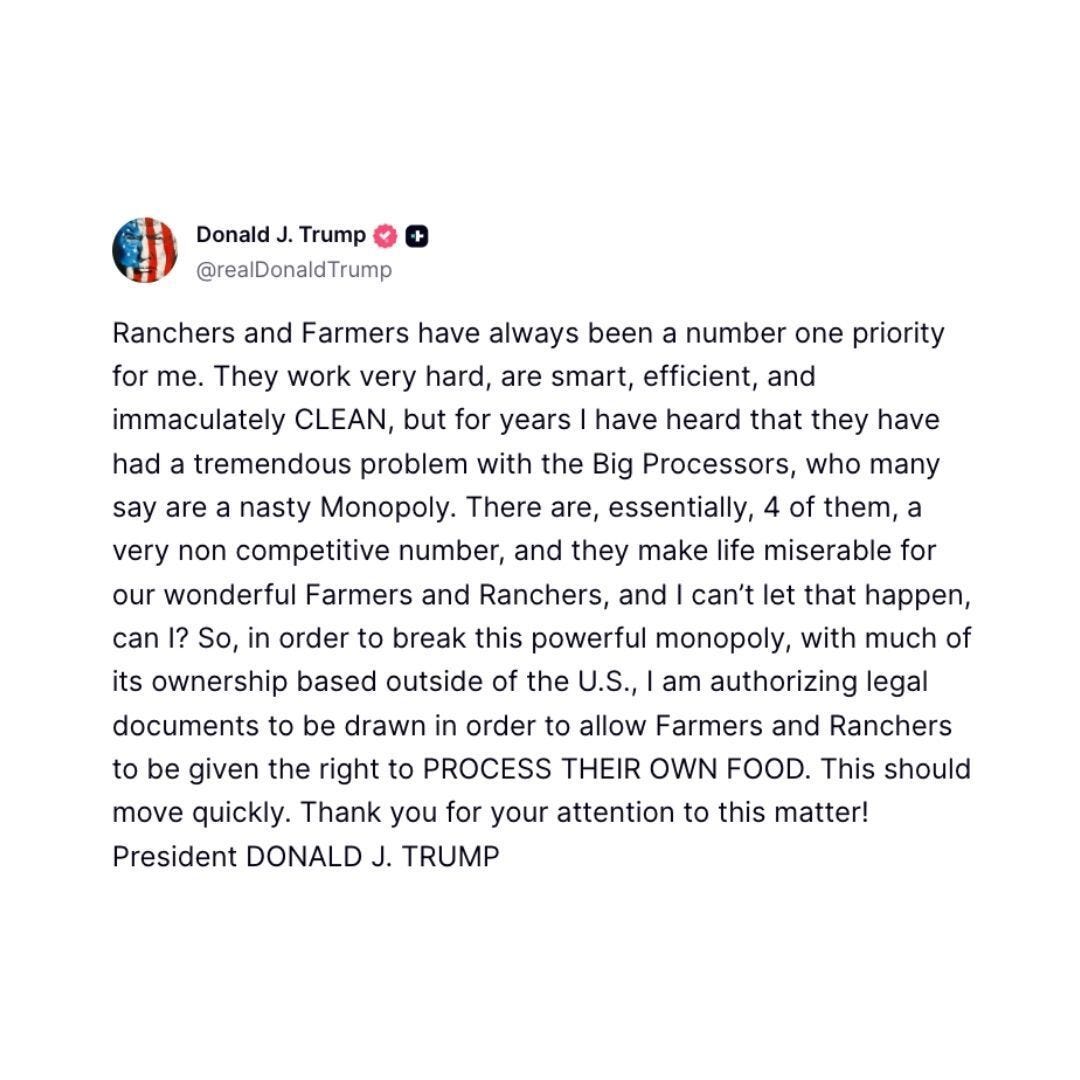
President Trump announced he is directing officials to draft legal documents allowing farmers and ranchers to process their own food, saying “this should move quickly,” a move that would loosen federal beef processing regulations. The announcement comes amid multiple ongoing foodborne illness outbreaks, including the Salmonella outbreak tied to contaminated jalapeños that has sickened hundreds across dozens of states, raising questions about the timing of easing oversight on meat processing specifically. Details remain thin on how the administration plans to implement the change or what federal inspection requirements, if any, would still apply to farmer and rancher processed products. Critics are likely to note that current inspection rules exist precisely to catch contamination before products reach consumers, a concern already highlighted this week by the Shanghai Ravioli recall over products falsely marked as federally inspected.
The FDA has expanded a recall of Lundberg Organic Jasmine White Rice sold in Florida, North Carolina, Tennessee and other states nationwide, affecting 27,324 packages of the 32-ounce product due to the possible presence of foreign material. The recall stems from an original April notice issued by Wegmans, which first flagged the issue, and it’s unclear what specific material may be contaminating the rice. The affected packages carry UPC code 073416040281, best-before dates of February 1 and 2, 2027, and lot numbers 260201MA and 260202MA. Consumers who have the product at home are advised not to eat it and to throw it away, though other Lundberg products like Carolina Gold Rice Middlins remain unaffected.
Baxter International voluntarily recalled two of its healthcare products this week over potential contamination with particulate matter. One lot of its 70% Dextrose Injection, used to provide extra fluids and carbohydrates to patients who can’t get enough through drinking, was recalled over the possible presence of steel particles, with the FDA warning this could cause life-threatening health consequences, particularly for patients receiving IV nutrition at home. Separately, a lot of Anticoagulant Sodium Citrate Solution, used to slow blood clotting during apheresis procedures, was recalled over possible fiberglass contamination, though it was distributed to only one U.S. customer. Both products came in VIAFLEX plastic containers, and the FDA said there have been no reports of adverse effects from either product so far, though Baxter is contacting affected customers directly with return instructions.
The FDA classified a Whole Foods recall of guacamole, salsa and pico de gallo products at its highest risk level, Class I, after the items were made with jalapeños from Coast Citrus Distributors that are linked to a multistate Salmonella outbreak. The recall, which affects nearly 13,000 units of Mild Guacamole Dip alone along with several other guacamole and salsa varieties, covers products sold in 13 states with best-before dates in early-to-mid August. The broader outbreak tied to the tainted jalapeños has sickened 431 people and hospitalized 57 across 32 states, with 93 percent of interviewed patients reporting they’d eaten at a Mexican-style restaurant beforehand, including chains like Chipotle and QDOBA that have since switched suppliers. Whole Foods said no illnesses have been linked directly to its recalled products and that it has pulled everything from shelves, offering refunds to affected customers.
Shanghai Ravioli Corporation, a Boston-based food company, recalled approximately 24,900 pounds of frozen buffalo chicken products after USDA inspectors discovered they were produced without federal inspection. The recall covers “Buffalo Chicken Rangoon” and “Benedetto’s Buffalo Chicken Mozzarella Stick” items made between July 2025 and June 2026, which bore false inspection marks under an establishment number that doesn’t hold a valid federal inspection grant. The products were shipped to foodservice locations across Maine, Massachusetts, New Hampshire, Rhode Island and Vermont, and USDA said some of the affected items may still be sitting in foodservice storage. It’s classified as a Class I recall, the agency’s most serious designation, though no illnesses or injuries have been reported so far.
Other news:
More than 1.2 million Texas voters, roughly 6 percent of the state’s total, have had their voter registrations suspended ahead of November’s midterms, often without knowing it, because their counties don’t have a current address on file or believe they’ve moved. The suspension doesn’t stop someone from voting, but it does complicate the process, requiring a “statement of residence” form at the polls or forcing voters who’ve moved counties to either vote in their old county or cast a provisional ballot. The suspensions are concentrated in some of Texas’s biggest counties, including over 129,000 in Dallas County, 56,000 each in Collin and Denton counties, and more than 73,000 in Tarrant County. Voters have until October 5 to fix their registration status through the Texas secretary of state’s website, a county election office, or by mail, though reaching all 1.2 million people in time is a real concern. The stakes are high in a state where Democratic state Senator James Talarico currently holds a narrow polling edge over Republican Attorney General Ken Paxton in the Senate race, and where Texas has also been cooperating with the Trump administration’s push to gain access to state voter rolls.
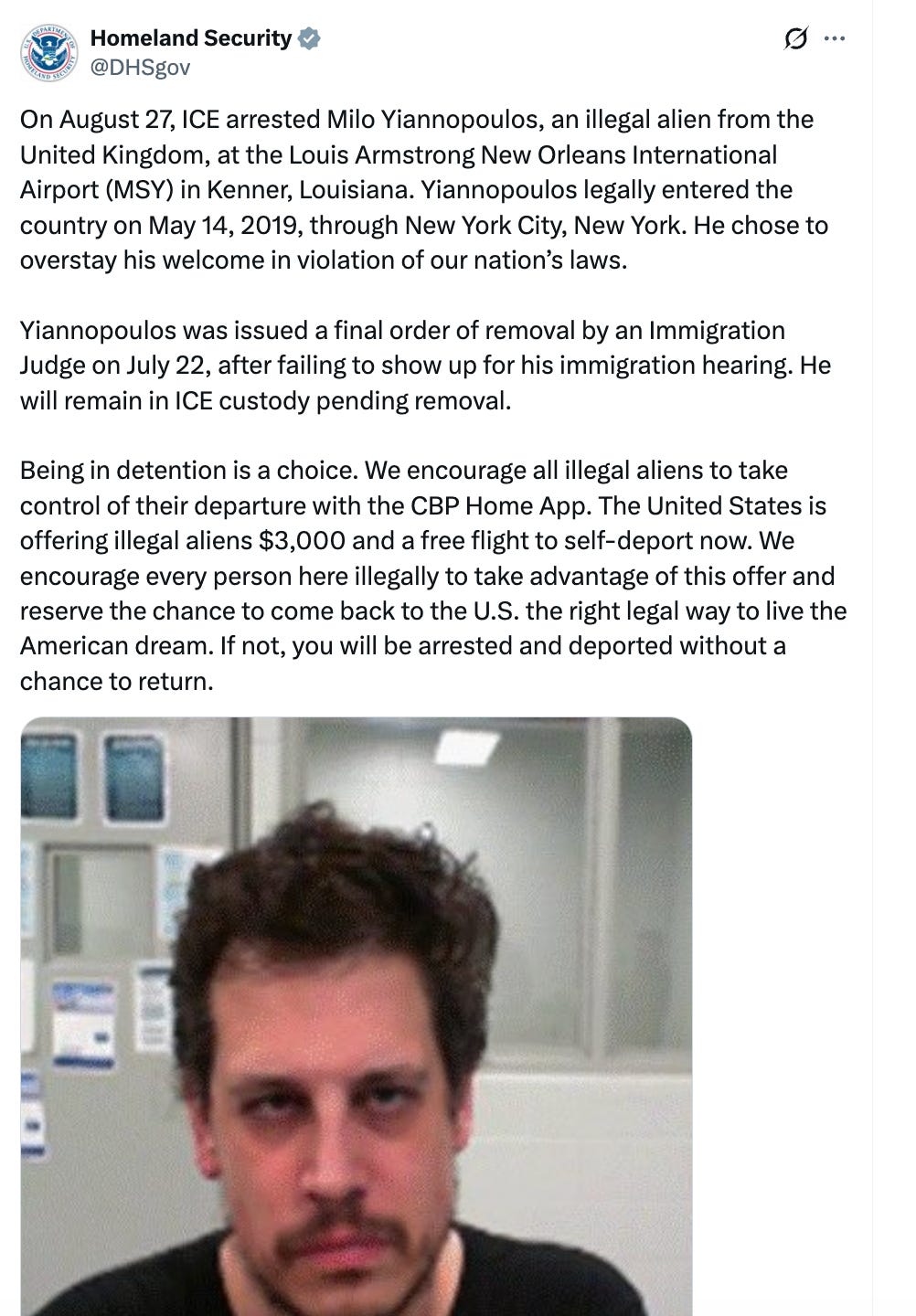
Right-wing commentator Milo Yiannopoulos, 41, appears to have been detained by Immigration and Customs Enforcement, according to a search of ICE’s inmate registry showing him held in Louisiana, though neither ICE nor Yiannopoulos has responded to the BBC’s request for comment and the circumstances remain unclear. Yiannopoulos, a British national who grew up in Kent and formerly edited Breitbart News, was an early and vocal Trump supporter, headlining a “Gays for Trump” event at the 2016 Republican National Convention and previously posting support for “total legal immunity for ICE agents.” He has since soured on the president, however, writing on X in March that Trump “has lost his way, bought off by foreign interests.” Yiannopoulos has long courted controversy over his comments on transgender people, Muslims, feminists and other groups, and was uninvited from CPAC in 2017 after footage surfaced that appeared to condone pedophilia, allegations he denied, saying he had been referencing his own experiences as a child. He has said he doesn’t consider himself part of the alt-right movement he was once closely associated with, despite calling it “energising and exciting.”
A military judge ruled Friday that confessions Khalid Shaikh Mohammed, the accused mastermind of the September 11 attacks, gave to FBI agents in 2007 at Guantánamo Bay cannot be used against him at trial, a major setback for prosecutors who had called those statements their most crucial evidence in the long-running death penalty case. Lieutenant Colonel Michael Schrama concluded that the statements weren’t voluntary, citing an “unbroken continuation of the CIA’s psychological conditioning and severe coercion” stemming from Mohammed’s earlier torture in secret CIA prisons, and found that FBI agents intentionally failed to explicitly inform him of his right to remain silent and to a lawyer. The ruling comes just before the 25th anniversary of the attacks and could further delay a trial that was only just scheduled for June 2028, with chief prosecutor Rear Admiral Aaron Rugh saying his team would review the decision and decide whether to appeal within five to ten days. The case has been mired in pretrial proceedings since 2012, and judges have already thrown out confessions from other defendants over torture-related concerns, including Mohammed’s nephew Ammar al-Baluchi and USS Cole bombing defendant Abd al-Rahim al-Nashiri. Aging survivors and victims’ families have expressed fear they may never see the case reach a final resolution.
White South Africans admitted to the U.S. as refugees could receive up to $4,500 per person in initial federal support starting October 1, nearly double the current roughly $2,400 amount and the highest level ever offered, according to four people familiar with the change who spoke to The Washington Post. Trump froze refugee admissions worldwide after taking office in 2025 but weeks later launched a separate program specifically bringing Afrikaners, South Africans of European descent, into the U.S. as refugees, claiming they face violent persecution in majority-Black South Africa, a claim South Africa’s government has strongly denied. While the increased aid would technically be available to any refugee, South Africans have made up more than 99 percent of all refugee arrivals to the U.S. this year, meaning the funding boost would overwhelmingly benefit that single group. The money is distributed to resettlement organizations to cover housing, food and other basic needs, with any unspent funds going directly to refugees as cash. The refugee office within Health and Human Services, which administers the program, did not respond to a request for comment.
Ottawa is weighing whether to rename Trump Avenue, a residential street in the city’s Central Park neighborhood, amid the ongoing U.S.-Canada trade dispute, with city councillors saying “Taco Avenue” is among the leading suggestions. Councillor Riley Brockington said he plans to work with residents on the renaming after the city’s October election, calling the current name an “embarrassment” and saying “we’re past the point of debating” given what he described as the “damage and carnage” the president has caused. The “Taco” suggestion references a 2025-era acronym meaning “Trump Always Chickens Out,” which went viral online after Trump repeatedly threatened and then pulled back on steep global tariffs. Other proposed replacement names floated by residents include Pelosi Avenue, Obama Avenue, Gulf of Mexico Avenue and Rosie O’Donnell Avenue. The street originally got its name roughly 25 years ago as part of a New York City-themed section of the neighborhood, alongside streets like Manhattan Crescent and Staten Way, back when Trump was known primarily as a New York real estate developer.
Federal Reserve Chair Kevin Warsh said Friday at the Fed’s Jackson Hole retreat that while inflation remains elevated, it isn’t yet clear the central bank needs to take urgent action, even as he called persistent price increases “concerning.” Warsh said the labor market looks “stable,” which is part of why he now views inflation as the bigger concern, and cautioned that even though summer inflation readings came in “better than expected, they do not tell me that underlying trends have meaningfully improved.” He didn’t specify how the Fed would respond if prices keep running above the 2 percent target, but emphasized that rate hikes remain the central bank’s primary tool, saying “we must be confident that underlying inflation is moving to our objective, clearly and at sufficient speed. Otherwise, we have work to do.” The speech had been closely watched after a rocky start to Warsh’s tenure, with market observers and some Fed economists worried he’d downplayed inflation risks, and following his remarks, odds increased that the Fed will raise its benchmark rate next month. Warsh also reiterated his preference for a “quieter Fed” that relies less on the kind of forward guidance his predecessor Jerome Powell used, warning that heavy reliance on Fed signals and market prices feeding off each other makes policymakers “more likely to be blinded to new developments.”
Republicans are threatening to boycott the NFL after a broadcaster made fun of Trump renaming Lake Ontario.
The Red Cross says at least 93,000 people may have been affected by Wednesday’s flash floods on the Nepal-Tibet border, warning the death toll, now at 584, will likely keep rising as rescuers struggle to reach areas cut off by destroyed roads and bridges. IFRC’s David Fisher said “thousands of homes have been destroyed or suffered significant damage” and called the trauma of the disaster “enormous.” Nepal’s foreign ministry has continued to decline offers of foreign search-and-rescue assistance from countries including India, China, the U.S., Britain, Japan, South Korea, Sri Lanka and Bangladesh, insisting its own security agencies can handle the operation, though a former Nepali ambassador suggested the refusal may be linked to sensitivities over the Rasuwa district’s border with Tibet. Rescue efforts were briefly suspended again Friday morning after a debris-dammed lake began overflowing, forcing crews to pull back and residents in Rasuwa to flee uphill. Meanwhile, information from the Chinese side remains scarce, with Beijing confirming only five deaths in Tibet and allowing just brief, state-controlled media reports on the disaster to circulate.
President Trump signed an executive order Friday creating a new U.S. Space Academy, a military academy dedicated to training service members, engineers and civil operators for jobs in space, saying the move was inspired by the growth of the Space Force and commercial spaceflight industry. Speaking at NASA’s Johnson Space Center in Houston, Trump offered few specifics, saying he would choose a location “very shortly,” but said the academy will prepare civilians for careers at NASA and in commercial spaceflight as well as within the Space Force, the military branch he established in 2019. Later that day, Trump became the first president to call U.S. astronauts aboard the International Space Station from Mission Control, telling them to “be careful, be safe, and we love you all,” and awarded the Congressional Space Medal of Honor to the crew of NASA’s Artemis II mission, who flew around the moon earlier this year. Astronaut Jack Hathaway, a Naval Academy graduate, welcomed the new academy news, while ISS commander Jessica Meir said the crew would “continue doing our best to inspire” the next generation. Trump also expressed broader optimism about space exploration, predicting the moon would eventually feel as close as “the first stop” on a subway line.
Mediators are stepping up efforts to reopen the Strait of Hormuz, with Iran agreeing to draft a list of conditions after Qatar’s prime minister pressed Tehran to respect freedom of navigation through the waterway that once carried 20 percent of pre-war global oil supplies. Iranian Foreign Minister Abbas Araghchi called the talks “creative” and renewed his appeal for the U.S. to drop military and economic pressure, saying “putting diplomacy back on track isn’t impossible... pressure doesn’t work,” while Iran’s foreign ministry separately condemned new U.S. sanctions announced this week as “state terrorism.” Iran’s security council secretary said Tehran has agreed with Oman on a shipping corridor through the strait using a designated central channel if the U.S. meets Iran’s conditions, though it remains unclear whether those conditions, which have previously included ending the U.S. port blockade and lifting sanctions, have changed. U.S. Central Command says American forces have cleared Iranian sea mines from the strait and helped 1,500 commercial vessels transit it in recent months, though traffic remains a fraction of normal volumes, with only seven vessels crossing Thursday compared to a 10-day average of 15. Gulf energy exporters are also increasingly rerouting trade through Saudi Red Sea ports and UAE facilities to reduce their reliance on the strait altogether.
Norway’s King Harald V, who fled the Nazi invasion as a child and found refuge at the White House before returning home to eventually modernize the country’s monarchy, died Friday at a hospital in Oslo at age 89, with no cause of death disclosed. Norwegian Prime Minister Jonas Gahr Store said “the whole nation is in mourning,” while tributes poured in from royal families across Europe. Harald defied tradition in 1968 by marrying commoner Sonja Haraldsen despite establishment warnings that it could doom the monarchy, and the couple remained married for more than five decades. As king, he became known for his emotional openness, environmental advocacy, and public support for diversity and religious tolerance, including a viral 2016 speech declaring that Norway includes “girls who love girls, boys who love boys” and people of every faith or none, and famously telling the crowd “Norway is you.” He is survived by Queen Sonja and his son, Crown Prince Haakon, who will succeed him as king, amid a royal family already facing scrutiny this year over Crown Princess Mette-Marit’s ties to Jeffrey Epstein and her son’s rape conviction.
King Oyo Nyimba Kabamba Iguru Rukidi IV, who became the world’s youngest reigning monarch when he was crowned King of Tooro at just three years old in 1995, has died at age 34, according to the kingdom’s prime minister, Calvin Armstrong Rwomiire Akiiki. The king, who was unmarried, died around 10 p.m. local time Thursday, with no cause of death disclosed, though a government minister had said he was receiving treatment in the U.S. shortly before the announcement. Tooro is one of several traditional monarchies in Uganda, a republic with an elected head of state, that still preside symbolically over their pre-colonial kingdoms while wielding significant cultural influence. Akiiki said the king left an heir, ensuring “continuity of the Crown,” and his death triggered widespread grief across Ugandan social media and national coverage, including tribute from opposition leader and pop star Bobi Wine, who wrote, “most devastating news! May His Majesty the King’s soul rest in eternal peace.”
Two new tropical storms, Karina and Lowell, formed Thursday in the Pacific Ocean and are both expected to strengthen into hurricanes in the coming days, according to the National Hurricane Center, with Karina located about 825 miles south of Baja California and Lowell roughly 1,765 miles west-southwest of it. Neither storm has coastal watches or warnings in effect, though Karina’s swells could bring life-threatening surf and rip currents to southwest Mexico and the Baja Peninsula over the weekend. Separately, Tropical Storm Dolly formed in the Atlantic far from land, with forecasters confirming its name has no connection to Dolly Parton’s death this week, since storm names are assigned years in advance from a preset alphabetical list. Dolly, the fourth named storm of the 2026 Atlantic season, could bring heavy rain and flash flooding to the Leeward Islands, Virgin Islands, Puerto Rico and Hispaniola through early next week. NOAA has forecast a below-average Atlantic season overall, with 8 to 14 named storms expected due to El Niño conditions.
A suburban Evanston woman, Vanessa Antonino, was reunited this week with her chihuahua Flor after the dog went missing for 12 years from Chicago’s north side. Antonino said Flor had been a source of comfort during a rough period of her life when she was living out of her car, and the dog vanished one day after Antonino left her in the vehicle while at work. Flor was recently found wandering near roads in Gary, Indiana, after severe storms hit the region, rescued by a woman helping with storm cleanup, and eventually landed at Griffith Animal Control, where the organization Microchip Hunters traced her outdated microchip information back to Antonino. A volunteer from the Evanston Animal Shelter drove Flor to reunite with Antonino, who said she “bawled” and felt “a piece of my heart was back with me.” Officials involved in the reunion are using the story to encourage pet owners to microchip their animals and keep contact information current, noting that reunions remain possible even after a decade or more apart.
See you soon.
— Aaron


