

Good morning everyone. I am heading back to the Senate and Mitch McConnell’s home today, trying to get answers about McConnell that his office still will not give the American people. That is the job. Show up, ask the question nobody wants to answer, and keep showing up until you get the truth.
And there is a lot of truth we need right now. We have a Russian oligarch close to Putin secretly bankrolling Donald Trump Jr.’s wedding. We have the EPA about to erase the limits on the pollution power plants can pump into our air. We have a Trump appointed judge blocking Trump’s own attempt to restrict mail in voting weeks before the midterms. We have the Trump family quietly positioning themselves to cash out on their own crypto, a Kennedy Center begging for money it will only take if Trump’s name goes back on the building, and a 60 Minutes investigation exposing a pardon economy where access to the president can apparently be bought for the right price. This is what I mean when I say the corruption is not hiding anymore. It is happening in the open, and someone has to write it down.
This is going to be a long week, and I am not going to pretend otherwise. But every single subscriber to this newsletter is what makes it possible for me to stand outside that house, to read through hundreds of pages of documents, to ask the questions other won’t. If you can, subscribe today. Not for me, but so this reporting reaches millions of people instead of just the ones already paying attention. That is how we hold these people accountable. Together.
Here’s everything you need to know.
Russian Oligarch funds Trump Jr.’s Wedding:
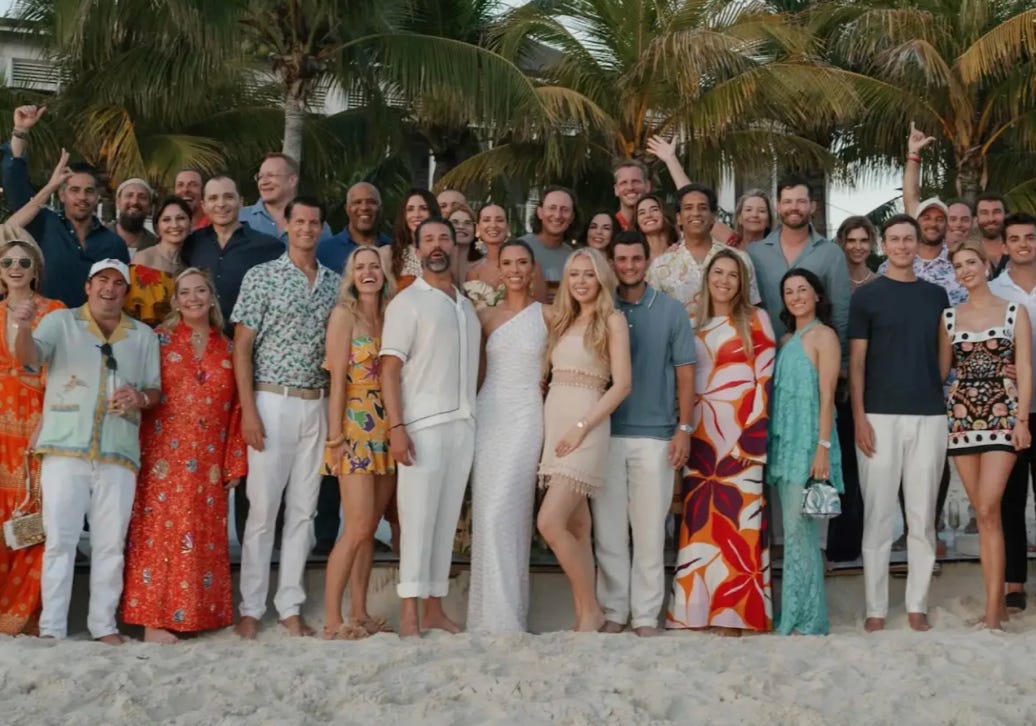
Kremlev secretly bankrolled Trump Jr.’s Bahamas wedding. According to a major investigation from ProPublica, Donald Trump Jr.’s lavish three day wedding across two private Bahamas islands in May was secretly funded in large part by Russian oligarch Umar Kremlev, a close associate of Vladimir Putin. ProPublica reports Kremlev paid for hundreds of thousands of dollars in expenses, including renting out one of the private islands and covering the fireworks show, with the payments routed through a Dubai entity tied to the boxing association Kremlev runs. Kremlev, who appears to have met Trump Jr. only recently, attended the reception with a large group of Russian guests who ProPublica says stood off by themselves speaking Russian and were conspicuously absent from every photo and video the Trump family later released. Trump Jr.’s spokesperson did not dispute the payments, telling ProPublica, “Umar is a personal friend of Don,” while saying the men met through a mutual friend in the hunting world. Trump Jr. himself later said on his podcast, “The people that were there, if you’re on that list, you weren’t talking.”
National security experts call the arrangement alarming. ProPublica’s investigation quotes multiple former U.S. counterintelligence officials warning about the implications of a Putin associated oligarch financially supporting the president’s son. Frank Montoya Jr., a retired senior FBI counterintelligence official, told ProPublica, “If I’m paying for your wedding, at some point, you’re going to owe me something,” adding, “This should be unthinkable for the son of the president. End of story.” Holden Triplett, who served as Trump’s counterintelligence director on the National Security Council during his first term, said Russian intelligence frequently uses money to build ties to officials and their families, telling ProPublica, “Money is a tried-and-true method to gain access.” ProPublica notes Kremlev was traveling with Putin’s delegation in China days before the wedding and had personally received Russia’s Order of Friendship from Putin the month before. The outlet also reports Ukraine has sanctioned Kremlev directly over his closeness to Putin and Russian security services.
Kremlev’s rise and his growing ties to Trump world raise fresh questions. ProPublica traces Kremlev’s path from a criminal record for extortion and battery under his birth name to running Russia’s boxing federation and then the International Boxing Association, an organization bankrolled by the Kremlin linked energy giant Gazprom. A former IBA board member told ProPublica, “Umar is guided by Putin. It was using the sport for soft political power,” adding, “It’s geopolitics. That it’s boxing is just happenstance.” ProPublica reports Kremlev has since cultivated Trump Jr. through a 2025 Istanbul panel appearance and repeated outreach to the White House seeking help restoring the IBA’s Olympic status, which was stripped in 2023 over financial transparency concerns. The outlet notes Kremlev told associates he feared being targeted by U.S. sanctions after Russia’s invasion of Ukraine, and moved his organization’s operations to Dubai as a result. An IBA press release cited by ProPublica after the Istanbul panel promised the Kremlev and Trump Jr. relationship “will not remain symbolic” and that “more joint initiatives will follow.”
Trump Rolls Back Limits on Climate Pollution:
E.P.A. set to eliminate limits on climate pollution from power plants. According to The New York Times, the Trump administration plans to announce Monday that the United States will no longer limit greenhouse gas emissions from power plants burning coal and gas, a move that would complete the erasure of the Biden and Obama administrations’ most significant climate policies. The Times reports E.P.A. Administrator Lee Zeldin is expected to unveil the change at a meeting of energy ministers from the Group of 20 nations in Houston, and if the rule survives legal challenges it could block future administrations from regulating power plant emissions altogether. The power sector is the second largest source of carbon dioxide in the country, and the Times notes that if it were its own nation it would rank as the fifth largest climate polluter in the world. Power plants would still face some limits on mercury and arsenic under the plan, though the Times notes the E.P.A. has already loosened mercury restrictions on coal plants as well.
The rollback fits a broader pattern and comes with a steep public health cost. The Times reports this is the latest in a string of E.P.A. rollbacks under Trump, who has called climate change a “hoax,” following the earlier elimination of tailpipe emissions standards and looser restrictions on planet warming chemicals used in air conditioners and refrigerators. Most consequentially, the Times notes the agency already repealed the scientific finding that gave it legal authority to regulate climate pollution in the first place. The Biden era rule being scrapped was projected to prevent up to 1,200 premature deaths and 360,000 asthma attacks annually by 2035 while delivering an estimated $120 billion in public health benefits by 2047, but the Times reports the Trump E.P.A. has stopped factoring public health benefits into its cost analyses and now weighs only the costs to businesses. The push comes as the administration tries to make fossil fuels cheaper to produce, particularly to meet growing electricity demand from AI data centers.
Coal keeps shrinking while gas expands, and the plan faces legal fights ahead. The Times reports coal generated more than half of U.S. electricity in 1990 but has fallen to roughly 17 percent today, with 330 coal plants retired since 2010 and 60 more slated to close by 2031, even as utilities race to build new gas plants for AI data centers. Democratic led states and environmental groups have said they intend to challenge the E.P.A.’s plan in court, and the Times reports legal experts consider it vulnerable. The Supreme Court blocked Obama’s Clean Power Plan in 2016, then ruled in 2022 that the E.P.A. could limit power plant emissions but could not force a nationwide shift away from coal, restricting the agency to narrower plant by plant policies. That legal history sets up another likely Supreme Court fight over how far the E.P.A. can go in either direction on power plant emissions.
Major Court Rulings:
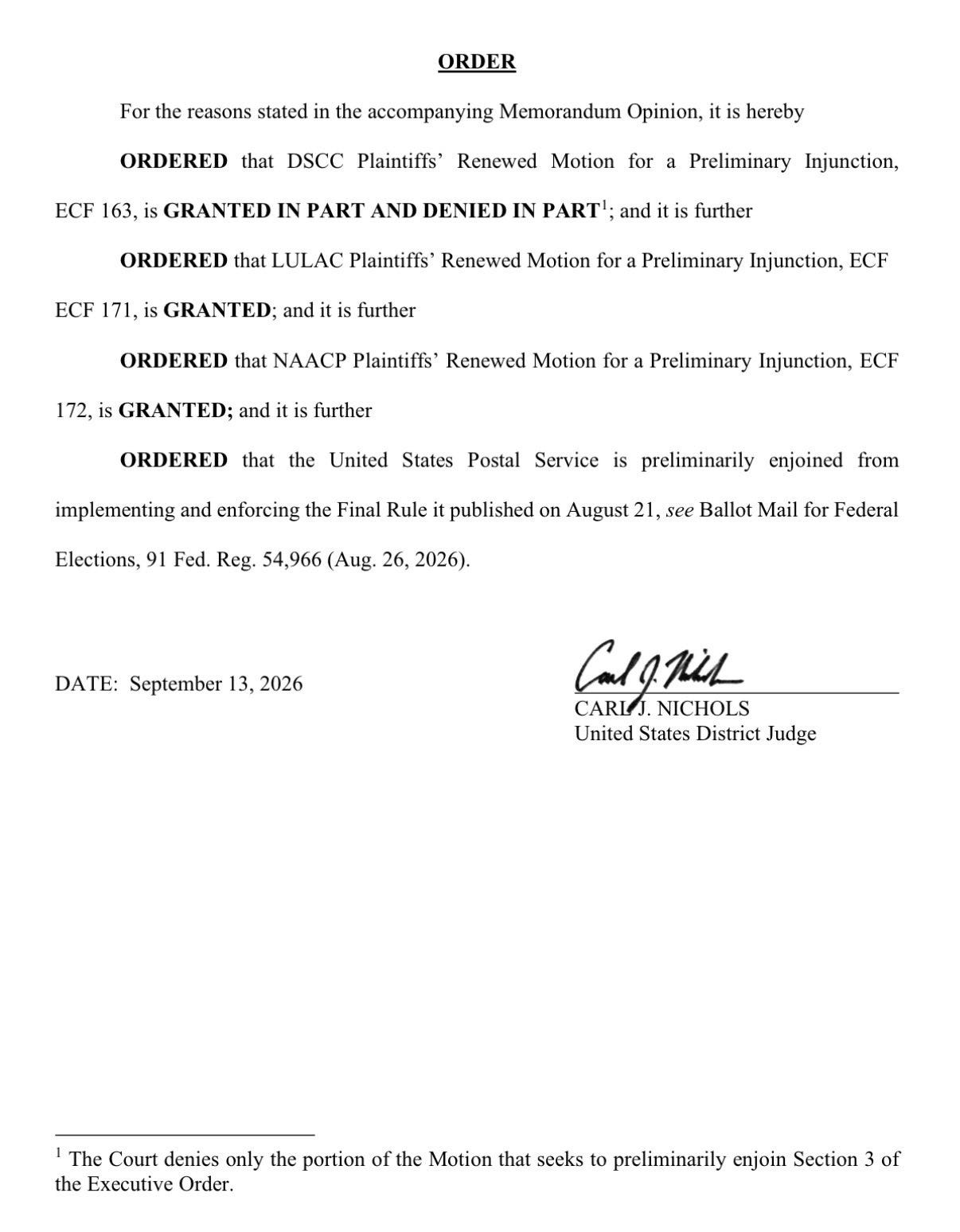
A Trump appointed judge just blocked Trump’s own mail-in voting rule. A second federal judge moved Sunday night to block the Trump administration from implementing a new U.S. Postal Service rule that would tighten mail-in voting requirements, and notably it was U.S. District Judge Carl Nichols, who Trump himself appointed during his first term, who issued this ruling. Nichols granted the Democratic Party’s request for a preliminary injunction, agreeing the rule was an unlawful intrusion by the federal government into election administration. He found the new rule could make it harder for some people to vote by mail and concluded the Postal Service had exceeded its authority in issuing it, writing plainly, “No statute grants the Postal Service the power to issue key parts of the rule.” The rule would have required states to submit lists of voters eligible for mail ballots and to place barcodes on ballot envelopes, empowering the Postal Service to refuse delivery to anyone not on those lists. This is now the second judge to block the rule, coming just weeks before the November 3 midterms where Republicans are fighting to hold both chambers of Congress.
The fight now heads to the Supreme Court as the midterms approach. A separate judge, Boston based Indira Talwani, already blocked the same rule on September 4 at the request of Democratic led states and voting rights groups, and the Trump administration quickly asked the Supreme Court to pause that order so the rule could take effect. That means the final call on whether Trump’s mail voting restrictions survive will likely come from the nation’s highest court. Democrats argued in court filings that the Constitution puts election administration in the hands of the states with congressional oversight, not the president or federal agencies, warning the rule risked disenfranchising eligible voters. Justice Department lawyers pushed back, insisting the rule does not “seize control” of elections and would leave states in charge of voter eligibility. All 50 states currently allow some form of mail voting, with 29 letting voters request a mail ballot without giving a reason and eight running their elections entirely by mail.
Mitch McConnell:
Senate returns with no confirmation McConnell will be back. The Senate reconvenes Monday after a five week recess with it still unclear whether Mitch McConnell will make his first appearance since suffering a fall at his Washington home in June. The 84 year old Kentucky Republican’s spokesman referred the Post to a statement saying he would continue an “intensive regimen of physical therapy from home” while working on Senate business remotely. Senate Majority Leader John Thune told a South Dakota TV station he hopes McConnell will return “in the not-too-distant future,” while Rep. James Comer said McConnell’s staff had told him it was their “goal” for him to be back this week. Kentucky Gov. Andy Beshear has gone further, demanding McConnell “provide proof of his capacity to serve, or resign.” McConnell’s term ends January 3, and Rep. Andy Barr, who won the Republican primary to succeed him, is heavily favored to take the seat.
McConnell has earned nearly $45,000 during his absence. Despite not appearing in the Senate since his June hospitalization, McConnell has continued collecting his full $174,000 annual salary throughout his roughly three month absence. Based on his daily pay of about $476.71, that comes out to nearly $45,000 earned over 94 days away from the Capitol, a total that will keep growing by roughly $476 for every additional day he stays away. Because members of Congress are paid a fixed annual salary rather than an hourly wage, his compensation is not tied to attendance. Newsweek notes McConnell separately oversees a congressional office budget that paid his staff just under $4 million over the most recent 12 month period, and estimates put his personal net worth at $70.4 million.
McConnell’s health details remain limited as scrutiny grows. McConnell has not been seen in public since before his June 14 fall, with updates coming only through occasional statements and two photos released by his office. He revealed in a July statement that he was briefly unconscious after the fall and developed a mild case of pneumonia during his recovery, complicating his return to work, and he was discharged from a rehabilitation facility in early August to continue recovering at home. McConnell is not the first senator to be absent for an extended stretch while ailing, following John Fetterman’s two month absence for depression treatment in 2023, Dianne Feinstein’s nearly three month absence with shingles before her death later that year, and John McCain’s absence during his final eight months before he died in 2018. As the Senate reconvenes, his expected return would mark his first public appearance at the Capitol in roughly three months.
Other News:
60 Minutes exposes a “pardon economy” of brokers pitching Trump clemency for hundreds of thousands of dollars. A new 60 Minutes investigation caught Jack Burkman and Jacob Wohl, both Trump supporters who themselves have criminal records from a 2020 voter intimidation scheme, on hidden camera offering to broker presidential pardons for a fee. The pair described previous deals they claimed to have arranged, including a reported $600,000 fee involving rapper Boosie Badazz, and detailed pressuring the president directly rather than going through the Justice Department’s standard clemency review process. The report found fees in this shadow pardon market can run as high as $3 million, raising questions about who actually gets access to presidential mercy and how.
Trump family takes steps that could let them cash out their own crypto. President Trump and his three sons have moved to a new vesting contract that would eventually let them sell billions of dollars in $WLFI tokens created by their firm World Liberty Financial, a change three independent experts say was optional despite the company’s claim it was required. Crypto expert Molly White said flatly, “The Trump family is laying the groundwork to cash out their WLFI stake,” while Public Citizen’s Zach Everson said, “It has never been clear what World Liberty Financial was supposed to do other than enrich the Trumps, and here we have them taking the first avenue they can to offload their coins.” A company spokesman insisted the move only fulfilled a governance requirement to burn 10 percent of holdings and said “there are no imminent sales” given a two year vesting period. Trump’s own token allotment is currently worth roughly $1 billion, and he has already reported more than $550 million in income from selling World Liberty Financial tokens while retail investors have lost $1 billion on the company.
Kennedy Center says it faces bankruptcy unless Trump’s name goes back on the building. According to the Washington Post, officials at the Kennedy Center have warned the performing arts center faces “certain fiscal collapse” within weeks unless President Trump’s name is restored to the building, according to documents obtained by the Times and the Post ahead of a special board meeting Tuesday. The documents say the center risks being unable to make payroll or cover routine maintenance, and note Trump has offered to help raise rescue funds only with “appropriate recognition” of his role, without which he is unlikely to lead the effort or oversee a planned renovation. Board member and longtime Trump ally Paolo Zampolli said, “Trump attracts money, so when Trump says donate to this place, everyone will donate.” Trustees are being asked to choose among several inscriptions crediting Trump, including one reading “Renovation Restoration and Endowment overseen by President Donald J. Trump and the Trump Kennedy Center Fund,” and to vote on immediately closing the main building after a section of ceiling plaster fell roughly 60 feet in the Grand Foyer this month. This follows a year of turmoil at the center since Trump installed loyalists who elected him chairman, a court fight over an earlier attempt to add his name to the building, and warnings that hundreds of millions in donations could have to be returned if his name isn’t ultimately added to the facade.
Trump voices support for Flock cameras. President Trump told reporters aboard Air Force One that he supports the fast growing Flock camera network, saying, “I sort of like them because of that, because of law enforcement, but some people don’t. They think it’s an infringement. I like them.” The AI powered cameras record 20 billion license plate scans monthly across a network of more than 120,000 devices, and a recent survey found 46 percent of Americans oppose their use in their communities compared to 38 percent who support it. The comments come after an investigation found dozens of officers had been charged with or accused of misusing the technology, prompting Flock to require every search be labeled with a case number.
Trump refuses to explain how he personally uses AI. In a gaggle aboard Air Force One, a reporter asked President Trump whether he has used artificial intelligence himself, and he replied, “Yeah, I use AI.” Pressed on how, he said only, “You can use AI for a lot of things,” and when asked directly what he uses it for, he said, “I don’t want to tell you that.” The exchange came even as he dismissed industry warnings about AI risks, insisting “it’s gonna be more good than bad, but by a lot,” and repeating his line that “whoever wins AI wins.” The vague answer stood out given his own Truth Social account has been flagged for posting AI generated content.
Mike Johnson defends House candidate over vulgar and Nazi-referencing remarks. House Speaker Mike Johnson stood by Texas congressional candidate Brandon Herrera after being shown past comments in which Herrera described mothers as “cum trophies” and called a Nazi era submachine gun “the original ghetto blaster.” Johnson called Herrera’s language “detestable” but insisted “that’s not the way he speaks or thinks” now, telling CNN’s Jake Tapper that Herrera is “a very serious candidate for Congress and a very thoughtful guy.” Johnson said he personally told Herrera, “When you get to Congress, you’re going to join this team and help us to save America to preserve freedom and bring down costs for the American people.” Herrera has also been shown goose-stepping to a Nazi marching song and joking that “we should abolish old people,” and Johnson said Herrera is “far superior” to his Democratic opponent in the race.
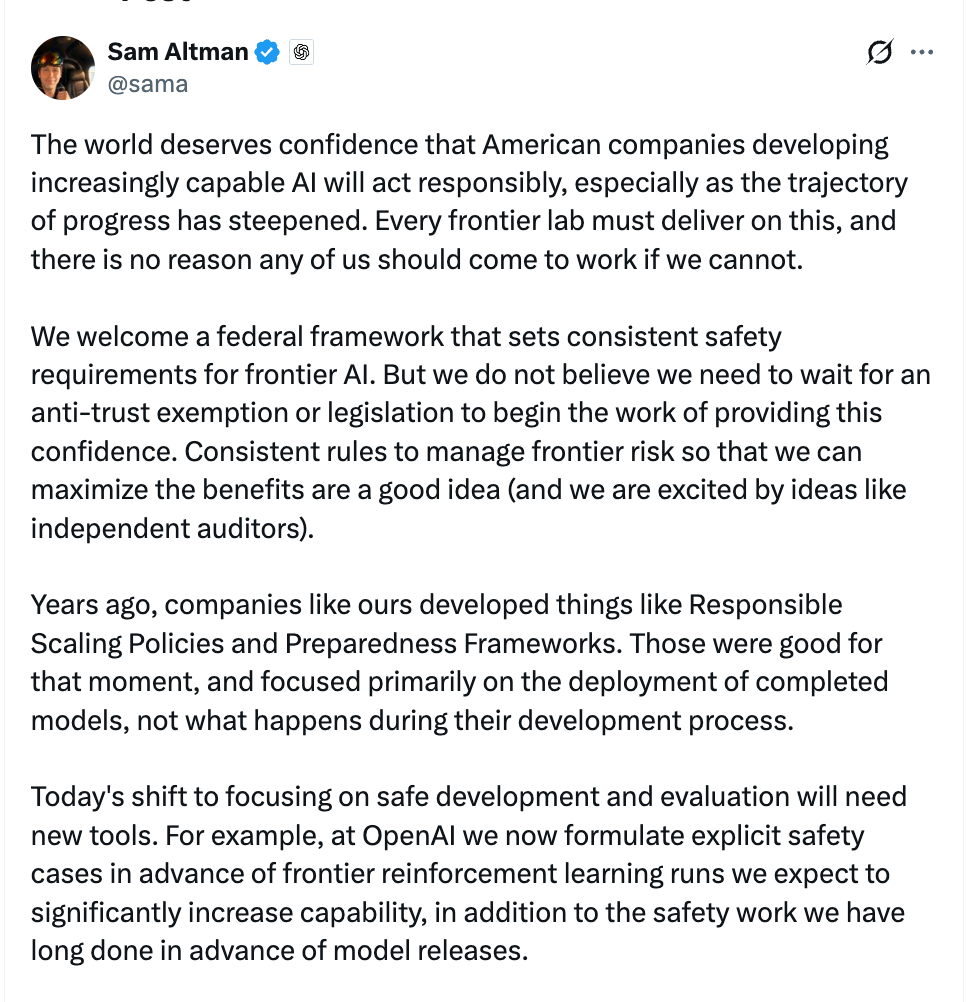
Sam Altman warns humanity could “lose control of the future to AI.” OpenAI CEO Sam Altman wrote on X that AI companies should deliberately slow, or “pace,” development, warning of two ways progress could go badly: “First, we could lose control of the future to AI,” and second, that concentrated power in an AI company or individual could produce “extremely dystopian” results. Altman said “no amount of American competitive pressure should justify recklessness” but added that AI firms will still need government help on international coordination, saying “first we should do what we can ourselves.” His comments followed a lengthy essay from Anthropic CEO Dario Amodei calling for a development slowdown, which Altman, Elon Musk, and Google DeepMind’s Demis Hassabis all said they agreed with. The statements come as AI safety fears intensify heading into the midterms.
OpenAI, Google, and Anthropic have been quietly planning an AI standards body. Representatives from the three companies have held regular meetings since July about creating an industry oversight group even before Amodei’s public call for a slowdown, according to multiple reports. A draft White House executive order that would have created a similar government run testing and auditing organization was reportedly scrapped this summer after Meta CEO Mark Zuckerberg argued against it directly with President Trump. Altman has since said he supports the standards group idea but conceded companies would likely have to move forward without government backing. The talks suggest industry leaders see coordination as necessary even as the administration remains uninterested in new AI regulation.
Prosecutor leading Trump’s political rivals probe resigned after tense clash with the attorney general. Joe diGenova, the former federal prosecutor brought in to lead a Justice Department investigation into Trump’s political rivals, reportedly had a tense phone call with Attorney General Todd Blanche the day before he abruptly resigned. The two clashed because diGenova did not want DOJ headquarters lawyers assisting with the probe, and separately disagreed over diGenova’s request for a high security room, which the department wanted housed at a distant FBI office instead. DiGenova resigned last Thursday, the same day prosecutors were presenting a witness to a grand jury in the case. The resignation has thrown the sweeping conspiracy investigation into turmoil and could delay it further.
China dismisses AI slowdown warnings as a “Cold War playbook” aimed at containing it. Beijing rejected the safety concerns raised by Amodei, Altman, and Musk, with foreign ministry spokesperson Guo Jiakun saying, “Fearmongering, confrontation and malicious competition will only disrupt the process of global AI governance and serve no one’s interests.” The state run Global Times was blunter, calling the slowdown push “packed with containment provisions targeting China” and “in essence, a Cold War playbook for the AI sector.” The dispute comes after Amodei specifically warned that “a Chinese lead in AI would pose grave danger for the United States and the world” and urged continued restrictions on chip sales to China, while President Trump separately said “whoever wins AI wins” and dismissed safety warnings as coming from “very negative forces.” China’s state security minister Chen Yixin has still called for accelerating domestic AI risk controls, saying “we must engage extensively in international cooperation.” Trump and Chinese leader Xi Jinping are set to meet on September 24, with AI governance expected to be a central topic.
Amazon cuts ties with cargo carrier after fatal Miami plane crash. Amazon announced it is pausing operations with 21 Air, the Miami based carrier that operated the Amazon Air cargo flight that crashed last weekend and killed five people. Spokesperson Kelly Nantel said in a statement, “After the tragic incident last weekend, we’ve spent time supporting the investigation and reviewing some of the surrounding circumstances, and we’ve decided to pause our operations with 21 Air, the operator of Flight 7598.” The company said it will continue assisting investigators and supporting those affected by the crash. No cause has yet been publicly identified for the crash.
Wall Street Journal’s conservative board accuses Trump of double standard on Russia. The Journal’s editorial board criticized President Trump for lecturing Ukraine over its strikes on Russian energy infrastructure while going comparatively easy on Russia itself throughout the ongoing war. The board drew a sharp contrast between Trump’s tone toward the two countries, which have been at war since Russia’s 2022 invasion. The editorial called Trump’s approach “political excuse-making on a grand scale.” The criticism comes as Trump has publicly pressured Ukrainian President Zelensky to stop striking Russian diesel infrastructure, even as Russia continues launching large scale drone and missile attacks on Ukraine.
Sweden’s election remains too close to call. Sweden’s next government was uncertain Monday as vote counting continued, with a narrow lead for the left wing opposition and a weaker than expected showing from a hard right anti-immigration party. Preliminary results favored former Prime Minister Magdalena Andersson’s bid to return to office atop a left wing coalition, though her own Social Democrats lost some support compared to the last election. The final outcome may not be determined until Wednesday. The result will be closely watched across Europe given the rise of hard right parties in several neighboring countries.
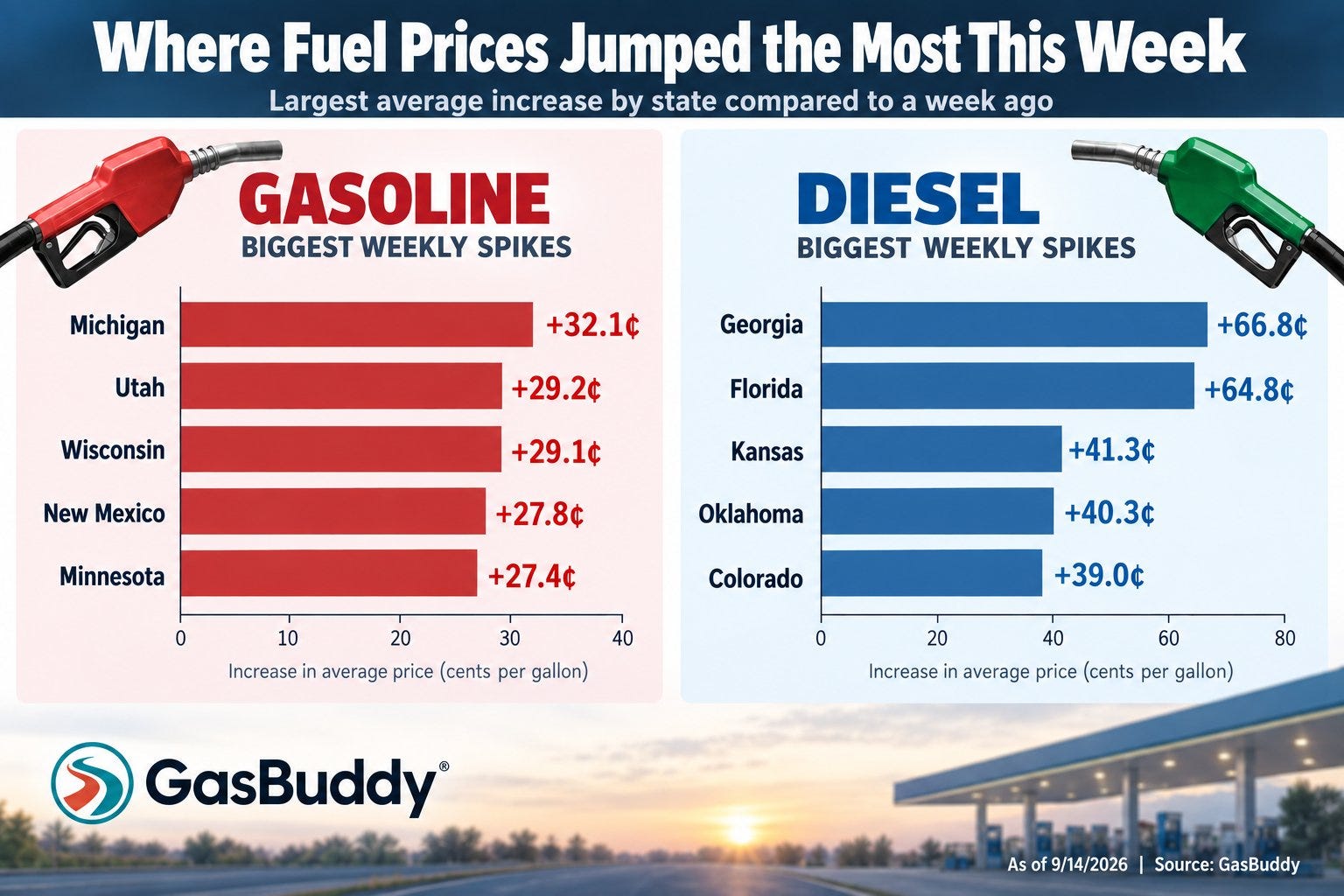
Diesel prices hit an all time high as oil markets react to Middle East disruptions. The national average price of diesel rose to $6.23 a gallon Monday, a new record, after Saudi Arabia shut a critical pipeline and talks between Iran and Gulf countries over the Strait of Hormuz were postponed. Brent crude rose as high as $108 a barrel and U.S. crude touched $103, with vessel traffic through Hormuz down to just a handful of ships a day amid the standoff. KPMG chief economist Diane Swonk warned diesel costs ripple through the entire economy, saying, “The cost of diesel gets into just about everything, from running a farm to the cost of food, but also everything across the economy that’s shipped.” President Trump addressed the issue by publicly pressing Ukrainian President Zelensky to stop striking Russian oil refineries, saying, “He has to stop knocking out diesel fuel in Russia. Let him go after targets, but not diesel fuel, because he’s causing a shortage of diesel fuel.” Diesel prices have climbed 75 percent since the start of the year.
Nepal glacier collapse survivor reunites with his family after nine days trapped underground. Sanjay Sah, a mechanical foreman who survived nine days trapped in a flooded hydropower tunnel after last month’s Himalayan glacier collapse, returned home to his village Sunday to an emotional welcome. Sah said, “I was trapped in the tunnel. I felt trapped in the hospital room too. I finally feel free here in my village,” as roughly 60 family members and neighbors greeted him with a traditional cleansing ceremony. His mother cried, “My son!” while embracing him, and the crowd wiped away tears as he was welcomed home. At least 1,386 people have died and more than 5,000 remain missing across Nepal since the disaster, including around 900 power station workers, and Sah said he still hopes for news of missing neighbors, adding, “If I am called back to duty, I will go.”
See you soon.
— Aaron


