

The House Judiciary Committee on Tuesday released the full deposition transcript of former Special Counsel Jack Smith, offering the most detailed public account yet of Smith’s rationale for prosecuting Donald Trump and rebutting Republican claims that the investigations were politically motivated.
Across hours of sworn testimony, Smith mounted a detailed and unapologetic defense of his prosecutorial decisions, repeatedly underscoring that the charges were driven by evidence, not politics, and that he would have brought the same cases regardless of party affiliation. I read the entire 255-page transcript so you do not have to. If you value accurate, real-time reporting grounded in primary sources, please consider subscribing to support this work. Right now it’s just me. But I have some big plans in 2026 that I cannot wait to share with you.
Here’s the summary:
DOJ Limits and Sealed Material
At the outset of the deposition, Smith’s counsel made clear that his testimony was constrained by legal restrictions imposed by the Department of Justice and the courts. According to representations made to the committee, DOJ interpreted Federal Rule of Criminal Procedure 6(e) narrowly, limiting grand jury secrecy to internal grand jury matters and making it virtually impossible for Smith to be prosecuted for violating those rules.
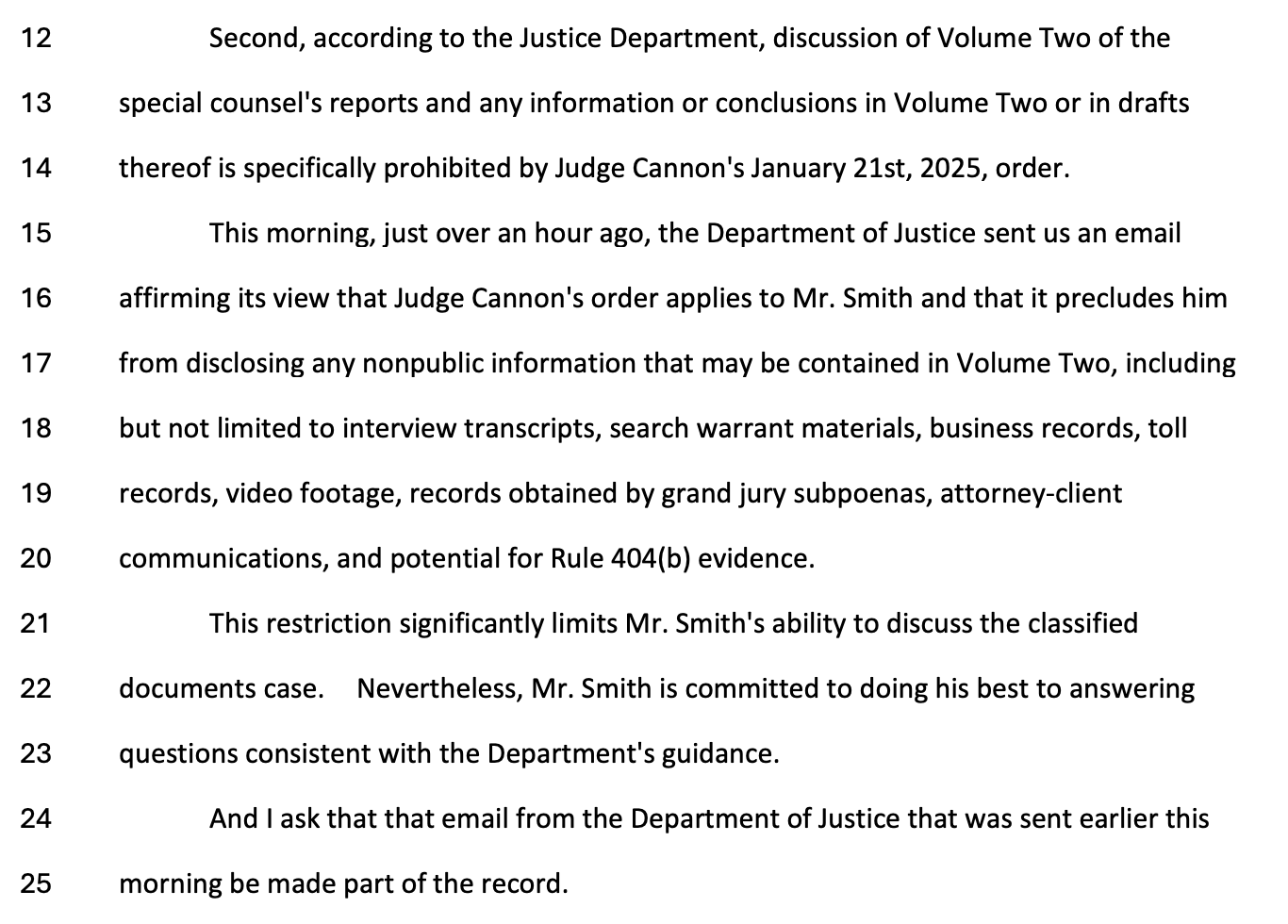
More significantly, DOJ instructed Smith that a January 21, 2025 order by Judge Aileen Cannon barred him from discussing any nonpublic material contained in Volume Two of the Special Counsel’s final report, including interview transcripts, search warrant materials, toll records, and grand jury evidence. As a result, Smith was unable to provide detailed testimony about the classified documents case, though he pledged to answer questions consistent with DOJ guidance.
“The Decision Was Mine”
In his opening statement, Smith took direct responsibility for the decision to charge Trump, while placing responsibility for the underlying conduct squarely on the president.
“The decision to bring charges against President Trump was mine,” Smith said, “but the basis for those charges rests entirely with President Trump and his actions, as alleged in the indictments returned by grand juries in two different districts.”
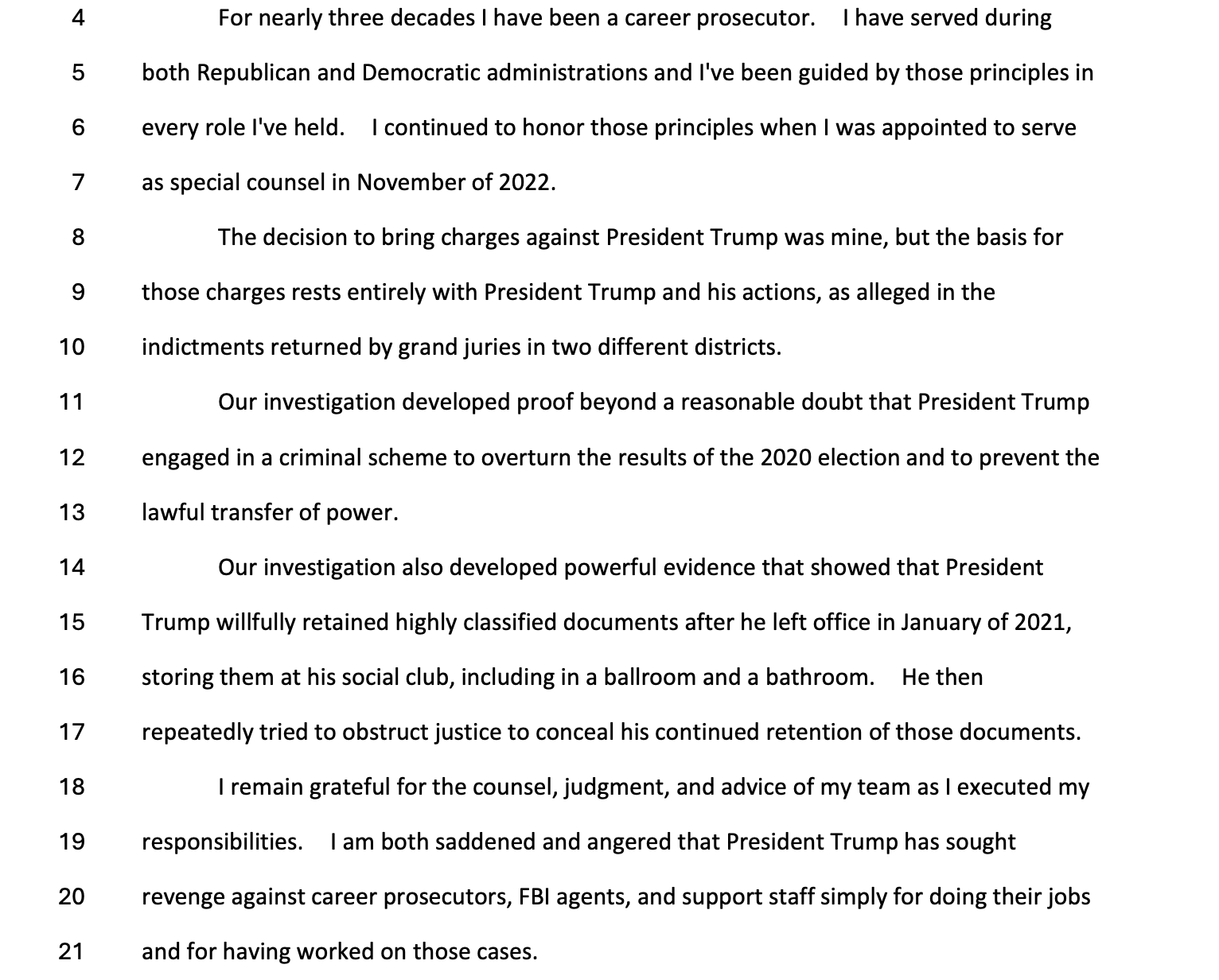
Smith testified that his investigation developed proof beyond a reasonable doubt that Trump engaged in a criminal scheme to overturn the results of the 2020 election and obstruct the lawful transfer of power. He also said investigators uncovered powerful evidence that Trump willfully retained highly classified documents after leaving office, storing them at Mar-a-Lago in locations including a ballroom and a bathroom, and repeatedly obstructed efforts to retrieve them.
Smith rejected claims that his actions were influenced by the 2024 presidential election, stating that he acted without regard to Trump’s political beliefs, associations, or candidacy.
Confidence in the Evidence
Addressing criticism over the timing and speed of the prosecutions, Smith said the pace reflected the strength of the evidence and his confidence that his team would have secured convictions at trial.
“If asked whether to prosecute a former President based on the same facts today,” Smith said, “I would do so regardless of whether that President was a Republican or a Democrat.”
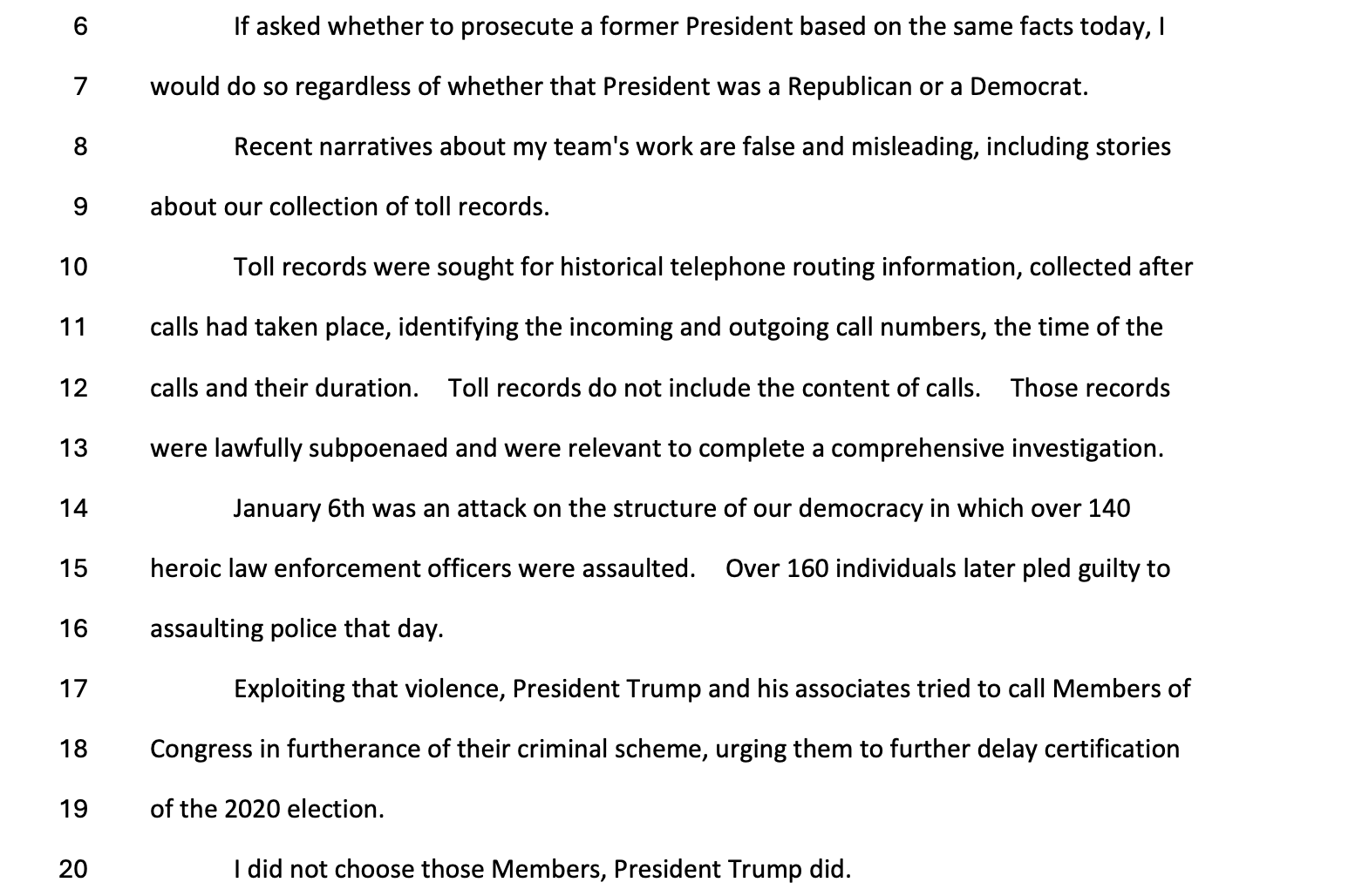
Smith also pushed back against allegations surrounding his office’s collection of toll records, emphasizing that such records contained only noncontent information, including phone numbers, call times, and durations, and did not include the substance of any conversations. He said the records were lawfully subpoenaed and necessary to complete a comprehensive investigation.
January 6 and Congressional Pressure
Smith described January 6, 2021, as an attack on the structure of American democracy, noting that more than 140 law enforcement officers were assaulted and over 160 individuals later pleaded guilty to assaulting police officers.
He testified that Trump and his associates exploited the violence by attempting to contact Members of Congress to delay certification of the 2020 election results.
“I did not choose those Members,” Smith said. “President Trump did.”
First Amendment Dispute
A central exchange during questioning focused on whether Trump’s false election fraud claims were protected by the First Amendment. Smith flatly rejected that characterization.
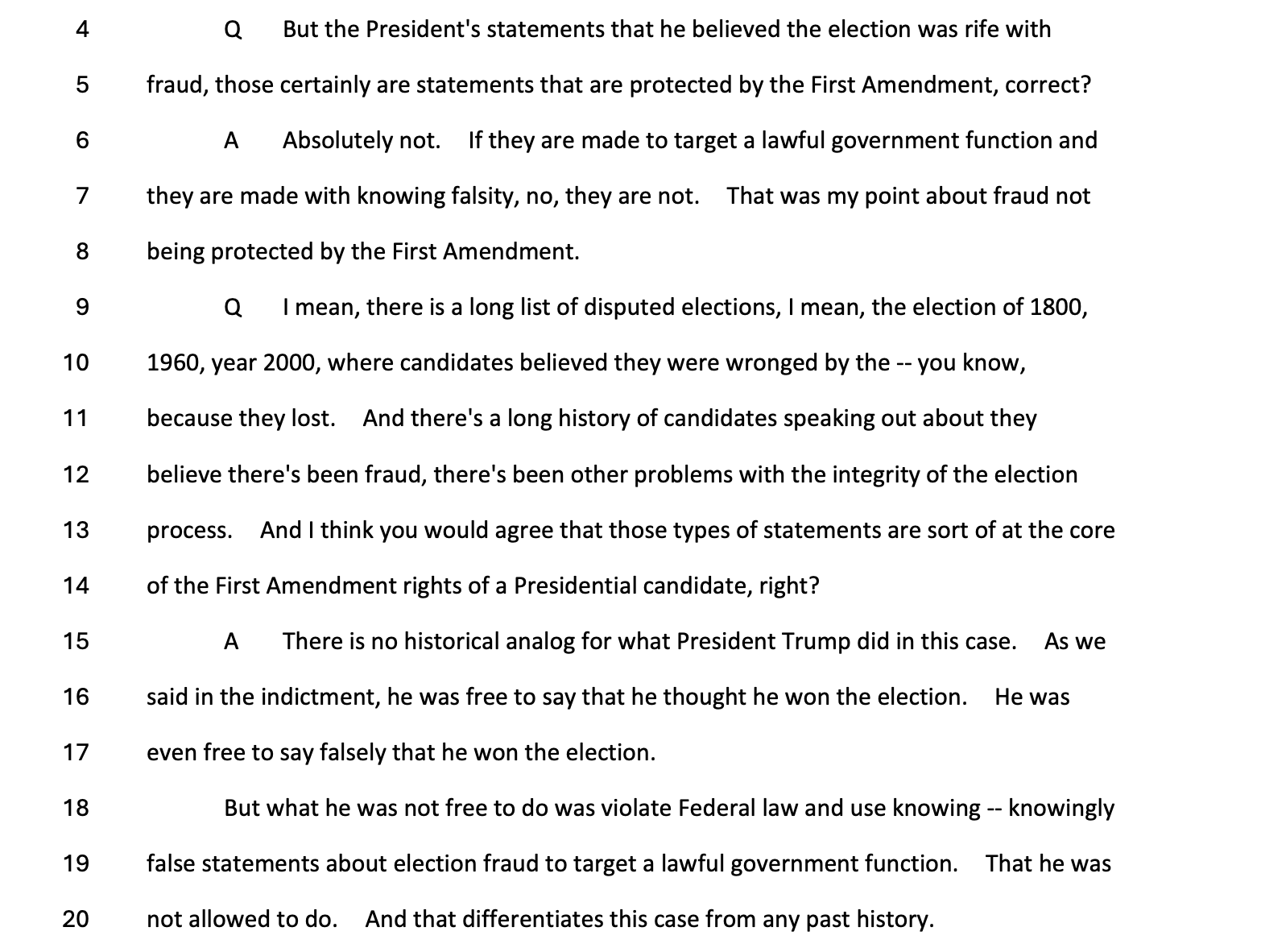
“If they are made to target a lawful government function and they are made with knowing falsity, no, they are not,” Smith testified. While acknowledging that Trump was free to claim he won the election, even falsely, Smith said he was not free to use knowingly false statements to obstruct lawful government processes.
“There is no historical analog for what President Trump did in this case,” Smith said.
Republican Witnesses Against Trump
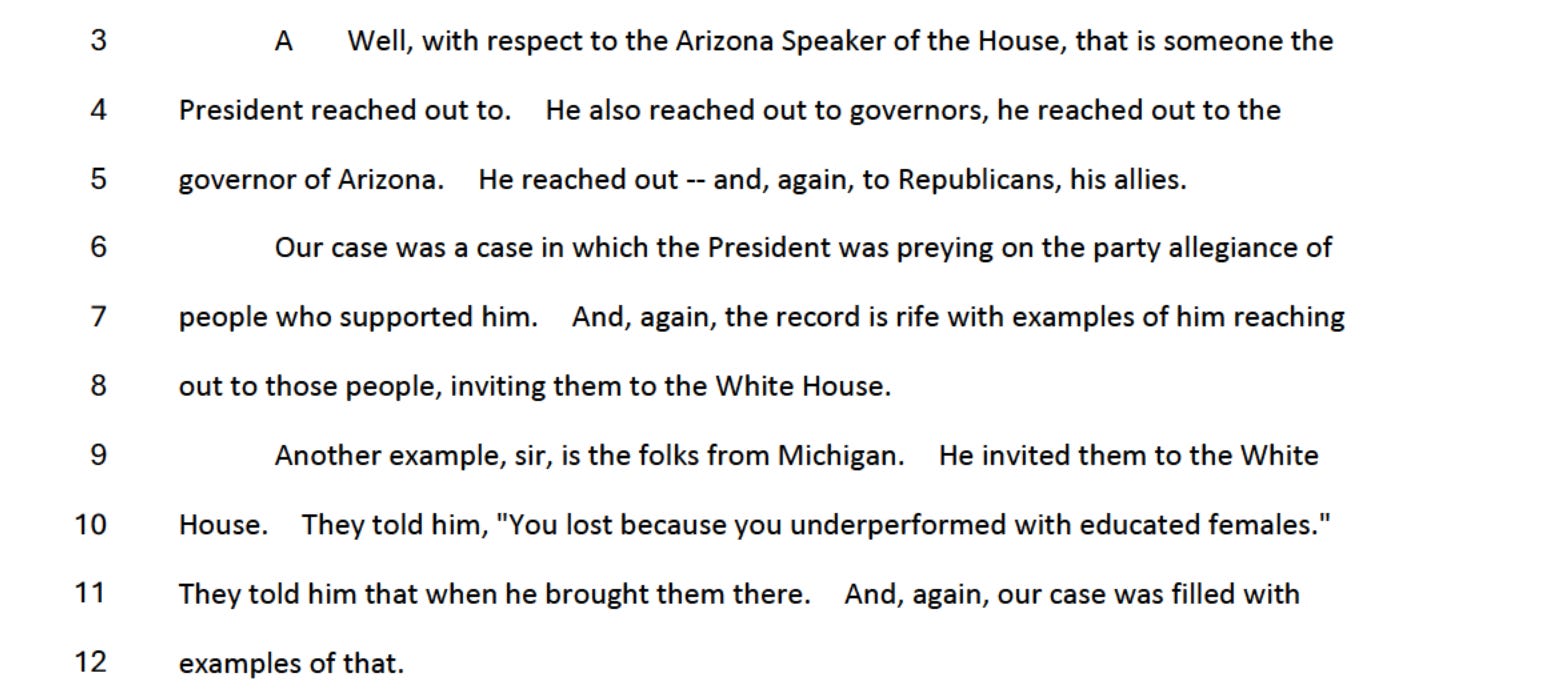
Smith emphasized that one of the strongest aspects of the prosecution’s case was its reliance on Republican witnesses and Trump allies, not political opponents.
“We had numerous witnesses who would say, ‘I voted for President Trump. I campaigned for President Trump. I wanted him to win,’” Smith testified, citing Republican legislative leaders in Arizona and Michigan and a Pennsylvania elector who described the scheme as illegal and an attempt to overthrow the government.
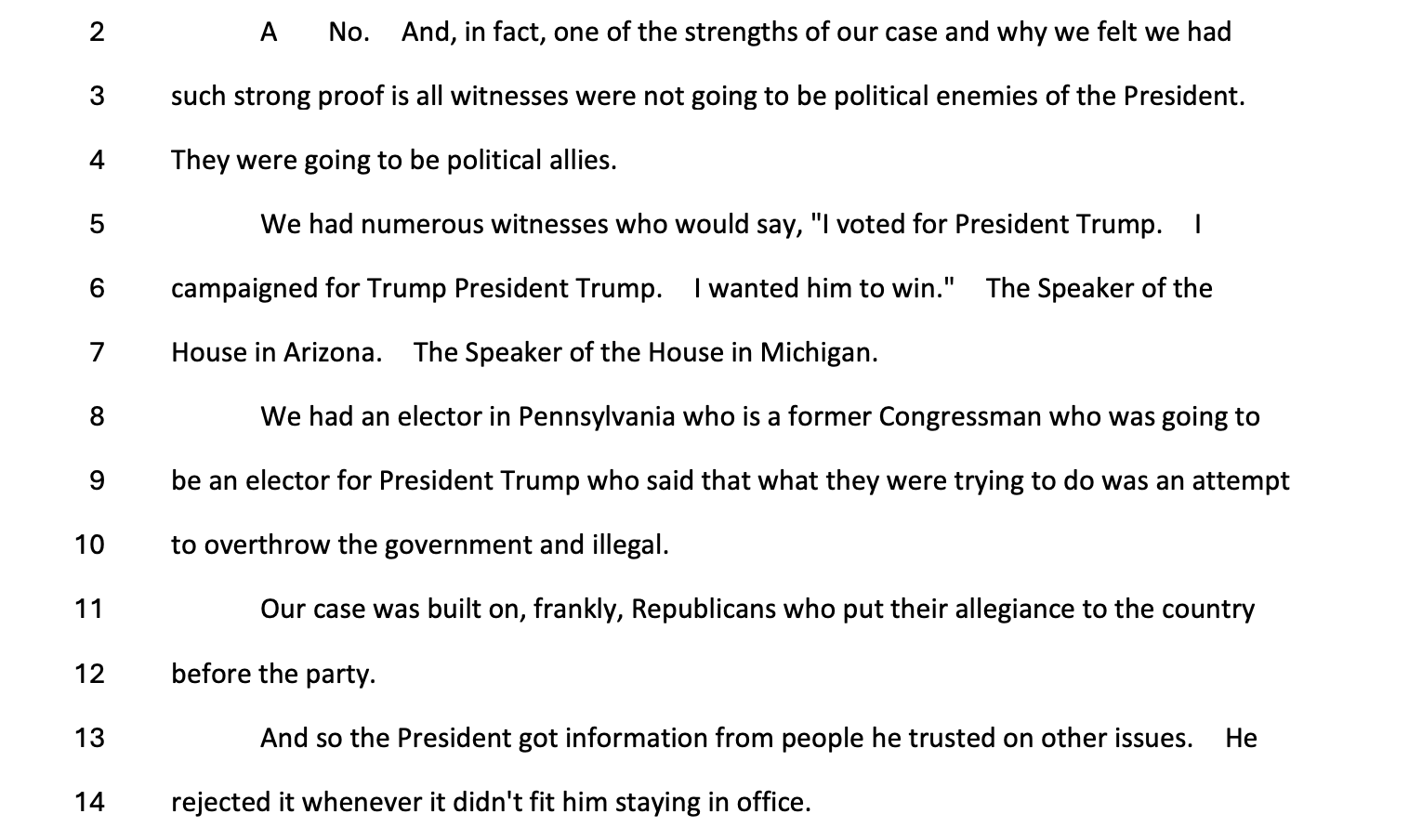
According to Smith, Trump repeatedly rejected accurate information that contradicted his effort to remain in office while embracing far-fetched legal theories that supported that goal.
Responsibility for January 6 Violence
When pressed on Trump’s role in the Capitol attack, Smith testified that while Trump did not explicitly order the breach, the violence was foreseeable and exploited.
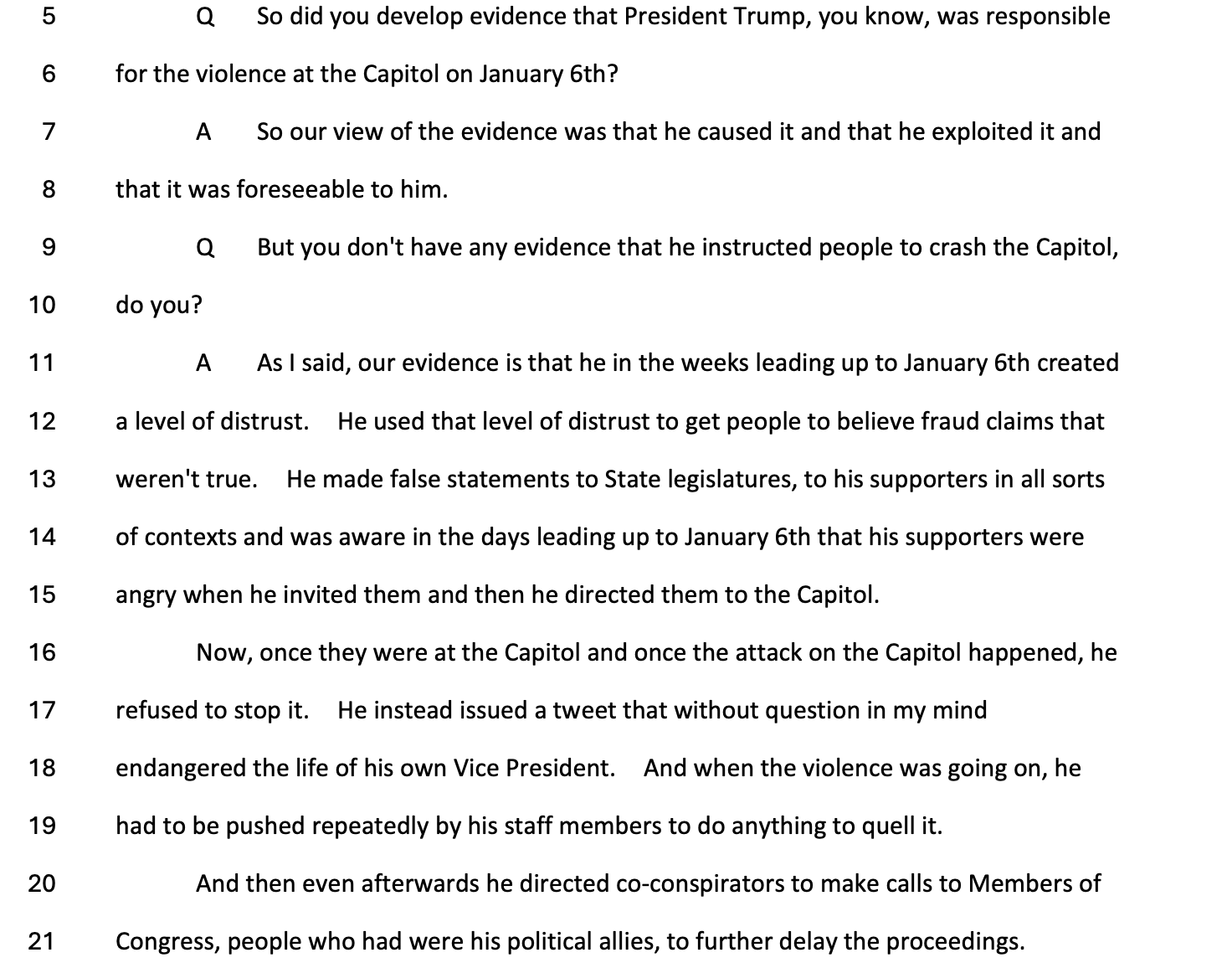
Smith said Trump spent weeks fueling distrust, invited angry supporters to Washington, directed them to the Capitol, and then failed to act decisively once violence erupted. He also testified that Trump later encouraged allies to pressure Members of Congress to further delay certification.
A Record Defense
Taken together, the deposition transcript presents Smith’s most comprehensive public defense of the Trump prosecutions to date. It frames the cases as evidence driven, legally grounded, and insulated from partisan considerations, even as Republicans on the committee continue to challenge their legitimacy.


