

Last night I had the honor of giving the keynote address at Webster University, standing in front of a room full of young people and talking about finding their power and their voice at a moment when so many forces are telling them to stay quiet. It’s a message I believe in more with every story I cover, because the same week I was telling students their voice matters, seven House Republicans found theirs and broke with Trump on Iran, Canada found its and started walking toward Europe instead of Washington, and museum curators found theirs and refused to bend to a White House trying to rewrite their work off the walls. Power and voice aren’t abstract concepts. They’re what happens when people who could stay quiet decide not to.

That’s the throughline of today’s newsletter: from a war powers revolt in Congress to a Smithsonian fight over who gets to tell America’s story, to an old ally quietly building a new home for itself abroad. Let’s get into it.
Thank you to everyone who’s already a paid subscriber, and to everyone who showed up last night in person, it means more than you know. If you’re not a subscriber yet, I’d ask you to consider becoming one. Independent journalism like this only survives because readers choose to fund it directly, and every subscription helps me keep showing up, whether that’s in a courtroom, at a board meeting, or in a college auditorium telling the next generation their voice counts too.
Here’s the news:
Iran war:
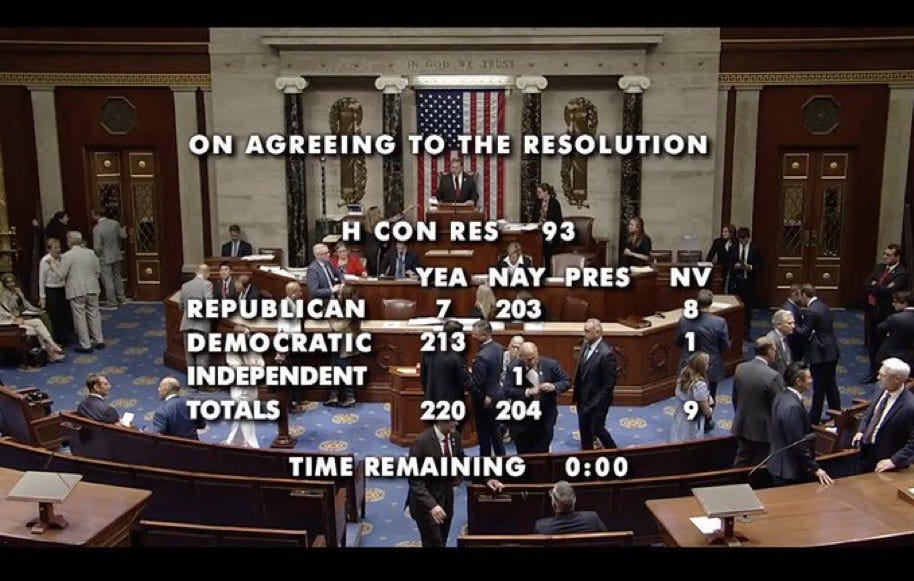
Seven House Republicans broke with Trump to help pass a resolution reining in his Iran war powers. The House adopted the measure 220 to 204 late Tuesday, with Reps. Thomas Massie, Brian Fitzpatrick, Warren Davidson, Tom Barrett, Nancy Mace, Mariannette Miller-Meeks and Zach Nunn joining all voting Democrats, marking the third significant blow to the administration since the conflict began and the largest bipartisan defection yet (up from just four Republicans on a similar July vote). The concurrent resolution, led by Rep. Seth Moulton, calls on Trump to terminate the use of U.S. forces against Iran, but it’s symbolic only, it doesn’t carry the force of law and isn’t subject to a presidential veto. Republicans who backed it argue the original 60 day War Powers Resolution window already expired, while the administration and most GOP members maintain Trump is acting within his constitutional authority as commander in chief. The vote is the sixth time the House has taken up an Iran war powers resolution this year, and it also helped fuel Massie’s separate push to impeach Defense Secretary Pete Hegseth.
Vice President JD Vance predicted the war will shift into a “much different phase” within a couple of months, while defending the administration’s handling of it. He told the New York Post that Trump, as commander in chief, is the one who determines “when conflicts start and when they stop,” and pushed back on the idea that the U.S. is engaged in “aggressive operations,” saying flatly, “We’re just not.” Vance acknowledged public impatience with the war’s length but offered no specific timeline beyond the vague forecast. His comments echoed an earlier deflection from a September 3rd press conference, where he told reporters that ending the war depended on when Iranian strikes on shipping “stop having an effect on world energy markets.” The remarks come as the war has become a defining midterm issue, with Republicans divided and Democrats hammering Trump over a “forever war.”
Oil markets are absorbing new shocks as strikes disrupt key export routes, with the State Department now warning Americans against travel to Saudi Arabia. Crude loadings stopped at Saudi Arabia’s Yanbu port on the Red Sea, a 400,000 barrel per day refinery operation that had served as a workaround for disruptions in the Strait of Hormuz, according to sources familiar with the matter. Oil analyst Andy Lipow warned the disruption could be “catastrophic” for consumers, especially Northeast heating oil customers facing “absolute sticker shock.” Separately, the State Department reissued a level 3 travel warning for Saudi Arabia over the risk of Iranian drone and missile targeting of American interests, and a level 4 “do not travel” warning for the Yemen border over terrorism risk. Together the moves reflect how the conflict is spreading economic and safety consequences well beyond the immediate battlefield.
CBS News obtained exclusive photos showing extensive, previously undisclosed damage to U.S. bases from Iranian missile and drone strikes. Images from Prince Sultan Air Force Base in Saudi Arabia show a destroyed Boeing E-3 Sentry surveillance aircraft, while photos from Camp Buehring in Kuwait show hollowed-out buildings and destroyed vehicles. One deployed service member told CBS, “This is major damage to our bases that hasn’t been communicated to the American public... we’re standing there with our eyes closed getting punched in the face,” and separately said “we’re not defending these bases, we’re just watching them get destroyed.” The Pentagon’s inspector general this week reported equipment losses worth up to $3.7 billion, including nearly 60 aircraft, across strikes on U.S. positions in Kuwait, Bahrain, Qatar, the UAE, Saudi Arabia, Iraq, Oman and Jordan. The Pentagon did not respond to CBS’s request for comment on the photos.

Smithsonian:
The Trump administration is preparing temporary signs accusing the Smithsonian’s American history museum of ideological bias. A September 3 letter from Interior Secretary Doug Burgum, obtained by The Atlantic, says the National Park Service plans to install about a dozen signs outside the museum at an estimated cost of $84,000, following an executive order Trump signed in July. The letter, sent in response to inquiries from Senators Jeff Merkley and Lisa Murkowski, extensively quotes museum director Anthea Hartig and outgoing Smithsonian Secretary Lonnie Bunch in an effort to frame them as ideologues, including resurfacing a 2020 lecture where Hartig acknowledged white privilege and a 2000 essay where Bunch discussed racial discrimination in the museum field. The signs’ final text hasn’t been written yet, and even Park Service staff working on the project reportedly don’t know who will write it. Burgum’s letter calls the move “necessary” and argues visitors deserve “important context” about the “personal viewpoints” curators are advancing.
Museum leadership is pushing back, and the fight is part of a broader pattern of pressure on the Smithsonian. Hartig told two House committees this summer that “our work is governed by the Smithsonian’s standards of scholarship, accuracy, independence, and nonpartisanship... the museum does not take sides in America’s political debates,” pointing to hundreds of patriotic objects and dozens of George Washington references already on display. Trump has also separately demanded the museum remove an abstract sculpture and replace it with a 30-foot George Washington statue, and Burgum’s letter singles out exhibits touching on transgender Americans and language guidance around the term “undocumented immigrant.” Conservative groups often tied to the administration’s history initiatives, including PragerU and Hillsdale College, both told The Atlantic they aren’t involved in writing the sign text, and Heritage Foundation fellow Mike Gonzalez declined to confirm or deny any role. The Smithsonian, which is partially federally funded but has historically operated independently with its own governing body, has been fending off pressure from the administration since March 2025.
Canada and the European Union:
The EU offered Canada a path to becoming its first “associate member,” as both drift from Washington under strain from Trump. European Commission President Ursula von der Leyen made the offer during a speech in Strasbourg with Canadian Prime Minister Mark Carney seated beside her, telling him “I would like to work with you on opening the door for Canada to be the first associate member of the European Union,” an announcement met with a standing ovation from lawmakers. Details on what associate membership would actually entail remain scant, but officials say Canada and the EU are working toward closer cooperation on trade, tech regulation, critical minerals and security ahead of an October summit. Von der Leyen also pitched a European equivalent to NATO’s mutual defense clause and a new European Security Council that would include non-EU partners like Britain, Norway, Ukraine, and Canada. The push reflects Carney’s own framing from a Davos speech earlier this year, that “middle powers must act together because if we’re not at the table, we’re on the menu.”
The overture comes as both Canada and the EU face deteriorating relationships with the United States. Trump has waged a trade war with Canada and repeatedly called for it to become the 51st state, and talks between the two countries collapsed entirely last month, prompting a wave of Canadian patriotism and polls showing roughly four in five Canadians now support closer EU integration. Meanwhile the U.S. has pulled back support for NATO and Ukraine, leaving Europe scrambling to shore up its own defenses amid recent drone incursions and other provocations attributed to Russia. One EU lawmaker, Barry Andrews of Ireland, put it bluntly: “China, Russia and the U.S. have turned their backs on international law. We need new allies.” The move still faces roadblocks, since some EU member states worry that offering too much to an associate could diminish the value of full membership, but Canada and the EU already have a free trade agreement making about 90 percent of trade between them tariff-free.
Other News:
A House panel voted unanimously, 41-0, to recommend Leon Black be held in contempt of Congress over Epstein files subpoenas. The billionaire financier refused to comply with subpoenas seeking his testimony and all nondisclosure agreements he’s a party to, and did not appear for his scheduled September 3 deposition, instead suing to block the subpoenas as “invalid” and an overreach of the committee’s legislative authority. Chairman James Comer said “subpoenas are not suggestions; they carry the force of law and require full compliance,” and stressed Black’s testimony is crucial because he maintained a close personal relationship with Epstein during the years Epstein was trafficking women. Black’s attorneys called the markup “a complete abomination” and accused Comer of violating House rules, while Black himself has said he regrets ever doing business with Epstein but “had no knowledge of any of Epstein’s heinous conduct,” despite paying him roughly $170 million from 2013 to 2017. More than a dozen Epstein survivors had urged Black to comply before his deposition, arguing his NDAs could shed light on his relationship with Epstein and others in his orbit; the resolution now heads to the full House, where Speaker Mike Johnson’s office has not said whether it will be taken up.
Federal firefighters say they’re being pushed past a breaking point during one of the most extreme wildfire seasons on record, and the government is failing them. Nine active firefighters and several retirees told the Guardian that a critical shortage of experienced supervisory personnel, combined with Trump administration directives prioritizing aggressive “direct attack” tactics, has left crews spread dangerously thin, with one firefighter saying “accidents have been through the roof” amid widespread fatigue from near-nonstop assignments since April. Wildfires are overrunning firefighters at the highest rate in 20 years, with 12 dangerous “entrapments” recorded by mid-August and 14 on-duty deaths this year, including three firefighters killed at Colorado’s Knowles fire in the most deadly entrapment in 13 years. Five senators warned in a letter that crews have “worked more fires than is safe” using temporary, underqualified supervisory structures, a claim that stands in stark contrast to Forest Service chief Tom Schultz’s congressional testimony that the agency’s firefighting workforce is “stronger than at any point in recent years” and “fully staffed.” By mid-September roughly 54,400 fires had burned more than 8.4 million acres, 149% of the 10-year average, and the country spent 48 consecutive days at the highest national preparedness level, nearly double the typical yearly average, leaving veteran advocates like retired fire chief Bobbie Scopa warning that doubling up leadership responsibilities “sets everyone up for failure.”
A new report warns the AI datacenter construction boom will triple the world’s annual toxic e-waste within 25 years, with no plan in place to handle it. The Basel Action Network calculated that AI-driven equipment retirement, including server racks weighing 1,360 kilograms each and the copper, steel and concrete needed for cooling and power systems, could generate up to 13 million metric tons of waste per year by 2030, enough to fill shipping containers that would circle the globe six times. The equipment isn’t designed for repair or reuse and must be completely replaced every two to five years, and the report notes electronic waste is already the fastest-growing waste stream on the planet, with only a fifth of it properly managed worldwide. There are currently 4,871 new datacenters in the US construction pipeline, part of a roughly $7 trillion global buildout over the next five years that BAN’s white paper notes is “roughly the cost of ending world hunger for the next 75 years.” The report arrives as a separate coalition of environmental and health experts called on the federal government to address air pollution from datacenter power generation, which they estimate could cause hundreds of thousands of new asthma cases and as many as 1,300 premature deaths annually in the US.
A television news helicopter crashed in a Los Angeles neighborhood, killing at least three people while covering an earlier fatal bus crash nearby. The NBC4 chopper went down near a one-story commercial building in Chatsworth in the San Fernando Valley and burst into flames, with fire officials still working to determine how many victims were inside the aircraft versus in the parking lot below; one person was hospitalized in unclear condition. Fire captain Branden Silverman described the helicopter as “pretty well destroyed,” and more than 50 firefighters responded after the wreckage ignited four cars and two storage containers on the ground. The crash happened roughly 90 minutes after an SUV slammed into the middle of an MTA city bus about 1.5 miles away, killing at least two people and injuring six others, an accident the helicopter crew had been sent to cover. The National Transportation Safety Board and Federal Aviation Administration are now investigating what caused the crash.
A major national study found more than half of US adults have experienced physical violence and nearly half have experienced sexual violence in their lifetime. The Tulane University and UC San Diego survey of 2,720 adults, conducted in English and Spanish, found the physical violence rate identical between women and men at 52%, though women most often experienced it at the hands of a spouse or partner (61%) while men most often experienced it from a stranger (38%). Sexual violence showed a starker gender gap, with 68% of women and 29% of men reporting it over their lifetime, and researchers found nearly one in five women reported potentially lethal intimate partner violence involving beating, strangulation, or a weapon, compared with 3% of men. Co-author Anita Raj said the findings show why relying on crime reports alone understates the true scope of the problem, warning “we also don’t want to find out about it at that point because if we’re finding out at that point, the risk for fatality has now gone up.” Economic hardship compounded the risk sharply: adults evicted in the past year were seven times more likely to report recent physical violence and nearly five times more likely to report intimate partner violence, and the study’s release came just three days after a quadruple stabbing in Louisiana killed a mother, her daughter, her son and his girlfriend.
Amnesty International found Iranian security forces ran a coordinated campaign of killing, torture and sexual abuse against protesters in the 2022 uprising, and that the resulting impunity paved the way for even bloodier crackdowns since. Drawing on leaked state documents and testimony, the group verified 377 deaths, including 56 children, from the demonstrations that erupted after Mahsa Amini died in police custody, and documented 16 cases of detainees being raped, including a 14-year-old girl and boys aged 16 and 17, describing state agents penetrating victims with batons, glass bottles and hosepipes. Leaked orders instructed forces to “respond mercilessly and go as far as causing death,” and the findings echo earlier Guardian reporting from 2022 describing medics’ accounts of security forces shooting female protesters in the face and genitals. Amnesty’s secretary general Agnès Callamard said the investigation “exposes the layers of command and coordination behind the Iranian authorities’ deadly protest crackdowns,” linking street-level agents to a hierarchical chain of command. The group named 87 officials for potential prosecution for crimes against humanity, including the late Supreme Leader Ali Khamenei, and said the 2022 crackdown’s impunity directly enabled the killing of thousands of protesters over 48 hours during January 2026’s anti-government uprising.
Saudi Arabia accused Iran-backed Houthi rebels of attempting to attack Mecca, declaring the holy city a “red line” in the escalating conflict, while the Houthis denied targeting it and accused Riyadh of “fabrications and lies.” Saudi military spokesman Maj. Gen. Turki al-Malki said air defenses intercepted a drone south of the city just before 7 p.m. local time Tuesday, and warned there would be no hesitation to take “necessary and deterrent measures” against the rebels. The Houthis said their operations have targeted Saudi oil facilities and military bases far from Mecca, and their rapid ground advance in Yemen, including capture of a key Red Sea port, has already shut down a crucial oil pipeline and threatens a second major shipping route through the Bab el-Mandeb strait. The escalation threatens to open a second front alongside the ongoing US-Israel war with Iran, with Brent crude near $108 a barrel and US diesel prices hitting a record $6.31; the US upgraded its travel advisory for Saudi Arabia to Level 3 and barred government employees from the Yemen border area, even as Trump said over the weekend the Houthis told him they “don’t want to fight with us” and predicted things would work out “fine and dandy.”
New satellite data shows Earth’s ice sheets have lost 12.5 trillion tons of ice since 1979, with the melt accelerating and driven increasingly by warmer ocean water rather than warmer air. An international team combining European and NASA satellite data found five-sixths of the melt now comes from warmer waters eating away at ice sheets from below and the sides, contributing to roughly an inch of global sea level rise since 1979, and researchers note that for every third of an inch of additional rise, another 2 to 3 million people get flooded at least once a year. Greenland’s Jakobshavn glacier is now retreating up to 164 feet a day, and study co-author Eric Rignot said “we are melting the polar regions, sea level is rising worldwide and will exacerbate the vulnerability of coastal regions.” Scientists said the changes lag global warming by decades, meaning ice loss will likely continue for decades even if warming stopped today, and outside expert David Holland said he’s concerned because most of the loss is coming from more abrupt “dynamical” processes, exactly what would be expected in an ice sheet instability collapse scenario. A brief pause in the acceleration from 2020 to 2023 turned out to be a short-term weather fluctuation rather than a trend reversal, with researchers saying the accelerating pattern has since picked back up.
Texas executed a man convicted in a 2005 triple murder Wednesday, while a Georgia execution scheduled for the same night was halted by a judge just hours earlier. LeJames Norman, 40, was sentenced to die for fatally shooting three roommates during a botched robbery in which he and an accomplice were searching for cocaine that turned out not to exist; the Texas Board of Pardons and Paroles denied clemency, and his attorneys’ last-ditch appeal to the US Supreme Court followed a lower court’s rejection of a stay. Stacey Humphreys, convicted of killing two real estate agents in a 2003 robbery at an Atlanta-area model home, received a stay after his lawyers invoked a new Georgia law letting survivors of abuse seek reduced sentences, though the state has vowed to appeal in hopes of still carrying out the execution as scheduled. Humphreys’ lawyers separately argue his sentence was tainted by a biased juror and an improperly constituted clemency board, claims that Justice Sonia Sotomayor said last year deserved further scrutiny rather than being left “caught in a web of procedural barriers.” Texas’s execution was its fifth this year, while Georgia has yet to carry out any, and Florida remains the nation’s busiest death chamber, accounting for more than half of the 25 executions carried out nationwide so far in 2026.
Belarus agreed to free 25 more political prisoners in exchange for the US lifting sanctions on two Belarusian companies, part of an ongoing negotiation to ease strongman Alexander Lukashenko’s international isolation. Trump envoy John Coale announced the deal from Minsk, saying “we agreed to an interim deal, and as a show of goodwill Belarus will release 25 people and in exchange the United States will lift sanctions on two companies,” though that number is far smaller than the 250 prisoners Coale secured in his last visit back in March. The sanctions being lifted target Lakokraska, a paint manufacturer, and Bellesbumprom, a state forestry and paper conglomerate, with penalties dating back to 2008 and 2023 respectively, and Coale also pledged to help Belarus recover tens of millions of dollars in frozen assets held by US banks. Rights group Viasna says Belarus still holds more than 900 political prisoners on charges like “extremism” or insulting the president, even after hundreds have been released since Coale’s diplomacy began last year, including Nobel laureate Ales Bialiatski. Exiled opposition leader Sviatlana Tsikhanouskaya welcomed the releases but cautioned against mistaking them for real reform, saying “the purpose should be to empty the prisons, not to rehabilitate the dictatorship,” and noting Lukashenko continues backing Russia’s war in Ukraine.
Japan now has more than 100,000 people aged 100 or older for the first time on record, underscoring the country’s rapidly aging and shrinking population. Health ministry figures released to mark the country’s Respect the Aged holiday show 107,677 centenarians, up nearly 8,000 from the previous year, with almost 88% of them women; the country’s oldest woman, Kyoto’s Fuyo Kishimoto, is 114, while its oldest man, Hikaru Kato, is 112. Health Minister Kenichiro Ueno credited medical advances and healthy lifestyles for the milestone, but acknowledged Japan must keep its social security system sustainable as the population ages, and a separate government survey found more than 20% of unmarried adults aged 18 to 34 say they never intend to marry, with nearly half seeing no benefit in it, citing the high costs of raising children. Japan’s fertility rate fell to a record low of 1.14 in 2025, far below the 2.1 needed to sustain the population, and experts project Japan’s population will shrink from 126 million to roughly 87 million by 2070, with nearly 40% of that population 65 or older. There were only 153 centenarians in Japan when record-keeping began in 1963, a figure that didn’t top 1,000 until 1981 and didn’t cross 10,000 until 1998.
Toxic haze from Indonesia’s worst wildfires in 11 years is spreading across Southeast Asia, sickening more than 12.5 million people and pushing regional air quality to hazardous levels. The fires, intensified by “super-El Niño” drought conditions, are hitting Borneo’s West Kalimantan province especially hard, and respiratory illness visits in the region’s hardest-hit provinces more than doubled in the first nine days of September alone, from roughly 51,000 to over 113,000 cases; one local clinic reported treating nearly as many breathing-difficulty cases in 11 days as it saw in all of August. Volunteers are running a door-to-door “Oxygen House” campaign, delivering oxygen cylinders to residents and firefighters struggling to breathe, while neighboring Singapore and Malaysia are also seeing air quality deteriorate from the drifting smog. Indonesia’s fires generated 19.7 million metric tons of emissions in the week ending September 7 alone, more than a third of the entire global total that week according to the EU’s Copernicus monitoring service, and fires have burned nearly 500,000 acres from January through July with an estimated 1.4 million additional acres burned in August. Indonesia has deployed more than 50 aircraft for water drops and cloud seeding, and Japan sent three Chinook helicopters and 180 crew members last week to assist with firefighting efforts.
See you soon.
— Aaron


